Choosing wall mirrors: proportion, placement, reflection and mounting
A mirror affects the room twice: through its frame and through everything it reflects. Test the view at real eye heights, record the complete weight and plan fixings for the actual wall before ordering.
In this guide
Choose the reflected view before choosing the frame
Mock up the outer dimensions, stand and sit in the room, and check what the mirror captures from entrances and everyday positions. Confirm glass, backing, total weight and hanging system, then match the installation to the wall construction and hidden services.
A wall mirror can add light, provide a useful dressing view and balance furniture, but product photography rarely shows the buyer’s sightlines or wall. Size alone is not enough. Shape, frame width, bevel, hanging points and glass quality influence both appearance and installation risk.
Turn the listing into a room decision
| Listing detail | Decision it supports | What still needs checking |
|---|---|---|
| Outer width and height | Wall proportion and clearance | Frame projection and nearby doors. |
| Visible glass area | Useful reflected field | Eye heights and viewing distance. |
| Total weight | Handling and fixing plan | Wall substrate and hardware rating. |
| Hanging orientation | Portrait or landscape use | Exact bracket spacing and level. |
| Materials | Finish and environment suitability | Backing, moisture advice and care. |
Separate proportion from usable reflection
Outer dimensions describe the decorative footprint; visible glass determines how much reflection is available. A wide frame can suit a furniture composition while providing less useful glass than a slim design. Record both. Our mirror-size guide covers width relationships; this guide focuses on placement, sightlines and installation.
For a console or mantel arrangement, start with the furniture width and the wall clearances, then test several paper outlines. The mirror does not need to match the furniture exactly. It needs enough visual connection to avoid floating while leaving breathing room around switches, lights, shelves and doors.
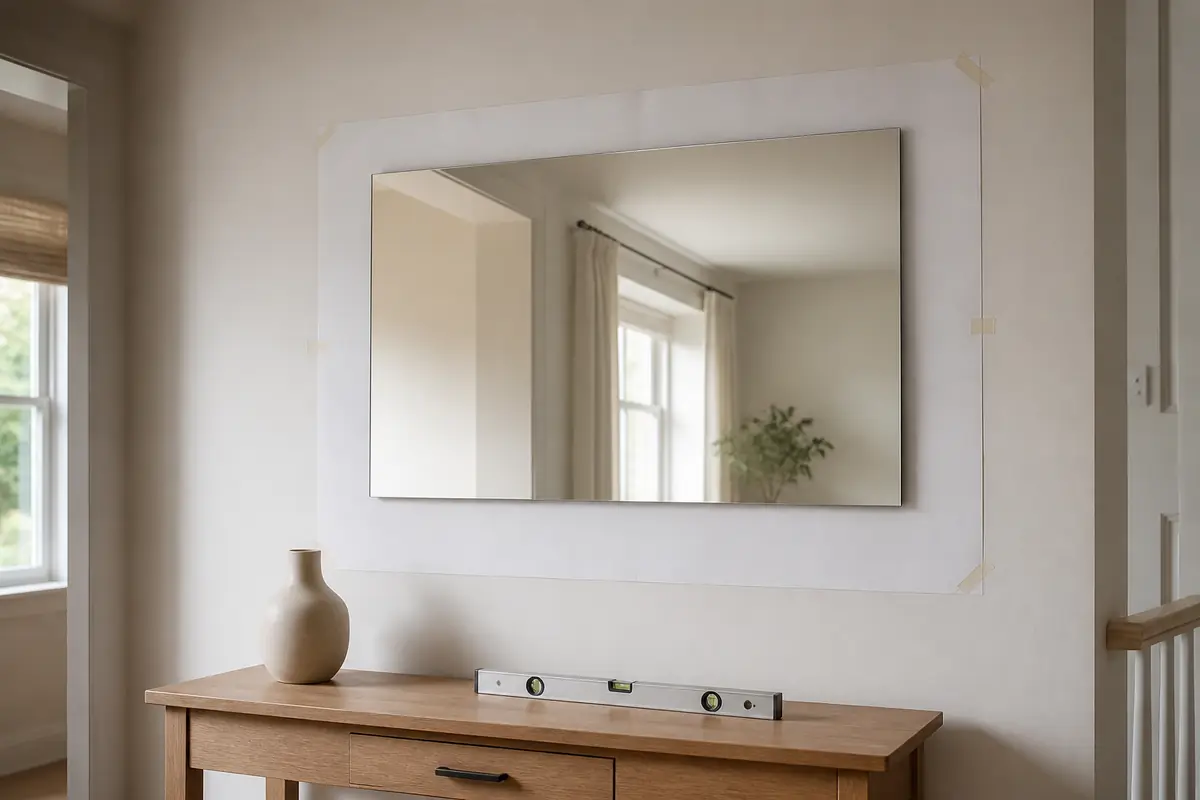
Mock up the complete outline
- Tape a paper outline using the full frame dimensions.
- Mark hanging points rather than only the centre line.
- Open nearby doors and check their complete sweep.
- View from entrances, seating and normal standing positions.
- Leave the template overnight and inspect in daylight and electric light.
A template exposes scale errors without lifting glass. It also shows whether sockets, thermostats, dado rails, picture rails or uneven plaster complicate placement. Do not drill from a catalogue diagram without checking the actual product hardware.
Judge the reflected scene
Stand where people enter the room and where the mirror will be used. A mirror opposite a bright window may increase useful daylight but also create glare, privacy issues or a distracting view. One facing an untidy storage area duplicates visual clutter. At night, check whether lamps or ceiling fittings reflect harshly.
For dressing use, test head-to-toe or upper-body coverage at the intended distance and eye heights of users. A decorative mirror placed high above furniture may not provide a practical face view. Decide which job has priority before choosing shape.
Check distortion and edge quality
Large sheets of thin or poorly supported mirror can distort straight lines, particularly near edges. Product images cannot reliably show this. Read the material and backing details, inspect the delivered item from several angles and compare door frames or tiles in the reflection before installation.
Look for chips, black edge damage, scratches, loose frame joints and movement between glass and backing. Keep protective material while inspecting safely. Photograph any concern and contact the seller before attempting to mount a damaged heavy object.
Plan around wall construction
Identify whether the wall is masonry, stud, plasterboard, lath and plaster or another system. Hollow-wall fixings, plugs and screws have specific compatible substrates and loads. The supplied hardware may not suit your wall, and a generic weight claim does not replace the fixing manufacturer’s instructions.
Locate pipes and electrical cables using appropriate information and detection methods. If the wall, hidden services, weight or access is uncertain, use a competent installer. Do not rely on adhesive strips for a mirror unless the mirror, wall finish, environment and complete rated system explicitly support that use.
Use both hanging points where designed
Some mirrors use D-rings and wire; others use keyholes, cleats or brackets. Follow the stated orientation and number of points. A wire can change tilt and wall load, while a cleat needs accurate levelling. Never rotate a mirror unless its hardware and instructions permit both orientations.
Record bracket spacing from the physical item, not just the frame. Use appropriate personal protection and lifting help. Heavy glass should not be balanced on furniture during marking. Keep children and pets away from the working area.
Consider bathroom and damp-room limits
Do not assume every decorative mirror suits a bathroom. Check the manufacturer’s environmental statement, backing, frame finish and any electrical features. Illuminated or heated mirrors add electrical zones, installation and product-safety considerations that require their own evidence and competent work.
Ventilation reduces persistent condensation but does not make an unsuitable material suitable. Follow cleaning guidance and avoid letting liquid reach backing or electrical parts. Plain glass, framed mirrors and electrical bathroom mirrors are not interchangeable categories.
Inspect delivery and return practicality
Check whether delivery is doorstep or room-of-choice, how damage must be reported and whether change-of-mind return collection is charged. Large mirrors can be expensive and risky to repack. Measure stairs, turns and lifts against packaging, not only the product.
Our measuring guide and delivery-surprises guide help document access. The UK returns guide separates change of mind from damage or misdescription.
Coordinate with nearby wall items
If the mirror forms part of a gallery or sits near framed work, compare frame thickness, edge spacing and alignment rather than matching colours mechanically. The gallery-wall guide, frame-size guide and wall-art sizing guide provide paper-template methods.
A mirror is usually visually stronger than a print of the same size because it changes throughout the day. Give it enough space and avoid surrounding it with objects that interfere with opening, cleaning or safe removal.
Plan cleaning and long-term access
A mirror above deep furniture can be difficult to clean safely. Check whether the surface can be reached from the floor with the furniture in place and whether the frame tolerates the recommended cleaner. Spraying liquid directly at the top edge can allow moisture to reach backing or frame joints; follow the manufacturer’s method.
Leave enough clearance to inspect fixings and lift the mirror off its bracket when decorating or moving. Do not build shelves tightly around a product that requires upward movement for removal. Retain the hardware diagram, weight and product code so a future installer does not have to guess.
Assess anti-tip and impact risks in the room
Consider children, pets, door impacts, exercise areas and furniture that may be climbed. A mirror near a staircase or narrow circulation route needs more than attractive proportion. The installation should prevent foreseeable contact and should not rely on furniture to hold the lower edge.
Floor-standing mirrors require their own anti-tip plan and are not made safe merely by leaning them against a wall. If a product offers both leaning and hanging use, follow the stated hardware and safety instructions for the chosen configuration. Stop using a mirror if the frame loosens, fixings move or glass becomes damaged.
Which wall-mirror route fits?
The reflected view and wall can support it
The scale balances the furniture, glass area serves a practical job and delivery, lifting and rated fixing are manageable.
Decoration matters more than broad coverage
The frame complements the room, the sightline remains useful and a lighter object reduces installation and return friction.
Balanced verdict
Keep the paper template until the delivered mirror has been inspected. If the outer dimensions, brackets or frame projection differ from the listing, the template and saved product page provide clear evidence before holes are drilled or packaging is discarded.
Photograph the paper template from the main entrance before ordering and compare it with the product’s outer dimensions once more. This final record is useful when a room contains sloping ceilings, rails or furniture that makes a simple width rule misleading.
The right mirror is the one whose reflected scene improves the room and whose complete weight can be mounted safely on the real wall. Use a template, inspect every sightline and treat fixings as an engineering choice rather than an accessory. If substrate, services or hardware remain uncertain, pause and use a competent installer.
Browse Gifts and styling guides and the retailer directory once the specification is fixed.
Check current official sources:
Frequently asked questions
How high should a mirror hang above a console?
There is no universal number. Mock up the outer frame, connect it visually to the furniture and test sightlines and clearances.
Can I use the supplied wall plugs?
Only if they are compatible with the identified wall and full load. Follow the mirror and fixing instructions.
Can a mirror face a window?
Yes, but check glare, privacy, heat exposure where relevant and the exact reflected view throughout the day.
Can any mirror go in a bathroom?
No. Check the exact manufacturer’s suitability, materials and any electrical installation requirements.
What should I inspect on delivery?
Glass, edges, backing, joints, finish, hanging hardware, weight information and any transit damage before mounting.
Methodology and limitations
We assessed wall mirrors through proportion, usable reflection, sightlines, glass, backing, weight, wall construction, fixings, damp-room suitability, delivery and returns. UK official sources were checked on 30 August 2026. No named mirror or fixing was load-tested.
Limitations
Walls and products differ. Follow the exact instructions and use competent advice where substrate, services, weight or electrical work is uncertain.
The image is an editorial illustration, not a photograph from a product test. Links are editorial and non-affiliate.