Dried flowers and branches: proportion, stability, shedding and care
Dried arrangements remove water from the equation but add brittle stems, dust, shedding and leverage. A safe display needs a stable vessel, restrained scale and a cleaning plan.
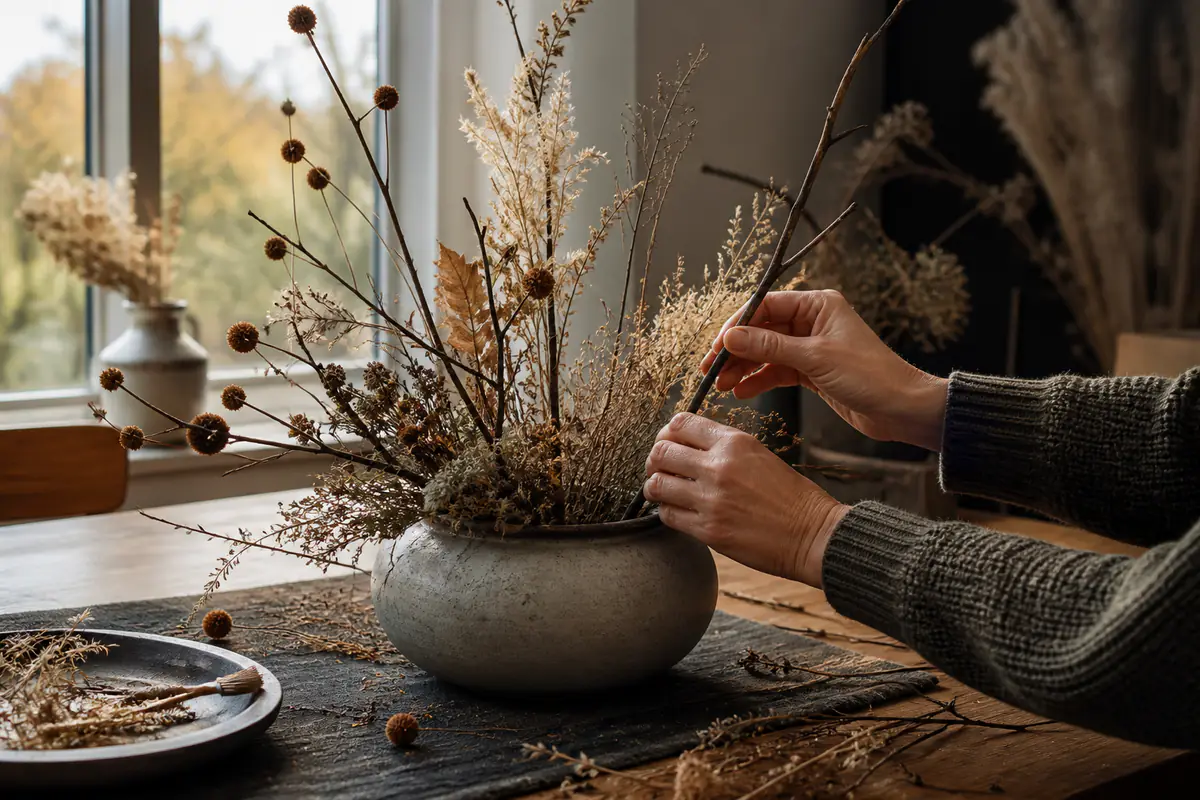
In this guide
Build for stability and maintenance before silhouette
Dried stems can last visually, but they are not maintenance-free and should not sit near flame, strong heat, damp or busy routes. Inspect material, trim cautiously, use a broad stable base and place the arrangement where falling fragments and long branches cannot injure people, pets or surfaces.
Scale the display with the wall-art sizing guide, coordinate nearby objects through the grouping guide, and check reflected mass with the mirror sizing guide.
| Element | Check | Support decision | Risk |
|---|---|---|---|
| Fine grasses | Shedding and static | Narrow grouping or removable insert | Fragments and dust |
| Seed heads | Brittleness and attachment | Gentle spacing | Breakage and ingestion |
| Branches | Length, forks and weight | Heavy broad-based vessel | Leverage and sharp ends |
| Preserved foliage | Maker care and treatment | Low-humidity stable display | Colour transfer or moisture damage |
Dried-display safety check
- Identify natural, dyed or preserved material.
- Inspect for damp, odour, pests and damage.
- Measure vessel opening and true base contact.
- Calculate branch spread and centre of mass.
- Trim with suitable tools and eye protection.
- Keep away from flame, heat and moisture.
- Choose a low-traffic, pet-aware location.
- Plan gentle dust and fragment removal.
Decide whether the material is suitable indoors
Identify untreated dried stems, dyed grasses, preserved foliage, painted branches or artificial additions. Ask how colour and preservation were achieved and follow any supplied care and safety information.
Reject damp, musty, mouldy, heavily shedding or pest-affected material. Dry botanical decoration should not be used to disguise a moisture problem, and uncertain plant material should stay away from food and curious pets.
Start with the finished location
Measure surface width, ceiling clearance, sightlines, doors, curtains and traffic before trimming. Include the full branch spread, not only vessel height. A dining display should preserve conversation and serving space.
Mark the projected outline with removable paper or a light stick mock-up. Mirrors can double visual mass and reveal untidy backs, while narrow shelves magnify instability. Coordinate the sightline with the wall-art grouping guide rather than crowding both displays.
Choose a vessel by true base and opening
Compare internal opening, body, weight and the flat contact area underneath, then place the object within the room scale described in the living-room composition guide. A wide body with a small foot can still tip when a branch is brushed.
The opening should gather stems without crushing them or allowing the arrangement to rotate freely. A removable dry insert can support stems, but it must not become wedged or raise the centre of mass excessively.
Treat long branches as levers
Branch length and side forks create leverage beyond their own weight. Rotate the arrangement gently at table level and check whether the centre of mass moves towards an edge.
Shorten from the base in small stages rather than cutting the visible crown first. Use suitable secateurs on a protected surface, control the offcut and wear eye protection where brittle twigs can spring.
Build structure before filling volume
Place the strongest stems first to establish height and direction, then add medium forms and fine texture. A dense mass can hide crossed pressure points that later snap or eject a brittle stem.
Leave negative space so every branch does not compete. Turn the vessel through the views the room will actually use and correct weight distribution before adding fragile seed heads.
Control shedding without coating everything
Some grasses and seed heads naturally release fragments. Work over a tray, shake only as the supplier permits and remove loose pieces with a soft brush. Do not spray unknown fixatives indoors or near flame.
A coating can change colour, create odour, add flammability or make later dust removal harder. Prefer material that is sufficiently stable in its natural or professionally preserved condition.
Keep dried material away from ignition and heat
Dry plant matter is combustible. Keep it well away from candles, open fires, cookers, hot lamps, heaters and hot electrical equipment, allowing for curtains, draughts and people moving the display.
Do not thread decorative lights through an arrangement unless the complete light product and placement are explicitly suitable and remain cool, undamaged and supervised as required. Flame-free appearance is safer than adding hidden heat.
Avoid damp and high-humidity locations
Bathrooms, condensation-prone windows and kitchens can soften material, distort it, transfer dye or encourage mould and odour. Preserved foliage may have specific humidity and sunlight limits.
A vase used dry should be completely clean and dry before assembly. Do not add water to mixed dried and fresh material unless every component and vessel is designed for that use.
Plan for people, pets and allergies
Place sharp or brittle branches beyond eye level and normal reach, without projecting into a walkway. Small fallen seeds or treated material can be a concern around children and animals; identify plant-specific risks before display.
Dust, fragrance and plant particles can bother some people. Keep arrangements modest, ventilate appropriately and remove the display if it triggers symptoms rather than masking it with scent.
Protect the supporting surface
Use a stable, non-staining pad that does not reduce grip. Check unglazed ceramic, metal, dye and loose fragments against timber, stone, paint and textiles.
Lift the vessel for cleaning rather than dragging it. Recheck level after moving the arrangement because a felt pad, folded cloth or trapped stem can turn a stable base into a rocking one.
Dust with the least force
Move the arrangement to a protected open area if safe, support stems near the base and use a soft brush or very low controlled airflow only when the material tolerates it. Strong vacuum suction can strip leaves or seed heads.
Clean the surface beneath separately and return the display only when both are dry and stable. Avoid wet wiping dried material unless its care instructions explicitly permit it.
Know when the arrangement is finished
Remove stems that develop damp, mould, pests, persistent odour, heavy shedding, sharp fractures or unstable weight. Age alone is less useful than condition, but sentimental value does not make degraded material safe.
Dispose according to local rules and treatments; painted, wired, glittered or chemically preserved material may not belong in garden compost. Save reusable clean mechanics separately.
Gift dried arrangements with an honest care note
Confirm the recipient wants botanical décor, has a suitable location and has no relevant pet or sensitivity concern. Include material identity, approximate dimensions, placement limits and gentle cleaning guidance.
Package to prevent crushing and sharp ends, without making the recipient guess how to remove wires or supports. For broader planning, browse Style & Gifts.
Is a dried arrangement suitable?
The location is dry, stable and low risk
Material condition is sound, the vessel controls leverage and the display can be dusted away from heat, flame, pets and traffic.
Shedding or placement cannot be controlled
Damp, heat, reach, allergies, unstable furniture or brittle projecting stems make the arrangement disproportionate to the room.
Balanced verdict
A good dried arrangement is a controlled structure, not a permanent maintenance-free bouquet. Buy sound material, support its leverage, leave space and remove it when condition or placement stops being safe.
Choose the vessel and room position before buying the stem volume so the arrangement serves the space rather than overwhelming it.
Official checks:
UK Fire Kills safety campaign ↗
NHS allergy information ↗
RHS guidance on potentially harmful plants ↗
Frequently asked questions
Do dried flowers need water?
No — Keep the vessel clean and dry unless a product is specifically designed as a mixed fresh-and-dried arrangement.
How can I stop dried grasses shedding?
Choose stable material, handle minimally and clean over a tray. Avoid unapproved sprays that may add odour, damage or flammability.
Are dried flowers safe near candles?
No arrangement of dry plant material should be placed near flame or significant heat.
How do I make tall branches stable?
Use a heavy broad-based vessel, control the opening, shorten leverage and place the arrangement outside traffic and reach.
How should dried flowers be dusted?
Support stems and use the least force, such as a soft brush, over a protected area. Follow any treatment-specific care instructions.
Methodology and limitations
We assessed dried botanical displays by material identity, condition, vessel geometry, leverage, composition, shedding, ignition, humidity, people and pets, surface protection, cleaning, disposal and gifting. We did not preserve or treat plants.
Limitations
Plant species, preservation treatments, dyes and household risks vary. Supplier instructions, fire safety and plant-specific pet or allergy advice take priority. Unknown treated materials require caution.