Picture frame sizes explained: mounts, aspect ratios and hanging
A frame labelled 30 × 40cm does not always display a 30 × 40cm image: an included mount can reduce the visible opening to 21 × 30cm, while the outer edge occupies more wall. Start with the actual artwork, decide whether a mount is wanted, then verify the aperture, rebate, glazing and external dimensions before ordering.
In this guide
Measure the artwork first, then match the frame’s stated picture size
Choose by the image or mount aperture, not by the amount of wall that looks empty. Record the artwork width and height in millimetres, note its aspect ratio, and check whether the retailer’s quoted size means picture capacity, mount opening or outside frame. Make paper templates using the true outer dimensions before drilling, and match the fixing to both wall and loaded frame.
This is a desk-based guide using current official UK frame specifications and a repeatable measuring method. Recommended Today did not buy, hang or stress-test a frame or fixing. Wall construction, artwork value, frame build and fitting instructions vary, so the responsible manufacturer’s limits take priority.
The four measurements that prevent most mistakes
| Measurement | What it describes | Why it matters |
|---|---|---|
| Artwork size | The physical width and height of the print, photo or object | Determines whether it enters the rebate without trimming |
| Mount aperture | The visible opening cut into the card mount | Usually overlaps the image slightly to hold it securely |
| Frame picture size | The image size the frame is sold to accept, often without a mount | This is commonly the number in a product title |
| Outer frame size | The complete edge-to-edge footprint including moulding | Needed for wall spacing, furniture clearance and paper templates |
| Rebate depth | The internal depth available for glazing, mount, work and backing | Flat prints need less depth than textiles or objects |
Use one unit throughout. Millimetres reduce rounding errors when a print is close to the opening. Measure the artwork in at least two places because paper can be cut slightly out of square. Record width first and height second, but remember that rotating a rectangular frame simply exchanges them.
A six-line frame record
- Artwork: exact width, height, thickness and orientation.
- Display: full bleed, visible border or separate mount.
- Aperture: visible opening after the mount overlap.
- Capacity: stated picture size and usable rebate depth.
- Footprint: true external width, height and projection from the wall.
- Hanging: loaded weight, supplied hardware and required wall fixing.
Common UK and metric frame sizes
Popular metric options include 10 × 15cm, 13 × 18cm, 21 × 30cm, 30 × 40cm, 40 × 50cm, 50 × 70cm and 61 × 91cm. The list is useful for shopping, but it is not a promise that a print produced to a paper standard will fit with the intended border. A4 is 210 × 297mm, for example, while a frame described as 21 × 30cm provides a nominal 210 × 300mm picture size. That small difference may be harmless behind a mount but should be verified for edge-to-edge display.
Traditional photo ratios create another family: 6 × 4in, 7 × 5in, 8 × 6in and 10 × 8in. Converting inches to centimetres does not change the composition. A 6 × 4in image is roughly 15.2 × 10.2cm and has a 3:2 ratio; a 10 × 8in print has a 5:4 ratio. Putting one into the other’s opening requires a crop, a border or a custom mount.
| Nominal format | Approximate ratio | Practical consequence |
|---|---|---|
| 6 × 4in photograph | 3:2 | Matches many camera images with little cropping |
| 7 × 5in photograph | 7:5 | May crop a 3:2 image at the long edges |
| 10 × 8in print | 5:4 | Squarer than 3:2; check faces and edge detail before cropping |
| A4 paper | 1:√2 | Enlarges proportionally to A3, but not to common photo ratios |
| 30 × 40cm frame | 4:3 | Can show a smaller A4-like image when supplied with a mount |
Mounts: the opening is deliberately smaller
A mount separates the artwork visually from the moulding and can keep the image away from glazing. Its cut opening is normally a little smaller than the artwork, creating an overlap that prevents the sheet falling through. Therefore, do not order a mount whose aperture exactly equals a print that has essential detail at the edge. Decide how many millimetres can be hidden on every side.
An official IKEA example checked on 19 August 2026 states that its 30 × 40cm PLOMMONTRÄD frame fits a 21 × 30cm picture with the included mount or a 30 × 40cm picture without it. That is a clear illustration of the two-size convention. The same retailer says the mount is acid-free, but archival suitability is broader than one component: backing, hinges, tape, glazing, humidity and light exposure all matter for valuable work.
For signatures, edition numbers or deckled paper edges, consider a larger aperture or float mounting by a competent framer. Do not attach irreplaceable work with ordinary pressure-sensitive tape. A replaceable poster and an original drawing justify different materials and risk controls.
Aspect ratio: crop, border or custom size
Aspect ratio is width divided by height. If the artwork and aperture ratios differ, scaling alone cannot make both edges fit. Filling the aperture crops part of the image; fitting the whole image leaves a border on two sides. Neither is automatically wrong, but the choice should be deliberate.
Make the crop decision before printing
- Duplicate the digital file and preserve the original.
- Set the intended print ratio in the crop tool.
- Keep faces, text and important objects away from the cut line.
- Allow for the mount to cover a small perimeter.
- Print a reduced paper proof if composition is sensitive.
- For an existing physical work, fit the frame to it rather than trimming casually.
If a standard frame is only slightly larger, a custom-cut mount can bridge the gap economically. When the artwork is unusually long, square or panoramic, a made-to-measure frame may avoid an ungainly border. Compare the complete delivered cost and cancellation terms before commissioning; personalised dimensions are less forgiving than standard stock.
Glazing, backing and depth
Glass is usually more scratch-resistant than plastic but heavier and breakable. Acrylic or polystyrene front protection is lighter and can be safer in busy areas, yet it may scratch more readily and attract dust through static. Product names such as “glass look” are not material specifications. Check the exact front-protection material and cleaning instructions.
Conventional shallow frames are intended for flat work. A folded textile, medal, dried flower or other object needs enough internal depth and a method that does not crush or chemically damage it. A shadow-box frame can be more suitable, but its greater projection and loaded weight change the hanging decision.
Light causes fading even when a product mentions UV reduction. Avoid treating glazing as complete protection. Limit direct sunlight, maintain a stable indoor environment and consider conservation advice for valuable or irreplaceable pieces.
Plan the wall with true outer dimensions
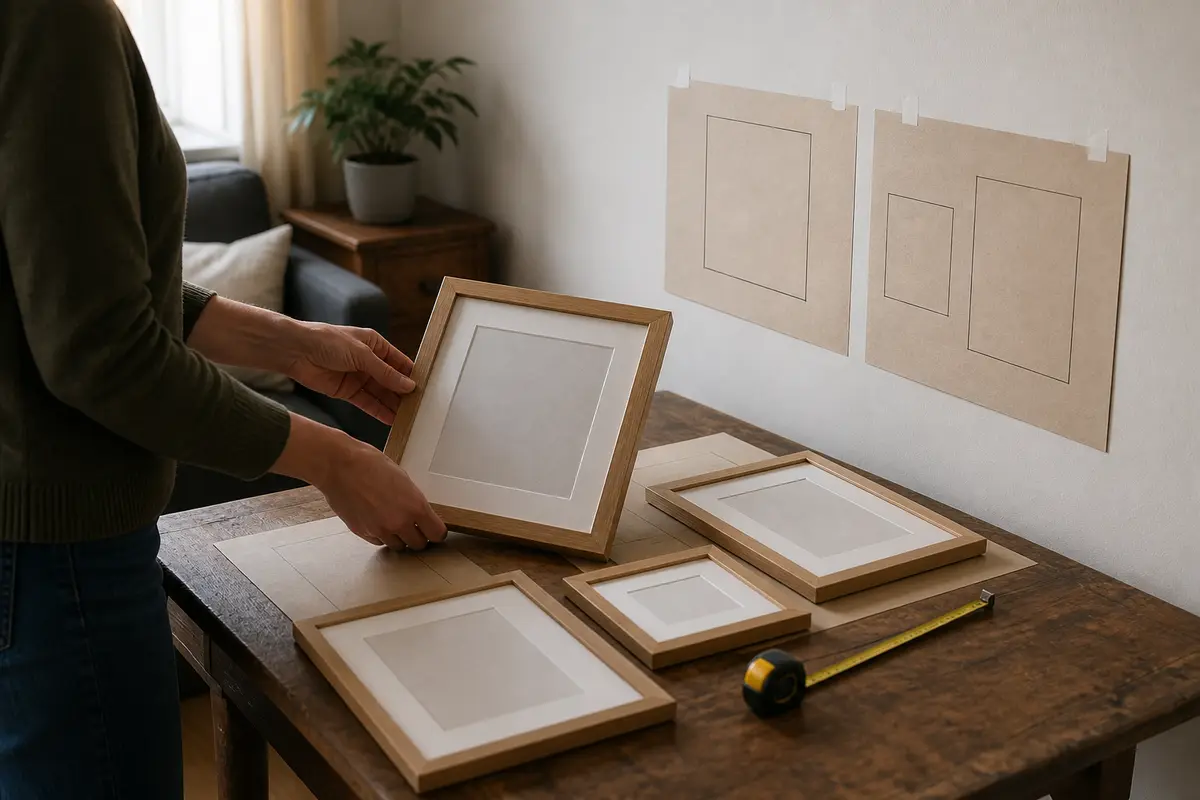
The retailer’s picture size is not the wall footprint. A broad moulding makes a 30 × 40cm frame substantially larger; two products accepting the same print can occupy different areas. Use the listed outer dimensions where available, or measure the assembled frame. Then cut paper rectangles, tape them lightly to the wall with a surface-appropriate method, and live with the arrangement before making holes.
Anchor the layout to a real reference: the centreline, furniture width, top edge or a consistent gap. For a group, the spaces between frames influence the result as much as the frames. Treat the collection as one overall rectangle and check that doors, curtains, switches and lamps still work. Our furniture measuring guide offers the same route-and-clearance discipline, while the product-shortlisting method helps reduce a sprawling choice of finishes.
A staircase or uneven wall needs extra care because visual level and physical level can conflict. Mark a reference line with removable tape, verify it with a spirit level, and calculate each hanging point from the frame hardware rather than assuming every cord or bracket sits at the same distance from the top.
Fixings: match wall, weight and hardware
A hook is only one part of a load path. Identify whether the wall is masonry, timber stud, plasterboard or another construction; weigh the complete frame with glazing and artwork; inspect the supplied hanger; and follow both fixing and frame instructions. Do not use an adhesive product above its stated load or on an unsuitable surface. Paint condition, texture, humidity and removal method can all affect performance.
Before making a hole
- Check for concealed electrical cables, pipes and other services.
- Confirm the wall material rather than guessing from the surface.
- Use the complete loaded weight, not the empty frame description.
- Inspect cord, D-rings, sawtooth hanger or rail for damage and alignment.
- Keep heavy glass frames away from beds, cots and high-traffic impact zones unless professionally secured.
- Stop and seek competent help when the wall, load or hidden services are uncertain.
Price and value: pay for the specification you need
On 19 August 2026, IKEA’s official UK 30 × 40cm category showed a black RÖDALM at £7, an oak-effect version at £9 and a white FISKBO at £4; a 30 × 40cm aluminium LOMVIKEN page showed £15. These are dated samples, not permanent prices or recommendations. They demonstrate that identical nominal picture capacity does not mean identical moulding, front protection, finish, mount, weight or longevity.
Compare a written specification, not just colour thumbnails. Include mount, replacement backing, specialist fixing, delivery and any custom cutting. For a multiple-frame wall, test one unit before committing to the whole set. Our total-cost guide keeps accessories and replacement risk visible, while the discount-checking guide prevents a sale badge substituting for fit.
If the frame is a present, record the recipient’s print dimensions or choose a reversible standard size rather than guessing from a social-media crop. Our practical gift guide explains how to preserve choice, and the Style & Gifts section covers related sizing, delivery and presentation decisions.
Who should choose which route?
Choose a standard frame if…
- The artwork matches a common picture size or can use a clean mount.
- The stated aperture, outer dimensions and depth are all suitable.
- The work is replaceable and ordinary glazing meets the brief.
- You value lower cost, availability and easier replacement.
Choose custom framing if…
- The artwork must not be cropped, trimmed or attached casually.
- The ratio, depth or surface is unusual.
- Conservation materials and reversible mounting matter.
- A precise outer dimension is essential to the intended wall layout.
Our verdict
The best frame is the one whose aperture protects the intended composition, whose rebate accepts the complete artwork package and whose outside dimensions genuinely suit the wall. A familiar number in the product title is not enough. Measure in millimetres, record both with-mount and without-mount capacities, and make a full-size paper template.
Standard frames are excellent when the ratios cooperate; a custom mount often solves a modest mismatch. Use custom framing where trimming, ordinary materials or a shallow rebate would compromise the work. Finally, treat hanging as a structural choice: loaded weight, wall type and correct fixings matter more than visual neatness.
Check current official information:
IKEA UK picture-frame range and sizes ↗IKEA 30 × 40cm with-mount specification ↗IKEA aluminium frame materials and sizes ↗
To turn individual frame measurements into a coherent arrangement, use our Gallery wall planning: spacing, alignment and paper templates.
Frequently asked questions
What does a 30 × 40cm frame mean?
It usually describes the nominal picture size without a mount, not the outside edge. Check the product specification: an included mount may display a smaller picture, and the moulding increases the wall footprint.
Will A4 fit a 21 × 30cm frame?
A4 is 210 × 297mm, while 21 × 30cm is nominally 210 × 300mm. It may fit, but check the real aperture, rebate and mount overlap rather than relying on rounded labels.
Should the mount aperture be smaller than the picture?
A mount opening will generally cover a small part of the artwork’s edge to hold it behind the aperture. A small overlap holds the artwork behind the opening. Decide how much edge detail can be covered and use conservation materials for valuable work.
Can I put a 6 × 4in photo in a 7 × 5in opening?
Not edge to edge without changing the composition. The ratios differ, so use a border or mount, or crop a copy of the image deliberately before printing.
How high should a picture frame hang?
There is no universal height — Relate the visual centre to normal viewing, nearby furniture and the whole group. Use a paper template and ensure doors, lights and circulation remain clear.
Are adhesive strips safe for every frame?
No — Suitability depends on the product’s load limit, frame hardware, wall surface, coating and environment. Follow the fixing manufacturer’s instructions and use a more appropriate fixing when uncertain.
How we researched picture-frame sizing
We checked official UK retailer specifications on 19 August 2026 and compared nominal picture sizes, included mounts, front-protection materials and dated prices. We then applied a repeatable artwork–aperture–rebate–outer-dimension–fixing sequence. Supporting internal guidance covers product shortlisting, measurements, total cost and discount evidence.
Limitations
Frame tolerances, mount apertures, external dimensions, materials, prices and stock change. We did not assess an individual wall, concealed services, valuable artwork or a fixing’s real installation. Manufacturer instructions and competent site-specific advice override this general guide.