Wall art sizing guide: frames, gallery walls and spacing above furniture
Choose wall art by measuring the furniture and the complete outer frame—not by guessing from a product thumbnail. A paper template can settle scale, spacing and height before you buy a print or make a single hole.
In this guide
Treat several frames as one shape
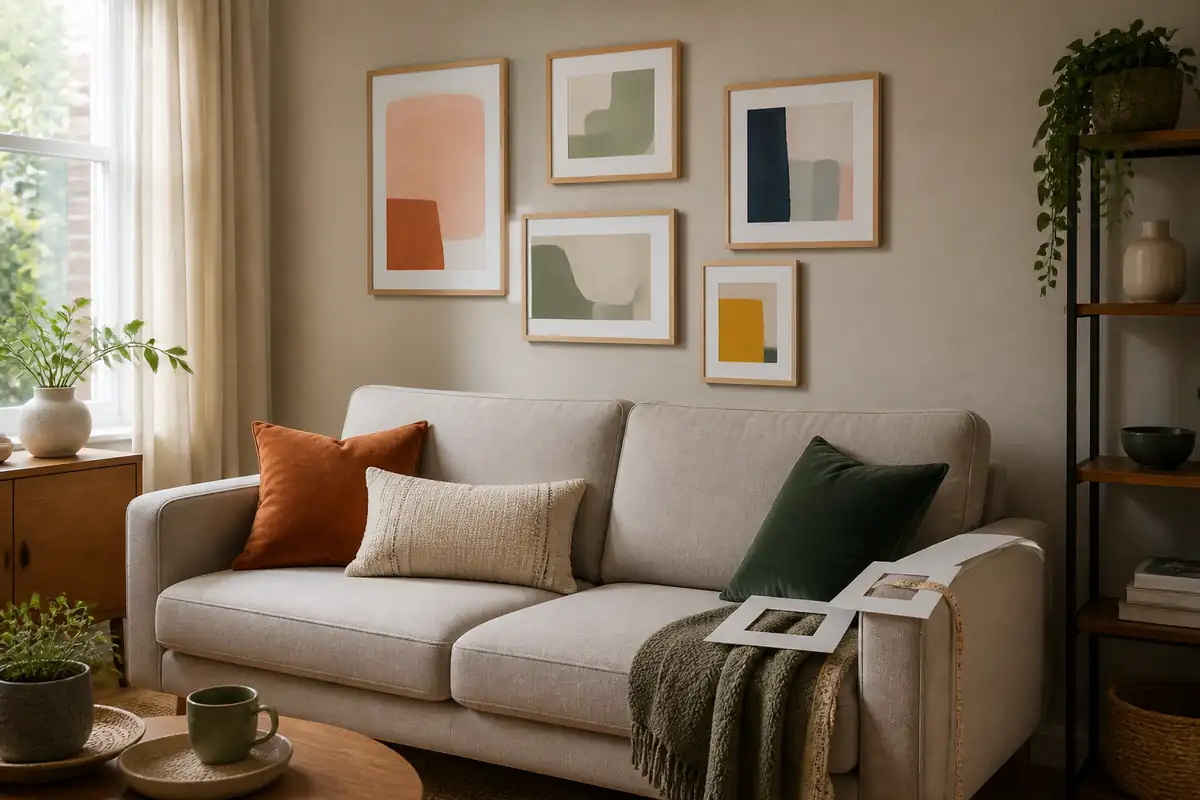
Above a sofa, bed or sideboard, start by testing artwork whose total outside width is roughly two-thirds to three-quarters of the furniture width. This is a starting range, not a design law. Keep a gallery wall’s outside edges, gaps and visual centre consistent, then tape paper rectangles to the wall and view them from the doorway and the main seat before ordering.
Wall art fails most often through scale rather than taste. A beautiful A4 print can look stranded above a two-metre sofa; three generous frames can overwhelm a narrow hallway; a mathematically centred picture can feel wrong when a lamp visually weights one side. The cure is to plan the group as part of the room and to separate print size, mount opening and external frame dimensions.
This guide belongs with our Home & Kitchen advice and the practical method for measuring before buying furniture. It offers repeatable starting points, then asks you to verify them at full scale.
Three dimensions that shoppers commonly confuse
| Measurement | What it means | Why it changes the plan |
|---|---|---|
| Artwork or print size | The paper, canvas or photograph itself | A 40×50cm print may sit in a 50×70cm frame when a mount is used |
| Mount opening | The visible window cut into the card mount | It is usually slightly smaller than the artwork so the edges are held |
| External frame size | The full height and width including moulding | This is the measurement that determines wall coverage, gaps and collision with furniture |
| Depth and weight | How far the frame projects and its complete hanging weight | These affect shadows, fixings and whether adhesive products are suitable |
IKEA’s 50×70cm RÖDALM illustrates the distinction: it accepts a 50×70cm picture without its mount or a 40×50cm picture with the mount, while the published outer frame is 52×72cm. Seven such frames are therefore 14cm wider and 14cm taller in total than calculations based only on the print sizes.
Current UK frame and wall-art price snapshot
Prices, dimensions and availability signals below were rechecked on official UK retailer pages on 25 August 2026. Stock, delivery and promotions change and must still be confirmed at checkout. The table shows why the frame, glazing and hanging plan belong in the art budget.
| Example | Price and published size | Planning note |
|---|---|---|
| IKEA FISKBO frame | £9; 50×70cm picture format | Low entry cost with plastic front; use the external dimensions for layout |
| IKEA RÖDALM black frame | £15; 52×72×3cm outer size; mount for 40×50cm picture included | One frame can create two different visual border treatments |
| John Lewis poster frame | £22; 52.2×72.2×1.5cm outer size; MDF frame and glass | Published weight is 2.5kg, so fixings matter as much as nominal format |
| H&M Home/Postery wood frame | £37.99–£39.99 for listed 50×70cm options | Finish can cost more than the print; verify whether a mount is included |
| Dunelm set of two abstract framed prints | £45; each 50×70×2.5cm; total published weight 4.08kg | A complete set simplifies coordination, but the 4.08kg published total still demands a suitable wall and fixing plan |
Complete cost: add print, mount, glazing, delivery and wall fixings. A frame that arrives separately can cost more to return than its price difference. Our total-cost guide applies to home décor too.
How to size one artwork above furniture
Measure the anchor, not the wall
When art belongs visually to a sofa, headboard, console or dining table, that furniture is the anchor. Measure its visible width. As a first experiment, multiply by 0.67 and 0.75 to create a target range for the outer width of the artwork or group. A 180cm sofa gives an initial range of about 121–135cm. A single 50×70 frame is clearly smaller; a pair of 52cm-wide frames with an 8cm gap creates 112cm, which may suit a restrained look but sits below the starting range.
This ratio is a composition tool, not an industry requirement. A tall narrow work may deliberately leave generous space; an asymmetrical room may need balance with a lamp or plant. Test the lower and upper range in paper. If both feel wrong, change deliberately and record why rather than following a percentage blindly.
Use the frame’s outside edge
Retailers often lead with the picture size. Add the moulding or use published outer dimensions. For an unframed canvas, use the canvas edge. For a work with a large mount, the blank border is still part of the visual mass.
Leave a relationship, not a random void
The gap above furniture should be close enough for the art to read as connected but high enough to avoid heads, cushions and objects. Rather than adopting one fixed number for every home, tape the bottom edge at several heights, sit down, open nearby doors and check the tallest person using the sofa or bed. Mantels and heat sources require their own safety clearance.
Gallery-wall maths that works before drilling
Calculate the complete group. For a row, add every external frame width plus each gap. Three 32cm-wide frames with two 6cm gaps make a 108cm group. For a grid, use the widest item in each column and tallest in each row. Irregular arrangements are easiest to plan on the floor, then transfer with paper templates.
Spacing should look intentional. Smaller frames generally tolerate tighter gaps; large frames need more breathing room. Start with one gap—often 5–8cm for medium frames—and repeat it. Change spacing only to solve a real alignment problem. Unequal margins can work, but accidental differences of one or two centimetres tend to look like measuring errors.
Choose one organising rule:
- Grid: shared top, bottom and vertical lines; calm and easiest to extend with identical formats.
- Centre line: mixed frames share a horizontal centre; useful above a long sideboard.
- Outer rectangle: irregular pieces fill a planned boundary; varied but controlled.
- Salon cluster: grows outwards from one anchor; flexible, but needs paper planning to avoid drifting.
Find the visual centre, not only the tape-measure centre
Geometric centre is the midpoint of the outer group. Visual centre also responds to dark colours, thick frames, large white mounts and nearby furniture. A small dark work may carry as much visual weight as a larger pale print. Arrange templates first, then temporarily attach photocopies or coloured paper approximating the tonal weight.
Centre the group on the furniture when the furniture is the clear anchor. Centre on the usable wall when the art serves the entire zone. Do not split the difference automatically: a sofa pushed off-centre by a doorway may make wall-centred art look detached. Photograph both template positions from the entrance; the image often reveals imbalance more clearly than standing close to the wall.
Frames, mounts and glazing change the result
A mount gives a small work more presence and separates paper from glazing. Off-white is usually quieter than brilliant white, but the best choice depends on the artwork and room. Check that the opening suits the exact print; “A3 frame” and “30×40cm frame” are not the same. Acid-free or pH-neutral mounts are preferable for work you want to preserve.
Glass is resistant to scratching and can feel clearer, but it is heavier and can shatter. Acrylic or polystyrene fronts are lighter and often safer in children’s rooms or above beds, though they scratch more easily and may attract dust. Reflections can obscure dark artwork opposite a window. Test with a similarly reflective object at the planned angle before paying for a full set.
Frame construction affects repeated rehanging. Check corner joints, backing clips, hanging hardware and whether replacements in the same finish and size are likely to remain available. Our guide to judging furniture quality explains why material labels alone do not establish durability.
Wall fixings: the frame is only as secure as the wall
The fixing must suit the wall material, frame weight, hanging hardware and location. IKEA explicitly notes that screws are not included because wall materials require different devices. A 2.5kg glass-fronted frame needs a more considered solution than a light plastic-fronted frame. Do not rely on an adhesive hook merely because a product photograph suggests a nail-free room.
Identify plasterboard, masonry or other construction and check for cables or pipes before drilling. Use the fixing maker’s stated load and installation method, with a safety margin. Heavy, valuable or above-bed artwork deserves professional advice if the substrate or route is uncertain. In rented accommodation, obtain permission for holes or changes; “removable” products can still damage paint or plaster.
Use two hanging points when the frame instructions support them: the frame is less likely to tilt and the load is shared. Match picture wire, D-rings, sawtooth hangers or rails to their intended fixing. Recheck the installation after several days and after any impact or wall movement.
Plan an arrangement with paper templates
- Make an inventory. Record each artwork, print size, mount, external frame size, orientation and weight.
- Mark the anchor width. Use low-tack tape above the furniture to show the approximate two-thirds and three-quarters points.
- Cut paper rectangles. Use the external dimensions, label each and mark its hanger position relative to the top.
- Arrange on the wall. Test the whole group, including exact gaps, without drilling.
- View from normal positions. Sit, stand in the doorway and check lamps, doors, curtains and ceiling line.
- Transfer hanger points. Measure from the template edge; use a level and the correct fixing.
This process is more reliable than ordering ten frames and hoping. Apply the same shortlist discipline described in our product-shortlisting guide.
Common planning mistakes
Buying the print before choosing the frame can create a custom-mount problem or leave unexpected borders. Check standard UK frame formats first unless the artwork justifies bespoke framing.
Centred too high makes art float near the ceiling. Judge the group in relation to the furniture and normal eye lines, not the wall’s empty midpoint.
Gaps measured between prints rather than frames create uneven outer spacing when moulding widths differ. Measure visible outside edges.
Expanding without a rule turns a gallery wall into disconnected items. Preserve a grid, centre line, outside boundary or anchor as new work arrives.
Ignoring access can block a cupboard door, thermostat, curtain stack or reading lamp. Templates reveal these collisions. For broader buying checks, see how to judge product quality online.
The furniture needs a clear visual anchor
Mock up the full framed dimensions and centre the composition against the furniture, allowing intentional margins and safe fixing points.
Several related pieces tell the stronger story
Plan the outside rectangle and spacing on the floor first, then hang the complete composition rather than improvising frame by frame.
Verdict
The best wall-art size is the one that creates a deliberate relationship with the furniture and survives a full-scale paper test. Use two-thirds to three-quarters of the anchor width as a starting experiment, calculate groups from outer frame edges and make spacing consistent. Then adjust for the actual room rather than defending a formula.
Buy frames only after confirming artwork size, mount opening, external dimensions, glazing, weight and fixing route. Retailer profiles for IKEA UK and Dunelm help with the final seller decision; the shop directory contains the wider set.
Check current official information:
IKEA 50 × 70cm frames ↗Dunelm abstract-print set ↗H&M Home frames ↗John Lewis poster frame ↗
Frequently asked questions
How wide should art be above a sofa?
Test a total outer width around two-thirds to three-quarters of the sofa as a starting range. Use paper templates and change it if the room, artwork or asymmetrical furniture makes another proportion more convincing.
How much space should be between gallery-wall frames?
There is no compulsory distance. A repeated 5–8cm is a useful experiment for medium frames. Smaller work can sit closer; large work may need more space. Consistency matters more than the exact number.
Should a gallery wall be centred on the wall or sofa?
Centre it on the sofa when the two should read as one zone. Centre on the usable wall when the arrangement serves the whole space. Templates photographed from the doorway make the choice clearer.
Does a 50×70cm frame measure exactly 50×70cm outside?
Usually not — That figure commonly describes the picture format. The IKEA and John Lewis examples are roughly 52×72cm outside. Always use published external dimensions for layout.
Can I use adhesive hooks for heavy frames?
Only when the hook maker explicitly supports the wall surface, frame type and total weight with a suitable margin. Paint condition, humidity and textured walls affect adhesion. Heavy glass frames often warrant mechanical fixings.
Should all gallery-wall frames match?
No — Mixed finishes can work when spacing, colour or an outer boundary provides order. Matching frames are easier to expand and make varied artwork feel calmer.
How we researched this guide
We checked dimensions, materials, weights, prices, mounts and hanging notes at IKEA UK, Dunelm, H&M Home and John Lewis on 17 August 2026, then rechecked volatile prices, availability signals and product details on 25 August 2026. The proportion and spacing ranges are editorial starting points to test, not safety standards.
Limitations and update policy
Wall construction, sight lines, furniture and artwork vary. We have not inspected the named frames or any reader’s wall. Prices, stock and specifications change; the table is a dated snapshot rather than a promise of continuing availability.
Use fixings suitable for the wall, frame weight and location. Check for hidden services and obtain competent help where the substrate or load is uncertain.