Measuring Up: How to Avoid Furniture That Doesn’t Fit
The delivery that won't come up the stairs is avoidable. A room-by-room measuring method, including doorways, turns and the numbers sellers omit.
In this guide
Quick verdict: measure the complete delivery route before judging whether furniture fits the room. Record the narrowest clear opening, every turning space and the item’s diagonal depth, then mark its working footprint on the floor.
| Check | What to record | Why it matters |
|---|---|---|
| Doorway | Clear width, height and frame depth | The door leaf and reveal reduce usable space |
| Turn or landing | Width plus swing space to the opposite wall | A long item may pass the opening but fail to rotate |
| Furniture | Assembled dimensions and diagonal depth | The diagonal controls tilted access |
| Final position | Closed and fully extended footprint | Doors, drawers and mechanisms still need room |
The sofa that will not go up the stairs is a familiar domestic disaster, and it is almost always a measuring failure rather than a manufacturing one. The item fits the room perfectly. It simply cannot get there.
Twenty minutes with a tape measure prevents it. This guide sets out what to measure, in what order, and which numbers sellers routinely leave out of the dimensions table.
The three measurements that cause most failed deliveries
Failed deliveries cluster around three numbers, and only one of them concerns the room.
The narrowest point on the route. Not the front door — the tightest constriction anywhere between the pavement and the final position. That is usually a hallway turn, a stairwell, or a doorway with a radiator opposite.
The diagonal depth of the item. Large furniture is tilted to pass through openings, and the diagonal is what must clear them. It is also the measurement most often absent from listings.
The turning space at each change of direction. A long item can pass through a wide doorway and still be unable to turn into it, because the corridor behind is too short to swing it round.
Measure all three before looking at the room itself. The room is the easy part; the route is where deliveries fail.
Access routes: doorways, corners, stairwells and lifts
Walk the route with a tape and write down every constriction in order.
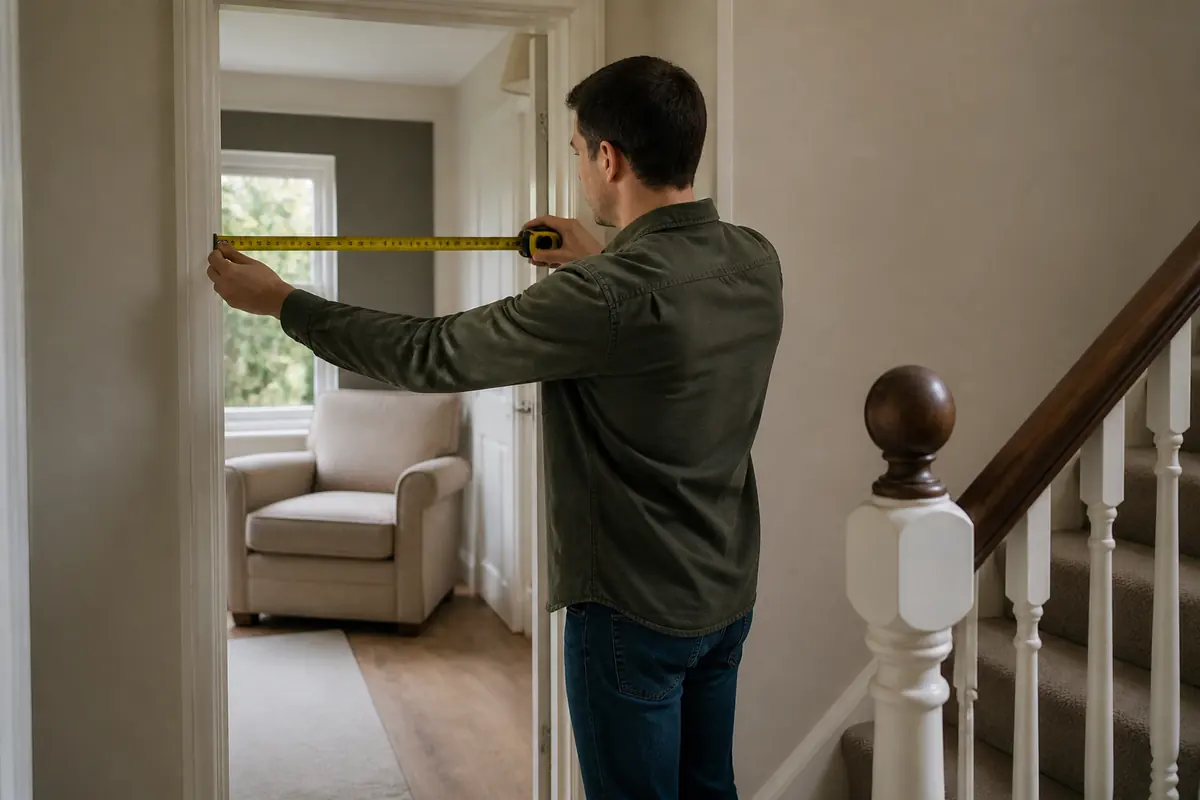
Doorways. Measure the clear opening with the door open, and again with the door removed if that is possible — the leaf and hinges take a surprising amount of width. Measure the height of the opening and the depth of the frame reveal.
Corridors and turns. Record the corridor width and, at each turn, the distance from the turn to the opposite wall. That distance limits the longest item you can swing.
Stairs. Measure the width between walls or banisters, the headroom at the tightest point, and the depth available on any half-landing. Winder stairs and quarter-turn landings are the classic failure point, because the usable space shrinks precisely where you need to rotate.
Lifts. Measure the door opening, the internal width and depth, and the internal height — a tall item may need to go in diagonally, which the ceiling may prevent.
Everything fixed in the way. Radiators, handrails, meter cupboards, light fittings, ceiling slopes, coving and newel posts all reduce the real dimensions below the architectural ones.
The diagonal-depth measurement nobody takes
Diagonal depth is the straight-line distance from the highest point of the back of a piece down to the front edge of its base. It is the measurement that decides whether a sofa or armchair will pass through a doorway when tilted, which is how large items are almost always manoeuvred.
Take it on the item by running a straight edge from the top of the back frame to the front of the base and measuring that line, or ask the retailer for it directly. Many manufacturers hold the figure even when the listing omits it, and a retailer that supplies it on request is one worth buying from.
Two adjustments make it usable. Where feet, castors or cushions are removable, ask for the diagonal with them off, since that is the real constraint. And compare the diagonal against the door opening rather than against the corridor, because tilting is what the doorway demands.
Reading a dimensions table properly
Dimensions tables are less standardised than they appear, and three ambiguities cause most errors.
What is included. Does the depth include cushions at rest or compressed? Does the width include arms, or the frame only? Does the height include feet? Assembled dimensions and packed dimensions are different numbers, and for flat-pack the packed carton is what has to reach the room.
Which orientation. Width, depth and height are not universally ordered, and a listing quoting three bare numbers has left you to guess. Check against a scale drawing or a labelled diagram where one exists.
What is missing. Seat height, seat depth, arm height, leg height and clearance under the frame are all absent from most tables, and they determine whether the piece is comfortable and whether it clears a skirting board, a radiator or a robot vacuum.
Where the table is thin, ask. A seller who answers dimensional questions precisely is displaying the same confidence as one publishing construction details, discussed in how to judge furniture quality.
Clearance: doors, drawers, radiators and sockets
Fitting the room is not the same as working in the room.
Allow for the full swing of every door — the item’s doors, and the room’s — and for drawers and extending mechanisms at full extension. Recliners and sofa beds need their extended footprint, not their closed one, and that figure should appear in the listing.
Radiators need airflow, and furniture pushed against one both blocks heat and subjects the piece to a heat source it was not designed for. Sockets and switches need to remain reachable, and a bed or wardrobe placed across a socket is a permanent irritation. Windows need to open, curtains need to draw, and cupboard doors need to clear handles opposite.
Finally, allow for walking. A room where every route requires turning sideways is technically furnished and practically unusable — the space-planning question examined in buying for a small kitchen.
Marking it out before you order
The single most effective step, and it takes ten minutes.
- Mark the footprint on the floor with masking tape, at the real assembled dimensions.
- Mark the extended footprint too for anything that reclines, extends or opens.
- Build the height with boxes or a stack of books at the tallest point, so you can see the piece’s bulk rather than imagining it.
- Walk every route you normally take through the room, including with an armful of laundry.
- Live with the tape for two days. It will tell you more than any photograph.
- Photograph the marked room before removing the tape, with the measurements written down.
The same principle applies to fitted goods, where the aperture rather than the room is the constraint, as set out in how to choose kitchen appliances.
What to do if it won’t fit after delivery
Act before anything is unpacked further than necessary, and before assembly begins.
For goods bought online you generally have a statutory right to cancel within the relevant period, which covers a change of mind — including discovering that an item does not fit. The deadlines, who pays return postage, and the deduction that can be made where goods have been handled beyond what is reasonable are all set out in UK returns and refunds rights. Made-to-order and bespoke items are commonly outside that right, which is exactly why measuring matters most for custom orders.
Separately, check the retailer’s own terms on failed deliveries: some charge for a second attempt or a failed access, and those charges are set out in the contract you accepted. If the item is already inside and simply too large for the room, the cancellation route usually still exists, but keep the packaging and handle the piece as little as possible.
Two things to do immediately: photograph the item in situ with the obstruction visible, and put the problem in writing to the retailer the same day. A dated record is worth more than a phone call, for the same reasons set out throughout how to judge product quality online.
Should you order it?
The route and working footprint both pass
You have measured every constriction, confirmed the diagonal depth and lived with the taped footprint. Use the same evidence-first approach in our guide to reading buying guides.
One critical dimension is missing
Ask the retailer for the packed and diagonal measurements before paying, especially for bespoke goods or access with stairs and tight turns.
Our verdict
A furniture fit decision is only as reliable as its narrowest measurement. Room dimensions are the final check, not the first. Mapping the route, confirming the item’s orientation and testing the footprint prevents the costly mismatch that product photography cannot reveal.
Check current UK delivery and cancellation guidance:
UK returns guidance ↗Citizens Advice cancellation guidance ↗
Frequently asked questions
What is diagonal depth?
The straight-line measurement from the highest point of the back to the front edge of the base. Because large furniture is tilted through openings, the diagonal is what must clear the doorway — and it is the figure sellers least often publish.
Do I measure the frame or the opening?
The clear opening, with the door open and ideally removed, since the leaf and hinges reduce the usable width. Measure the frame depth too, because the reveal limits room for tilting.
Can I return furniture that won’t fit?
For online orders you generally have a statutory cancellation right covering a change of mind, including a fit problem. Made-to-order and bespoke items are commonly excluded, and the retailer’s own failed-delivery terms may apply.
How much clearance should I allow?
Enough for doors and drawers at full extension, airflow at radiators, access to sockets and room to walk. Mark the footprint on the floor and walk your normal routes rather than applying a fixed figure.
How we write this guide
This article is a method piece drawn from standard delivery and access practice — the measurements retailers and carriers request when assessing access, the role of diagonal depth in manoeuvring upholstered items, and the ambiguities common in published dimensions tables. The returns section reflects the statutory distance-selling cancellation right described in our returns guide, where it is set against the underlying regulations.
We publish no dimensions, clearance figures or standard doorway sizes: buildings vary, and a number printed here would be applied to a house it does not describe. The method produces your own figures instead. No furniture was handled, and no brands or retailers are named or ranked.
Recommended Today may earn commission from links to retailers. Commission does not influence our editorial content or the order of any recommendation. This guide is reviewed at least every 18 months. Next scheduled review: February 2028.