Rental-friendly decorating: removable fixes and avoiding damage
“Removable” does not mean risk-free on every paint, plaster or veneer. Read the tenancy, ask in writing for anything ambiguous, test materials discreetly and keep an evidence-backed removal plan from the start.
In this guide
Decorate with freestanding layers first and adhesives second
Begin with lamps, textiles, plants, freestanding storage and art resting on furniture or picture ledges already provided. If you want adhesive hooks, film or temporary wallpaper, confirm that the agreement and landlord permit it, identify the exact surface, follow weight and removal instructions and test in a discreet place. Photograph the check-in condition and every approved change. Drilling, painting and electrical work require explicit permission and may need a competent professional.
This is practical shopping guidance, not legal advice for a particular tenancy. Rules and deposit schemes differ across England, Wales, Scotland and Northern Ireland, and a contract can impose specific conditions. In England, assured periodic tenancies replaced assured shorthold tenancies on 1 May 2026; read current government guidance for your nation.
Start with the agreement and check-in evidence
Search the tenancy for decoration, alterations, fixtures, nails, adhesives, painting and reinstatement. A clause may prohibit changes, require written consent or specify the original colour. If it is silent, do not interpret silence as permission for a material alteration. Send a precise request that names the room, surface, product type, number of fixings and your removal plan.
Save the reply with the tenancy. Photograph walls, floors, doors, worktops, tiles and furniture in clear light before installing anything. Include existing chips, stains and filled holes. The UK government says tenants must take care of the property and repair or pay for damage they cause; deposit disputes rely on evidence. Our online-shop checklist helps verify sellers when buying unfamiliar removable products.
Your permission message should state
- The exact room and surface: painted plaster, tile, glass, veneer or timber.
- Whether you propose adhesive, screw, paint, film or freestanding installation.
- Product type, dimensions, quantity and maximum load.
- How and when it will be removed.
- Whether you will make good and to what agreed standard.
- A request for written approval and any conditions.
Rank ideas by reversibility and consequence
| Approach | Typical reversibility | Main risks | Best control |
|---|---|---|---|
| Freestanding lamps, plants and furniture | High | Scratches, water rings, tipping and blocked ventilation | Felt pads, trays, stability and clear air paths |
| Rugs and textiles | High | Dye transfer, trapped moisture, trips and sun fading | Compatible underlay, lifting checks and non-slip placement |
| Adhesive hooks or strips | Conditional | Paint lift, residue, overload and incorrect removal | Surface check, test, cure time and pull-tab technique |
| Removable film or wallpaper | Conditional | Paint/plaster lift, bubbles, residue and uneven fading | Permission, sample patch and slow staged removal |
| Drilling or painting | Low without repair | Services, structure, finish mismatch and deposit claim | Explicit written approval and qualified work where needed |
Freestanding layers give the largest safety margin
Change colour and texture with cushion covers, throws, bedding, curtains that use existing hardware and a properly underlaid rug. A floor lamp can alter the feel of a room without touching the ceiling wiring. Tall plants or folding screens can create zones, but protect floors from water and do not obstruct heaters, vents, doors or escape routes.
Freestanding storage avoids holes but creates tipping risk. Follow the manufacturer’s stability instructions; if wall restraint is required, obtain permission for the fixing rather than omitting it. Our small-bedroom storage guide separates genuine capacity from visual bulk, while the hallway storage guide protects circulation and exits.
Adhesive strips depend on the surface, paint and removal
Paint may look sound but have poor adhesion to the layer beneath. Fresh paint may need a curing period. Matt, chalky, textured or wallpapered surfaces can be vulnerable; damp and temperature also affect bond. Clean only with the method the strip maker specifies and let the surface dry. Do not substitute a stronger solvent or add glue.
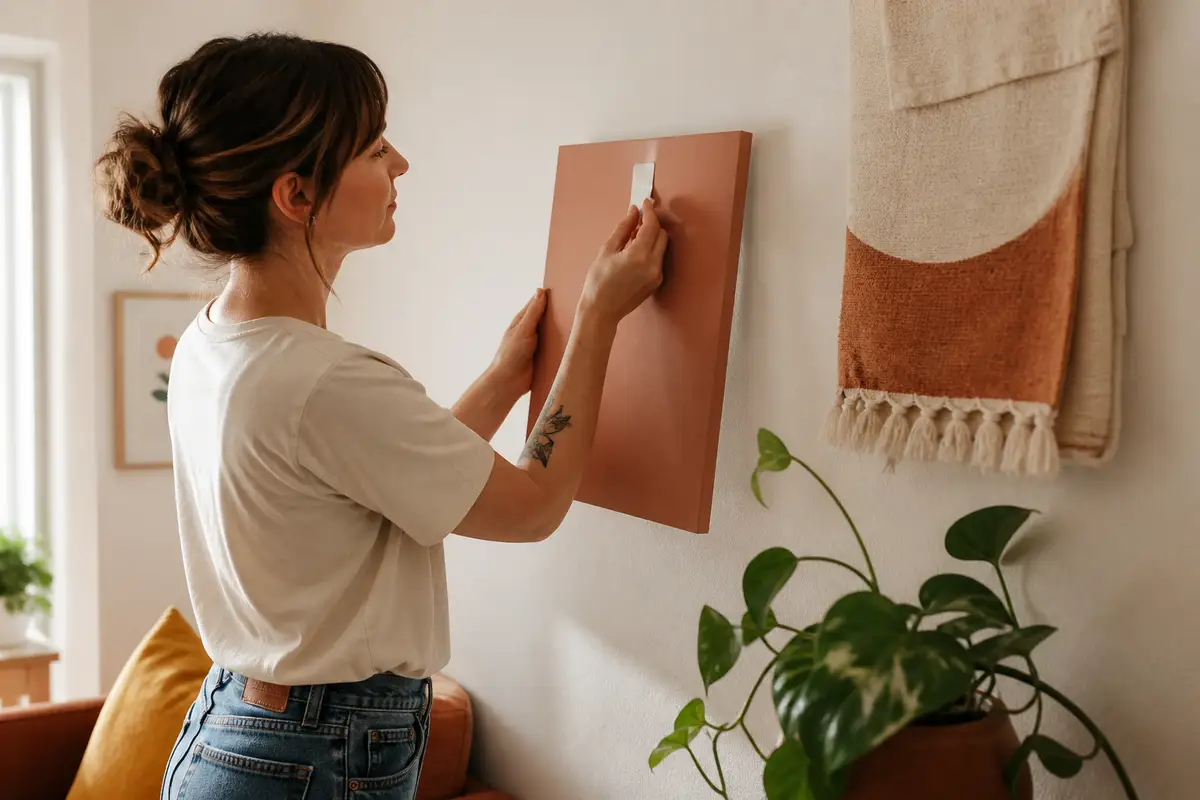
Respect the product’s surface exclusions, weight limit and cure time. Use more than one fixing only if the instructions permit load sharing; extra strips do not automatically multiply capacity. For removal, support the object and pull the release tab slowly in the stated direction, usually parallel to the wall rather than outwards. If the tab tears or resistance feels wrong, stop and consult the current instructions.
Peel-and-stick film and wallpaper can still lift paint
A removable covering creates a large adhesive area. Risk rises on weak paint, unsealed plaster, damp walls, paper wallpaper and textured surfaces. A tiny sample left for a realistic period is more informative than pressing and peeling immediately. Test removal as well as adhesion, but remember that ageing, heat and sunlight can change performance over months.
Use film on a surface the maker explicitly supports. Do not cover ventilation grilles, sockets, appliance controls or heat sources. Around kitchens and bathrooms, steam, grease and sealant edges create further problems. A cabinet wrap can damage veneer or leave a visible fade boundary even if it peels cleanly. Written permission is still the safer route.
Display art without creating a future repair job
Lean lightweight framed art on a stable sideboard with anti-slip support and secure it against tipping. Use existing picture rails or approved hooks where provided. Keep heavy glass away from beds, sofas and busy paths. When choosing a scale, our wall-art sizing guide helps avoid buying a piece that demands riskier fixings simply because it is too large.
A freestanding mirror can make a room feel larger, but it needs stable support and often an anti-tip restraint. The mirror sizing guide covers placement and proportion. Never rely on a light-duty adhesive for a heavy mirror unless the manufacturer explicitly approves the exact load and surface—and the landlord approves the installation.
Lighting changes a room without changing wiring
Layer a floor lamp, table lamp and plug-in task light. Check cable routes, socket loading, shade clearances and bulb ratings. Do not trail leads under rugs or across doors. Smart bulbs can alter colour temperature without replacing fittings, but confirm compatibility and keep the original bulb if it belongs to the property.
Do not replace a ceiling fitting, move a socket or alter fixed wiring as a decorating shortcut. That is electrical work, not a reversible accessory. Seek written permission and use an appropriately competent electrician where required. Avoid attaching fabrics or decorative covers around heaters or luminaires.
Protect floors, windows and existing fixtures
Place breathable, compatible pads under furniture and check them periodically; rubber and dyed materials can mark some floors. Use plant saucers and lift pots to inspect for condensation. Test rug underlays on the exact surface and avoid thick edges that create trips or stop doors opening.
For windows, use existing tracks and poles if safe. Tension rods can mark reveals or fall if overloaded, and adhesive blind systems still depend on surface condition. Do not compromise fire escape, ventilation or child-safety requirements. The blackout-curtain guide explains lining, sizing and installation trade-offs.
Create an installation and removal record
- Photograph the clean surface in consistent light.
- Save permission and instructions, including batch or product details.
- Test discreetly for the recommended period.
- Install within the stated load and record the date.
- Inspect periodically for movement, residue, damp or staining.
- Remove before the final rush, using the maker’s method.
- Photograph the restored surface and retain waste or receipts if a dispute is possible.
Do not perform an unauthorised repair that makes damage worse. If paint lifts or plaster fails, inform the landlord or agent and agree next steps. Deposit schemes can provide dispute resolution when the parties cannot agree, but evidence is stronger than memory.
Shop for a complete solution, not a “renter-safe” badge
Record surface compatibility, maximum item dimensions and weight, number of fixings, curing time, removal method and replacement availability. Avoid listings that promise “damage-free on all walls”; no adhesive can control unknown paint preparation. The product-shortlisting guide helps turn those conditions into pass/fail criteria.
For decor retailers, our IKEA UK review and Dunelm UK review explain range and fulfilment trade-offs. Check current returns before opening consumable adhesive packs; the UK returns guide separates retailer policy from statutory rights.
It creates the effect without changing the building
Textiles, lamps, freestanding furniture and objects can supply colour, storage and scale while keeping the original finish visible.
Adhesive, drilling, paint or wiring touches the property
Written detail protects both sides and exposes reinstatement conditions before money and time are committed.
Balanced verdict
The most rental-friendly room is planned around reversible objects, not products merely marketed as removable. Surface condition and removal technique decide whether an adhesive is low risk. Permission and a condition record decide whether the outcome is defensible.
Use freestanding layers first, test small areas, avoid structural or electrical improvisation and leave time for careful removal. A slightly quieter scheme is better than a deposit dispute or damaged home.
Check current official information:
GOV.UK tenant rights and responsibilitiesGOV.UK tenancy deposit protectionGOV.UK deposit disputesNorthern Ireland deposit information
For greenery that does not require fixing anything to the walls, compare materials and placement with our Artificial Plants Buying Guide: Materials, Scale and Realistic Placement.
Frequently asked questions
Do I need permission for removable hooks?
Check the tenancy. Because hooks can lift paint and may count as an alteration, written permission is the safer approach when the agreement is unclear.
Is peel-and-stick wallpaper damage-free?
No guarantee applies to every paint or plaster. Confirm surface compatibility, obtain permission, test adhesion and removal, and expect ageing to change performance.
Can a landlord deduct for ordinary wear?
Deposit decisions distinguish fair wear from damage using the agreement, age, condition and evidence. Decoration damage may support a deduction; use the relevant scheme’s current guidance.
Should I fill holes before moving out?
Only according to the agreement or an agreed reinstatement plan. Poor filler and mismatched paint can make the condition worse.
What is the lowest-risk way to add colour?
Use washable textiles, lamps, art resting safely on furniture and plants with floor protection. These change the room without changing fixed finishes.
How we researched this guide
Recommended Today reviewed current GOV.UK tenant responsibilities, tenancy-deposit and dispute guidance, alongside the practical conditions common to removable-fixing instructions. We ranked choices by reversibility, consequence and evidence rather than marketing labels.
Limitations
We did not inspect a tenancy, wall finish or product. Law and schemes vary by UK nation, and manufacturer instructions change. Seek legal or qualified trade advice where needed and recheck permissions before purchase.