Artificial Plants Buying Guide: Materials, Scale and Realistic Placement
A convincing artificial plant starts with believable scale, varied structure and the right placement—not simply the most detailed leaf seen close up.
In this guide
Measure the empty volume, then choose a plant that belongs there
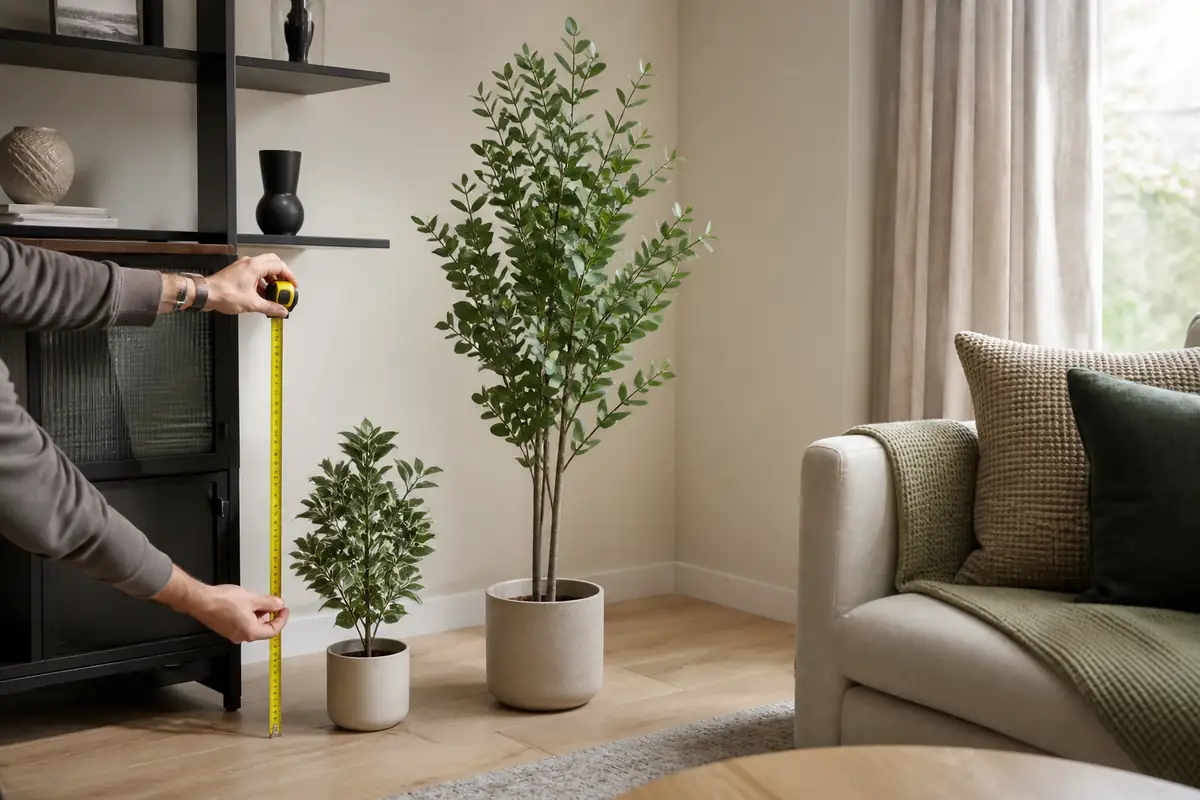
Small artificial plants work best as restrained shelf accents; tall floor plants need credible branching, a stable inner pot and enough visual mass for the room. Check actual height and pot diameter, leaf and stem materials, cleaning instructions and explicit indoor/outdoor suitability. A decorative cachepot and careful shaping often matter more than buying the densest option.
This guide assesses specifications and placement principles. We did not inspect, bend, dust or weather-test the products referenced. “Realistic” is subjective and changes with viewing distance, light, photography and styling.
Choose the role before the species
An artificial plant can fill a dark corner, soften a hard furniture line, add a small colour accent or create privacy. A screening plant needs different height and leaf density from a small decorative accent, even when both are artificial. Start by photographing the empty space from normal viewpoints and measuring the available height, width and pot footprint.
| Placement | Useful scale | Main risk |
|---|---|---|
| Desk or narrow shelf | Small pot and controlled spread | Oversized leaves reveal repetition |
| Bookcase gap | Trailing or compact form | Blocking books, vents or lighting |
| Floor corner | Tall branching plant with stable base | Too sparse for the room volume |
| Bathroom | Wipeable, moisture-tolerant specification | Paper, metal or adhesive not suited to damp |
| Balcony or outside wall | Explicit indoor/outdoor product | Fading, wind load and insecure fixing |
Measure like furniture rather than a living specimen. Our guide to measuring before buying furniture helps record access, depth and nearby doors. Keep artificial foliage away from heat sources, naked flames and working appliances.
Materials change look, cleaning and location
Artificial leaves commonly use polyethylene, polyester fabric, PEVA, EVA, paper or combinations over wire and steel stems. Plastic can take moulded texture and is often wipeable. Polyester can soften leaf movement but may show woven edges close up. Paper can look deliberately graphic and natural in a dry room but is not automatically suitable for damp or outdoor use.
Current IKEA examples demonstrate the range. A small FEJKA herb set uses polyethylene and polypropylene with 5cm pots and 11cm height. A 170cm artificial weeping fig combines recycled polyester, paint, steel and polyethylene and is listed for indoor and outdoor use. A SMÅTÄRNA paper fig uses paper leaves and wire-supported stems for shaping. These are different material systems, not quality tiers.
Read the material list for
- Leaf surface and edge construction.
- Wire or steel inside bendable stems.
- Inner-pot plastic and any ballast.
- Paint or flocking that may collect dust.
- Paper or textile restrictions around moisture.
- Stated recycled content without assuming overall sustainability.
A recycled-content percentage is useful product evidence but does not prove low total impact, recyclability or long life. Apply the questions in our greenwashing guide to the precise claim.
Scale: use pot diameter, height and spread
Product height alone can mislead. A 150cm plant with a narrow crown may disappear beside a broad sofa, while a lower plant with wide branching can dominate a walkway. Record overall height, maximum spread, inner-pot diameter and the dimensions of the decorative pot you plan to add.
The cachepot should hide the plain inner pot without swallowing the stems. Check internal diameter and depth, not only the external styling. A heavy ceramic cover can improve stability, but the floor and furniture must support it. Use non-scratch protection where appropriate.
A simple scale test
- Mark the listed height on the wall with low-tack tape.
- Mark the widest expected spread.
- Place a box matching the outer pot footprint.
- Walk past doors and seating at normal speed.
- Photograph the mock-up from the room entrance.
This method is more reliable than judging a styled retailer photograph. Product images may use wide lenses, crop the pot or show fully arranged branches. For nearby wall pieces, compare the same visual mass principles in our wall-art sizing guide.
Where the plant sits beside a mirror, check the reflected crown and pot as well as the direct view; the object can appear twice as dense from one angle. The room-scale checks in our mirror sizing guide help avoid a crowded composition.
What makes an artificial plant look convincing?
From normal viewing distance, believable structure matters more than perfect leaf printing. Look for variation in leaf angle, size and colour; visible but not identical branching; a stem thickness that supports the crown; and a transition into the pot that can be disguised. Repeated identical leaves in symmetrical rings usually read as manufactured.
Realism can improve after unpacking. Follow the manufacturer’s shaping instructions and bend only parts designed to move. Rotate clusters gradually rather than forcing a sharp crease. Add a suitable outer pot and, if safe, a removable surface dressing that does not trap moisture or create a choking risk.
Placement helps. A slightly shaded corner can soften plastic shine, while harsh direct side light exposes mould lines and dust. Do not hide a badly scaled plant in darkness; choose the right form first. A single well-scaled plant is often more convincing than many small unrelated specimens.
Indoor versus outdoor suitability
“Artificial” does not automatically mean outdoor-safe. The product page should explicitly state indoor/outdoor use. Even then, wind, frost, prolonged sunlight and water can affect colour, joints, ballast and fixings. Ask whether UV resistance is stated and for how long any guarantee applies; avoid inventing a fade-free lifespan.
Wall panels and hanging plants need fixings suitable for the wall and total load. Current IKEA FEJKA wall products state indoor/outdoor use and remind buyers that screws are not included because wall materials require different fixing devices. That is a practical installation warning, not an invitation to improvise.
Light, care and household safety permit it
You value growth and natural variation and can provide appropriate light, watering, drainage and pet-safe selection.
The location defeats living care
The space is dark or access is awkward, and a measured, wipeable decorative object solves the visual brief without pretending to be maintenance-free.
Cleaning and long-term appearance
Artificial plants avoid watering but still collect dust and grease. Check the care label: current IKEA plastic examples specify wiping with a dry or damp cloth, depending on the product. Avoid soaking wire, paper, flocked surfaces or weighted bases unless the instructions allow it.
Choose a plant you can reach and clean. A dense wall panel above cooking fumes may require more work than a smooth-leaf floor plant. Test a hidden area before using any cleaner and support stems while wiping. Replace or repair only where the product design and manufacturer guidance permit it.
Long-term value comes from continued suitability, not zero care. Include outer pot, mounting hardware, cleaning time and eventual disposal in the calculation. Our furniture-quality framework offers useful stability and finish checks for decorative objects.
Artificial plants as gifts
A small plant can suit a workspace or low-light home, but do not assume the recipient wants plastic décor or has a suitable shelf. Ask about style, pets, children, dust sensitivity and storage. A very large floor plant creates an obligation and should be chosen with the recipient.
Keep gift receipts and dimensions. Use our gift-selection guide to match the item to the person rather than to a generic trend.
Buying checklist
- Define the decorative job and viewing distance.
- Measure height, spread and pot footprint.
- Read every leaf, stem and pot material.
- Confirm indoor/outdoor suitability in writing.
- Check shaping, assembly and cleaning instructions.
- Plan an outer pot and stable placement.
- Inspect repetition, shine and exposed joins.
- Keep return condition intact until scale is confirmed.
Balanced verdict
The strongest artificial plant is a measured decorative object that suits its location, materials and viewing distance. Small accents should be restrained; floor plants need stable bases and enough spread; outdoor pieces need explicit suitability and secure installation. Realism comes from proportion, variation and placement as much as leaf detail. Artificial plants reduce watering, not cleaning or decision-making.
Check current product specifications:
IKEA small FEJKA materials and size ↗IKEA 170cm FEJKA specification ↗IKEA paper plant materials ↗IKEA wall panel and fixing guidance ↗
Frequently asked questions
What material looks most realistic?
No material always wins. Moulded plastic can give detailed texture, polyester can soften movement and paper can create a deliberate botanical look. Structure and distance matter.
Can any artificial plant go outside?
No — Look for explicit indoor/outdoor suitability and any UV or weather information for the exact product. Secure it against wind.
How tall should a floor plant be?
There is no universal height — Mark the listed height and spread in the actual room, then judge it from entrances and seating.
How do I clean an artificial plant?
Follow its care instructions. Many plastic plants can be wiped, while paper, wire, flocking and weighted pots may need gentler dry care.
Do artificial plants need a decorative pot?
Not always, but an outer pot can hide a plain inner pot and improve proportion. Check internal diameter, depth, stability and floor protection.
Are artificial plants maintenance-free?
No — They avoid watering but require dusting, occasional reshaping and checks for fading, loose parts or insecure fixings.
How we researched artificial plants
We reviewed current IKEA UK product pages on 27 August 2026 across small plastic plants, a 170cm floor plant, a paper plant and an indoor/outdoor wall panel. We compared listed materials, measurements, care and placement claims without physical inspection.
Limitations
We did not assess realism, odour, colourfastness, fire behaviour, outdoor ageing or durability. Product images, prices, stock, material percentages and specifications change. Recheck the exact listing and safety instructions before purchase and purchase.