Blackout Curtains Compared: Measuring, Lining, Fitting and Price
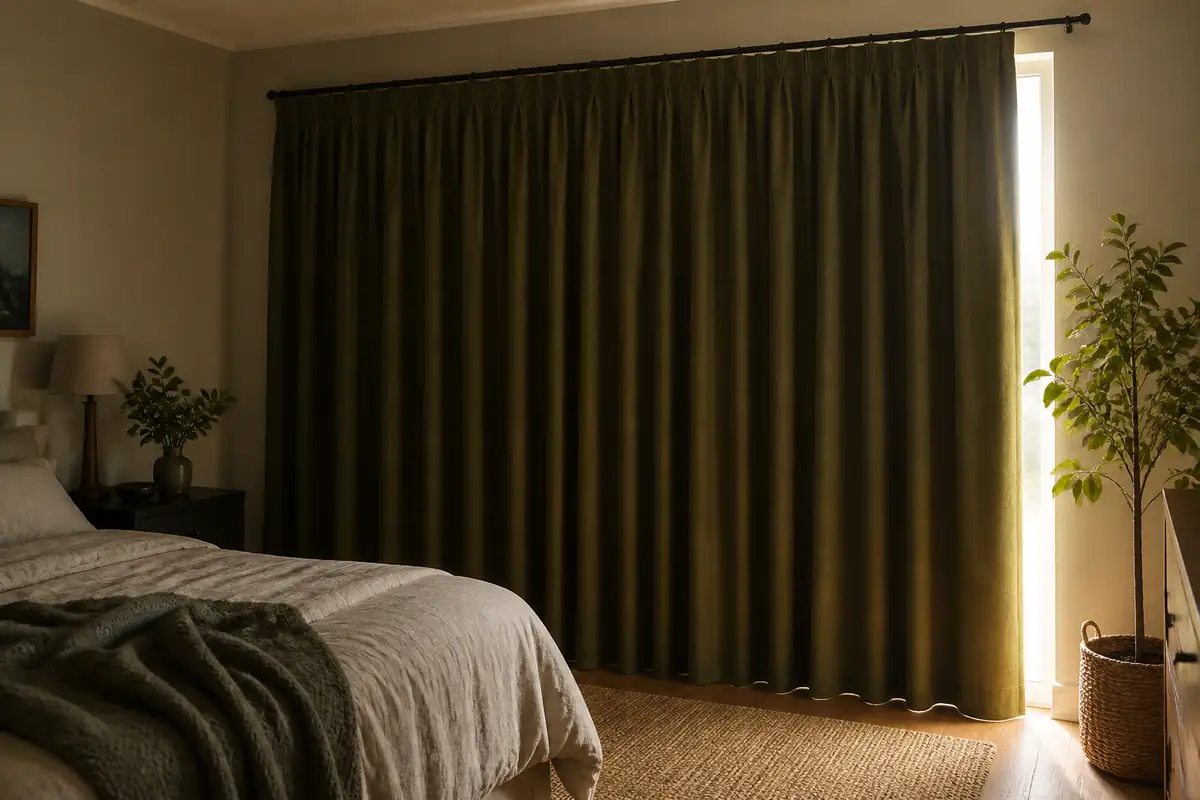
Blackout fabric cannot darken a room if the curtains are too narrow, too short or fitted close to the glass. Measure the pole or track, allow generous fullness and treat edge gaps as part of the product decision.
In this guide
Fit matters more than the word “blackout”.
IKEA’s MAJGULL pair at £40 is the clearest low-cost ready-made blackout option in our dated sample, while KORGMOTT at £49 provides another full-length pair with a different construction and heading. Dunelm’s Oscar pair at £55 offers a shorter 183cm drop and eyelets for a common UK window size. None will create complete darkness if light escapes above, below, between or beside the panels.
This guide compares real ready-made products, but it is primarily a fitting guide. Labels such as blackout, block-out and room-darkening are not interchangeable, and retailer dimensions are easy to misread. We have not installed or laboratory-tested these curtains. Our recommendations use official product specifications, care instructions and measuring guidance, with every performance limitation stated plainly.
Blackout, block-out and room-darkening: what is the difference?
“Blackout” and “block-out” are retailer descriptions for fabric designed to prevent light passing through the panel. IKEA makes a useful distinction: its room-darkening curtains allow a small amount of light through, whereas its block-out products are designed to block it. That difference is visible in the product range—MERETE is described as room-darkening, while MAJGULL and KORGMOTT are sold as block-out.
The label concerns the fabric, not the whole window. Light can still enter around the curtain edges, through an uncovered centre gap, above a low pole or beneath a short drop. A pale room can also appear brighter because light from the edges reflects off walls. For a nursery, shift worker’s bedroom or light-sensitive sleeper, the installation can matter as much as the material.
Do not assume a dark colour automatically blocks more light. The backing, coating, weave and number of layers determine transmission. Equally, do not infer thermal or acoustic performance from a blackout label. A substantial curtain may reduce draught sensation, but only a stated, evidenced claim supports a particular insulation or sound result.
Blackout curtain prices compared
We checked the exact UK listings on 21 August 2026. Sizes are not like-for-like: IKEA’s quoted width and drop are per curtain and its examples use a 250cm drop, while the selected Dunelm price is for a 168cm width and 183cm drop. The table is a market snapshot, not a ranking based on price alone.
| Exact product checked | Size and quantity | Price shown | Construction and care |
|---|---|---|---|
| IKEA MERETE Room-darkening, white, eyelets |
Pair; each curtain 145 × 250cm | £29 | 100% cotton; machine washable; up to 4% shrinkage stated |
| IKEA MAJGULL Block-out, dark green, heading tape |
Pair; each curtain 145 × 250cm | £40 | Recycled polyester; machine wash at 30°C; do not tumble dry |
| IKEA KORGMOTT Block-out, dark grey, heading tape |
Pair; each curtain 145 × 250cm | £49 | Recycled polyester with laminated construction; machine wash at 30°C; low-temperature tumble drying permitted |
| Dunelm Elements Oscar Blackout eyelet curtains |
Pair; selected size 168 × 183cm | £55 | Polyester/cotton face with polyester blackout lining; dry clean |
Price snapshot: checked on the official IKEA UK and Dunelm pages on 21 August 2026. Size selections, colours, postcode stock, delivery and prices can change. Recheck the exact pair and delivery basket before ordering.
The £29 MERETE pair demonstrates why the cheapest item is not necessarily equivalent: it is room-darkening rather than block-out. MAJGULL costs £11 more and is positioned for stronger light control. KORGMOTT costs another £9 and uses a laminated construction. The Dunelm Oscar pair costs £55 in the selected size, but its shorter drop and eyelet heading may suit a window where IKEA’s 250cm panels would require hemming or a different pole.
Alteration cost can reverse a headline saving. IKEA supplies iron-on hemming tape with some curtain products, but check the exact pack. If you cannot shorten a 250cm panel neatly, include professional alteration. Likewise, a cheap pair is not cheap if it requires a new pole, brackets or wall repair. Use our total-cost method to compare the installed result rather than the shelf price.
How to measure for blackout curtains
Measure the pole or track—not only the glass
Dunelm’s measuring guidance says to measure the pole or track rather than simply the window. If there is no fitting yet, its guide recommends allowing the pole to extend about 20cm beyond each side of the window. That overlap gives the fabric somewhere to sit without exposing the glass when closed. An outside-recess track is commonly allowed about 10cm on each side in the same guidance.
Measure with a rigid metal tape where possible and record in centimetres. Take width and drop more than once. Check for radiators, window handles, deep sills, furniture, sockets and doors. The same discipline applies to larger home purchases; our guide to measuring before buying furniture provides a reusable room-and-access checklist.
Understand whether a width describes one curtain or the pair
This is the most expensive easy mistake. Dunelm says ready-made curtain sizes normally refer to each individual curtain in a pair unless stated otherwise. IKEA’s product pages also specify the measurement per curtain. A pair labelled 145cm wide therefore gives 290cm of flat fabric before gathering.
Do not size curtains to equal the pole width. They need fullness to form folds and close without being pulled taut. Dunelm recommends that the total width of both curtains should be at least twice the window width. Heading type and desired fullness can alter the ideal multiplier, so read the product guidance, but twice the span is a useful starting check.
Choose the drop from the hanging point
The relevant start point depends on the heading. Eyelet curtains hang from the pole through metal rings, leaving a small amount of fabric above it. Pencil-pleat hooks attach to a track or rings at an adjustable position. Heading-tape curtains can support different hanging methods. Measure from the manufacturer’s stated point, not from the top of the bracket.
Decide whether the curtain should finish at the sill, below the sill or near the floor. For light control, a longer drop generally reduces the bright gap beneath the panel, but it must not create a trip hazard or lie against a heat source. Uneven floors and ceilings are common, so measure at more than one point. Allow for any stated shrinkage before hemming a washable curtain to an exact length.
Measurements to record before ordering
- Finished pole or track width, excluding decorative finials.
- Available overlap beyond the window on the left and right.
- Drop from the correct hanging point to the intended finish.
- Total flat curtain width and intended fullness.
- Distance to radiators, handles, sills, furniture and the floor.
- Wall material, bracket condition and whether the fitting can bear the fabric.
Eyelet, heading tape and lining choices
Eyelets: simple, but the pole remains part of the fit
Eyelet curtains slide directly onto a pole and create large, regular folds. They are straightforward to remove and rehang, which suits the dry-clean-only Dunelm Oscar pair if access is convenient. They cannot be used directly on a conventional track. The fabric folds can project into the room, and the distance between pole and wall affects light escaping above and around the sides.
Check eyelet diameter against the pole. A thick decorative pole may not pass through or slide smoothly. Eyelets also expose portions of the pole between folds, so a pole fitted too close to the edge of the window can create a visible light channel.
Heading tape: more flexible, more setup
MAJGULL and KORGMOTT use heading tape. Depending on the product, this can work with hooks on a track, rings on a pole or a rod passed through a concealed channel. The flexibility is useful when trying to place the fabric closer to the wall, but spacing hooks and forming even folds takes more care than threading eyelets.
Read the product instructions before buying hooks or gliders. Hardware is often sold separately, and the weight of lined or laminated curtains can expose weak fixings. If the bracket position, wall type or load is uncertain, seek competent fitting advice rather than relying on a universal wall plug.
Separate lining, sewn-in lining or coated fabric?
A sewn-in blackout lining, as specified for the Dunelm Oscar curtains, gives a distinct face fabric and backing. A laminated or coated construction can provide light blocking within the panel without the same layered drape. Separate liners can upgrade existing curtains, but their size, attachment points and weight must match the current pair.
Care is a practical difference. MAJGULL and KORGMOTT are listed as machine washable at 30°C, while Oscar is dry-clean only. A child’s room, dusty street or allergy-sensitive household may place more value on washable fabric than on a small price difference. Follow the label: heat can damage coatings and shrinkage can change a carefully chosen drop.
How to reduce light gaps
- Extend beyond the frame. A wider pole or track lets closed curtains overlap the wall rather than stop at the glass edge.
- Fit sufficiently high. Position above the reveal where the wall and fixing allow, reducing the bright strip over the window.
- Use enough fullness. Panels pulled tight can separate in the middle and transmit more light through stressed folds.
- Create a centre overlap. Arrange the leading edges to meet generously rather than merely touch.
- Choose an appropriate drop. A near-floor finish can limit light beneath the fabric, provided it is safe and clear of heaters.
- Consider the side return. A wraparound pole or track return can bring the outer edge closer to the wall.
- Layer where necessary. A correctly fitted blind behind curtains can address edge gaps that fabric alone cannot remove.
The aim should be appropriate darkness, not a mathematically perfect seal. A daytime nursery may need dependable nap conditions; an occasional guest room may only need reduced glare. Define the outcome before paying for custom tracks or multiple layers. For rentals, check the tenancy agreement before drilling and consider whether an existing pole can be improved safely.
Colour, appearance and room use
Blackout curtains occupy a large visual area when closed. Check colour in the room’s morning and evening light if samples are available. Online images vary by screen and photography, while the backing may be visible from outside. A darker olive or grey can feel calm in a bedroom but heavy in a small north-facing room; a pale face fabric with a proper blackout lining can keep the room visually lighter when the curtains are open.
Pattern alignment matters across a pair. A patterned option may suit the room better than a plain curtain, but compare repeat placement, matching across both panels and care rather than assuming equal appearance from a small swatch. Check the exact size price because a longer drop can sit in a different price tier.
Use customer photographs to investigate colour and drape, not to establish dimensions or performance. Reviews can reveal repeated complaints about pinholes, stiffness or colour variation, but they do not prove a failure rate. Our guide to common buying biases explains why vivid isolated experiences can outweigh stronger evidence.
Which blackout curtains should you choose?
IKEA MAJGULL at £40
Choose it when a 145 × 250cm pair works with the planned heading and you want a washable block-out product below £50. Include hemming and hardware in the real cost.
Dunelm Oscar at £55
Choose the 168 × 183cm eyelet pair when that drop and pole system fit without alteration and the dry-clean care requirement is acceptable.
KORGMOTT at £49 is the alternative when its laminated construction, colour and heading suit the room better than MAJGULL. MERETE at £29 is the budget choice only when room-darkening is enough; it should not be presented as equivalent to a block-out product.
Dunelm is strongest when its broad size and heading selection reduces alteration. IKEA is strongest when its long ready-made dimensions and lower pair prices fit the window. Read our complete Dunelm review, browse the shop directory, and compare only after the window dimensions are fixed. The shortlisting method helps reduce colours and patterns without opening dozens of near-duplicate tabs.
Returns, delivery and alteration risk
Confirm whether the selected size is available for delivery or collection to your postcode and what return method applies. Curtains are bulky enough that a return journey or courier fee can erase a small saving. Inspect colour, pair quantity, panel dimensions, heading and care label before removing tags or altering the fabric.
Hemming, washing or fitting can make a change-of-mind return impossible. Hang carefully for an initial visual check only if the retailer permits it and the product remains in returnable condition. Keep packaging until both panels have been checked for consistent length, finish and damage. A fault or misdescription is different from simply changing your mind.
Our verdict
For a long ready-made blackout pair, IKEA MAJGULL at £40 offers the clearest balance of price, washable care and stated block-out construction in this snapshot. KORGMOTT is a credible £49 alternative. Dunelm Oscar at £55 becomes the better fit when its 183cm drop and eyelet heading avoid alteration.
The product name should never make the final decision. Measure the pole or track, seek roughly twice the span in total fabric width, verify whether dimensions describe each panel, and plan for edge light. A correctly sized £40 pair can outperform a premium curtain stretched across the wrong fitting. Continue through our Home & Kitchen guides for more measurement-led buying advice.
Check current official information:
Dunelm curtain measuring guide ↗Dunelm Oscar blackout curtains ↗IKEA MAJGULL ↗IKEA KORGMOTT ↗IKEA MERETE ↗
Frequently asked questions
Should blackout curtains be twice the window width?
As a starting point, the combined flat width of both curtains should be at least twice the window or fitting span, consistent with Dunelm’s ready-made guidance. Heading type and desired fullness can alter the ideal amount, so check the exact product instructions.
Why do blackout curtains still let light in?
The fabric may block light while gaps remain above, below, between and beside the panels. A wider and higher fitting, enough fullness, centre overlap, side returns or a blind behind the curtains can reduce those channels.
What is the difference between blackout and room-darkening curtains?
Room-darkening fabric reduces light but may allow some through. Blackout or block-out fabric is designed for stronger light blocking. Neither label guarantees a completely dark room because installation gaps remain.
Does curtain width refer to one panel or the pair?
For the ready-made Dunelm and IKEA examples in this guide, the displayed width refers to each individual curtain, and the product is sold as a pair unless stated otherwise. Always confirm the quantity and sizing note on the exact listing.
Can blackout curtains be machine washed?
Some can and some cannot. IKEA MAJGULL and KORGMOTT are listed for a 30°C machine wash, while Dunelm Oscar is dry-clean only. KORGMOTT allows low-temperature tumble drying but MAJGULL does not. Follow the sewn-in label because coatings and linings can be damaged by unsuitable heat or treatment.
Do blackout curtains keep a room warm?
Substantial curtains may reduce the sensation of draughts, but blackout describes light control, not a guaranteed thermal rating. Look for a specific evidenced thermal claim and address window gaps separately rather than assuming every blackout product insulates equally.
How we compared blackout curtains
Recommended Today rechecked the exact official Dunelm and IKEA UK product pages, dimensions, quantities, heading types, materials, care instructions and prices on 21 August 2026. We also used Dunelm’s official curtain-measuring guidance. The shortlist covers different price, heading and light-control choices rather than pretending mismatched sizes are direct substitutes.
We did not order, install, wash, measure light transmission or test thermal performance. Product descriptions are attributed to official listings and limitations are stated. External links are editorial and non-affiliate.
Prices, sizes, colours, stock, delivery and product specifications change. Recheck every exact listing immediately before purchase. Wall construction and heating clearances vary; use competent fitting advice where required.