Hallway storage ideas: measuring depth, access and daily capacity
Good hallway storage removes friction without narrowing the route. Measure the space in use, count what must live there and protect doors, stairs, meters and escape access before buying furniture.
In this guide
Preserve the route first, then size storage to daily behaviour
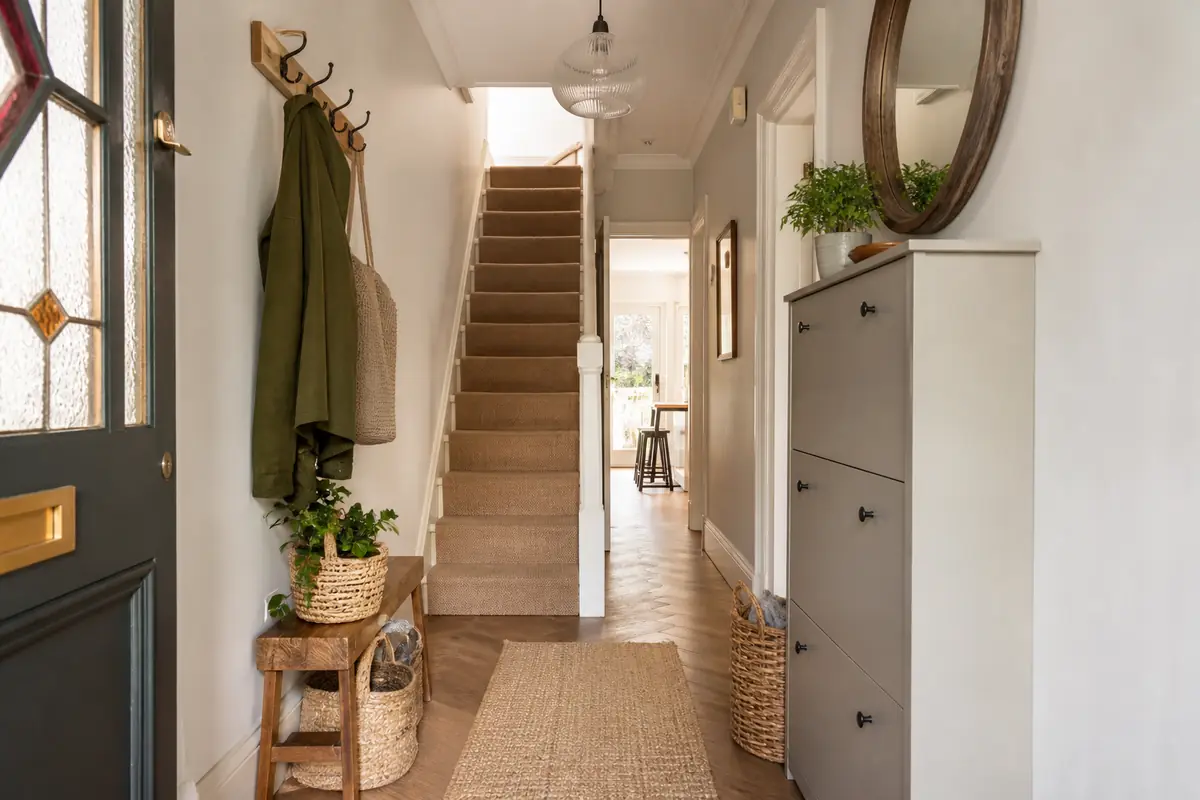
Mark the minimum clear walking line with doors open, coats hanging and shoes in use. Choose shallow closed storage for visual calm, hooks for fast access, a bench only where sitting does not obstruct movement, and baskets only when every basket has a fixed category and capacity. Shared communal corridors and escape routes are not overflow-storage areas.
This guide concerns private domestic hallway planning. Fire doors, communal routes, rented-property fixtures, electrical equipment and structural walls need appropriate permission and competent advice. Recommended Today did not install or load-test furniture.
Storage types compared
| Type | Best use | Main constraint |
|---|---|---|
| Slim shoe cabinet | Concealing a measured number of ordinary shoes | Internal tilt depth may reject boots or large sizes |
| Hooks or rail | Fast access to current coats and bags | Garments project farther than the hardware |
| Bench with storage | Sitting plus low-volume shoes or accessories | Needs clear knee, door and circulation space |
| High shelf or closed cupboard | Infrequent lightweight items | Safe reach, wall fixing and falling-object risk |
| Open baskets | Small named categories used every day | Easy to overfill and difficult to clean around |
Map the hallway in use
Measure wall length, width, ceiling height and any sloping stair underside. Then add the moving parts: front door arc, internal doors, cupboard doors, radiator valves, meter boxes, sockets, alarms and stair newel. A cabinet that fits a bare wall can block the front door, pinch the stair approach or prevent a utility door opening.
Mark the proposed footprint with low-tack tape and live with it for a day. Wear a coat, carry shopping and pass another person if that reflects the household. Add the real projection of hanging garments, not just hook depth. Our furniture measuring guide explains how skirting and uneven walls reduce usable space.
Hallway survey record
- Clear walking width at the narrowest point.
- Every door arc, handle and letterbox projection.
- Stair start, handrail and required headroom.
- Radiator, thermostat, socket, alarm and meter access.
- Skirting depth and wall material for fixings.
- Delivery route and space to assemble or turn furniture.
Private hallway versus communal escape route
Do not treat a shared corridor, stair or lobby as an extension of the flat. Government fire-safety guidance for small blocks says communal escape routes should be kept clear and highlights combustible storage as a risk. London Fire Brigade similarly warns against using shared hallways as overflow storage because obstruction can hinder escape and firefighting.
In a private internal hallway, preserve fast exit and avoid interfering with fire doors, alarms or electrical equipment. The exact legal and tenancy position depends on the building. If an item would sit outside the dwelling or affect a protected route, obtain written building-management or landlord guidance rather than relying on an attractive social-media example.
Count daily capacity before choosing furniture
Make an inventory at peak use, not on a tidy day. Count everyday shoes, wet footwear, school bags, work bags, dog leads, umbrellas, helmets, keys and seasonal coats. Separate daily, weekly and seasonal items. Only daily items need the prime zone; the rest can move to bedroom wardrobes, under-bed boxes or another cupboard.
Capacity claims need internal measurements. A cabinet advertised for twelve pairs may assume small low shoes placed closely. Measure the longest and tallest pair, including boots. Test a cardboard volume equal to the internal compartment. The furniture-quality guide helps compare hinges, backs, fixings and stated loads after the size passes.
| Category | Count method | Useful margin |
|---|---|---|
| Daily shoes | Pairs in current rotation plus largest dimensions | One wet or guest pair if genuinely needed |
| Coats | Bulky winter width, not hanger count | Enough gap for drying and easy removal |
| Bags | Loaded projection and strap drop | No contact with door handles or floor |
| Small items | Named tray or basket per category | Fixed maximum, not an empty catch-all |
Shoe storage: internal geometry matters
Tilt-out cabinets can be shallow outside because shoes sit at an angle, but heels, boots and large trainers may not fit. Ask for internal compartment dimensions and opening clearance. Ventilation and wipeable surfaces matter for damp footwear; do not seal wet shoes into a tightly packed cabinet.
A low open rack is faster but visually busy and collects dust. A bench may support dressing if the manufacturer states a suitable sitting load; never infer load-bearing capacity from appearance. Fix tall or narrow units according to instructions, especially in homes with children. Freestanding does not mean tip-safe.
Coats, hooks and wall fixing
Hook height should work for intended users and keep long garments clear of heaters and floors. Space hooks by bulky coat width. A row of six hooks may practically hold only three winter coats. Bags add leverage, so use fixings appropriate for the wall and the product’s load instructions.
Do not drill before checking for hidden cables and pipes. Renters should confirm alteration rules. Over-door products avoid drilling but can stop doors closing, damage seals or change fire-door behaviour; do not use them where they interfere with a door’s designed operation.
Benches, baskets and the landing zone
A landing zone works when each object has a deliberate destination: key tray, post slot, dog-lead hook and return basket. It fails when a wide surface becomes an invitation to pile. Prefer a small surface with boundaries over a console deeper than the route can support.
For a bench, tape the full depth and then sit within the mock footprint. Check knees, open doors and shoe access. Lift-up lids need overhead and finger clearance; drawers need pull-out space. A basket below should slide without scraping the route. Compare total owned volume with our shortlisting method before paying for a coordinating set.
Materials, cleaning and durability
Hallways receive grit, rain and repeated impacts. Wipeable finishes, protected edges and replaceable trays can be more useful than delicate open-grain surfaces. Read material descriptions precisely: foil-wrapped board, painted timber and metal have different edge and moisture behaviour. “Wood effect” is not solid wood.
Check the back panel, drawer runners, hinge adjustment, included wall restraints and spare-part availability. A narrow cabinet opened many times a day needs stable hardware. Our durability guide provides questions about repair and replacement rather than promising a lifespan from price. When shopping remotely, the online product-quality guide helps distinguish documented construction from styling photography.
Delivery and assembly
Measure the packaged product through the front door and around stairs. Flat-pack components can be long even when the finished cabinet is shallow. Confirm whether assembly requires floor space, two people or wall anchoring before the hallway is filled with parts.
Keep fixings labelled and follow the sequence. Do not substitute wall fixings without understanding the wall. If pipe, cable or structural uncertainty exists, use a competent installer. Photograph damage before assembly and retain the retailer listing, using our online retailer checklist for unfamiliar sellers.
The route can accept its full depth
Internal geometry fits the inventory, doors open safely and wall restraint is practical.
Speed and ventilation matter more
A limited daily set can remain orderly without projecting into the walking line.
Balanced verdict
The best hallway storage is often smaller than the largest unit that fits the empty wall. It preserves movement, serves a counted daily inventory and remains easy to clean and reset. Closed cabinets calm visual noise; hooks and racks reduce friction; neither works when capacity is imaginary.
Protect the route first. Move seasonal excess elsewhere, buy only after a taped trial, and treat shared corridors as safety spaces rather than storage opportunities.
Check current official safety guidance:
GOV.UK small-block fire-safety guideLondon Fire Brigade hallway and escape guidance
Frequently asked questions
How deep should hallway storage be?
There is no universal depth. Subtract the proposed unit, doors and hanging items from the real route, then confirm that normal passage and every door remain workable.
Are slim shoe cabinets suitable for boots?
Not always — Tilt compartments can reject tall, wide or large footwear. Compare internal measurements with the largest pair.
Can I put a shoe rack in a communal hallway?
Do not assume so — Communal escape routes should remain clear; obtain building-management guidance and follow current fire-safety requirements.
Does a storage bench support an adult?
Only when the manufacturer states an appropriate sitting or maximum load and the product is assembled and positioned as instructed.
Should hallway cabinets be fixed to the wall?
Follow the product instructions. Tall, narrow or front-opening furniture can tip, so use the supplied restraint with fixings appropriate to the wall.
How we researched this guide
Recommended Today combined official UK and London Fire Brigade escape-route guidance with a repeatable measurement, inventory and furniture-evaluation method on 28 August 2026.
Limitations
Homes, lease terms, fire strategies, wall structures and product loads differ. This guide cannot approve an installation or replace manufacturer, landlord, building-management or competent professional instructions.