Sonos Ray vs Beam Gen 2 UK: connections before the premium
Audit the source, television and audio connection before paying for soundbar features that your actual setup may not be able to supply.
In this guide
Choose the audio path your TV can supply
Start with Ray when an optical connection and a compact soundbar answer your actual television setup. Investigate Beam (Gen 2) when HDMI ARC or eARC control and compatible Dolby Atmos playback are useful to you. Beam’s specification is broader, but its price premium only buys a useful result if the television, source, service and settings can deliver it. Neither model is a guaranteed cure for every dialogue problem.
This is a research-led UK comparison of Sonos Ray and Beam (Gen 2), checked on 22 November 2026. It excludes the first-generation Beam, Beam Ultra, second-hand bundles and surround packages. Our soundbar buying guide for connections and room fit introduces the wider category; this page narrows that decision to the two named products and a practical compatibility check.
The differences that change the purchase
| Buying question | Sonos Ray | Sonos Beam (Gen 2) | Check at home |
|---|---|---|---|
| TV connection | Digital optical | HDMI ARC/eARC; optical adapter included | Identify the actual television output, not a spare HDMI input |
| Atmos route | Not an Atmos soundbar | Supported with a compatible source and audio path | Check the service, device and TV passthrough |
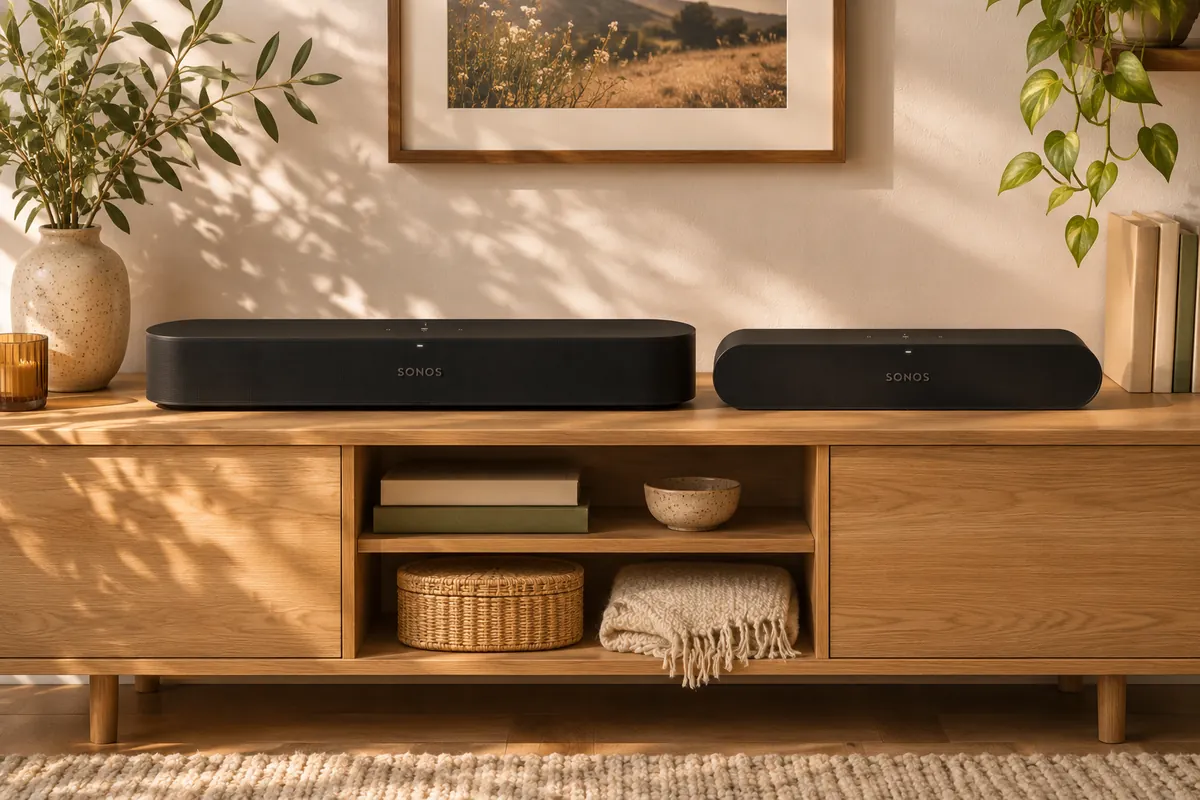
| Published size | 557 mm wide, 70.1 mm high, 93 mm deep | 651 mm wide, 68 mm high, 100 mm deep | Measure the shelf and the lower edge of the screen |
| TV volume control | Check compatibility of the optical/remote arrangement | HDMI CEC can operate over the suitable ARC connection | Test normal remote use with the actual television |
| Music use | Wi-Fi streaming and AirPlay 2 | Wi-Fi streaming and AirPlay 2 | Confirm your app, network and preferred service |
These are published features and dimensions, not our measurements or listening results. Height alone is not enough: a TV stand’s feet, a shelf lip or the remote receiver can still create a placement problem. Include cable access behind the unit rather than matching only the front face to the width of a cabinet.
Trace one working signal from source to speaker
Write down the television model and the device that supplies most of your viewing. A built-in streaming app, a separate streaming box and a games console can travel through different settings even when they use the same screen. The label on a streaming subscription does not by itself establish the audio format that eventually reaches a soundbar.
A connection audit before ordering
- Find the TV’s optical output and any HDMI port specifically marked ARC or eARC.
- Check the TV manual for the audio formats it can output from your chosen source.
- Confirm that the programme and subscription tier offer the format you want.
- Note which HDMI socket would be occupied and whether another device must move.
- Keep a record of the settings so an installation problem can be traced step by step.
Sonos explains that Dolby Digital Plus Atmos can work over a compatible HDMI ARC path, while lossless Dolby TrueHD Atmos requires eARC. Do not reduce that distinction to “ARC never supports Atmos” or “every HDMI port supports Atmos”. The relevant capability belongs to the complete chain, and a device or television that re-encodes the signal may change what arrives.
After setup, check the received audio format in the Sonos app using the manufacturer’s instructions. A successful cable connection and audible sound do not prove that the intended format is playing. This verification is more useful than deciding from the packaging badge and leaving the television on an unsuitable output setting.
Optical can be a deliberate choice
Ray’s optical connection can be appropriate for a television that has a suitable output and for a buyer whose priority is a straightforward soundbar rather than Atmos. The relevant question is whether the supported format and remote arrangement do the job you want. A missing feature is only a practical disadvantage when it blocks something you intend to use.
Beam can also use the included optical adapter, but that changes the purchase argument. Sonos states that optical use does not provide HDMI CEC control or the HDMI Atmos route. If your TV only provides optical and you do not plan to replace it, do not count unavailable HDMI benefits as immediate value. You may still prefer Beam for other reasons, but those reasons need their own justification.
Evaluate dialogue and room fit without invented test scores
We have not listened to Ray and Beam in a controlled comparison. Manufacturer descriptions of clearer speech are not our test findings, and this article does not assign an invented dialogue score. If speech is the primary concern, choose a seller with a clear, suitable inspection or trial policy and understand what is allowed before opening or using the product.
Use familiar material with ordinary dialogue, music and effects when an authorised trial permits it. Listen from the seats that matter at the volume you normally use, and compare any speech or night-mode setting deliberately. A dramatic demonstration at a shop’s preferred volume cannot establish how a unit will behave at quiet evening levels in your room.
The separate soundbar value guide for room fit and total cost helps structure that decision. If music matters as much as television, consider the different compromise described in our soundbar versus powered speakers comparison for a small room rather than assuming either Sonos option is automatically the right category.
Leave room for the system you actually want
Count the complete planned system, not only the first soundbar. A wall mount, compatible rear speakers, a subwoofer or changes to furniture can affect cost and placement. None should be treated as essential merely because it appears beside the product on a shopping page. Price the smallest system that meets the stated brief before considering extras.
Check the latest app and network requirements against the devices in your household. If setup depends on a compatible phone or a particular tuning feature, establish that before purchase. Our soundbar ownership guide to placement, updates and control covers the ongoing friction that a short showroom demonstration may miss.
Use the current premium as a question, not an answer
At the manufacturer UK page check on 22 November 2026, black Ray displayed £169 against a £199 reference price and black Beam (Gen 2) displayed £339 against £449. The observed headline difference was £170 before a final delivery and basket check. Both pages offered an add-to-basket route, but we did not reserve stock or establish delivery to a particular postcode.
That £170 difference does not measure sound quality. It is the amount to assess against useful compatibility, control and any other requirements you have verified. Reference prices are the manufacturer’s displayed comparisons, not our independent price-history finding. Do not assume the same promotion will remain available after the dated observation.
If purchasing through a retailer, the Currys versus John Lewis electronics comparison addresses shopping support and transaction differences. Confirm the same generation, condition and bundle before comparing it with a brand-direct price. Our guide to documenting an online purchase explains which listing and order details are useful to retain if the delivered product differs.
Which Sonos soundbar deserves your shortlist?
Shortlist Ray for the optical brief
Your television provides a suitable optical output, its remote arrangement is compatible and you do not require Atmos. Confirm the smaller unit’s physical fit and evaluate the sound through a clearly permitted trial route.
Shortlist Beam (Gen 2) for the HDMI brief
Your source and TV support the intended ARC/eARC features, and those features matter enough to justify the full premium. Verify the received format after setup instead of assuming the badge proves the signal path.
Our balanced verdict is that the connection audit should decide which product remains in contention before a promotion decides where to buy it. Ray can answer a narrower optical requirement; Beam offers a broader HDMI proposition with conditions attached. Neither needs to win every category to be the more sensible purchase for one specific television.
Sonos specifications and compatibility evidence
Sonos Ray UK price, dimensions and optical specificationSonos Beam Gen 2 UK specification and included adapterTV connection requirements for Sonos home theatre productsSonos explanation of ARC, eARC and Dolby Atmos sourcesHow to check the audio format actually received by Sonos
Ray and Beam connection questions
Will any free HDMI socket work for Beam’s TV audio?
Identify the television’s ARC or eARC connection and follow its manual. An ordinary HDMI input is not interchangeable with that return-audio connection.
Can Beam provide Atmos through the optical adapter?
The optical route does not carry the HDMI Atmos formats discussed here. Check your television’s ARC/eARC capability if Atmos is part of the brief.
Does an Atmos subscription guarantee an Atmos signal?
The programme, source device, television and settings must also support the required path. Verify the received format in the Sonos app.
Is the taller Ray necessarily harder to fit beneath a TV?
Measure the actual gap and stand arrangement. Both width and depth, as well as access to the remote receiver, can decide whether either unit fits.
Have you tested which one has clearer dialogue?
This comparison uses published specifications and setup guidance. It does not present independent listening measurements or a claimed hands-on winner.
How we audited the two soundbar routes
Recommended Today reviewed Sonos’s UK product pages and support explanations on 22 November 2026. We separated optical, ARC and eARC requirements, recorded the displayed page prices and developed the source-to-TV-to-speaker checklist for a prospective UK purchase.
Limits of the audio research
No room response, loudness, latency or speech-intelligibility tests were performed on these soundbars. Future software, services and prices can change. A compatible specification establishes a possible audio route rather than a guarantee about its perceived quality in a particular home.