Soundbar vs powered speakers for a small living room
A soundbar usually makes TV easier to hear with one tidy unit and remote control. Powered speakers create a wider stereo image for music, but need space and the right connection. In a small room, placement beats wattage.
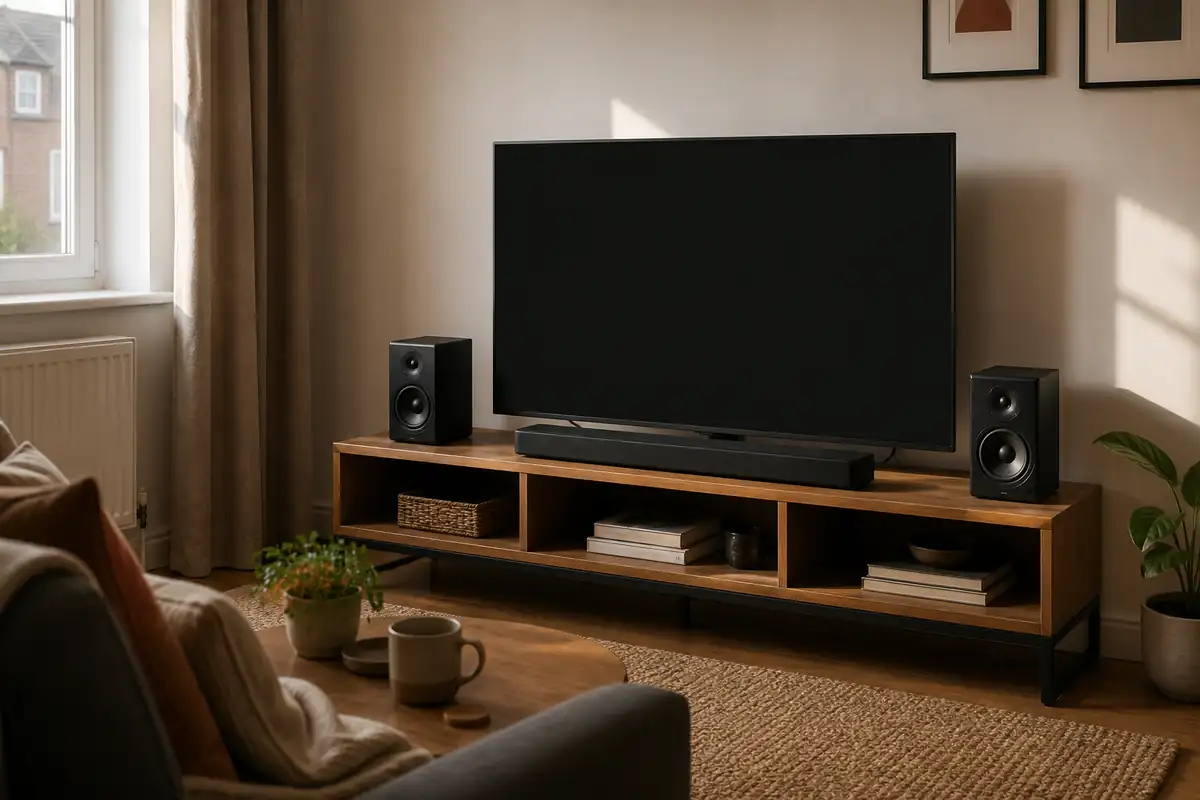
In this guide
Choose a soundbar for effortless TV; choose powered speakers for genuine stereo
A compact soundbar with HDMI ARC or eARC is the safer choice when dialogue clarity, one remote and minimal furniture are the priorities. Choose powered speakers when music matters as much as television and you can position the pair wider than the screen. An active speaker pair with HDMI ARC can combine much of both approaches; optical-only speakers are viable, but volume control and audio-format settings require more care.
Small living rooms are not automatically easy rooms for audio. A sofa may sit against a wall, the television may share a narrow unit with a router and console, and a subwoofer can disturb a neighbour before it sounds cinematic. The best upgrade is the one that fits the available width, connects predictably to the TV and improves the content you actually watch.
Use this guide with our Tech & Audio section and the plain-English guide to product specifications. Neither a Dolby badge nor a large wattage figure guarantees intelligible speech or balanced sound in your room.
Soundbar and powered speakers compared
| Decision | Soundbar | Powered speaker pair |
|---|---|---|
| TV convenience | Usually strongest with HDMI ARC/eARC, CEC and one-unit setup | Excellent if HDMI ARC is fitted; optical models may need their own remote |
| Dialogue | Centre-focused processing and speech modes can help | Creates a phantom centre when seating is central and the pair is positioned well |
| Music | Compact and convenient, but stereo width is constrained by the cabinet | Physical separation can produce a wider stereo image |
| Placement | Needs clear space below the screen; may block a low TV sensor or picture | Needs two stable positions, separation and a cable or power route |
| Bass | Small bars are limited; packages may add a separate subwoofer | Cabinet volume can provide fuller bass; some pairs have a sub output |
| Format handling | Models may decode Dolby formats or create virtual height effects | Many accept stereo PCM; do not assume surround-format decoding |
| Upgrade path | Often tied to the maker’s compatible sub and rear speakers | Some allow a sub; otherwise the pair is usually a self-contained system |
Current UK prices: compare systems that solve the same problem
The following official retailer prices and availability signals were checked on 24 August 2026. They are a market snapshot, not permanent deals, and should be checked again before purchase. We have included products from budget to premium because the connection and layout can matter more than the category name. Postcode-level stock may still differ from the national product page.
| Example | Price and relevant published details | Interpretation |
|---|---|---|
| Majority D80 powered speakers at Argos | £99.95; 80W system; HDMI ARC, optical, RCA, USB, 3.5mm and Bluetooth; 23 × 15.5 × 15.5cm each; postcode check required for stock | An active pair with HDMI ARC reduces the usual TV-control disadvantage |
| Edifier R1280DB powered speakers at Richer Sounds | £119; 42W amplifier; optical, coaxial, analogue inputs and Bluetooth; remote included; online ordering shown | A flexible stereo pair, but no HDMI ARC is listed |
| LG US40TR soundbar package at John Lewis | £231.57; 4.1-channel bar, wireless subwoofer and rear speakers; free delivery from store shown, without collection | More boxes and cables can add immersion while undermining the simplicity advantage |
| Edifier S1000MKII powered speakers at Richer Sounds | £299; 120W amplifier; optical, coaxial, analogue and Bluetooth inputs; online ordering shown | More substantial active speakers for listeners prioritising music and stereo scale |
| Sony HT-S2000 soundbar at John Lewis | £399; HDMI eARC; Dolby Atmos and DTS:X listed; standard delivery and Click & Collect shown | Format support and virtual processing carry a premium, but room geometry still limits the effect |
| Sonos Beam Gen 2 at Currys | £449; Dolby Atmos; HDMI eARC and optical adaptor listed; delivery and collection options shown subject to local stock | A compact connected soundbar whose ecosystem and account dependence belong in the ownership decision |
Compare the complete setup: stands, longer inter-speaker cable, wall mounts, an HDMI cable, subwoofer and delivery can change the answer. See our total-cost-of-ownership method before comparing a bare pair with a soundbar package.
Why a soundbar is usually easier with television
HDMI ARC and CEC reduce remote-control friction
When the television and soundbar implement HDMI ARC or eARC and HDMI-CEC correctly, the TV can send audio back through one HDMI connection and its remote can control volume and power. That is the closest experience to using the TV’s own speakers. Confirm which HDMI socket on the TV is labelled ARC or eARC, enable the relevant settings and test power, mute and volume before hiding cables.
Optical can carry clean digital audio and is useful for older televisions, but it does not provide the same standardised control path. Some TV remotes can be taught to control a bar or a universal remote can help; neither should be assumed. Bluetooth is convenient for a phone but is a poor default TV connection because lip-sync delay, reconnection and volume behaviour vary.
The cabinet keeps dialogue near the screen
A soundbar places its drivers close together beneath the picture. That limits true stereo separation, yet it also anchors speech near the image for several seats. Bars may include a dedicated centre channel or dialogue processing. Those features can help with quietly mixed programmes, but they cannot repair every soundtrack; compression, background music and room reflections still matter.
One unit is easier to accommodate
Measure height as well as width. A tall bar can cover the bottom edge of a low television or its infrared receiver. Wall mounting the TV may solve that but adds cost and work. Also check depth if the bar sits on a narrow mantel or shallow shelf. “Compact” is not a measurement.
Why powered speakers can sound more natural
Physical separation creates a real stereo image
A pair placed to the left and right of the television can reproduce spatial information using actual distance rather than processing inside a single enclosure. Music can feel less confined to the screen, and effects panned across a film have room to move. Aim for broadly symmetrical placement and point the speakers towards the main seating position if the maker recommends it.
The central seat receives a “phantom centre”: identical dialogue information from left and right appears to come from between them. Sit far to one side and that image pulls towards the nearer speaker. A soundbar with a centre-focused layout may therefore serve a wide sofa more consistently, even if the powered pair sounds better in the best seat.
Larger cabinets can deliver useful bass without a subwoofer
Small bookshelf enclosures usually have more internal volume and wider driver spacing than an ultra-slim bar. That can produce fuller mid-bass at ordinary levels. It does not mean every powered speaker has deep bass, and it does not make a published wattage directly comparable with a soundbar. Driver size, cabinet, tuning, distortion limit and listening distance all contribute.
Multiple inputs suit music and other sources
The Edifier example accepts optical, coaxial, analogue and Bluetooth sources, while the Majority example adds HDMI ARC and USB. That can make one pair the hub for a TV, turntable with the appropriate phono stage, streamer or games setup. Wireless quality depends on the codec both devices actually negotiate, as our Bluetooth codec guide explains.
Connections and formats: the checks that prevent silence
Write down the TV model and inspect its audio outputs before choosing speakers. A modern set may offer eARC/ARC, optical and Bluetooth; a monitor may have only a headphone socket. Then check the audio system’s matching input. Adapters can solve some mismatches, but they add power supplies, remotes and possible format limits.
With optical powered speakers, set the TV to a format the speakers accept—often stereo PCM. If the TV sends a Dolby bitstream to a pair that only understands PCM, the result may be silence or noise. A soundbar advertising Dolby Atmos still needs a compatible source and path. Streaming-app output, TV passthrough and HDMI settings all participate. “Atmos” printed on a compact bar describes format handling or virtualisation; it does not promise the discrete overhead-speaker result of a full installation.
eARC provides more bandwidth than ARC and can carry higher-bandwidth formats, but that matters only when the source, TV, content and soundbar all use it. Do not pay for a connection whose benefit your viewing chain cannot deliver. Apply the compatibility-first approach from our future-proof technology guide.
Placement in a genuinely small room
For a soundbar, leave the front and any upward-firing drivers unobstructed. Do not push it inside a cabinet if the instructions expect open space. For powered speakers, avoid burying one behind the television or placing the pair at very different heights. Rear-ported models may need space from the wall; follow the maker’s guidance rather than a universal distance copied from another product.
Hard surfaces produce early reflections that can make dialogue or treble sound sharp. Curtains, a rug and normal furnishings may help without turning the room into a studio. Make one change at a time: position first, TV audio setting second, level or EQ last. If every control changes at once, you will not know what improved the result.
Keep speakers stable and allow ventilation. A powered pair normally contains the amplifier in one cabinet, requires mains power and uses a cable to the second speaker. Measure that cable route before buying; stretching it across a doorway is not a usable installation. Our shortlisting guide provides a simple way to record these non-negotiables.
Bass, neighbours and late-night listening
Low frequencies travel through floors and shared walls readily. A subwoofer can create impact at moderate listening levels, but in a flat it may create more conflict than enjoyment. Before adding one, improve dialogue, move the main speakers away from resonant furniture and try a night or dynamic-range mode. Place a sub on a stable surface and use its level control conservatively.
A bar without a sub can be the more neighbour-friendly choice, but a thin cabinet may tempt you to raise the whole volume to find warmth. Powered speakers with fuller mid-bass can sound satisfying at a lower level, although they too can transmit vibration. Isolation pads may reduce furniture buzz; they do not soundproof a building.
Smart features, privacy and useful life
Wi-Fi streaming, room calibration, voice assistants and multi-room systems can be genuinely useful. They also create reliance on an app, account, network and continuing software support. A basic optical or HDMI system may remain usable long after its streaming platform changes. If smart functions are central, check the supported services, phone requirements, privacy controls and whether ordinary TV audio still works without an account.
Proprietary wireless rear speakers and subwoofers can make expansion tidy, but they constrain future purchases to compatible models. Treat future accessories as a cost only if you realistically plan to buy them. The principles in our online quality-check guide help distinguish an announced ecosystem from a durable ownership benefit.
A fair room test within the return period
- Use the intended connection. HDMI ARC convenience cannot be judged over temporary Bluetooth.
- Match ordinary volume. Louder often sounds more impressive in a quick comparison.
- Play three familiar samples. Use quiet dialogue, a busy scene and music you know.
- Check every normal seat. A perfect centre image may collapse at the end of the sofa.
- Test daily controls. Power, mute, volume, app reconnection and source switching matter every day.
- Keep packaging and settings reversible. Confirm the retailer’s return conditions before mounting anything.
Retailer support and return routes can decide a close comparison. Our Currys review and John Lewis electricals review show which terms to record alongside the hardware.
Simple TV dialogue and tidy control lead
The width, connections and remote behaviour fit the television, and a compact enclosure is preferable to wider stereo placement.
Music and stereo separation matter
The room allows correct left-right spacing and the inputs, volume control and stands fit both television and music use.
Verdict
For a small living room used mainly for television, a compact HDMI ARC soundbar is the default recommendation. It keeps dialogue close to the picture, minimises furniture demands and is most likely to preserve one-remote operation. Choose dimensions and connection first, then sound modes and format badges.
For a room where music matters equally, powered speakers are often the more rewarding purchase. Their physical separation can create stereo scale that a compact bar cannot reproduce. An HDMI ARC pair such as the Majority example narrows the convenience gap; an optical pair remains sensible when you accept a separate remote and verify PCM output. Skip a subwoofer initially, place the main system properly and add bass only if the room and neighbours allow it.
Check current official information:
Currys Sonos Beam ↗John Lewis Sony HT-S2000 ↗John Lewis LG US40TR ↗Argos Majority D80 ↗Richer Sounds Edifier R1280DB ↗Richer Sounds Edifier S1000MKII ↗
If the speakers will be paired with a portable projector, check placement, connections and viewing conditions with our Portable Projectors: Brightness, Streaming, Speakers and Hidden Compromises.
Frequently asked questions
Are powered speakers better than a soundbar for dialogue?
They can produce clear dialogue for a central listener, but the phantom centre shifts when you sit off-axis. A soundbar with centre-focused output or a dialogue mode may serve several seats more consistently. Placement and the programme mix remain important.
Do powered speakers work with any television?
No — The TV needs an output that matches a speaker input, such as HDMI ARC, optical or analogue. For optical, confirm that the speakers accept the TV’s selected output format, commonly stereo PCM.
Is HDMI eARC essential in a small room?
Not for ordinary stereo or many compact soundbars. eARC matters when the entire source-to-speaker chain uses higher-bandwidth formats. ARC can still provide TV audio and CEC control. Buy for verified compatibility, not the newer label alone.
Will a Dolby Atmos soundbar create sound above me?
It may use upward-firing drivers or virtual processing to suggest height, but the effect depends on the bar, ceiling, seating, source and room. It should not be equated with discrete ceiling speakers, especially from a very compact cabinet.
How far apart should powered speakers be?
There is no universal distance. Start with a symmetrical position either side of the TV, broadly aimed at the main seat, and follow the manufacturer’s wall-clearance advice. Increase separation only while dialogue remains centred and each speaker stays safely supported.
Do I need a subwoofer?
Usually not as a first purchase in a small room. Improve placement and live with the main system first. Add a compatible sub only if films or music clearly lack low bass and the building can tolerate it.
How we researched this guide
We checked prices, availability signals and published specifications at Currys, John Lewis, Argos and Richer Sounds on 24 August 2026. We also checked the retailers’ published delivery and return information. We compared connection types, layout, dimensions, published power, format support and included controls. We did not buy, measure or listen to these products, and we make no hands-on sound-quality claim.
Limitations and update policy
Room acoustics and hearing are personal, while prices, postcode-level stock, firmware, streaming services and retailer terms change. Published power figures are not necessarily measured on the same basis. The table is a dated snapshot rather than a promise that a product will remain available. Visit our UK shop-review directory for related retailer research.
Keep volume at a safe level and follow the manufacturer’s placement, ventilation and mounting instructions. Returns may be restricted after installation or damage, so check terms before drilling or discarding packaging.