Soundbars value guide: room fit, dialogue, connections and total cost
A soundbar is good value when it solves an audible problem in the actual room without creating connection, placement or upgrade friction. More channels and louder marketing do not guarantee clearer everyday television.
In this guide
Pay for the room problem you can define
Start with dialogue, listening distance, television connections and placement, then treat channels and immersive formats as secondary evidence. A modest compatible soundbar used daily can be better value than a complex package whose subwoofer, rear speakers or app requirements do not fit the household.
Choose the hardware with the soundbar buying guide, compare soundbars with powered speakers, and coordinate the display using the 4K television guide.
| Need | Evidence that matters | Cost to include | False shortcut |
|---|---|---|---|
| Clear dialogue | Voice processing, centre handling and returnable trial | Soundbar and any required cable | More total watts |
| Small-room television | Width, height, listening distance and controlled bass | Mount or furniture changes | Maximum channel count |
| Immersive films | Source format, eARC, room geometry and speaker layout | Subwoofer or rear kit | A format badge alone |
| Long ownership | HDMI support, updates, replaceable accessories and warranty | Battery remotes and future adapters | Launch-year prestige |
Soundbar value worksheet
- Name the exact listening problem.
- Measure television width and available height.
- Record seating distance and room boundaries.
- Check television HDMI ARC or eARC support.
- List every source and required audio format.
- Decide whether a subwoofer is acceptable.
- Include mounts, cables and optional speakers.
- Keep a dialogue-first returnable test plan.
Define the audible problem before the product tier
Write whether the current problem is quiet dialogue, uneven volume, weak bass, narrow stereo, television speakers firing into furniture or a desire for more cinematic scale. Rank these outcomes because one system rarely maximises all of them at the same price.
Use familiar programmes at ordinary household volume as the reference. A dramatic shop demonstration can reward bass and loudness while hiding whether speech remains clear during news, drama and late-night viewing.
Measure room, television and furniture as one system
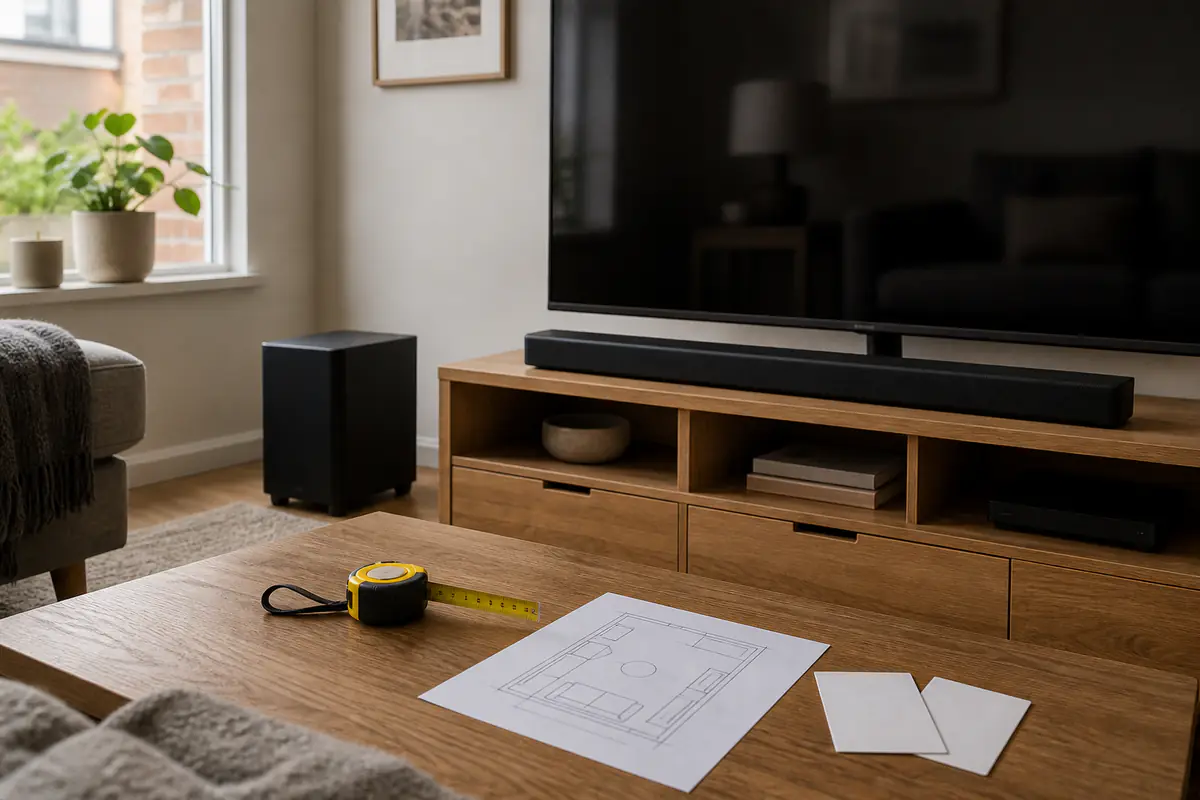
Record television width, stand clearance, wall-to-screen gap, shelf depth, seating distance and nearby corners. A bar that blocks the infrared receiver or picture edge creates daily friction even if its audio specification is impressive.
Note hard surfaces, open doorways and asymmetrical seating. Reflections and room volume influence bass and spatial effects, so a compact enclosed room should not be judged from the same channel promise as a large open-plan space.
Prioritise dialogue at normal listening levels
Look for a dedicated centre channel or credible dialogue processing, but treat labels as prompts for a trial rather than proof. Test several voices, accents and mixes without pushing the volume beyond normal use.
A dialogue mode can help, yet excessive processing may thin music or make effects harsh. Value comes from a setting the household can leave in place, not a feature that needs adjustment for every programme.
Match HDMI ARC or eARC to the source chain
List the television model, ARC or eARC port, streaming apps, set-top box, games console and disc player. The source, television and soundbar must all support the required path for a format to arrive as intended.
Use the signal-chain method to trace source, cable, input, processing and output. A format logo on one component cannot repair a limitation elsewhere in the chain.
Treat channel counts as implementation claims
A number such as 3.1 or 5.1.2 describes intended channels, not guaranteed separation in the room. Driver direction, processing, ceiling height, side walls and seating position affect whether reflected effects are convincing.
Compare the basic bar, bar with subwoofer, and any rear-speaker package as different systems. Do not pay for theoretical channels that the room cannot place or the household will not install.
Decide whether bass hardware fits the household
A separate subwoofer can add scale and reduce demand on small bar drivers, but it needs floor space, power, wireless reliability and neighbour-aware placement. Built-in bass may be sufficient where dialogue and convenience dominate.
Check whether bass can be adjusted independently and whether a night mode is usable. A powerful subwoofer kept permanently low because of neighbours is not automatically better value than a balanced simpler system.
Price optional rear speakers honestly
Some soundbars support proprietary wireless surrounds later. Record their current price, power needs, stands or wall mounts and compatibility with the exact bar generation before calling the system expandable.
An upgrade path has value only when parts remain available and the room has suitable positions. Apply the future-proofing guide rather than paying now for an ecosystem that may never be completed.
Include installation and cable management
Add the correct HDMI cable where genuinely required, wall mount, fixings, trunking, furniture changes and safe power access. Do not run mains leads inside walls or overload extensions to preserve a clean photograph.
Wall mounting should maintain ventilation, service access and secure fixings appropriate to the structure. If professional installation is needed, include it in the comparison before choosing a heavier or multi-part system.
Check controls without depending on a phone
Confirm whether television volume control works through HDMI-CEC, what the supplied remote can change, and whether essential functions remain available without an account or app. Household members should be able to operate basic audio reliably.
Apps can improve setup and updates but add permissions, network and support dependencies. Record whether the product retains useful local controls if the app, router or cloud service changes.
Compare music performance only if it will be used
If the bar will replace a music system, test stereo balance, tonal consistency and connection options with normal listening material. Wide virtual effects for films can be less convincing for music.
A household focused on music may prefer the trade-offs in the powered-speaker comparison. Do not assign value to Bluetooth, multi-room or voice features that no one intends to use.
Build total ownership cost
Use the total-cost-of-ownership guide to include the bar, subwoofer, surrounds, mounts, cables, installation, power, remote batteries and replacement risk. Optional modules should not disappear from the comparison.
Divide cost by credible years and weekly use only after compatibility and repair prospects are considered. A discounted end-of-line ecosystem can be poor value if a failed proprietary speaker or control service cannot be replaced.
Test during the return window without overclaiming
Use the same programmes, seating, volume and settings for each candidate. Check dialogue, quiet scenes, action peaks, music, lip synchronisation, source switching and standby wake-up over several normal sessions.
Preserve packaging and condition, and do not drill permanent fixings until the core system is accepted. Record observable results instead of declaring audiophile quality from a short loud demonstration.
Choose the simplest system that meets the evidence
Score dialogue, compatibility, room fit, control, bass, installation and ownership cost before considering prestige. A simpler 2.1 or 3.1 system can be the stronger result when immersive reflections and rear speakers are impractical.
Browse the Tech & Audio archive for related setup decisions. Recheck firmware support and live connections before purchase because television and audio standards continue to evolve.
Compare warranty and support as part of value
Record the warranty length, who handles it, proof required and whether firmware, remote controls, power supplies and optional speakers remain supported. A technically capable bar is poor long-term value when a small proprietary component cannot be replaced.
Keep the serial, receipt and configuration notes without publishing them. Before a reset or support request, record inputs, settings and symptoms so a compatibility fault can be distinguished from a hardware failure efficiently.
Plan neighbour-aware listening
Bass travels through structures differently from dialogue. Test sensible evening volume and subwoofer placement without assuming a night mode will remove every low-frequency disturbance.
A system that repeatedly creates conflict is poor household value. Controlled bass, isolation guidance and a simpler speaker layout can produce a more usable result than unused maximum output.
What level of soundbar is good value?
Dialogue and convenience are the real needs
A compact compatible system fits the television, works through ARC, stays controllable and improves speech without unwanted bass hardware.
The room and sources support it
eARC, source formats, ceiling and wall geometry, subwoofer placement and optional surrounds are all evidenced and will be used.
Balanced verdict
Soundbar value is the cost of solving the actual room’s audio problem reliably. Prioritise dialogue, connection integrity and placement, then add bass and spatial hardware only when the room and listening habits justify them.
The best-value system is often the least complex one that the whole household can operate every day.
Official checks:
HDMI Licensing Administrator eARC information ↗
Dolby official Atmos overview ↗
Which? soundbar buying information ↗
Frequently asked questions
Is a higher soundbar channel count always better?
No — Room geometry, driver layout, source formats and speaker placement determine whether the additional channels produce useful separation.
Do I need HDMI eARC?
It is useful for some higher-bandwidth formats and simpler source routing, but ordinary ARC may meet a dialogue-focused television setup.
Is a separate subwoofer worth it?
Only when the room, neighbours and listening habits support deeper bass and the extra floor space, power and cost are acceptable.
Can a soundbar replace speakers for music?
It can for casual listening, but test stereo balance and connections. Powered stereo speakers may suit music-first households better.
What costs should be added to a soundbar price?
Include subwoofer or surrounds, mounts, cables, installation, power, remote batteries and the risk of proprietary replacement parts.
Methodology and limitations
We assessed soundbar value through room geometry, dialogue, connection chains, channel implementation, bass, optional surrounds, installation, controls, music use, ownership cost and a repeatable home trial. We did not conduct laboratory audio measurements.
Limitations
Room acoustics, hearing, television firmware, source formats and product support vary. Confirm live compatibility, dimensions, update policy, warranty and retailer return terms before purchase.