Heat-pump tumble dryers buying guide: capacity, labels, programmes and drainage
Heat-pump technology can reduce standardised electricity use, but the right machine still depends on load pattern, cycle time, room conditions, filters, drainage and a complete installation plan.
In this guide
Buy around the laundry workflow, not the technology badge
Match the dryer to realistic wet loads, compare the exact energy label and product sheet, and check programme capacity, installation temperature, drainage and filter work. Measure the packaged delivery route as well as the operating space.
A heat-pump dryer recirculates warmed air and recovers heat rather than relying on a simple high-temperature exhaust route. That can improve energy performance under standardised conditions, but it does not make every model interchangeable. Capacity, cycle length, sensing, room limits and maintenance determine whether the efficiency survives ordinary ownership.
Use specifications as evidence, not promises
| Evidence | Useful question | Common mistake |
|---|---|---|
| Rated capacity | Will normal washed loads fit without splitting? | Assuming every programme accepts the maximum. |
| Energy label | How does the exact model compare under the test? | Treating it as an exact household bill. |
| Programme data | What load, duration and dryness target apply? | Comparing only programme names. |
| Noise | Is placement compatible with living space? | Ignoring floor, cabinet and vibration. |
| Dimensions | Is there clearance for door, airflow and service? | Using cabinet depth alone. |
Audit loads before choosing capacity
Count a normal week of towels, bedding, cotton, synthetics, sportswear and delicate items. Note what is actually tumble-dried and what remains line-dried. The washer’s kilogram rating does not guarantee a like-for-like dryer load because textiles retain different water amounts and dryer programmes may set lower limits.
A dryer large enough for the typical wash avoids awkward splitting, but spare headline capacity has no automatic value. Check duvet and bulky-item instructions separately. The washing-machine capacity guide helps align the two appliances without assuming their drums perform the same job.
Read the exact energy label and product sheet
Match model codes across the retailer listing, manufacturer page, label and product information. Standardised data is useful for comparing models tested on the same basis. It cannot predict an annual bill without the household’s loads, programme mix, tariff and drying target.
Use the method in our appliance running-cost guide and energy-label guide. Avoid multiplying one optimistic cycle figure by an invented number of loads. If a retailer and manufacturer display different model suffixes, resolve the discrepancy before comparing.
Measure the whole installation
- Cabinet: width, height and depth at front, middle and rear.
- Door: complete swing, loading stance and nearby cupboard conflicts.
- Clearance: the manufacturer’s stated ventilation and service space.
- Socket: an appropriate connection accessible without unsafe extensions.
- Floor: level, stable and suitable for the loaded appliance.
- Room: operating temperature and moisture conditions within instructions.
Do not place a dryer in a garage, cupboard or unheated space merely because it physically fits. Heat-pump performance and safe operation depend on the manufacturer’s environmental and clearance requirements. Stacking needs the approved kit and compatible models, not an improvised shelf.
Plan drainage and tank emptying
Many dryers collect condensed water in a removable container and some permit a drain connection. Check what is supplied, hose length, routing requirements and whether the installation service includes drainage. A tank that is awkward to lift may become daily friction for some users.
Drain hoses must follow the exact instructions without kinks, insecure joints or an unsuitable waste connection. If professional plumbing or electrical work is required, include it in the delivered cost. Keep isolation and filter access available after furniture is returned.
Compare programmes using the manual
Record maximum load, target dryness, approximate duration and option restrictions for the cycles likely to be used. A quick, wool, duvet or shirts programme may accept far less than rated capacity. Sensor drying can reduce unnecessary running when the load and installation support it, but a named sensor does not prove perfect results on mixed fabrics.
Follow garment labels. Heat-sensitive coatings, foam, rubber-backed items and products contaminated with oils may be unsuitable or hazardous. Do not use a general “delicates” name as permission to ignore textile or dryer instructions.
Decide whether longer cycles fit the household
Heat-pump dryers often work at lower temperatures and cycle length may differ from older designs. Compare the complete workflow rather than assuming longer is worse: lower-temperature drying may be valuable, while an appliance needed for several rapid consecutive loads may create a bottleneck.
Look at time-to-end display, delay controls, anti-crease behaviour and the consequences of pausing. Connected notifications may be convenient, but app support and accounts should not be essential to safe basic use. Our total-cost guide helps weigh time, electricity and service together.
Maintenance is part of efficiency
Identify every lint filter, heat-exchanger area, sensor and water container in the manual. Check how often each needs attention, whether parts are removable and how delicate fins are protected. A “self-cleaning” claim still needs precise instructions and does not mean maintenance-free.
Blocked airflow, ignored filters or unsuitable cleaning can impair performance and safety. Choose a design whose routine the household can complete. Ask about guarantee scope, call-outs and spare parts, using our repairability guide.
Plan delivery, installation and old-appliance collection
Measure gates, doors, stairs, lifts and turns against packaged dimensions. Confirm threshold versus room-of-choice delivery, unpacking, stacking, connection, test, packaging removal and WEEE collection separately. Our delivery-access checklist prevents the most avoidable failures.
Compare retailers only after adding every service. The AO versus Currys large-appliance comparison shows why installation and recycling must be verified at the basket and postcode, not inferred from a help-page headline.
Check sensor and dryness controls against real fabrics
Sensor programmes estimate moisture under stated conditions, but mixed weights and fibres can finish unevenly. A thick waistband or towel edge may remain damp while lighter pieces are ready. Check whether the machine lets the user choose cupboard, iron or extra-dry targets and whether that setting is available on the intended programme.
Do not repeatedly overdry an entire load to finish one heavy item. Sorting by fabric weight, removing ready pieces or using a timed finish where permitted may be more appropriate. Follow textile labels and the manual; no sensor name guarantees protection from shrinkage, heat damage or tangling.
Compare ownership support before the guarantee headline
Record who provides the guarantee, how faults are reported, whether labour and call-out are included, and what happens when a repair is not economical. A long headline term may exclude parts, wear items, filters or unauthorised installation. Registration requirements and proof of purchase should be clear.
Look for accessible manuals, fault-code explanations and a parts route before buying. Keep model and serial evidence, installation records and maintenance dates together. If performance deteriorates, check permitted maintenance first but do not open sealed systems or bypass safety devices.
Which route fits?
Frequent drying justifies the complete ownership plan
Loads, room conditions and maintenance suit the model, and lower standardised energy use outweighs price and cycle-time trade-offs.
Placement or workflow conflicts with the manual
The room is unsuitable, service access is poor, filters are impractical or urgent back-to-back loads dominate.
Balanced verdict
Ask for the final basket in writing when installation, stacking, drainage or collection is involved. Record which work is included, which site conditions can cause refusal and whether a failed service changes delivery or return charges. These details are part of the appliance decision, not optional administration after purchase.
Compare the laundry area after a normal week as well as on a tidy showroom-style day. Baskets, doors and cleaning access need permanent space, and the household must be able to reach the filter and tank without moving heavy furniture. A technically efficient dryer that is awkward to maintain is unlikely to keep performing as intended.
Before payment, place the model code, rated capacity, label data, regular programme duration, dimensions, clearance, drainage route and service package on one page. This prevents a similar-looking variant or incomplete delivery option entering the basket. Recheck that the door hinge and control access suit the final position, especially when the machine will sit beside a wall or beneath a counter.
A heat-pump dryer is a strong route when its documented capacity, room limits, programmes and maintenance fit the household. Technology type alone cannot rescue a bad installation or unrealistic load plan. Compare the exact label, manual and delivered service, then retain the evidence with the receipt.
Read our tumble-dryer types comparison, browse Home & Kitchen and check retailer profiles.
Check current official sources:
GOV.UK energy labelling guidance ↗
Electrical Safety First tumble-dryer guidance ↗
GOV.UK electrical waste guidance ↗
Frequently asked questions
Does a heat-pump dryer need a vent?
It does not use an external exhaust vent like a vented dryer, but it still needs the placement and clearances specified by its manufacturer.
Can it go in a garage?
Only if the exact manual permits the environmental conditions. Low temperatures and moisture can be incompatible with correct operation.
Should dryer capacity match washer capacity?
Use actual wet loads and programme limits. Equal headline kilograms do not guarantee every washer load suits every dryer cycle.
Is a drain hose always included?
No. Check the exact model contents, compatible accessories and installation scope.
Does self-cleaning mean no filter work?
No. Follow every stated lint, sensor, tank and exchanger instruction for the specific model.
Methodology and limitations
We assessed heat-pump dryers through loads, standardised labels, programmes, installation, drainage, cycle workflow, maintenance, repair and delivery. Official UK sources were checked on 30 August 2026. No named machine was laboratory tested.
Limitations
Models, labels, services and prices change. Recheck the exact product sheet, manual and retailer basket before purchase.
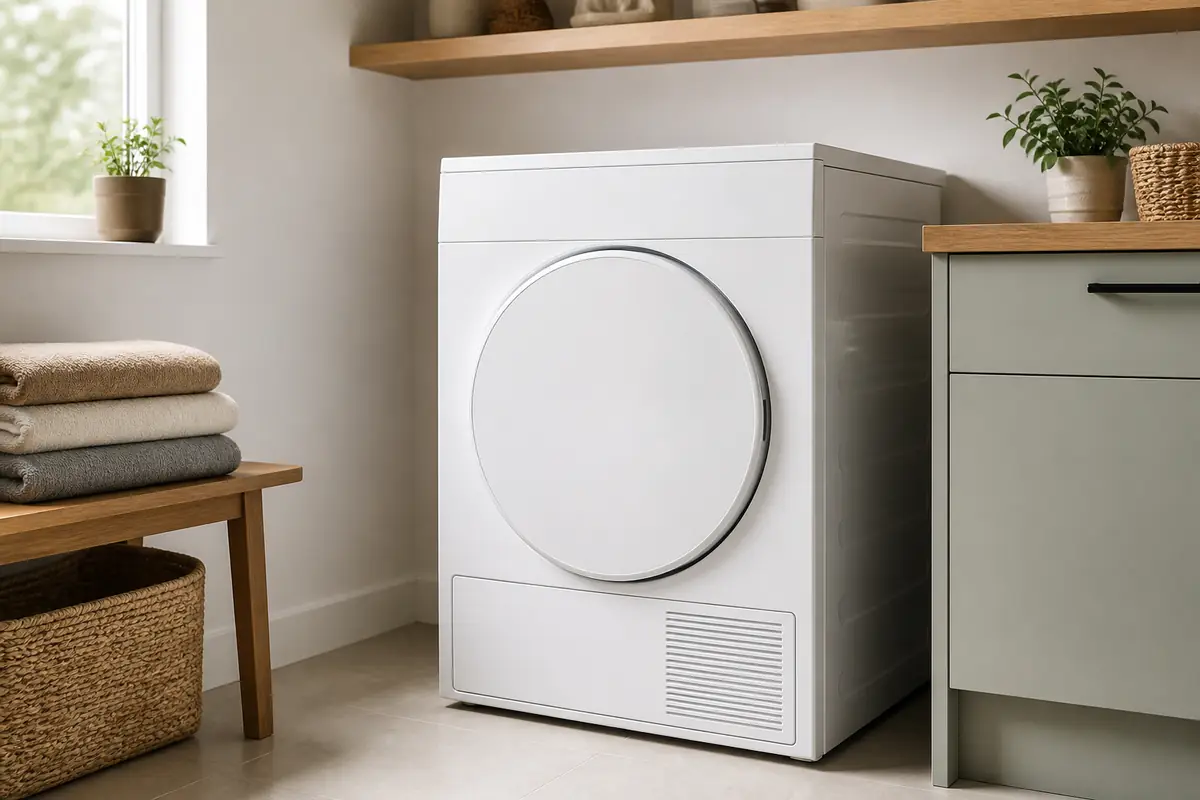
The image is an editorial illustration, not a photograph from a product test. Links are editorial and non-affiliate.