Large-appliance delivery access: doors, stairs, flooring and handover
An appliance can fit its final space and still fail to reach it. Measure the complete delivery route, confirm what the crew will move or disconnect, protect surfaces and agree what must be checked before the team leaves.
In this guide
Measure the tightest turn, not only the narrowest doorway
Record packaged and unpackaged dimensions, every clear opening, stair width, landing depth and the final service gap. Send unusual access details to the retailer in writing before dispatch. Never rely on a delivery crew to remove doors, lift over unsafe obstacles or improvise plumbing and electrical work that was not included.
Delivery access is part geometry and part service contract. The product page describes an object; the retailer’s delivery terms describe what people will attempt. Both must work. A few centimetres of theoretical clearance are not enough when handles, hinges, packaging, turning radius and safe grip space are added.
Build a route survey from vehicle to final position
| Route point | Measure or record | Hidden constraint |
|---|---|---|
| Parking and entrance | Distance, steps, permits, gates and entry time restrictions. | Vehicle cannot stop safely or concierge access is unavailable. |
| External and internal doors | Clear width and height with the door fully open. | Handle, closer, threshold or fixed security furniture reduces clearance. |
| Hall and corners | Corridor width, diagonal turn and opposing wall distance. | A long appliance cannot rotate despite fitting the door. |
| Stairs and landing | Narrowest width, headroom, tread turn and landing depth. | Banister, light fitting or low ceiling removes hand space. |
| Final recess | Width, height, depth, ventilation and door swing. | Pipes, sockets, skirting or worktop lip occupy the nominal space. |
| Connections | Type, location, isolation and reach. | Included service excludes alteration, extension or unsafe existing fittings. |
Use clear openings, not frame-to-frame guesses
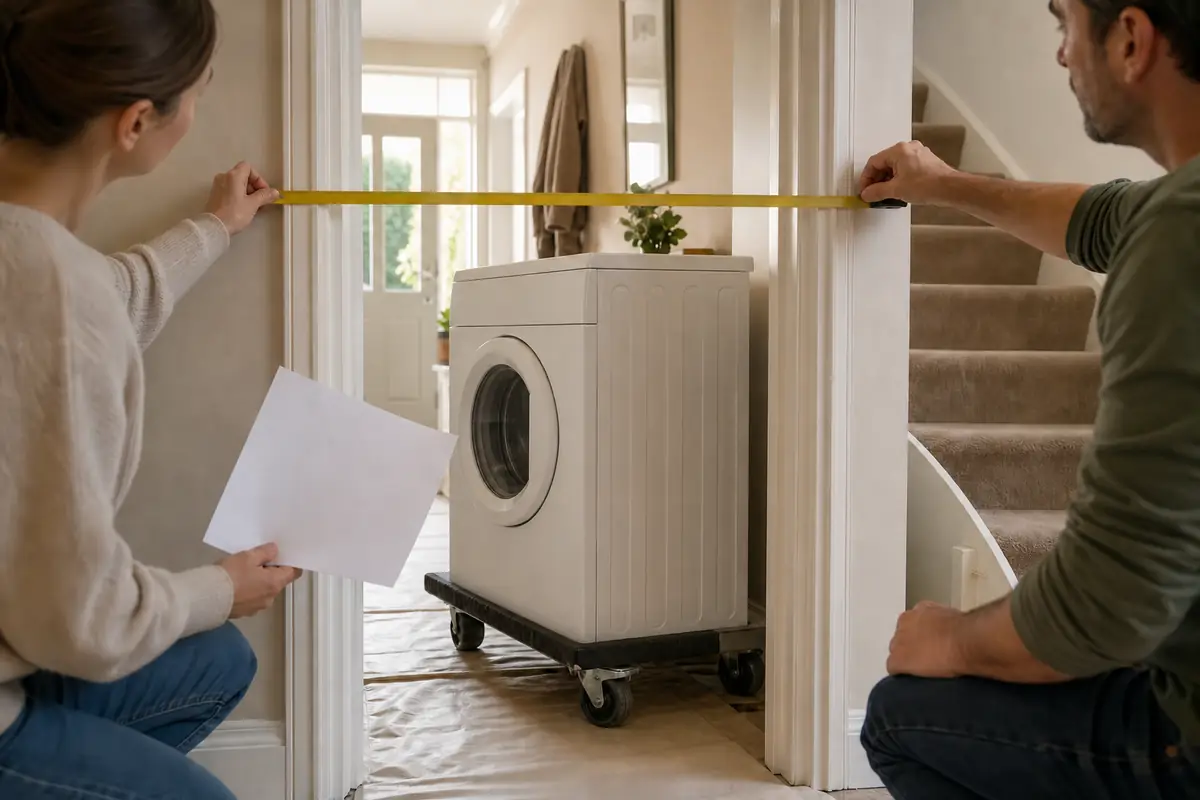
Measure between the points the appliance will actually pass when the door is held at its maximum usable angle. Include protruding handles, locks, radiators and fixed furniture. If a removable door would solve access, ask who may remove and refit it, whether that is included and whether doing so affects fire, security or lease requirements.
Repeat each critical measurement and photograph the tape position for your own record, keeping numbers private where they reveal home details. Our dimensions and tolerances guide explains why quoted product width is not the same as required clearance.
Check the turning envelope
A rectangular appliance moving around a corner sweeps a larger space than its width. Mark the product footprint on cardboard or use taped floor lines, then model the route without blocking an exit. The diagonal can help at a door but becomes a problem under a low ceiling or pendant light.
- Write packaged dimensions separately. Some crews will not unpack outside or before a difficult route.
- Record every change of level. A single threshold can stop a trolley or tilt a tall fridge.
- Measure hand space. Safe handling needs room beyond the bare product outline.
- Remove only agreed obstacles. Clear rugs, small furniture and fragile items; do not alter building fabric casually.
- Protect the route. Use suitable clean coverings that do not create a slip or trip hazard.
- Keep children and pets away. The delivery path must remain controlled throughout the handover.
Final-space dimensions include operation and maintenance
Allow the manufacturer’s ventilation clearances, hose bends, plug access and levelling adjustment. Check whether a fridge door can open far enough to remove drawers, whether a washer detergent drawer clears a worktop and whether an oven door conflicts with a nearby handle. A product that enters the recess but cannot be serviced is not a successful fit.
Compare the exact model drawing rather than a category average. Include future filter, tray and hose access in the ownership plan. Our guides to appliance repairability and total ownership cost help assess what happens after installation.
Confirm the delivery service in writing
“Delivery”, “room of choice”, “installation” and “recycling” are different services. Check floors covered, stair limits, access exclusions, unpacking, packaging removal, disconnection of the old unit and whether the crew will reverse appliance doors. Ask what happens if access is judged unsafe and whether a failed-delivery charge applies.
Tell the retailer about tight stairs, upper floors without a lift, restricted parking, rural access, timed entry, unusually long carries and delicate flooring. A note left only for the driver at the door is too late. If buying through a marketplace, establish which trader controls fulfilment.
Connections are not a DIY afterthought
Check the model’s electrical, water, drainage, gas and ventilation requirements before purchase. Do not assume a nearby socket, valve or outlet is suitable. Gas work must be done by an appropriately registered engineer, and electrical work may require a competent installer under applicable rules. A delivery crew should not be pressured to connect unsafe or incompatible services.
For washers and dishwashers, inspect the route and final floor for leaks after the first permitted cycle. For refrigeration, follow the manufacturer’s standing-time and start-up instructions after transport. Keep the manual and model details accessible without leaving personal order papers on display.
Handover checks before the crew leaves
Inspect the exterior in good light, check the model identifier against the order and record visible transit damage before signing an unqualified acceptance where possible. Confirm accessories and documents without dismantling the product. If installation was included, ask for a demonstration of isolation points and basic operation appropriate to the service.
Do not sign “received in good condition” without reading it. A signature does not necessarily remove statutory rights, but a clear contemporaneous note strengthens the evidence. Keep a dated set of overview and detail photographs with the order record, then use our proof-of-purchase guide if the original receipt is missing.
What if access fails?
Ask the crew to state the specific unsafe or impossible point and record it without obstructing them. Do not demand risky lifting. Contact the retailer while the product remains controlled and establish redelivery, a different service, an alternative model or cancellation rights. Responsibility and charges depend on the information supplied, the service terms and the facts.
If delivery is late, damaged or disputed, follow the retailer complaint framework and check current UK consumer rights.
Create a one-page delivery brief
Put the order model, service level, contact method and unusual access facts on one page for the household—not on a public door or visible window. Include where the crew may stop, which entrance to use, floor level, lift dimensions, number of steps, narrowest turn and whether building management has imposed a time window. Add photographs only when they clarify a route and do not expose security arrangements unnecessarily.
Compare that brief with the retailer’s written acknowledgement. If the retailer has not confirmed an upper-floor carry, packaging removal or installation, treat it as unresolved. Verbal reassurance from a sales conversation is difficult to use later unless it is reflected in the order. Ask for the service description or confirmation by email and retain it with the receipt.
On the day, keep the route clear but do not leave doors insecure in advance. Nominate one adult to handle questions and another only if genuinely needed; a crowd makes heavy handling harder. Have the isolation points accessible, yet leave disconnection to the agreed competent person. This preparation reduces delay without transferring the retailer’s safety decisions to the customer.
Which delivery plan is appropriate?
The route is level, clear and generously sized
The written service covers the intended room, connections are already compliant and the packaged product has ample turning clearance.
Stairs, turns or services are uncertain
A heavy or tall product must negotiate tight geometry, building controls apply, or installation needs more than a straightforward approved connection.
Balanced verdict
A route survey is as important as measuring the final gap. The best plan records the packaged object, every turn, the crew’s working space and the exact service purchased. Escalate uncertainty before dispatch; do not convert a preventable measuring problem into an unsafe doorstep negotiation.
Before ordering, use our shortlisting method and browse more Home & Kitchen guidance or the shop directory.
Check current official guidance:
HSE manual-handling guidance ↗Gas Safe Register home guidance ↗Citizens Advice service complaints ↗
Frequently asked questions
Should I measure the appliance with packaging?
Yes. Confirm both packaged and unpackaged dimensions and when the delivery service is willing to remove packaging.
Will delivery crews remove internal doors?
Do not assume so. Check the exact service and arrange authorised removal separately if necessary.
Is “room of choice” the same as installation?
No. Positioning, connection, testing, door reversal and old-product removal may be separate services.
How much spare clearance is enough?
Follow the exact manufacturer and retailer requirements; add handling and turning space rather than relying on a universal allowance.
What should I do about visible delivery damage?
Record it promptly, note it at handover where possible and contact the retailer with the order and evidence.
Methodology and limitations
We mapped large-appliance delivery through access geometry, service scope, connections, surface protection and handover evidence. Official UK handling, gas-safety and consumer guidance was checked on 29 August 2026. No property or delivery service was surveyed.
Limitations
Buildings, products, leases and retailer services differ. This is not structural, electrical, gas or manual-handling advice. Use the exact model drawing, retailer terms and qualified trades where required.
The image is an editorial illustration, not a photograph from a product test. Links are editorial and non-affiliate.