Heat-pump tumble dryer ownership guide: filters, cycle time, safety and repair
Record the exact model and check current safety notices before routine use. Clean every user-accessible filter at the specified interval, protect airflow, load by programme and investigate a change in heat, smell, sound, moisture or cycle time instead of adding repeated extra cycles.
In this guide
Model checks come before maintenance tips
In 2026 the UK product-safety service carries an urgent modification programme for specified heat-pump tumble dryers, with owners of affected or uncertain models directed to stop use and contact the manufacturer. A clean filter does not override a recall or corrective action. Verify model and serial first.
For technology choice before purchase, see our heat-pump dryer guide and dryer-types comparison. This ownership guide cannot replace a safety notice, manual or competent engineer.
| Symptom | Check without dismantling | Escalate when |
|---|---|---|
| Longer cycle | Load, programme, filters, moisture sensor and room conditions | Change persists after permitted care |
| Damp laundry | Fabric mix, load, spin, sensor setting and tangling | Heating, drainage or airflow appears faulty |
| New smell | Stop and identify lint, drain or electrical category | Burning, smoke or electrical concern |
| Water issue | Tank seating, drain hose and documented route | Leak reaches electrics or source is unknown |
| New noise | Load objects, level and programme stage | Scrape, bang or fan strain repeats |
Verify model and safety status
Photograph the rating plate, model, serial, purchase and installation. Search the official UK safety service and manufacturer notices by exact identifier. Register the appliance where the maker offers it so corrective information can reach you.
If an official notice says stop using the machine, do so. Do not wait for smoke, finish one last load or assume a different colour is excluded. Contact the published programme route and retain its reference.
Before every drying session
- Check the appliance is not subject to a safety action.
- Empty pockets and remove items unsuitable for tumble drying.
- Use the programme and maximum load stated for the fabrics.
- Clean required filters by the exact method and refit fully.
- Confirm air paths and required room clearance are open.
- Seat the water tank or drain route correctly.
- Stop for burning smell, smoke, severe heat or abnormal noise.
Filters are a system
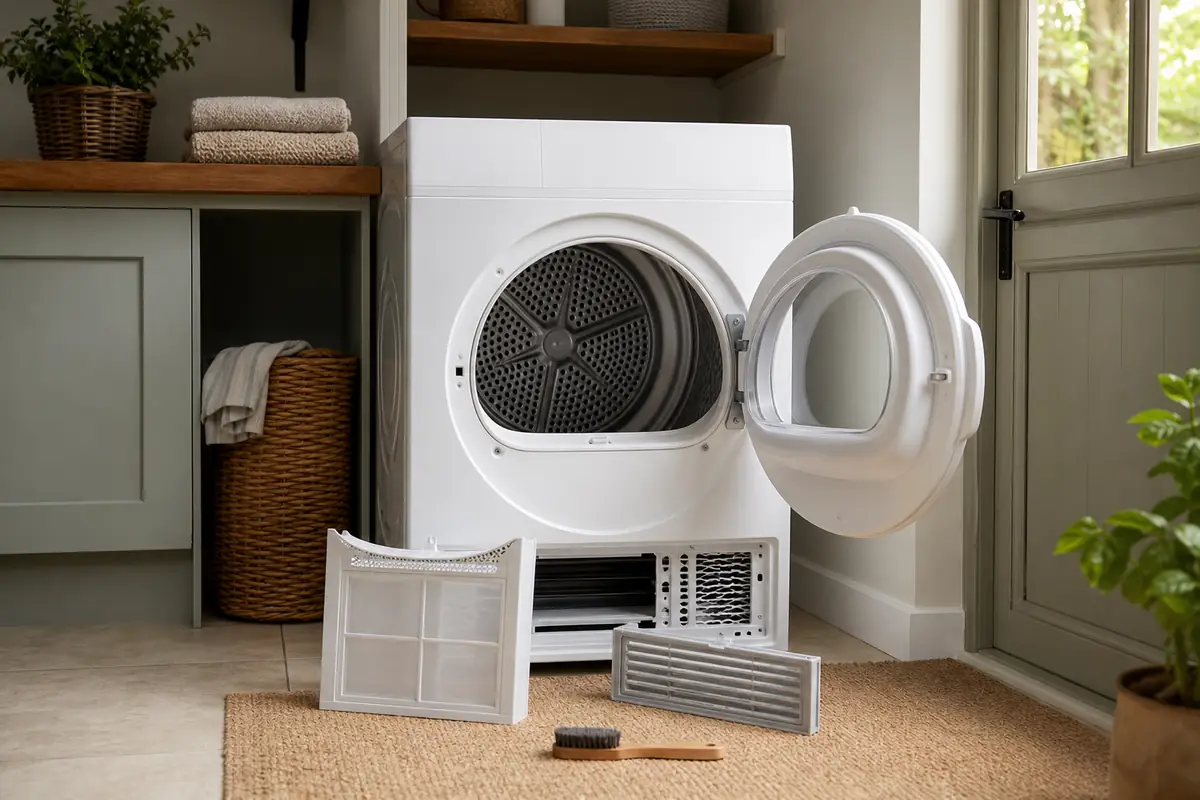
Heat-pump models may have door filters, lower filters, foam elements or user-accessible heat-exchanger care with different intervals. Follow the manual. Removing visible lint from one screen does not prove the complete user-maintenance route is clear.
Clean with the specified dry or water method and let washed parts dry fully before refitting. Do not run without filters, pierce mesh or use a vacuum on delicate parts unless permitted. Never open a sealed refrigerant system.
Prepare laundry for efficient drying
Use an appropriate washer spin for the fabric so the dryer is not asked to remove avoidable water. Separate very heavy and very light items where mixed loads confuse sensing. Untangle sheets and close duvet covers as care labels advise.
The drum’s headline capacity does not apply to every programme. Leave room for tumbling and check individual garment labels. Oil, solvent, foam, rubber-backed and heat-sensitive items can create serious hazards and may be prohibited.
Long cycles are not automatically faults
Heat-pump dryers often operate at lower temperatures and can take longer than vented or condenser expectations. Sensors adjust duration as moisture changes. Room temperature, load mix, initial wetness, filter condition and selected dryness all affect time.
Create a normal baseline using similar loads. Record programme, weight estimate, washer spin, room condition, displayed time and actual finish. A repeated change under comparable conditions is more useful to an engineer than “it takes ages”.
Keep sensors and drum surfaces clean
Fabric conditioner and residue can affect moisture sensing. Clean only the user-accessible sensor and drum areas by the manual’s method. Do not sand, scrape or apply household solvent. Check pockets for crayons, adhesive and metal objects before drying.
If residue transfers to clothing, stop and identify it. Repeated hot wiping can damage coatings. Keep photographs and ask the maker or engineer about the exact surface.
Manage condensate safely
Empty and seat the water container as directed, or inspect the approved drain hose for kinks and secure connection. Water near electricity requires caution. Do not continue operation to watch a leak develop.
Clean spills, isolate safely and report whether leakage appears during the cycle, emptying or after standing. Household plumbing and appliance condensate faults need different repairs.
Ventilation still matters
A heat-pump dryer does not exhaust a traditional vent hose, but the appliance and room still have clearance and ambient-temperature requirements. Do not pack cupboards around vents or store lint and laundry against the case.
Keep the floor level and firm. A decorative cover, thick mat or closed door can alter airflow or access. Follow installer and manufacturer instructions for under-counter or cupboard locations.
Use a maintenance rhythm you can prove
After each load, remove lint from the user-cleanable filter exactly as the manual describes and check that it is seated correctly. Empty the condensate tank when the machine is not plumbed to drain. Monthly—or at the manual’s interval—inspect the second filter or heat-exchanger access area without bending fins, forcing covers or introducing water where it is prohibited. Record the date and any unusual lint, odour or moisture.
Every few months, check the plug, accessible cable, door seal, drum and ventilation clearances. Vacuum only accessible lint with the appliance isolated and never remove service panels. A maintenance log helps distinguish gradual loss of performance from a sudden fault and gives an engineer useful context.
Troubleshoot drying results in a safe order
First confirm the appliance is not subject to a safety action and that no warning tells you to stop use. Then check load type, spin speed, programme, filter seating, condensate tank and room conditions. Separate heavy towels from light synthetics and untangle bedding. An overloaded mixed load can remain damp in places; a very small load may not contact moisture sensors consistently.
If time or energy rises repeatedly with comparable loads, clean only the parts authorised in the manual and repeat one controlled load. Record programme, load weight or composition, start condition and outcome. Do not keep resetting a breaker, bypassing a warning or running an appliance that smells hot, sparks, smokes or makes a new mechanical noise.
Prepare for an engineer visit
Have the full model, serial number, purchase record, displayed error and maintenance history ready. Photograph the installation clearances and drainage arrangement without opening the casing. Describe whether the problem occurs on every programme or only particular loads. This avoids vague “not drying” reports and helps establish whether the cause is installation, maintenance, sensor behaviour or a component failure.
Ask for the diagnosis, proposed part, total quote and warranty on the repair in writing. For a machine within rights or warranty, contact the responsible seller or provider before authorising an unrelated repair that could complicate the claim.
Repair or replace?
The fault and support route are clear
The model is not awaiting mandatory action, safe diagnosis is available and parts and labour can restore dependable operation.
Safety or sealed systems are compromised
An official notice applies, burning or electrical signs occur, leaks threaten electrics or repair cannot restore safe performance.
Engineer evidence and spare parts
Record codes before resetting. Note whether the compressor, fan, drum, pump or heater stage appears to start without opening panels. A competent engineer can use model, programme and symptom stage to prepare.
Ask about call-out, diagnosis, part, labour warranty and sealed-system competence. Use our appliance repairability guide to compare a defined repair with replacement without assuming energy savings alone repay a new machine.
Energy use in context
Energy-label data compares products under standard methods. Your result depends on water remaining after washing, load, programme, sensor target and maintenance. Avoid over-drying; choose cupboard or iron dryness for the actual next step.
One correct full load may be more efficient than several small cycles, but overloading impairs tumbling. Air drying can complement the machine when indoor moisture can be managed; see our laundry moisture guide.
Decide whether the problem is the machine or the laundry system
Compare the dryer with upstream conditions. A washing machine leaving items unusually wet, a low spin speed chosen for a mixed load, densely folded bedding or a cold utility space can lengthen drying without proving a dryer fault. Our tumble-dryer types comparison explains why heat-pump cycles normally trade lower-temperature drying for more time, but the manual remains the authority for the exact model.
Use two comparable loads and change only one variable at a time. Record the washer spin, approximate load, programme, filter condition, room condition and final dryness. If performance improves after correcting preparation or maintenance, keep monitoring. If it does not, or if new noise, heat, smell, leakage or an error appears, stop experimentation and use the authorised support route. Never use repeated unattended runs as a diagnostic method.
Balanced verdict
Safe ownership starts with exact model verification, then filter, airflow, load and cycle evidence. Longer operation can be normal for heat-pump technology, while new burning smell, smoke, leakage or severe noise is not.
Follow corrective actions immediately and maintain only user-accessible parts. Browse Home & Kitchen for related appliance guidance.
Official safety checks:
UK product recalls and alerts ↗2026 heat-pump dryer corrective action programme ↗GOV.UK energy-labelling guidance ↗
Frequently asked questions
Why does a heat-pump dryer take longer?
Lower-temperature operation, sensing, load, initial moisture and room conditions all affect time.
Can I use a recalled dryer if filters are clean?
No — Follow the official corrective action, including stop-use instructions, for the exact model.
Should I wash dryer filters?
Only when the manual specifies how, and refit them fully dry.
Can I clean the heat exchanger myself?
Clean only the heat-exchanger area that the model manual explicitly identifies as user-accessible, using its stated method; refrigerant pipes and service-only covers belong to a competent engineer.
Is damp laundry always a fault?
No — Check load, fabric mix, washer spin, setting and filters; investigate a persistent change.
Methodology and limitations
We assessed model safety, filters, loads, sensing, condensate, ventilation, cycle evidence, energy and repair using current UK safety and energy sources. No dryer was opened or electrically tested.
Limitations
Designs and active safety programmes vary. Exact official notice, manual and competent engineer take priority.