Washing machines buying guide: drum size, labels, programmes and dimensions
A larger kilogram claim is not automatically a better machine. Match real loads, space, access, label data, programme limits and service arrangements.
In this guide
Buy for the regular load and the complete installation
Measure the route and installation bay, inventory typical weekly loads and compare the energy label and product sheet for the same model code. Check capacity limits for the programmes actually used, not only the cotton maximum. Include delivery, connection, removal and repair access in the decision.
Washing machines combine a headline capacity with dozens of constraints: the drum may take its maximum only on selected programmes; the cabinet can be deeper than its nominal depth once hoses and door are included; and a quick cycle often accepts a smaller load. The best choice is the machine that fits the home and completes ordinary washing predictably.
Translate specifications into household decisions
| Evidence | What it tells you | What it does not prove |
|---|---|---|
| Rated kg | Maximum dry textile load under stated conditions | Capacity on every programme. |
| Energy label | Standardised efficiency and cycle information | Your exact annual bill. |
| Spin class | Standardised residual-moisture performance | Quietness or fabric gentleness. |
| Noise figure | Declared airborne sound for the labelled stage | Vibration on your floor. |
| Programme list | Available control routes | Full load, duration or results on every fabric. |
| Cabinet dimensions | Body envelope | Hose, plug, door and service clearance. |
Start with a seven-day load audit
Count separate cotton, synthetic, delicate, bedding, sports and hygiene-sensitive loads for a normal week. Weigh two representative dry loads if practical. Note items that fill the drum by volume before reaching a large mass, such as duvets, and check their care labels and the manufacturer’s programme guidance.
The comparison in our 8 kg, 9 kg and 10 kg guide helps convert household patterns into a shortlist. Spare capacity can reduce awkward splitting, but a consistently half-empty large machine is not automatically efficient.
Read the energy label as a standardised test
Match the model code on the machine, retailer page, energy label and product information sheet. Current labels use an A-to-G scale and include standardised consumption and performance data. Compare like with like and keep the sheet with the purchase record.
The labelled figures support comparison; they do not predict a household using different temperatures, loads, options or tariffs. Use the appliance running-cost method and the broader energy-efficient appliance guide without inventing an annual saving.
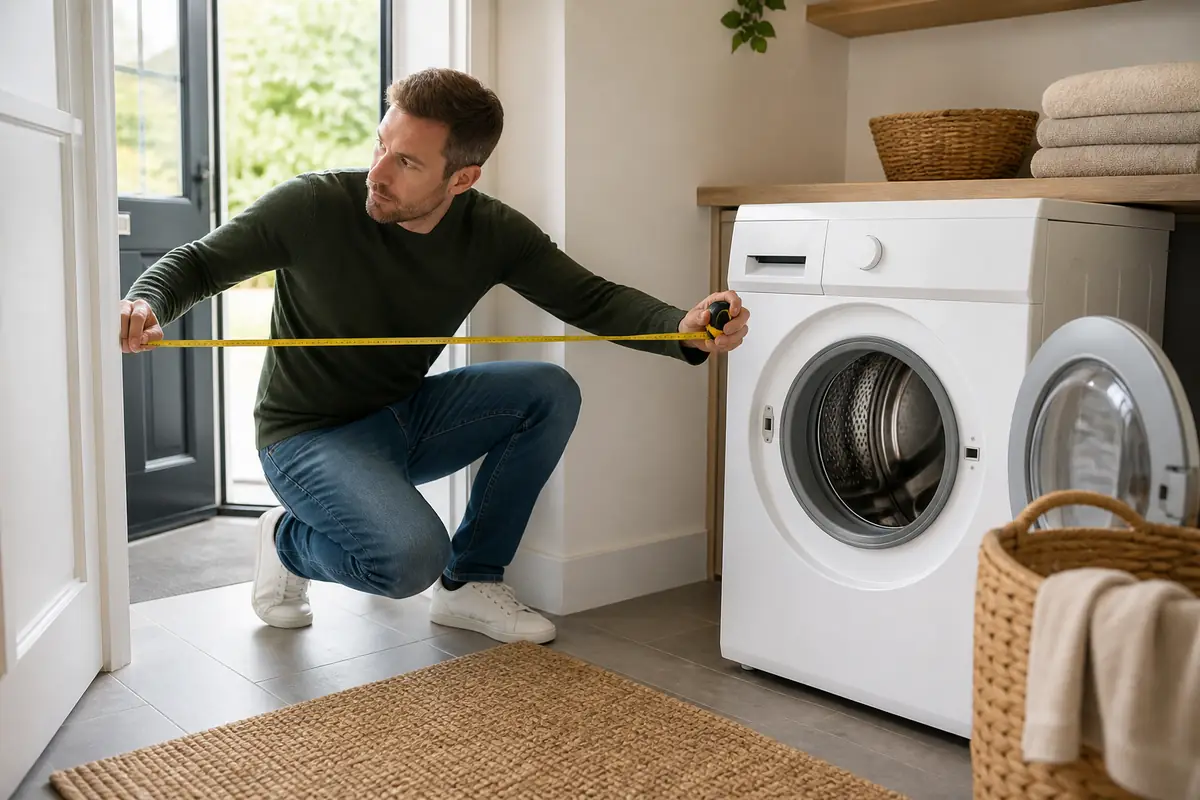
Measure the bay, connections and full door
- Width: measure at front, middle and rear, including uneven walls.
- Height: check worktop, flooring and adjustable-foot range.
- Depth: include hoses, plug, valves, cabinet projection and door.
- Door swing: test loading space, nearby doors and baskets.
- Connections: locate approved water, waste and electrical points.
- Service access: preserve room to isolate, inspect and remove the machine.
Never assume a “standard” bay is square. Photograph and record the narrowest dimensions, skirting and pipes. Freestanding and integrated machines have different furniture, hinge and ventilation requirements. Installation must follow the exact instructions and applicable professional advice.
Walk the delivery route
Measure entrances, turns, stairs, lifts and internal doors against the packaged dimensions when available. Identify parking, access restrictions and whether the carrier removes packaging or an old machine. A product that fits the bay but cannot pass the stair turn has failed the buying brief.
Confirm services in writing before payment: delivery threshold, unpacking, connection eligibility, transit-bolt removal, test cycle, recycling and failed-access charges. Our large-appliance retailer comparison illustrates why service scope must be checked separately from item price.
Check capacity programme by programme
Read the manual before purchase where available. Record maximum load, temperature range, default spin, duration and option restrictions for the cycles likely to be used. Quick, wool, delicate and steam-associated programmes may accept much less than the headline capacity.
A programme name is not a guarantee for every garment. Follow textile labels, separate incompatible colours and finishes, and do not treat a marketing label such as “hygiene” as evidence of a medical outcome. Useful controls are the ones the household will understand and repeat.
Compare spin, moisture and drying workflow
Higher spin can leave less water for line or tumble drying, but the result varies by load and programme. Check whether spin can be reduced for delicate items and whether imbalance handling lengthens the cycle. Large bedding needs space to redistribute.
Judge the whole workflow: unloading height, basket space, indoor drying and tumble-dryer capacity. A large wet load that must be divided later may simply move the bottleneck. Avoid promising exact drying savings without matched measurements.
Assess noise and floor suitability
Use the declared label figure as one comparison point, then examine installation requirements. An uneven or flexible floor, retained transit bolts, poor levelling or contact with cabinetry can create vibration that a catalogue figure cannot predict. Open-plan and night-time use make placement more important.
Do not plan improvised pads or altered cabinetry unless the manufacturer permits them. Check whether the machine can be levelled within the bay and whether hoses remain unstressed. Investigate new banging, movement or leaks rather than accepting them as normal.
Prioritise maintainability over novelty
Check filter access, detergent drawer removal, door seal cleaning and emergency-drain procedure. Ask about guarantee scope, labour, call-out arrangements and parts support. The repairability and spare-parts guide separates a long feature list from a practical ownership plan.
Connected controls can help some households, but app dependence, account requirements and support lifespan add complexity. Essential washing and safety functions should remain understandable. Price detergent, energy, water, repair and disposal in the total-cost framework.
Inspect delivery before signing off
Check model, visible damage and supplied parts. Preserve packaging only as required and photograph problems promptly. Ensure transit bolts and installation pieces are handled according to instructions; keep bolts if the manual says they are needed for future transport.
Run only the specified commissioning check. Stop and isolate safely if there is a leak, burning smell, unusual movement or electrical concern. Do not continue cycles merely to gather evidence. Record installer details and report the issue through the contractual seller.
Compare detergent dosing and rinse control
Automatic dosing can reduce repetitive measuring for compatible detergents, but it adds reservoirs, cleaning steps and proprietary instructions. Check whether the household can override the dose for water hardness, load and product concentration. Confirm how the machine behaves when a different detergent, powder or specialist cycle is needed.
Extra-rinse options can help a defined preference but use additional water and time. Do not assume a named allergy or baby programme proves suitability for a medical need. Read the exact programme method and seek appropriate professional guidance where skin or health concerns exist.
Plan for breakdowns and laundry continuity
Record how many days the household can manage without the machine and whether a laundrette, family machine or retailer loan service is realistic. A long guarantee is less useful if diagnosis is slow, exclusions are unclear or service access requires dismantling fitted furniture.
Before purchase, locate the filter, emergency release and isolation points in the manual. Keep the seller, manufacturer and installer records together. If a fault appears, note the programme, load and error exactly, but do not dismantle, bypass safety devices or repeatedly run a leaking or overheating machine.
Check disposal and replacement timing
Ask who will disconnect and collect the old appliance, whether it must be drained, and what happens if the new delivery fails. WEEE and retailer collection routes have specific responsibilities; do not leave a machine outside or arrange an unknown collector solely on price.
Schedule replacement before an essential deadline where possible, but resist artificial countdown offers. A measured bay, route photograph and saved shortlist make a later replacement faster without keeping an unsuitable spare machine.
Which washing-machine route fits?
Regular loads are compact and frequent
The programmes accept those loads, the cabinet fits comfortably and ownership cost remains proportionate.
Bulky or consolidated loads justify it
The household can fill it appropriately and delivery, floor, drying and service access all support the size.
Balanced verdict
Choose the washing machine whose documented programmes, dimensions and service route fit the household—not the largest drum or highest badge alone. Verify the exact model label, measure every clearance and treat delivery and installation as part of the product.
Review UK returns, browse Home & Kitchen guidance and use the shop directory.
Check current official sources:
GOV.UK energy labelling guidance ↗GOV.UK consumer product safety advice ↗GOV.UK electrical waste guidance ↗
Frequently asked questions
Is a 10 kg machine always more efficient?
No. Compare standardised label data and actual load behaviour; size alone does not establish household efficiency.
Do quick programmes wash a full load?
Often not. Check the exact manual for load, temperature and option limits.
Does cabinet depth include hoses?
Not necessarily. Allow the clearances stated by the manufacturer and measure the complete installation.
What should I keep after installation?
Keep the receipt, model and serial evidence, manual, label sheet, service record and transit bolts where instructed.
Can I install a washing machine myself?
Only when the site, instructions, competence and applicable requirements support it; otherwise use a suitable professional service.
Methodology and limitations
We assessed washing-machine choice through load audit, labels, programmes, dimensions, access, spin, noise, installation, maintenance and ownership cost. Official UK energy and product sources were checked on 29 August 2026. No named machine was laboratory tested.
Limitations
Models, programmes, labels, tariffs and services change. Recheck the exact product sheet, manual, site and retailer terms before purchase.
The image is an editorial illustration, not a photograph from a product test. Links are editorial and non-affiliate.