How to choose a rug for a dining room: size, pile and cleaning
The right dining-room rug is sized for chairs in use, not just the table at rest. Measure the full pull-back area, favour a surface that releases crumbs and check the care label before committing to a large, spill-prone textile.
In this guide
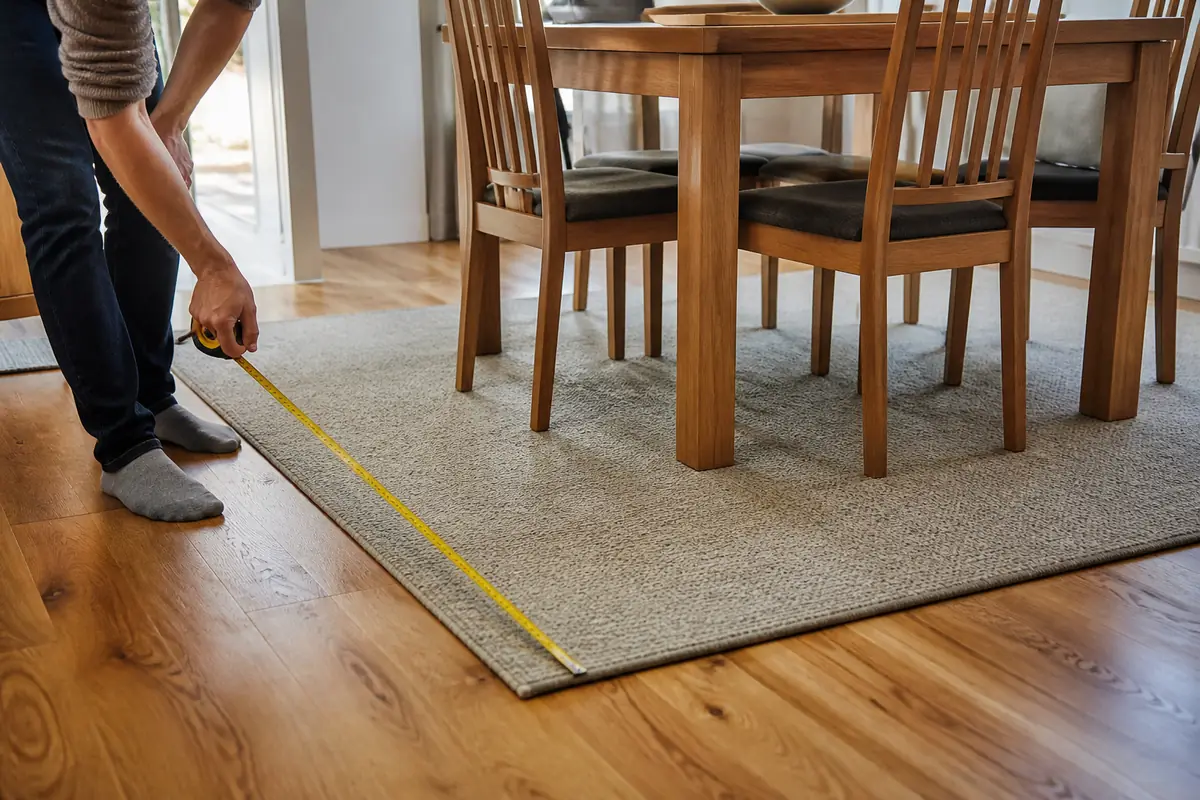
Add roughly 60–70cm beyond every chair edge, then prove the rectangle on the floor
For a rectangular table, add about 120–140cm to both the tabletop length and width as a first estimate, increasing the allowance where chairs are deep or frequently pulled back. A flatwoven or genuinely low-pile rug is easier for chair legs and crumbs. Test the full outline with tape, open nearby doors and sit at every place before choosing a material or colour.
A dining rug can define an open-plan zone, soften noise and make a room feel finished. It also sits under moving furniture and directly beneath spills. That makes dimensions, edge stability and cleaning more important than the small styled photograph on a retailer page.
Dining-room rug size starts with pulled-out chairs
IKEA’s current UK dining guidance recommends a rug extending roughly 60–70cm beyond the table on each side so chair legs remain on the rug when pulled out. Its broader size guide allows 60–80cm on the long sides. These ranges are useful starting points, not building rules. Chair depth, sitter movement, end chairs and the room boundary decide the final size.
If a rear chair leg falls off the rug whenever somebody sits down, it can catch the edge when pushed back in. The repeated drop also disturbs the rug and feels awkward. Measure the chair in its normal occupied position, not tucked tightly beneath the table.
Use the tabletop as the first calculation:
| Tabletop example | Minimum planning calculation | Likely standard size to test | What may force a change |
|---|---|---|---|
| 120 × 80cm | 240–260 × 200–220cm | 160 × 230cm is usually too narrow; test around 200 × 300cm | Compact chairs and constrained room may require no rug |
| 160 × 90cm | 280–300 × 210–230cm | 200 × 300cm can be a starting point | End chairs may need more length |
| 200 × 100cm | 320–340 × 220–240cm | 240 × 340cm or a custom size may be more realistic | Door swings and open-plan walkways |
| 110cm round | 230–250cm diameter | 230–250cm round, or a large square | Wide chairs and a central pedestal |
The first row illustrates why a common 160 × 230cm rug can look generous online but fail under a dining table: after an 80cm table width, only 40cm remains on each side. That is short of the usual chair pull-back allowance. A smaller rug may still work as a decorative mat with a bench, but it should not be presented as a safe universal answer.
Mark the rug outline before buying
Use low-tack painter’s tape to mark the full candidate rectangle. Position the table and all chairs as they are used, then sit down and stand up at every place. Pull the chairs back naturally. Walk the main route carrying a plate. Open doors, drawers and nearby cupboards. Check radiator clearance and whether the rug would bridge a floor threshold.
Leave the outline in place for a day. A rug that technically fits may squeeze a walkway or make an open-plan room feel lopsided. Photograph the taped shape from the doorway and from seated eye height. This simple test is more dependable than estimating from a product image. The same approach underpins our furniture measuring guide.
For an extending table, plan around the configuration used most often, then decide what happens on occasions when it is fully extended. If extension doubles the table length, a fixed rug may become undersized. It can be better to accept a hard floor for large gatherings than to buy an oversized rug that obstructs the room every day.
Rectangular, round or square?
Matching the rug to the table shape is an easy visual rule, but not a requirement. A rectangular rug provides a predictable runway for end chairs and suits most rectangular rooms. A round rug can echo a round table and soften a boxy space, provided its diameter includes the pulled-out chairs. A square rug can work beneath a round or square table in a square room.
Measure the furniture group rather than relying on the label. A round table with four wide armchairs may need a larger diameter than a six-seat rectangular table with compact side chairs. If the available standard size leaves a narrow strip beyond the table, changing shape does not solve the chair-clearance problem.
Why flatwoven and low-pile rugs usually work best
IKEA recommends flatwoven or low-pile constructions for dining because chairs move more smoothly and cleaning is easier. Crumbs sit closer to the surface instead of disappearing into a deep pile, and chair legs are less likely to catch in long fibres or fringe. That practical advantage matters several times a day.
“Low pile” is not a precise industry-wide promise. Read the listed pile height and construction. A 15mm soft pile may be marketed as low within one range but still feel thick beneath narrow chair legs. A 2–7mm flatweave or short pile is generally easier to move across, but backing, rug pad and edge binding also affect stability.
Fringes look decorative but introduce a cleaning and chair path at each end. Loop piles can catch pet claws or damaged chair feet. A very thin rug may curl if the backing and underlay are poor. Inspect edge photos and the care guide, then check the rug on a hard floor with the intended underlay.
Dining rug materials: cleaning is part of the purchase
| Material or construction | Dining-room strengths | Limitations to accept |
|---|---|---|
| Polypropylene or polyester flatweave | Often low-profile, stain-tolerant and available in washable or easy-care ranges | Care varies by backing; heat and harsh cleaning can damage it |
| Wool flatweave | Resilient fibre, warm texture and good long-term appearance when maintained | Usually requires prompt blotting and professional cleaning; may shed initially |
| Jute | Firm, textured flat surface and natural colour; often easy to vacuum | Usually not washable; liquid can mark natural fibres and deep cleaning is limited |
| Cotton or recycled-cotton washable rug | Some products can be machine washed, useful for frequent spills | Large sizes may exceed a domestic machine and can shrink or distort |
| Viscose-rich rug | Soft sheen and decorative finish | Moisture-sensitive and generally a poor match for routine food spills |
The fibre name alone does not determine care. Backing, dyes, weave and size matter. Read the exact product label. A listing that says “washable” may still state that only small and medium sizes fit an 8–10kg domestic machine. Dunelm’s Marshall guidance, for example, warns that a large rug may need a launderette; its cotton-rich construction may shrink slightly after washing.
Current UK dining-rug price snapshot
These official UK listings were checked on 27 August 2026. They show how size, fibre and care route change the ownership decision. They are not rankings, and the exact colour, stock and price must be rechecked before purchase and purchase.
| Exact listing checked | Displayed price and size | Construction and care | Dining-room question |
|---|---|---|---|
| IKEA LOKALTÅG low-pile rug | £89, 200 × 300cm | Recycled-polyester surface, rubber middle layer; machine wash at 40°C | Does the selected size still fit the available machine and chair envelope? |
| IKEA LOHALS flatwoven rug | £129, 160 × 230cm; 200 × 300cm shown as £50 more | 100% jute; vacuum and rotate; do not wash | Can the room tolerate a natural fibre that is not washable? |
| IKEA TÄNNISBY flatwoven rug | £299, 160 × 230cm | 100% wool surface with cotton warp; vacuum regularly and use professional carpet cleaning when needed | Does the handmade wool construction justify the higher price for this room? |
Price note: “washable” is not the same care route across these examples. Record the exact selected size and variant, then read its own label. The price difference between 160cm and 200cm widths buys materially more floor coverage, but it may also create storage, transport and cleaning costs.
Check current guidance, examples and care:
IKEA dining-table rug guide ↗IKEA LOKALTÅG listing ↗IKEA LOHALS listing ↗IKEA TÄNNISBY listing ↗
Plan for spills before choosing the colour
For wet spills, IKEA’s current care guidance says not to rub: absorb with paper towels or a damp white cloth before liquid penetrates further. Dry material should be scraped gently towards the centre. Vacuuming, rotating and periodically cleaning the underside help reduce uneven wear. The exact product instructions override any general technique.
Ask four practical questions: Can the rug fit in the washing machine? If not, can it be transported to a launderette or cleaner? Where can it dry flat? What does a professional clean cost locally? A pale washable rug can be easier to own than a dark jute rug if the household has frequent spills, while a well-maintained wool flatweave may outlast a cheaper finish in a low-spill home.
Vacuum equipment matters too. Several IKEA listings specify a standard floorhead rather than a rotating brush. Check the rug label and vacuum instructions, particularly for loops, fringes and natural fibres. Our vacuum specifications guide helps distinguish useful floorhead information from headline power.
Use an underlay—and size it correctly
A suitable anti-slip underlay can reduce movement, protect the floor and make vacuuming easier. It should sit beneath the rug rather than protruding at the edges, and it must be compatible with the floor finish and any underfloor heating. Do not assume a rubber or latex backing is safe for every sealed timber, vinyl or heated floor; check both manufacturers.
Underlay adds a little height. Test whether chair feet cross the edge cleanly and whether doors clear the combined thickness. Replace or reposition a pad that bunches. An underlay supports a correctly sized rug; it does not make a narrow rug safe for chairs that repeatedly drop off its edge.
Colour and pattern: practical, not only decorative
A highly contrasting border makes the rug edge visible, but it can also emphasise an undersized rectangle. Mid-tones and broken patterns may disguise crumbs between cleans better than a plain pale or very dark surface. Natural variations in jute and wool are part of the material, not exact colour matching.
Order a sample where available and view it in daylight and evening light. Compare it with the table, floor and chair upholstery, but avoid buying every textile as a matching set. Our furniture-quality guide explains why construction evidence matters more than a styled room image, while the expected-lifespan guide helps set a sensible ownership horizon.
Common dining-rug mistakes
Measuring only the table. The chair in use determines the rug boundary.
Choosing a common stock size by habit. A 160 × 230cm rug is often too narrow once a standard table and pull-back space are calculated.
Treating “low pile” as a fixed measurement. Read the listed millimetres and inspect the edge.
Assuming “washable” means home-machine washable at every size. Check machine capacity, shrinkage, drying and transport.
Ignoring the extending table. Decide which configuration the rug must serve.
Skipping the underlay and floor check. Movement, floor-finish compatibility and total height are part of the installation.
A dining-room rug buying checklist
- Measure the table, each chair’s occupied pull-back and the full room.
- Add roughly 60–70cm beyond the furniture as a starting point, then test the actual chairs.
- Mark the candidate rug with tape and leave it in place for a day.
- Check doors, routes, radiators, table extension and neighbouring furniture.
- Choose pile, weave and edge construction for chair movement and crumbs.
- Read the exact care label, including machine capacity and professional-cleaning needs.
- Add underlay, delivery, return and cleaning costs to the price.
A settled dining zone is the goal
Choose a rug large enough for chairs to remain supported when pulled back, after measuring the table in its extended form.
Space or budget sets a hard limit
Mock up chair movement and accept the visual and practical compromise rather than relying only on the table-top dimensions.
Balanced verdict: is a rug right for your dining room?
A dining-room rug works when it is large enough for every occupied chair, low enough for smooth movement and realistic to clean. It can define an open-plan area and soften sound, but a rug squeezed between walls or doors creates more friction than benefit. In a very compact or spill-heavy room, a cleanable hard floor may be the better choice.
Start with the taped outline, not a style. Then compare exact materials and ownership costs. Browse related retailers in our UK shop directory, read the detailed Dunelm UK review and IKEA UK review, or continue through Style & Gifts.
Check current official information:
IKEA dining-table rug guide ↗IKEA LOKALTÅG listing ↗IKEA LOHALS listing ↗IKEA TÄNNISBY listing ↗
Frequently asked questions
How much larger should a rug be than a dining table?
As a starting point, allow about 60–70cm beyond each side, or add roughly 120–140cm to table length and width. Test the actual chairs because deep seats and end places can need more.
Is a 160 × 230cm rug big enough for a dining table?
Often it is not. Beneath an 80cm-wide table it leaves only 40cm on each long side, less than the usual chair pull-back allowance. It may suit a very small table or bench arrangement, but tape the outline first.
What pile is best under a dining table?
Flatwoven or genuinely low-pile rugs are generally easier for moving chair legs and vacuuming crumbs. Read the actual pile height, backing and edge design rather than relying on the marketing label alone.
Can a dining-room rug be machine washed?
Only if the exact care label allows it and the selected size fits the machine. Large “washable” rugs may require a commercial machine or launderette and enough space to dry flat.
Should a round table have a round rug?
It can, but shape is secondary to clearance. A round rug must extend beyond every pulled-out chair. A large square rug can also work if it suits the room and furniture group.
Do I need an anti-slip underlay under a dining rug?
Often yes, especially on a smooth hard floor. Use a pad compatible with the rug, floor finish and underfloor heating, trim it beneath the edge and include its thickness in the chair and door test.
How we researched this dining-room rug guide
Recommended Today reviewed official UK guidance and product pages from IKEA and Dunelm, including chair-clearance advice, stated dimensions, pile or weave, fibre composition, backing, care, underlay recommendations and current prices. We calculated example rug footprints from table dimensions and compared care routes for jute, synthetic and cotton-rich products. Prices were recorded on 27 August 2026.
Limitations
We did not install, clean or physically inspect the named rugs. Furniture proportions, room routes, floor finishes and washing-machine capacities differ, while natural fibres vary. Prices, colours, stock and care specifications can change. Recheck the exact selected size, product label, floor compatibility, delivery and return terms on publication and purchase day.
This is a measuring and material-selection guide, not a product ranking. The rug-measuring sources were selected as non-affiliate references for dimensions and material checks.