Vacuum Specifications Explained: Suction, Filtration and Runtime
Air watts, kPa, HEPA grades and quoted runtimes measure different things. How to compare vacuum specifications without being misled by the big number.
In this guide
Quick verdict: no single suction number predicts cleaning. Compare the floor head, sealed airflow, filtration, useful runtime, battery terms and consumable cost as a system, matched to your flooring and storage.
| Specification | What it indicates | What it cannot prove |
|---|---|---|
| Air watts or kPa | A test of airflow or pressure under stated conditions | Pickup through a particular floor head |
| Maximum runtime | Best-case battery duration in a named mode | Runtime with a powered head at useful suction |
| HEPA claim | A filter grade when the standard is identified | Whole-machine sealing |
| Motor wattage | Electrical input | Cleaning efficiency or floor performance |
Vacuum cleaners are marketed on a rotating cast of numbers — watts, then air watts, then kilopascals — each presented as the definitive measure and none of them comparable across brands. Meanwhile the two things that most determine whether a machine cleans well, the floor head and the seal, rarely carry a figure at all.
This guide explains what each specification measures, where it stops being comparable, and what to look at instead. It is the vacuum-specific application of product specifications explained.
Why wattage stopped meaning what it used to
Wattage describes electrical power drawn from the socket, not cleaning performance. Two machines drawing identical power can differ enormously in how much of it becomes useful airflow, depending on motor efficiency, sealing and the design of the air path.
It also stopped being a differentiator for mains machines, because input power for vacuum cleaners is limited under ecodesign rules. That was a deliberate policy choice made on the basis that performance did not depend on raw input power — and the market response was to switch the marketing to other figures rather than to reduce cleaning ability.
For cordless machines, wattage is even less useful, since battery voltage, motor efficiency and the power mode selected all sit between the figure and the floor. Treat any headline wattage as a description of consumption, exactly as in how to choose kitchen appliances.
Air watts, kPa and sealed suction
Three figures, measuring three different things.
Kilopascals describe sealed suction: the pressure difference the motor generates when the airway is blocked. It tells you about lifting power in a sealed condition, which is relevant for pulling debris out of carpet pile — and nothing about airflow when air is actually moving.
Airflow, where quoted, describes the volume of air moved per unit of time. Airflow is what carries dust along the tube.
Air watts attempt to combine suction and airflow into a single figure representing work done. In principle this is the most useful of the three; in practice its value depends entirely on where and how it was measured — at the motor, at the wand, or at the floor head, which give very different numbers for the same machine.
The critical caveat: these are not measured to a single universal consumer standard across manufacturers, and the measurement point is frequently unstated. So compare figures within one manufacturer’s range, where the method is probably consistent, and treat cross-brand comparisons as unreliable. Where a manufacturer states the measurement point, that disclosure is itself a positive signal.
Runtime claims and which mode they refer to
For cordless machines, runtime is the specification most likely to disappoint, because the headline figure describes the most favourable configuration.
A quoted maximum normally means the lowest power setting with a non-powered attachment fitted. Attach a motorised floor head — which most cleaning requires — and the head’s own motor draws power too. Select a boost mode and consumption rises sharply. The result is that real runtime in normal use can be a fraction of the headline.
Three things to look for. Whether the manufacturer publishes runtimes for each mode and attachment, which is the honest presentation. Whether the battery is removable, since a second battery doubles working time and a non-replaceable battery caps the machine’s life. And how long charging takes, because a short runtime with a long charge is a different machine in practice from the same runtime with a fast one.
Filtration: HEPA grades and what they capture
Filtration matters because a vacuum takes in dust and must not put it back out again — and the filter is only half the story.
A high-efficiency filter is defined by a grade indicating the proportion of particles of a specified size it captures. Two cautions. Terms such as “HEPA-type”, “HEPA-like” or “HEPA-style” carry no defined meaning and are not the same as a stated grade. And a filter’s grade is irrelevant if air can bypass it: unsealed machines leak dust-laden air through joints and seams, so whole-machine sealing is the property that determines what actually reaches the room.
What to look for on a listing: a stated filtration grade rather than a badge; an explicit claim about the machine being sealed; whether filters are washable or replaceable; and how often they need attention. Filters clog with use, and a clogged filter reduces airflow — which is why maintenance affects measured performance more than most specifications do.
Bagged versus bagless, honestly compared
Bagged machines contain dust in a disposable bag, which usually means less exposure when emptying, better retention of fine dust and often more consistent airflow as the bag fills, since the bag itself acts as a filter. The trade-off is a recurring consumable cost and the need to keep the right bags available.
Bagless machines empty into a bin with no consumable to buy, which is cheaper to run and immediate to empty. The trade-offs are dust exposure at the point of emptying, more frequent filter maintenance, and airflow that can fall as the bin fills or the filter loads.
Neither is better in the abstract. The honest comparison is a whole-life one: bag costs against filter replacement costs, both projected over the years you expect to own the machine, using the framework in total cost of ownership. And check bag availability for the specific model before buying, since a discontinued bag format effectively ends a bagged machine’s life.
Floor heads and why they decide performance
The floor head is where the machine meets the dirt, and it does more for real-world cleaning than any headline figure.
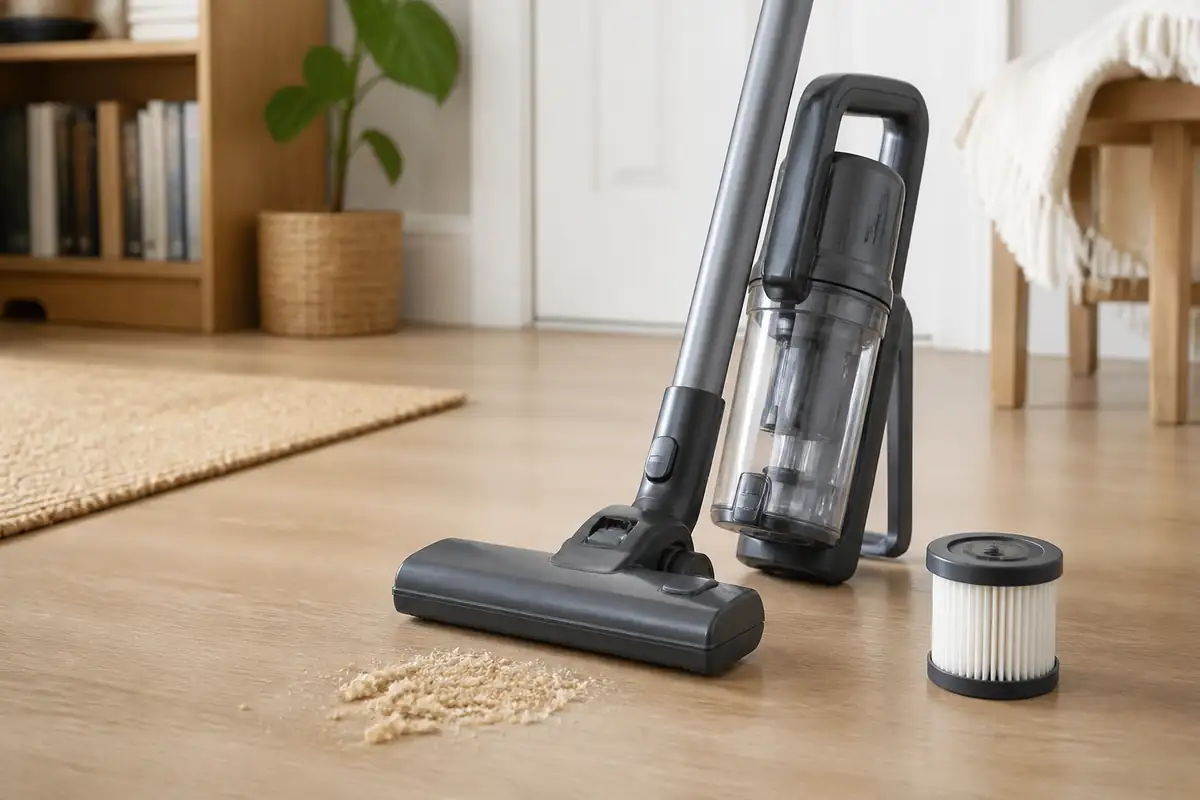
What matters: whether the brush bar is motorised or air-driven, since a driven brush agitates carpet pile far more effectively; whether the head is designed for carpet, hard floor or both; the seal against the floor and how the head handles edges; whether the brush bar can be removed and cleaned, because hair wrapping is the most common performance complaint in every vacuum category; and the head’s height and articulation, which decide whether it reaches under furniture.
Manufacturers rarely quantify any of this, so the evidence comes from construction detail in the listing and from repeated, specific owner reports — the pattern-reading method in how to judge product quality online. A machine with excellent figures and a poor head cleans worse than the reverse.
Consumables: filters, belts and batteries
Vacuums are consumable-heavy, and the recurring cost frequently exceeds the difference in purchase price between two models.
Filters need washing or replacing on a schedule; check whether they are washable, how many the machine has, and what replacements cost.
Bags, on bagged machines, are the obvious recurring cost — and third-party availability matters as much as price.
Belts, where fitted, wear and snap, and are usually cheap and owner-replaceable on serviceable designs.
Brush bars wear and can be damaged by hair and debris.
Batteries, on cordless machines, are the decisive one: a battery that cannot be replaced affordably ends the machine’s life regardless of everything else.
Before buying, search the model number with each of these parts and see whether they are sold individually and to consumers — the five-minute check in appliance repairability and spare parts.
Matching specification to your actual flooring
- Mostly carpet: prioritise a motorised brush bar, sealed suction and head design over headline air watts.
- Mostly hard floors: prioritise airflow, a soft or dual-mode head, and edge performance; aggressive brush bars can scatter debris.
- Mixed flooring: a head that switches modes, or two heads, matters more than any single figure.
- Pets: a removable, clearable brush bar and easy hair management outweigh most specifications.
- Stairs and cars: weight, cable or runtime, and the attachment set decide usability.
- Small homes: storage footprint and charging arrangements matter as much as cleaning, as covered in buying for a small kitchen.
In every case, the durable considerations are the ones outside the specification list: sealing, head design, filter maintenance, parts availability and battery replaceability. Those decide how well a vacuum cleans in year three, which is the only performance figure that matters.
Which vacuum trade-off suits your home?
Frequent short cleans matter most
Check real operating weight, powered-head runtime and storage. A repairable battery improves the calculation in our repairability guide.
You clean larger areas in one session
A corded or bagged design may trade instant access for steadier output, larger capacity and less filter handling.
Our verdict
Buy the complete air path, not the largest number. The right head, good sealing, suitable filtration and usable runtime matter more together than any headline specification alone.
Check current UK product and electrical-safety guidance:
GOV.UK product safety guidance ↗Electrical Safety First product guidance ↗
Frequently asked questions
Do more watts mean more suction?
No. Watts describe power drawn, and input power for mains vacuums is limited under ecodesign rules, so it has largely stopped being a differentiator. What matters is how efficiently power becomes airflow at the floor head.
What is the difference between air watts and kPa?
Kilopascals describe sealed suction with the airway blocked; air watts attempt to combine suction and airflow into one figure for work done. Neither is measured to a single universal consumer standard across brands, so compare within a range rather than across brands.
Is a HEPA filter necessary?
Sealing matters as much as the filter — a high grade helps only if air cannot bypass it. Terms like “HEPA-type” carry no defined meaning, so look for a stated grade plus a claim about whole-machine sealing.
Are quoted runtimes realistic?
They usually describe the lowest setting with a non-powered attachment. A motorised head or boost mode reduces runtime substantially, so check which mode the figure refers to.
How we write this guide
This article is research-led. It draws on established principles of airflow and suction measurement — the distinction between sealed suction, airflow and combined work figures, and the effect of measurement point on quoted values — together with the ecodesign limits applying to vacuum cleaner input power and the way filtration grades are defined by particle capture efficiency.
We have tested no vacuums, and this guide names no brands or models, publishes no rankings, and gives no air watt, kilopascal, decibel or runtime figures: these are not measured to a single universal consumer standard across manufacturers and would invite exactly the cross-brand comparison the article warns against. Where a specification is not comparable, we say so rather than supplying a number.
Recommended Today may earn commission from links to retailers. Commission does not influence our editorial content or the order of any recommendation. This guide is reviewed at least every 18 months. Next scheduled review: February 2028.