Curtain heading types explained: eyelet, pencil pleat, pinch pleat and wave
The heading controls how curtains attach, fold, stack and move. Choose it with the pole or track, window clearance and fabric weight—not as a decorative detail after ordering.
In this guide
Match the heading to the installed hardware before choosing fabric
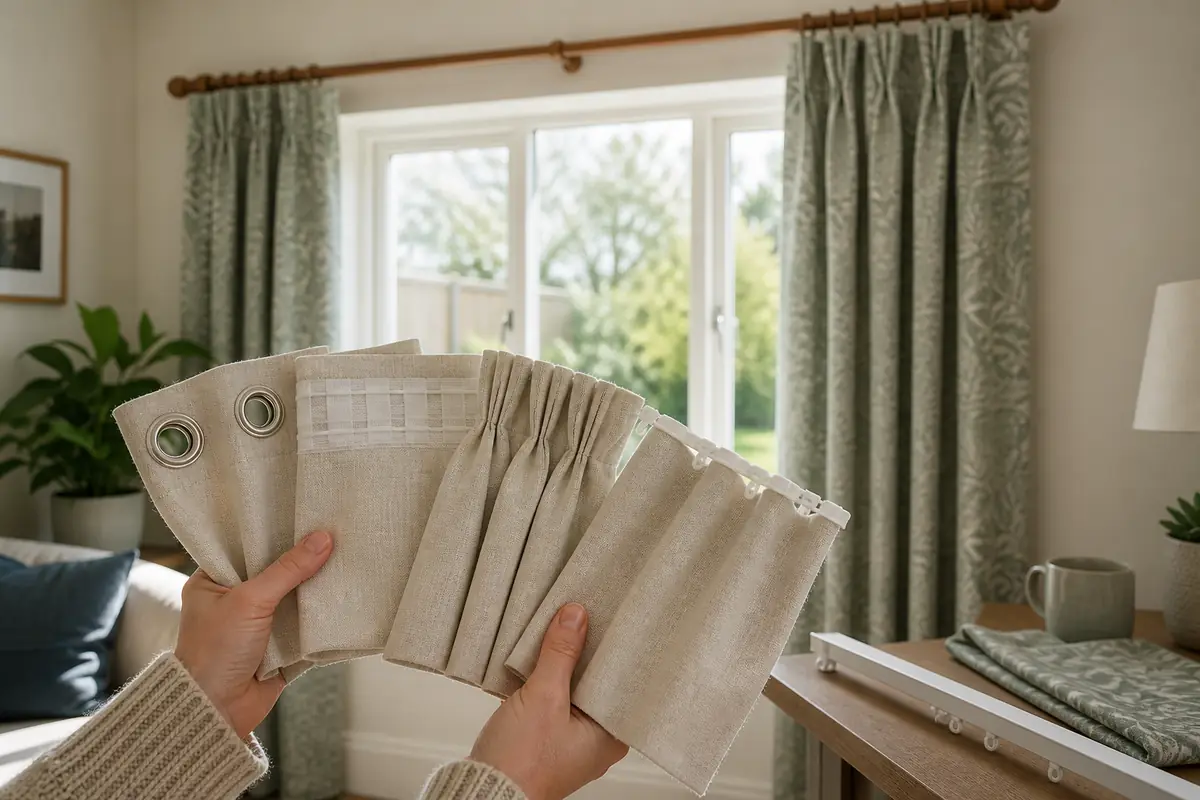
Eyelets are simple and contemporary but need a correctly sized pole. Pencil pleats offer adjustable gather on a pole or track. Pinch pleats create a tailored, fixed-width finish and are commonly made to measure. Wave headings need a compatible track and glider spacing to form even folds. None is universally best: the right choice is the one that fits the hardware, stack space, opening routine and measured finished width.
A curtain heading is the constructed top edge where fabric meets the supporting hardware. It determines more than appearance. The heading changes the hanging point, the amount of fabric required, the projection into the room, the width occupied when open and whether the curtain can travel around a bay or beneath a pelmet. Choosing the wrong one can leave a perfectly good pair unusable.
Curtain headings compared at a glance
| Heading | Usual hardware | Width behaviour | Best reason to choose it | Main limitation |
|---|---|---|---|---|
| Eyelet | Pole only; rings are built into the curtain | Even, relatively large folds; heading is not gathered with cords | Easy hanging and frequent opening on a straight pole | Not suitable for an ordinary curtain track |
| Pencil pleat | Track with gliders or pole with rings and hooks | Draw cords adjust the gathered width | Flexible ready-made choice for existing tracks or poles | Gathering and hook spacing take time; cords must not be cut |
| Pinch pleat | Track or pole with rings, using hooks | Pleats are sewn in; finished width is effectively fixed | Structured, tailored presentation | Measurement errors are less forgiving and made-to-measure pricing is common |
| Wave | Compatible wave track or specialist glider pole | Track spacing creates a repeated S-shaped fold | Clean, regular folds with an understated top edge | The complete track, glider, tape and hook system must work together |
Eyelet curtains: simple hardware, visible pole
Eyelet curtains have metal or reinforced rings set directly into the heading. The pole passes through alternate eyelets, producing broad waves. John Lewis states that its eyelets have a standard 40mm diameter; IKEA lists a 3.9cm inner diameter for the current MERETE pair. Those figures show why “standard pole” should still be measured: the ring must pass over the pole and any removable end fitting, while leaving enough clearance to slide without scraping.
The pole remains part of the visual design. Its finish can show through the rings, and the fabric sits above and below the pole. Measure the drop from the product’s specified point rather than copying a pencil-pleat measurement. A bracket placed close to the wall can make deep folds rub the sill, radiator cover or window handle.
Eyelets suit a straight pole and curtains that are opened often. They do not attach directly to a standard track. They are also a poor shortcut for tight bays because rigid rings need to travel over the pole and cannot usually pass support brackets. For a bay, a purpose-designed system matters more than the heading’s appearance.
Pencil pleats: adjustable gather for poles or tracks
Pencil-pleat heading tape contains several draw cords and rows of hook pockets. Pulling the cords gathers the flat fabric into narrow vertical pleats. Hooks then connect it to track gliders or rings on a pole. This dual compatibility makes pencil pleat useful when the hardware already exists.
Adjustment is an advantage only when done deliberately. John Lewis advises gathering each curtain to the required width, knotting and retaining the cords rather than cutting them, then spacing hooks at roughly 8cm intervals. The pocket row changes how high the fabric sits relative to the track. A lower pocket can help cover the track; a higher one hangs the curtain lower. Check the product instructions because tape designs differ.
Dunelm warns shoppers to be satisfied with style and size before pulling the cords because a gathered ready-made pair may not be accepted as an ordinary change-of-mind return. That is a good general sequence: inspect colour, defects, width and drop first; gather only after the decision to keep the curtains.
Pinch pleats: a fixed tailored heading
Pinch pleats are groups of two or three permanently sewn folds. Unlike pencil pleats, they are not pulled to width at home. The maker calculates the fabric allowance and constructs the heading to the ordered finished width. Hooks attach the curtain to a track or to rings on a pole.
The finish is controlled and formal, but the fixed width leaves less room to correct a measuring mistake. John Lewis describes double and triple pinch pleats as made-to-measure options, while Dunelm currently lists pinch pleat within its made-to-measure service rather than its ordinary ready-made range. Custom orders can have stricter cancellation and return conditions, so confirmation should include finished width, fullness, hook position, split, lining and stated manufacturing tolerance.
A heavy triple pleat uses more fabric and concentrates load at the hooks. The track or pole, brackets, wall fixing and gliders all need an adequate weight rating. Do not infer that an existing lightweight track can carry a lined, floor-length made-to-measure pair.
Wave curtains: the track creates the rhythm
A wave heading forms smooth alternating folds through a coordinated system: heading tape is hooked to gliders held at fixed distances along a compatible track. The consistent spacing, not merely the fabric, produces the wave. A normal track with freely moving gliders will not automatically create the same result.
Wave can look quiet and contemporary because the track is visually recessive and there is no bulky gathered heading. It can also stack in a predictable sequence. However, the folds project in front of and behind the track. Measure clearance from handles, sills, radiators, blinds and walls, and include the return at each end where privacy matters.
Ask the supplier for the required track type, glider spacing, hook, tape, fullness and stack estimate as one specification. Replacing only the curtain or only the track can break the system. For ceiling tracks, confirm the substrate and fixing method; plasterboard alone is not a universal load-bearing answer.
Current UK price snapshot: heading changes the total
These official listings were checked on 27 August 2026. They are not a like-for-like quality ranking: fabric, lining, light control, size and included hardware differ. They demonstrate why the curtain price alone does not reveal the installed cost.
| Official listing | Heading and size | Displayed price | Installation implication |
|---|---|---|---|
| IKEA MERETE room-darkening curtains | Eyelets; pair; each curtain 145 × 250cm | £29 | Needs a compatible pole; 3.9cm inner eyelet diameter |
| IKEA MAJGULL block-out curtains | Multi-way heading tape; pair; each curtain 145 × 250cm | £40 | Can use rod pocket, tabs or compatible track hooks and gliders |
| IKEA VIDGA single wall-track set | Track component promoted with MAJGULL | £23 | Hardware is a separate budget line; quantity and bends depend on the window |
| Dunelm Elements Oscar blackout pair | Eyelet; several ready-made sizes | £45–£65 current range | The selected width and drop determine the live price; confirm the exact variant before comparison |
Price note: size selections, colours, promotions, stock and delivery can change. Compare the same finished coverage and include pole or track, brackets, rings, gliders, hooks, alteration, fitting and delivery. A lower curtain price can produce a higher installed total.
Check official specifications:
John Lewis curtain headings and hanging guide ↗Dunelm curtain buying guide ↗Dunelm Elements Oscar listing ↗IKEA MERETE listing ↗IKEA MAJGULL listing ↗
How fullness changes the finished result
Fullness is the ratio between flat fabric width and the span it covers when dressed. Two times fullness means roughly twice as much flat fabric as the track or pole width. It creates folds rather than a stretched sheet. IKEA’s current guidance suggests multiplying the rod or track width by 1.5 for a full look or 2 for extra fullness, then dividing by one curtain’s width and rounding up.
That calculation is a useful screen, not a universal specification. Pencil pleat can be gathered within a range; pinch pleat has fullness built into the made width; wave systems use a supplier-defined ratio and glider spacing. Eyelet folds also consume width. Use the maker’s method for the exact heading and read whether the advertised width describes one curtain or the whole pair.
More fullness is not always better. It increases stack-back, weight and cost and can crowd a shallow recess. Too little fullness looks flat and may expose gaps when closed. For light control, adequate side return and central overlap can matter more than adding another half-width that cannot stack clear of the glass.
Measure the hardware, drop and stack—not only the window
- Identify the support. Record pole diameter and usable length, or track type, glider count and weight rating.
- Measure the covering span. Use the installed pole or track length, excluding decorative finials, unless the manufacturer instructs otherwise.
- Choose the hanging point. Eyelet, pocketed tape and fixed hooks start the drop at different positions.
- Measure the drop in several places. Floors, ceilings and sills may not be level. Decide on sill, below-sill or floor finish.
- Estimate stack-back. Ensure open curtains can clear enough glass without blocking furniture, sockets or door travel.
- Check projection. Include deep folds, handles, blinds, radiator clearances and any pelmet.
- Confirm the pack. Establish whether width is per curtain, whether the product is a pair and which hooks or gliders are included.
Our measuring-before-buying guide provides a room-recording method, while the furniture-quality guide explains how to examine materials and construction remotely. If the window is part of a wider home order, compare retailer services in the Dunelm review and IKEA UK review.
Which heading works best in common situations?
An existing straight curtain pole
Eyelet is simplest when the pole diameter fits and no support bracket blocks travel. Pencil pleat or pinch pleat can also work with enough rings. Count rings and include one at each anchored end where required.
An existing track
Pencil pleat is the most flexible ready-made route. Pinch pleat can work when measured to the finished span. Wave needs a purpose-designed compatible system; do not assume an ordinary track can be converted with tape alone.
A wide window or frequently used patio door
Prioritise smooth travel, manageable panel weight and stack position. Wave can be effective with the correct system, while eyelets can move easily on an uninterrupted pole. A centre support that rings cannot pass may limit where the curtains can stack.
A formal room or prominent patterned fabric
Pinch pleat provides controlled repetition, but pattern placement and seams should be agreed for made-to-measure work. Pencil pleat is less fixed and can look appropriate when carefully dressed. Heading choice cannot compensate for poor pattern matching.
Smooth movement and stacking matter
Wave or pencil pleat can suit the installed track when hook type, fullness and finished drop are measured together.
The pole should remain visible
Eyelet or tab styles can simplify the look when pole diameter, bracket projection and stack-back space all fit.
Balanced verdict: choose the system, then the style
Eyelet is the easiest pole-only option; pencil pleat is the most adaptable ready-made option; pinch pleat is the tailored fixed-width option; wave is the cleanest system-dependent option. The best heading is not the most expensive or fashionable. It is the one that can be correctly supported, measured, opened and maintained in the actual room.
Before paying, calculate the installed total using our total-cost framework, check construction with the online quality guide and retain the measurement sheet. Browse related interiors advice in Style & Gifts.
Check current official information:
John Lewis curtain headings and hanging guide ↗Dunelm curtain buying guide ↗IKEA MERETE listing ↗
Once the heading works with the track or pole, compare the sizing and return trade-offs in our Ready-Made vs Made-to-Measure Curtains: Cost, Fit and Return Rights.
Frequently asked questions
Can eyelet curtains go on a track?
Not on an ordinary curtain track. Eyelets are designed for a pole passing through the rings. Choose a pole or a different heading made for hooks and gliders.
Can pencil-pleat curtains hang from a pole?
Yes — Fit suitable rings to the pole and connect curtain hooks from the heading tape to those rings. Count the rings and space the hooks evenly.
Can pencil-pleat cords be cut after gathering?
No — Knot and retain the excess so the curtain can be relaxed for cleaning or adjusted later. Cutting the cords can make the heading difficult or impossible to release.
Are pinch pleats adjustable?
The pleats and finished width are normally sewn in, so they are not adjusted like pencil pleats. Some hooks allow a small height adjustment, but that does not correct a materially wrong width.
Do wave curtains need a special track?
Yes — The wave depends on compatible tape, hooks and connected gliders at controlled spacing. Confirm the complete system with the curtain or track supplier.
How much fullness do curtains need?
It depends on the heading and supplier. About 1.5 to 2 times the pole or track span is a common ready-made screen, but fixed pinch pleats and wave systems use their own specified ratios.
How we researched this curtain-heading guide
Recommended Today compared current official John Lewis and Dunelm heading, measuring and hanging guidance with IKEA UK product specifications for eyelet and heading-tape curtains. We recorded current dimensions, hardware notes and displayed prices on 27 August 2026. We also checked our existing retailer profiles and blackout-curtain research to prevent overlap and create useful internal links.
Limitations
We did not fit, draw, launder or measure the named curtains. Track geometry, wall construction, fabric weight, supplier fullness and manufacturing tolerances vary. Prices, ranges and service terms can change. Recheck the exact product, pack quantity, hardware compatibility, weight rating and measurement method before ordering and before purchase.
This is an independent buying guide. Official external links were non-affiliate at the time of research.