How to Judge Furniture Quality When You Can Only See Photographs
Frames, joints, foam density, veneer versus solid wood: the details that decide whether furniture lasts ten years or two, and how to spot them online.
In this guide
Quick verdict: photographs can reveal furniture quality when they show the frame, joints, suspension, cushion construction, upholstery specification and dimensions. A styled front view cannot substitute for those details, so ask the retailer for evidence before paying for a structural premium.
| Area | Strong listing evidence | Weak signal |
|---|---|---|
| Frame | Named material, joint method and underside images | “Solid construction” without detail |
| Suspension | Named springs or webbing and attachment method | “Sprung seat” alone |
| Cushions | Fill, density, casing and replacement route | Softness language |
| Upholstery | Composition, abrasion result and removable covers | Close-up colour photograph only |
Furniture is among the most expensive things bought sight unseen, and among the hardest to return. It is also sold almost entirely on appearance: styled photographs, fabric swatches and a paragraph about the collection, with the structural information — the part that decides whether it survives a decade — buried in a specification tab or absent altogether.
This guide is about finding that information, and about what its absence tells you. It names no brands and ranks nothing.
Frame construction and why it decides everything
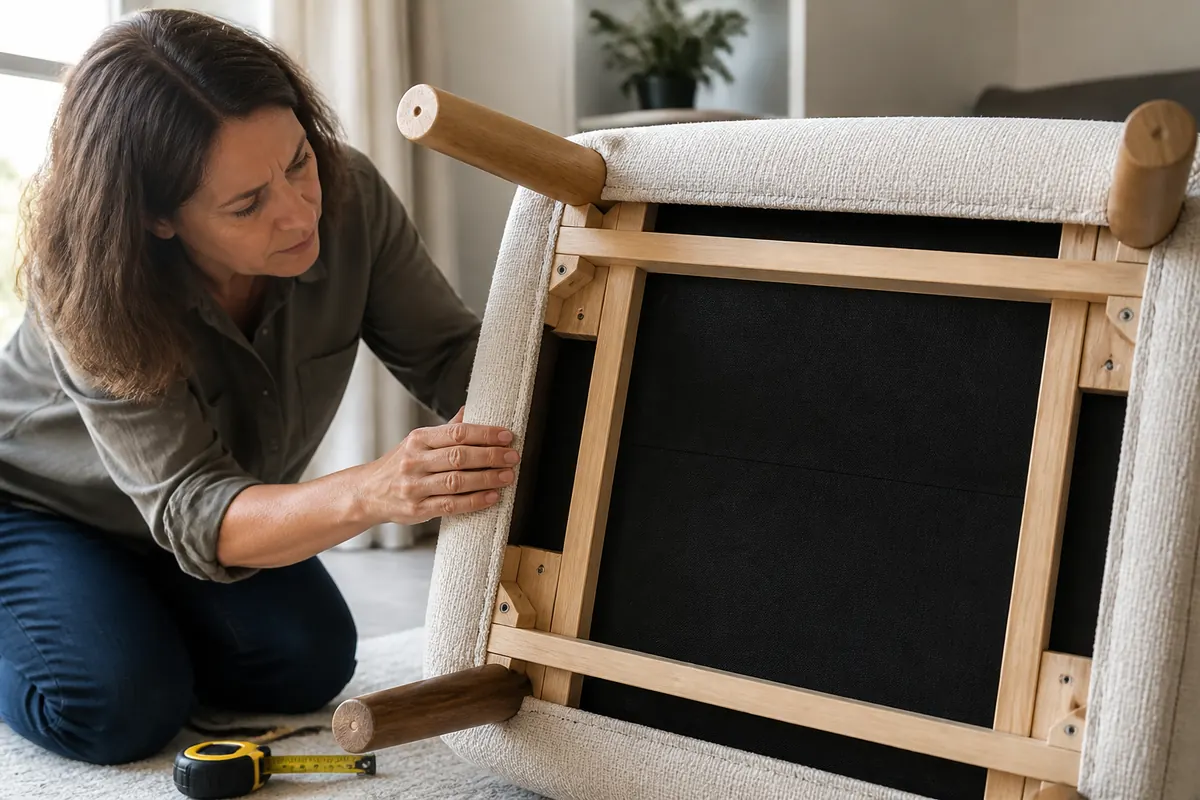
Everything visible sits on a frame you will never see. Once a frame fails — a rail cracks, a joint loosens, a leg works free — the piece is usually finished, because reupholstering a broken frame costs more than replacing the item.
What to look for in the specification: the frame material and whether the timber is kiln-dried, since seasoned timber is dimensionally stable while unseasoned timber moves and splits as it dries; whether the frame is hardwood, softwood, engineered board or a mixture; and whether corner blocks are used, which are the reinforcing pieces fitted into the angles where load concentrates.
Two signals cost nothing to check. Weight, because a substantial frame has mass — the same honest proxy described in how to judge product quality online. And the guarantee, particularly whether the frame carries a longer term than the upholstery, which tells you which part the manufacturer is confident about.
Joints: dowels, screws, staples and mortise
Frames fail at joints, so the fixing method is the single most informative structural detail.
Interlocking joints — mortise and tenon, dovetails, corner blocks glued and screwed — resist racking, the twisting force that eventually loosens furniture. In case goods, dovetailed drawers are the traditional indicator, and the presence of dovetails at both front and back is a stronger signal than at the front only.
Dowels with glue are a reasonable middle ground, common and durable when well executed.
Screws are fine, particularly with glue and corner blocks, and better than nails because they resist withdrawal.
Staples are appropriate for fixing fabric and light trim and appear in perfectly good furniture. The warning sign is staples carrying structural load in a frame, where an interlocking joint should be.
Sellers rarely photograph joints, so the useful move is to ask. A retailer that can answer specifically has the information; one that cannot has told you something too.
Solid wood, veneer, MDF and particleboard
Solid wood can be repaired, sanded and refinished, and it ages well. It also moves with humidity, so wide solid panels may cup or split, which is why good solid furniture uses construction that allows movement.
Veneer is a thin layer of real timber over a substrate. It is not a downgrade by definition — it allows figured timber across large stable surfaces — and the substrate is what matters. Plywood is strong and holds fixings; MDF is stable and takes a smooth finish but is heavy and holds screws poorly at edges; particleboard is the weakest of the three and degrades badly when wet.
Foil, laminate and printed finishes reproduce a wood appearance without any timber. Durable enough in light use, they cannot be repaired when chipped.
Read the listing for where each material is used. “Solid wood legs” alongside a particleboard carcass is a common formulation, and both halves of that sentence are true.
Upholstery: foam density, fillings and covers
Seat cushions are the part you interact with most and the part that visibly fails first.
Foam density describes weight per unit of volume and predicts resistance to going flat. It is distinct from firmness: dense foam can be soft. Where a seller publishes a density figure they are being unusually forthcoming; where cushions are described only as “high-resilience” or “luxury”, no measurement has been offered.
Filling types trade comfort against maintenance. Foam holds its shape with little effort; feather and fibre are softer and require regular plumping; combinations wrap foam cores in softer material to get both. None is superior — the question is whether you will do the maintenance the filling needs.
Covers should be assessed on fibre composition, weight and whether covers are removable and replaceable, which extends the life of the whole piece. A published abrasion test result — a rub count — is a comparative durability figure worth noting when present. Loose covers that can be cleaned or replaced change the ownership arithmetic considerably, as in total cost of ownership.
Suspension: webbing, springs and mesh
Between the frame and the cushion sits the suspension, which carries the load and determines how a seat feels after a few years.
Serpentine springs — S-shaped steel wires running front to back — are common, quick to install and generally durable, though they can sag if the gauge is light or the spacing wide.
Eight-way hand-tied springs are the traditional method in high-end upholstery: labour-intensive, adjustable, long-lived, and rarely found at ordinary prices.
Elastic webbing works well when tensioned properly and re-tensionable when it stretches; it is the most repairable of the three.
What you want from the listing is simply that the method is stated. A seat described only as “sprung” has told you nothing, and suspension is the layer that most often explains why a sofa that felt supportive in a showroom feels tired within a couple of years — the lifespan question in how long should things actually last.
Fire safety labels and what they tell you
New upholstered furniture supplied in the UK must meet ignition resistance requirements covering fillings and covers, and carry a permanent label confirming compliance. The label is sewn or fixed to the item and stays with it for life.
For a buyer, it has two uses beyond safety. Its presence indicates the item was manufactured for the UK market to those requirements — worth checking on imported or marketplace listings where an item may have been made for another market. And its absence on new upholstered furniture is a reason to question the listing rather than a detail to overlook.
Second-hand furniture is a different matter, since requirements and enforcement differ for used goods sold privately. If a private-sale sofa carries no permanent label, you have no assurance about what it is filled with.
Flat-pack versus assembled construction
Flat-pack is not inherently inferior — it lowers shipping cost and damage risk, and some well-made furniture ships this way. But it constrains construction, because every joint must be assemblable with the fixings supplied.
That usually means cam locks, barrel nuts and dowels rather than interlocking glued joints, which is fine for light-duty items and less good for pieces carrying weight or racking force. Two practical consequences: repeated disassembly wears fixing points, particularly in particleboard, so flat-pack furniture generally survives fewer house moves; and replacement fittings matter, so check whether the manufacturer supplies spares.
Assembled furniture arrives as a finished object, which also means it must fit through your door. Measure the route — doorway, stairwell, turn, bannister — before ordering, because delivery access is the most common cause of a large-furniture return.
Questions to ask a seller before ordering
- What is the frame made of, and is the timber kiln-dried?
- How are the frame joints fixed, and are corner blocks used?
- What is the seat foam density, and what are the cushions filled with?
- What suspension is used?
- Are covers removable, and are replacements available?
- What does the guarantee cover — frame, suspension, cushions, covers — and for how long each?
- What are the exact packed dimensions for access, and does delivery include assembly and removal of the old item?
A seller who answers these specifically is one worth buying from. And because furniture is used daily for years, the arithmetic in cost per use usually favours spending at the structural end — frame, suspension, replaceable covers — rather than on finish. The same reasoning governs fitted items in how to choose kitchen appliances.
When is the evidence sufficient?
The structure is documented
Dimensions, access, frame, suspension and fabric all match the room and use. Preserve the comparison with our shortlisting method.
The listing relies on styling
A premium without construction evidence is impossible to verify online.
Our verdict
Good furniture listings make hidden construction visible. Buy the frame, suspension and serviceable covers before colour or staging.
Check current UK product information:
Frequently asked questions
Is solid wood always better than veneer?
Not always. Solid wood is repairable but moves with humidity; a quality veneer over a stable substrate resists movement and allows figured timber on large surfaces. What matters most is the substrate — plywood behaves very differently from low-grade particleboard.
What does foam density tell me?
Weight of foam per unit of volume, which predicts resistance to going flat. It is distinct from firmness — dense foam can be soft. A published figure is a sign of confidence; “luxurious” is not a measurement.
Are staples always a bad sign?
No. Staples are appropriate for fabric and light trim. The problem is staples carrying structural load in a frame, where an interlocking, reinforced joint belongs.
What does the fire label mean?
New upholstered furniture supplied in the UK must meet ignition resistance requirements and carry a permanent label confirming compliance. Its absence on new furniture is a reason to question the listing.
How we write this guide
This article is research-led. It draws on established furniture construction practice — frame timber and seasoning, joint types and their resistance to racking, substrate behaviour in solid, veneered and engineered panels, foam density as distinct from firmness, and the common suspension systems — together with the UK requirement that new upholstered furniture meet ignition resistance requirements and carry a permanent compliance label.
We have inspected no furniture, and this guide names no brands, publishes no rankings, and gives no density figures, rub counts or expected lifespans: those are published per product by manufacturers and vary by construction. Judgements from photographs and listings are probabilistic — they tell you what to check and what to ask, not how a specific item was built.
Recommended Today may earn commission from links to retailers. Commission does not influence our editorial content or the order of any recommendation. This guide is reviewed at least every 18 months. Next scheduled review: February 2028.