Dehumidifiers buying guide: extraction rate, humidistat, noise and temperature
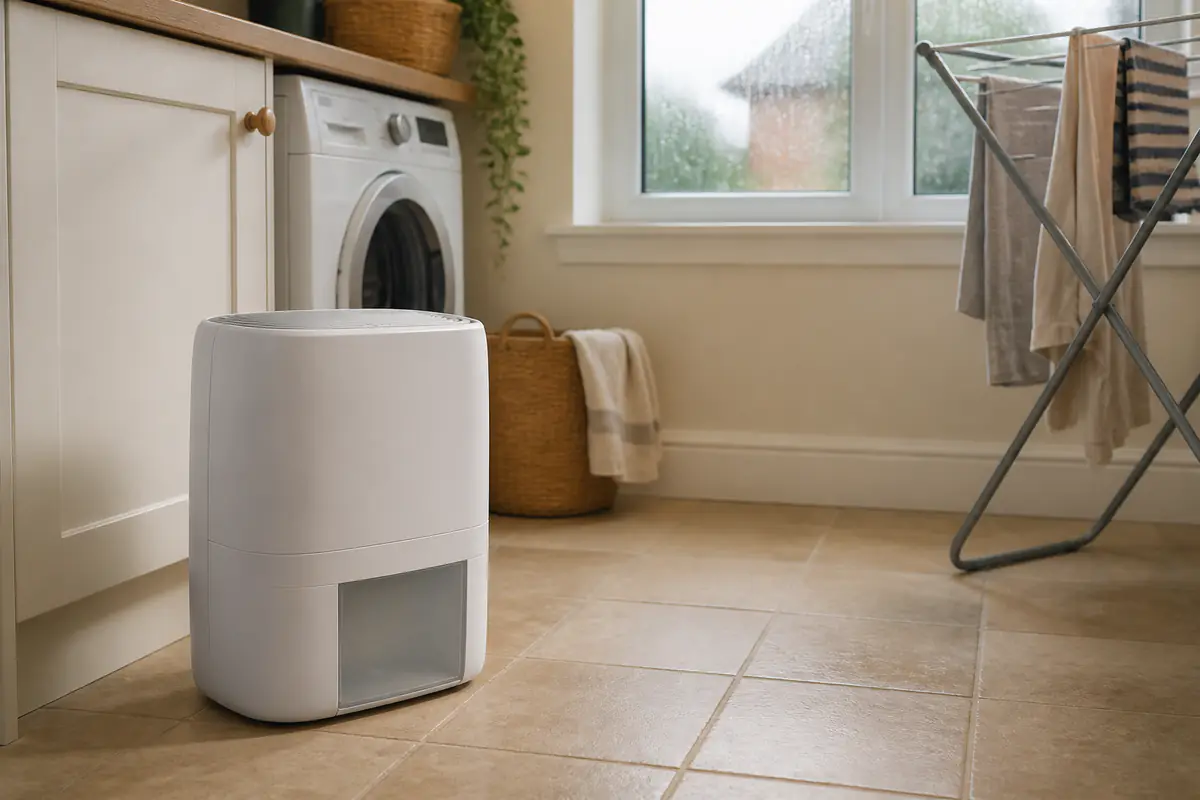
A dehumidifier should be chosen for the moisture source, room temperature and practical drainage route. A large daily extraction claim alone does not prove useful performance in a cool UK home.
In this guide
Diagnose the moisture before sizing the machine
A dehumidifier manages airborne moisture; it does not repair a leak, failed ventilation or structural damp. Record temperature and humidity, address the source, compare technology at realistic conditions and plan tank, drainage, noise and energy use.
Use our laundry-mode guide for drying clothes, measure rather than guess with the indoor air-quality monitor guide, and compare alternatives in the clothes-airer guide.
| Situation | Evidence | Likely priority | Do not assume |
|---|---|---|---|
| Warm occupied room | Temperature, humidity and moisture load | Controlled compressor performance | Headline litres equal home result |
| Cool garage or utility | Lowest real operating temperature | Low-temperature suitability | Every technology behaves alike |
| Laundry drying | Room closure, airflow, drainage and noise | Humidistat plus practical placement | Laundry mode replaces ventilation |
| Unattended drainage | Safe fall, connection and overflow controls | Documented continuous drain | A loose hose is fail-safe |
Dehumidifier requirement sheet
- Moisture source and affected rooms.
- Typical minimum and maximum temperature.
- Measured relative humidity pattern.
- Door and ventilation behaviour.
- Required operating hours.
- Acceptable sound location.
- Tank-emptying ability.
- Safe drain and energy budget.
Find the moisture source first
Look for leaks, plumbing faults, roof or gutter problems, blocked ventilation, unvented drying, cooking and bathing moisture, cold surfaces and overcrowded storage. Record when condensation or mould appears.
A dehumidifier can reduce airborne moisture while the source is addressed, but it must not hide structural or health risks. Seek landlord, surveyor or repair help where responsibility or fabric failure is involved.
Measure temperature and humidity over time
Use a reasonable monitor in representative positions and record morning, evening, weather and activities. One reading near the machine or window does not describe the whole home.
Relative humidity changes with temperature, so compare patterns alongside room conditions. Our monitor guide explains placement and interpretation limits.
Choose the dehumidification technology
Compressor and desiccant designs behave differently with temperature, power, heat output, weight and sound. Compare official operating ranges and performance evidence for the actual room.
Do not reduce the decision to a universal rule that one type is always better. A warm living room, cool garage and intermittent laundry room create different trade-offs.
Interrogate the litres-per-day claim
Rated extraction can be measured under warm, humid laboratory conditions that differ from a UK home. Find the stated test temperature and humidity and any lower-condition data.
Use the number to compare within a transparent method, not as a promise of water collected daily. Moisture load, room closure, temperature and target humidity alter the result.
Size for connected space and source
Record room volume, open doors, stairwells and whether one unit is expected to serve several zones. Air must reach the inlet and outlet for the machine to influence another room.
An oversized unit can add cost and noise; an undersized one may run continuously. Choose for the defined area and moisture generation, not the whole property by floor area alone.
Evaluate the humidistat
Check available set points, accuracy claims, hysteresis and whether the display shows measured or target humidity. A stable automatic cycle can be more useful than maximum continuous operation.
Compare the unit with a separate monitor cautiously because sensors occupy different positions. Do not chase identical numbers by placing both in the same exhaust stream.
Account for sound character and location
Compare sound level at the relevant mode and distance, but also consider compressor cycling, fan tone and vibration. A machine tolerable by day may disturb sleep or calls.
Plan a firm level surface with required clearance. Soft carpet or a resonant cabinet can alter noise and airflow and may be prohibited by the manual.
Check airflow and placement
Record inlet, outlet and clearance requirements and whether laundry can remain the required distance away. Avoid corners, curtains and furniture that short-circuit or block airflow.
Do not place the unit where collected water, a loose hose or a cable creates a trip or electrical hazard. Keep children and pets in the placement plan.
Choose a manageable tank
Compare capacity, handle, lid, fill weight, removal direction and whether the tank can reach a sink without spilling. A larger tank is not useful if the owner cannot lift it safely.
Check automatic shut-off and full indication, but do not treat them as permission to ignore the machine indefinitely. Inspect the tank and seating regularly.
Set an emptying and cleaning routine
Choose a check time that matches the moisture load and tank size, then note how quickly the tank fills in ordinary use. Empty and clean it by the manual rather than waiting for smell, slime or repeated full warnings.
Keep the float, seal and tank seating unobstructed and allow cleaned parts to dry as directed. If several people use the machine, assign responsibility for the tank, filter and hose inspection so automatic operation does not become assumed maintenance.
Plan continuous drainage as plumbing
Verify hose diameter, connector, maximum run, fall, pump requirement and permitted drain. Secure the line against movement and keep it free from kinks and freezing.
A gravity hose that rises or falls out of the drain can leak. Use continuous drainage only as documented and inspect it before leaving the machine unattended.
Include filter access and replacements
Identify washable and replaceable filters, access direction, cleaning interval and parts availability. A blocked filter can reduce airflow and change noise or energy use.
A basic dust screen is not automatically an air purifier. Do not buy the unit for particle or allergen claims unless the exact filtration evidence supports that separate purpose.
Compare controls after a power interruption
Check timer, restart memory, child lock, defrost and error behaviour. Smart control can be helpful, but essential humidity operation should remain understandable if an app or cloud service changes.
If use with a smart plug is contemplated, confirm manufacturer permission and safe restart behaviour. Do not switch compressor equipment repeatedly through an external timer without documented compatibility.
Calculate running cost at realistic duty
Use rated power, measured or expected duty cycle and current tariff scenarios rather than assuming full power every hour. Compare lower and higher moisture weeks.
The appliance running-cost guide shows the method. Energy spent addressing an unresolved leak is not evidence that a larger appliance is needed.
Plan laundry use as a room system
Dry clothes in a suitable contained room with airflow around the load and the unit positioned by its manual. Extracted water and reduced drying time depend on load, spin speed and room conditions.
Compare with a high-spin wash, ventilation and heat-pump dryer ownership. A laundry mode does not justify unsafe overcrowding or placing wet fabric against the machine.
Check frost and defrost behaviour
Compressor coils can frost in cooler air, so compare the official minimum temperature and defrost method. Cycling into defrost is not necessarily a fault, but persistent poor performance needs diagnosis.
A cool garage may call for different technology or expectations. Do not use improvised heaters beside the dehumidifier to force a laboratory-like condition.
Use the return period as a measured trial
Keep packaging and record temperature, starting humidity, target, hours, water collected, noise and cycling in the intended room. Test tank handling and drainage without permanent alteration.
Do not create excessive moisture to demonstrate collection. Follow online return evidence and distinguish dissatisfaction from an actual fault.
Plan service life and parts
Check warranty route, filters, tank, hose, float and service support. Compressor or refrigeration faults are not user repair jobs, and desiccant systems also contain heat and electrical risks.
Use the repairability guide and browse Home & Kitchen for related moisture and appliance decisions.
Compressor or desiccant dehumidifier?
The room is normally warm enough
Official lower-condition performance, sound, tank and running pattern suit an occupied heated space.
Cool-room performance matters more
The operating range and added heat suit a garage or cooler utility trade-off despite different energy and sound behaviour.
Balanced verdict
Choose a dehumidifier from conditions, not headline capacity. Diagnose the source, measure temperature and humidity, compare realistic performance and plan airflow, water and energy.
A successful unit is safe to empty or drain and quiet enough to operate when moisture is actually produced.
Official checks:
NHS damp and mould health information ↗
GOV.UK product safety advice ↗
HSE electrical safety information ↗
GOV.UK private-renting repair information ↗
Frequently asked questions
What extraction capacity does a UK home need?
It depends on moisture source, connected room volume, temperature and target humidity; rated litres may use conditions unlike the home.
Are compressor or desiccant models better?
Neither is universal. Compare realistic operating temperature, energy, heat, sound and the defined moisture task.
Can one dehumidifier serve several rooms?
Only when air can circulate effectively; closed doors and distant zones reduce influence and may require a different plan.
Is continuous drainage safe unattended?
Only when the exact documented hose, fall or pump, secure drain and inspection routine make leaks and blockage appropriately controlled.
Will a dehumidifier cure damp or mould?
It can manage airborne moisture but does not repair leaks, failed ventilation or structural damp; the source and health risk still need action.
Methodology and limitations
We assessed dehumidifier buying through moisture diagnosis, measured conditions, technology, rated extraction, space, humidistat, noise, airflow, tanks, drainage, filters, controls, running cost, laundry, cool-room behaviour, trial use and support. We did not test models, survey buildings, diagnose damp or promise a universal target setting. Exact property and health concerns may need qualified assessment.
Limitations
Building fabric, occupancy, weather, temperature and moisture sources vary. Specifications and energy prices change. Follow the exact manual, keep water and electricity controlled, and obtain competent repair, housing or health advice where appropriate.