Indoor air-quality monitors: PM2.5, CO2, VOC readings and placement
An indoor monitor does not measure “air quality” as one universal fact. Each sensor responds to a defined quantity, with its own range, interference, calibration and uncertainty. Choose the pollutants relevant to the room, place the device consistently and use patterns to guide source control and ventilation.
In this guide
Buy the measurement, not the coloured score
List the actual questions first: particles from cooking, CO2 as a ventilation indicator, selected VOC concerns, humidity or temperature. Then verify sensor type, units, logging, calibration guidance and data policy. A red light can prompt investigation; it cannot diagnose a pollutant source or medical condition.
This guide is about consumer monitoring and decision-making, not occupational compliance, medical diagnosis or proof that a home is safe. Suspected combustion, gas, carbon monoxide, serious damp or health symptoms require the appropriate alarms, professional assessment and official advice.
Define the question before choosing sensors
A kitchen affected by frying, a crowded bedroom, a damp bathroom and a newly decorated room present different questions. Start with the activity, time and location of concern. Decide whether you need immediate alerts, a week-long trend or evidence before and after a change.
Do not buy the device with the longest list of abbreviations. The evidence-research method helps translate a feature list into measurable decisions and exposes sensors whose type, range or maintenance is not documented.
| Reading | Useful question | Main limitation |
|---|---|---|
| PM2.5 | Do fine-particle levels rise during an activity? | Cannot identify composition or source alone |
| CO2 | Is occupied-room ventilation keeping pace? | Not a complete air-quality measure |
| Total VOC | Does a broad VOC signal change over time? | Selective response; not compound identification |
| Relative humidity | Is moisture persistently high or very low? | Changes with temperature and placement |
| Temperature | Are readings comparable under similar conditions? | Local heat sources distort room representation |
Specification record
- Pollutant or environmental quantity and stated sensor type.
- Units, measurement range, resolution and documented accuracy.
- Warm-up, calibration, drift and replacement guidance.
- Logging interval, local display, export and account dependency.
- Power source, battery behaviour and offline operation.
- Alert thresholds and whether the user can see raw readings.
- Privacy, support period and update route.
Understand PM2.5 readings
PM2.5 refers to particles with aerodynamic diameter up to 2.5 micrometres. Consumer optical sensors estimate concentration from light scattering, and their response can vary with particle composition, humidity and calibration. A number is not a laboratory analysis of what the particles contain.
Use repeated patterns: a cooking peak, candle use, vacuuming or outdoor ingress. Compare like conditions and annotate activities. If a reading rises, source control and appropriate ventilation are usually the first questions; purchasing a purifier is not the automatic answer.
Use CO2 as a ventilation indicator carefully
People exhale carbon dioxide, so an occupied-room rise can indicate that ventilation is not keeping pace with occupancy. The reading does not describe every pollutant and cannot prove that an empty room is healthy. Combustion sources also require separate safety controls.
Check whether the device uses a documented non-dispersive infrared sensor or another method, and read calibration instructions. Automatic baseline calibration can be unsuitable where the room never reaches outdoor-like levels; do not disable or alter it without understanding the manufacturer’s method.
Interpret VOC sensors as broad signals
Many consumer devices report total VOC or an index rather than identifying individual compounds. Sensors can respond differently to alcohol, cleaning products, fragrance, cooking and humidity. A spike may show that something changed without revealing which compound or health significance.
UK guidance provides values for selected VOCs based on compound-specific evidence. A broad consumer sensor cannot be assumed to measure those individual concentrations. Use source information, ventilation and professional testing where a specific chemical concern must be resolved.
Track humidity with temperature
Relative humidity describes moisture relative to air temperature, so a reading can change when the room warms without moisture being added or removed. Place temperature and humidity sensing away from a radiator, direct sun, shower spray, kettle, open window or dehumidifier outlet.
For a moisture-control purchase, the dehumidifier sizing guide covers room and extraction questions. A monitor can show trends but does not locate a leak, bridge or hidden mould.
Place one monitor for a defined purpose
A central breathing-zone position away from walls, corners and direct sources can support room trends, but the manufacturer’s placement guidance takes priority. A kitchen experiment may deliberately position the monitor where cooking effects can be compared, while a bedroom CO2 log should represent the occupied sleeping zone.
Record height, distance from window or door and whether a fan, purifier or heater changed airflow. Moving the device repeatedly destroys comparability. If you need multiple rooms, rotate it through fixed marked positions for equal periods before deciding that several devices are necessary.
Establish a baseline before reacting
Allow the stated warm-up and settling time, then collect ordinary readings for several days. Annotate occupancy, cooking, cleaning, windows, weather and equipment. A one-minute peak and an eight-hour elevation are different problems.
Compare medians, peak duration and recovery after a defined action. Do not chase a perfectly flat graph. Sensor noise, door opening and normal activities create variation; the goal is a repeatable pattern that changes a practical decision.
Test interventions one at a time
If a cooking peak is observed, repeat a similar task with lids, extraction and safe ventilation changed individually. If bedroom CO2 rises, compare occupancy and ventilation arrangements without introducing unrelated fragrances or devices. One change at a time makes the result interpretable.
Keep safety and outdoor conditions in view. Opening a window can admit particles when outdoor pollution is elevated, and mechanical extract must be used as designed. The monitor informs a trade-off; it does not issue universal instructions.
Do not substitute a monitor for required alarms
An air-quality monitor is not automatically a certified smoke, heat or carbon-monoxide alarm. Check the exact product purpose and applicable instructions. Never use a VOC or CO2 reading to rule out a combustion hazard or delay leaving an unsafe space.
Register relevant safety products, test alarms as directed and check official alerts. The manual-before-buying guide helps identify calibration, alarm, replacement and service requirements before payment.
Audit app, account and export dependence
A display-only device can be useful for immediate behaviour; longer experiments benefit from timestamps and export. Check whether history requires a cloud account or subscription, what happens without internet and whether raw readings can be downloaded in a durable format.
Connected monitoring creates household-pattern data. Read privacy and support terms and avoid placing accounts or screens where they expose occupancy. A product that loses useful history when a service closes may have a shorter practical life than the sensor.
Calculate ownership and maintenance cost
Include batteries, mains adapters, sensor replacement, calibration service, subscription and expected support. A low purchase price with an undocumented sensor or locked history may be poor value. Use the total-cost framework to compare the complete monitoring period.
Check returns before activating an account or removing protective parts, and verify the trader with the UK shop checklist. If accuracy is central, ask what evidence the manufacturer publishes rather than relying on star ratings.
Keep filtration claims separate
A monitor can sit inside a purifier, but the displayed value may be measured near the machine’s intake and may not represent the room. Likewise, a falling local particle reading does not establish removal of gases, allergens or infection risk.
The vacuum-filtration guide explains why filter labels, sealing and maintenance are a system. Apply the same discipline to any purifier: defined pollutant, airflow, filter, room and maintenance rather than a single coloured score.
Choose a monitor when
- A specific reading will change a practical action.
- The sensor, units and limitations are documented.
- You can place and log it consistently.
- Raw data remains accessible enough for the experiment.
Seek another route when
- A required safety alarm or professional test is needed.
- A specific compound must be identified.
- Symptoms or serious damp need qualified assessment.
- The product hides sensors behind one unexplained score.
Balanced verdict
An indoor monitor is valuable when it answers one defined question repeatedly. PM2.5, CO2, VOC, humidity and temperature are related environmental signals, not interchangeable grades.
Choose documented sensors, establish a baseline and change one condition at a time. Treat alerts as prompts to investigate and use official safety or professional routes when the question exceeds the device.
Check current official information:
UK indoor VOC guidanceGOV.UK air quality and health collectionUK product safety alerts and recalls
Frequently asked questions
Does one air-quality score measure everything?
No. It combines or simplifies selected sensors using a manufacturer method.
Can a CO2 monitor detect carbon monoxide?
No. Use the correct certified carbon-monoxide alarm and follow its instructions.
Can a VOC sensor identify a chemical?
Most consumer total-VOC sensors cannot identify individual compounds or their health significance.
Where should I place the monitor?
Follow the manufacturer and choose a fixed representative position away from direct sources unless testing one deliberately.
How long should I log readings?
Long enough to cover representative activities and repeated conditions; several days is more useful than one isolated peak.
Does a falling reading prove a purifier works?
It shows a change at that sensor position, not universal removal of every relevant pollutant.
How we researched this guide
Recommended Today reviewed current UK indoor-air and selected-VOC guidance, consumer sensor documentation principles and repeatable monitoring methods.
Limitations
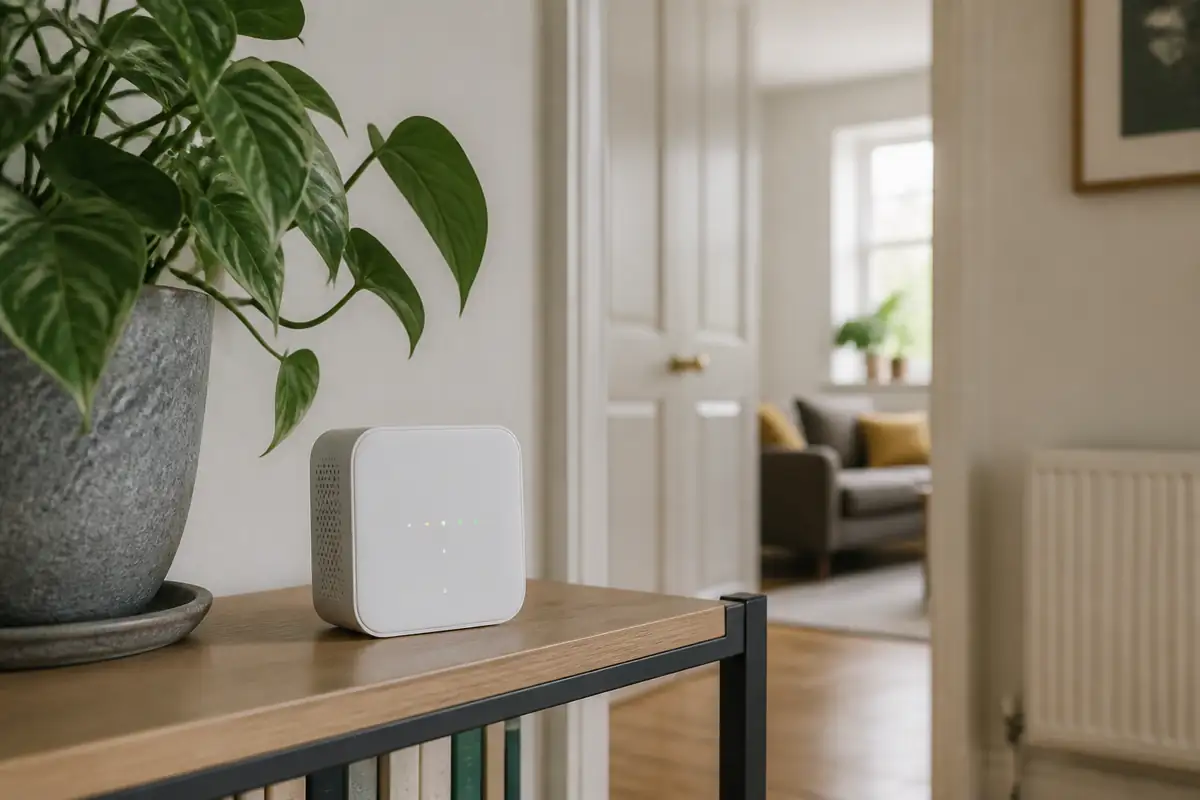
We did not calibrate a monitor, test a home or provide medical, occupational or building advice. Sensors and official guidance change. Recheck the exact model and concern before purchase. The image is an editorial illustration, not a photograph from a product test.