Clothes airers buying guide: capacity, stability, ventilation and storage
A useful clothes airer holds a real wash load, stays stable and fits storage. Compare usable rail spacing, garment drop, open footprint, ventilation and room moisture.
In this guide
Map the wet load and the open footprint first
Choose enough separated rail for the household’s normal wash, then confirm doors, routes, radiators and ventilation still work. A tall tower saves floor area but can crowd long items; a winged airer gives flexible drops but needs more width. Heated models add controlled warmth, not permission to ignore moisture and electrical safety.
Airers are often sold by metres of drying space, tiers or claimed wash loads. Those figures cannot reveal whether adult shirts hang freely, sheets fit without dense folding or socks occupy every short rail. If excess indoor humidity is the main constraint, read our dehumidifier sizing guide before buying a larger rack.
Start with the household’s actual laundry
Record one representative load before measuring products: number of shirts, trousers, towels, underwear and any bedding. Note the longest item and whether it can be folded over a rail without doubling drying time or creating a visible line. A baby-clothes load needs many small hanging points; a bedding load needs broad uninterrupted span and room circulation.
Do not size only to washing-machine kilograms. Dry load ratings describe textiles entering a machine, while airers must manage wet shape, spacing and weight distribution. Our washing-machine capacity guide explains why drum kilograms do not translate directly into rack metres.
Compare layouts by usable geometry
| Airer type | Strength | Constraint | Measure carefully |
|---|---|---|---|
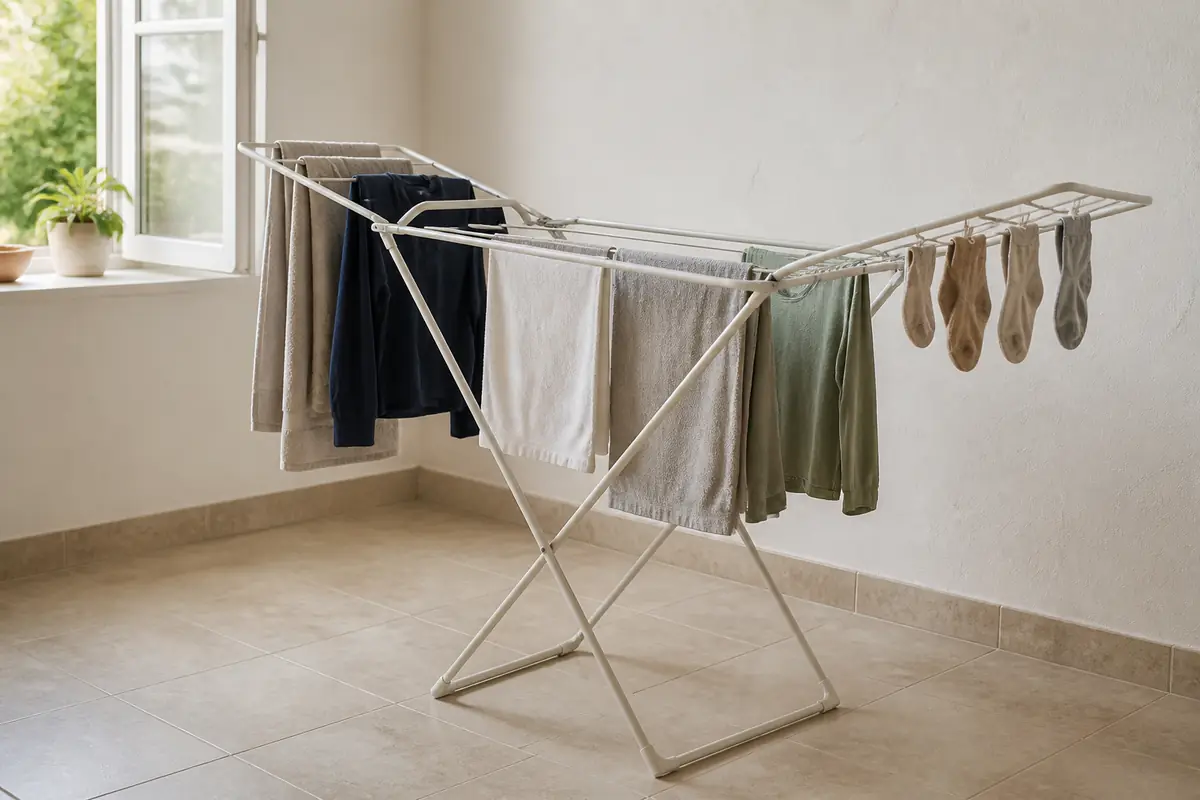
| Winged | Flexible heights for mixed garments | Wide open footprint | Wing locks, drop and floor width |
| Tower | More rail over a smaller floor area | Short drops and crowded inner tiers | Tier spacing, stability and caster locks |
| Bath or radiator style | Uses an existing edge or narrow zone | Limited capacity and support compatibility | Contact surface, heat rules and balance |
| Wall or ceiling mounted | Preserves floor space | Needs correct structure and installation | Fixings, load, reach and pull direction |
| Heated | Adds local warmth to permitted textiles | Electricity, cable and cover restrictions | Rated input, controls and exact instructions |
A tall airer can fit a small floor rectangle yet obstruct sight lines or collide with a pendant light, cabinet or sloping ceiling. A winged model may fit when closed but block a door when opened. Draw its maximum footprint on the floor and include the user’s working space for loading both sides.
Rail metres need translation
Published drying length normally adds every rail end to end. That is a comparable number, but it treats an inner 40-centimetre rail as equal to an outer one with full garment drop. Count how many adult tops, trousers and towels can hang without touching the floor or bunching against a lower tier.
Closely spaced rails increase theoretical metres but reduce airflow and access. Wet items should not be packed so densely that every surface touches another. Removable shelves or folding tiers can create long-item space, provided the remaining frame stays stable and the manufacturer allows that configuration.
Check load ratings and weight distribution
Wet laundry is heavier than dry laundry. Seek a stated maximum load and follow any per-wing or per-tier limit. Spread heavy towels, jeans and bedding across the frame rather than loading one raised edge. A rack that twists under uneven weight can close unexpectedly or mark flooring.
Wall-mounted and ceiling systems transfer load to fixings and building structure. The fixing must suit the wall or ceiling material and the direction of force; a generic plug is not automatically appropriate. If the structure is uncertain, use a competent installer. Never infer a sitting, climbing or child-hanging load from a laundry rating.
Stability comes from more than a wide base
Inspect the leg angle, cross-bracing, hinge locks and feet. A frame should open positively and resist accidental folding during loading. Rubber or polymer feet need enough contact area for the floor without staining it. Casters can help move an unloaded tower, but every required brake should be engaged before use.
Place the airer on a level surface away from door swings, stairs, cooking and open flames. Children and pets can pull hanging clothes or enter the frame. A lightweight airer should not be used outdoors unless the maker allows it and conditions are suitable; wind can turn wet sheets into a large sail.
Ventilation is part of the product decision
Drying laundry releases moisture into the room. An airer does not remove that water; it only supports the clothes while evaporation moves it into the air. Use ventilation or suitable humidity control, and follow current housing and appliance advice. Repeated condensation on windows, walls or cold corners signals a room problem that a denser rack will not solve.
Leave air gaps between items, open permitted room ventilation and avoid pressing laundry directly against walls. A fan or dehumidifier may improve movement or moisture removal when used safely and as instructed. Do not place an ordinary unheated airer against a space heater or drape clothing over a heater. For running-cost comparisons, use our appliance cost guide.
Heated airers require an electrical brief
Before choosing a heated model
- Check rated wattage, plug and cable reach without relying on a trailing extension.
- Read whether a cover is supplied, optional, required or prohibited.
- Confirm permitted textile contact and maximum loading.
- Look for clear controls, indicator and overheat protection information.
- Keep the appliance away from water sources and follow unattended-use guidance.
- Check the current product-safety and recall record for the exact model.
A heated airer is not a tumble dryer in rack form. Warm rails can speed local evaporation, especially where fabric touches them, but overlapped layers may still dry unevenly. A cover can retain warmer air only when designed for that model and used exactly as instructed; improvised blankets can create a hazard.
Materials affect rust, marking and repair
Powder-coated steel can be rigid and economical, but chips may expose metal. Stainless steel terminology should be supported by a material specification where corrosion resistance matters. Aluminium reduces weight but tube shape, joints and wall thickness determine stiffness. Plastic joints carry much of the folding stress even on a metal frame.
Look for smooth rail finishes that will not snag delicate textiles or transfer colour. Caps should be secure. Screwed joints may be easier to tighten or replace than permanent rivets, although the complete design decides durability. Store only when dry, especially in a humid cupboard, and use our repairability guide to check spares and support.
Folded dimensions are a pass-or-fail measurement
Measure the storage opening at its narrowest point, including skirting, hinges, pipes and handles. Record folded width, depth and height, plus the direction in which the airer must be lifted. A slim product can still be too tall for an under-stairs cupboard or too heavy to hang safely on a wall hook.
Freestanding folded frames can reopen or fall. Use any transport catch and store where children cannot pull them over. A model that is effortless to deploy will be used more consistently than one requiring furniture to move every wash day. Compare dimensions with the same care used in our storage-furniture comparison.
Choose compact footprint or open access
Floor width is the strict limit
You mostly dry small and medium items, can create long-item gaps and have enough height, stability and access around the tiers.
Mixed drops and easy loading lead
You have a wider clear floor area and need adaptable heights for shirts, trousers, towels and flat-supported pieces.
Accessories should solve named problems
Sock clips, hanger slots and mesh shelves can release main rail space. They are useful only when accessible and rated for the intended items. A flat mesh level may support knitwear while reducing distortion, but the garment still needs airflow and label-compliant care. Sharp clips can mark fabric; detachable pieces can be lost.
Integrated shoe holders are not universally suitable for footwear care. Wet shoes may need shape support, gentle temperature and separation from clothing. The airer should remain a laundry support, not a reason to ignore each item’s instructions.
A disciplined shortlist
- Photograph and count one representative wet load.
- Measure longest garment drop and required rail spacing.
- Map the full open footprint, height and loading route.
- Confirm total and section load limits.
- Inspect hinges, locks, feet, joints and rail finish.
- Plan ventilation and any electricity safely.
- Measure folded storage and compare warranty or spare parts.
Balanced verdict
A good clothes airer turns stated rail length into separated, stable and accessible drying space. Choose the geometry for real garments, not the largest headline number. Heated models can be useful, but they add electrical responsibilities and still need moisture management; ordinary models remain effective where spacing, ventilation and routine are sound.
Before buying an unfamiliar model, use our online-shop legitimacy checklist, or browse the Home & Kitchen archive for appliance and storage decisions.
Official safety and housing guidance:
GOV.UK consumer product safety advice ↗UK product safety alerts and recalls ↗GOV.UK: health risks of damp and mould ↗
Frequently asked questions
How large an airer do I need?
Count a representative load and translate rail metres into actual garment spaces, including long-item drop and airflow.
Are tower airers better for small rooms?
They use less floor width, but need height, stability and enough tier spacing. Long garments may require tiers to fold away.
Will a heated airer stop condensation?
No — It can increase evaporation, but the released moisture still needs ventilation or suitable removal from the room.
Can I cover a heated airer?
Only with a cover specifically permitted for the exact model and used according to instructions. Never improvise a cover.
Can an indoor airer be used outside?
Only if the manufacturer permits it and conditions are safe. Wind, uneven ground and corrosion can create risks.
Methodology and limitations
We assessed clothes airers through household load, usable rail geometry, open footprint, garment drop, stability, wet-load support, materials, ventilation, heated operation, storage, maintenance and public safety guidance.
Limitations
We did not dry a standardised load on named products or publish speed rankings. Room temperature, humidity, airflow, textile type, spin extraction and spacing change results. Verify the exact dimensions, ratings, instructions and safety notices.