Dehumidifier laundry modes: what they do and how to compare running cost
Laundry mode is a control programme, not a separate drying technology. It may set a lower humidity target, higher fan speed or fixed run time, but performance still depends on room temperature, starting humidity, airflow, wet load, extraction efficiency and safe placement.
In this guide
Compare energy per completed load, not the button name
Read the manual for the exact laundry programme, record power at the relevant setting, then measure hours needed for a repeatable load in a closed ventilated room. Cost per hour × actual compressor or heater run time is more useful than a promotional claim. Stop automatically or return to humidity control when the load is dry.
This guide explains selection and measurement. It does not claim that a dehumidifier replaces safe ventilation, heating, mould remediation or every tumble-dryer use. Never cover the appliance, direct it at dripping garments or use it where the manual prohibits.
Read what the programme actually changes
One model’s laundry mode may run the fan high for a fixed period; another may target a low relative humidity and cycle its compressor; a desiccant unit may combine stronger heat and airflow. The label therefore cannot be compared across brands without the manual.
Meaco describes one current Smart Laundry programme as selecting high fan, a 35% relative-humidity target and a six-hour timer, while cycling the compressor around that target. This is one implementation, not a universal definition.
| Evidence | Why it matters | Common comparison error |
|---|---|---|
| Programme logic | Shows target, timer and cycling behaviour | Assuming every laundry button works alike |
| Input power by setting | Supports energy calculation | Using one maximum wattage for every hour |
| Room temperature | Affects compressor extraction strongly | Comparing warm and cold tests |
| Water removed and dry time | Measures the completed task | Comparing litres-per-day labels alone |
| Noise and airflow | Affects usable placement and overnight suitability | Ignoring high-fan operation |
Repeatable home laundry log
- Garment types and post-spin wet weight.
- Room volume, temperature and starting humidity.
- Rack position, spacing and door or window state.
- Exact mode, fan and target setting.
- Plug-in energy reading for the complete cycle.
- Elapsed time and water collected.
- Dryness check at cuffs, waistbands, seams and pockets.
Choose capacity for conditions, not laundry slogans
Published extraction in litres per day is often measured under defined warm and humid conditions that may not match a UK utility room. Compare test conditions as well as capacity. A larger rating can finish sooner, but oversizing does not guarantee lower energy per load.
The UK dehumidifier sizing guide covers room volume, temperature and moisture load. Laundry is a concentrated temporary load, so consider both the everyday humidity task and the wettest routine.
Compressor and desiccant units behave differently
Compressor dehumidifiers are generally most effective in warmer occupied rooms; cold air reduces coil performance and can trigger defrost cycles. Desiccant models can maintain extraction at lower temperatures and release more heat, but usually draw more power.
Do not compare wattage without cycle time and useful heat. A colder unheated space may make a desiccant unit operationally suitable despite higher power, while a normal heated room often favours a compressor. The manual’s operating-temperature range is a hard filter.
Air movement dries fabric as well as the room
Space garments so air reaches both sides, open pockets and separate thick folds. Place the rack and appliance according to clearance instructions, with intake and outlet unobstructed. Rotating dense items partway can expose hidden damp areas.
A fan may continue after the compressor stops, so a silent compressor cycle is not necessarily an off appliance. High fan can shorten drying but increase noise. Decide whether the room can remain closed without blocking required background ventilation.
Calculate energy for the complete task
Use measured kilowatt-hours where possible. Otherwise multiply input kilowatts by active hours, recognising that a humidistat-controlled compressor may cycle. Multiply energy by the unit rate on the household tariff. Do not publish a fixed pence figure without the dated tariff.
Include repeated extension cycles if heavy items remain damp. The total-cost framework also adds filter, maintenance and expected service life rather than comparing electricity alone.
Compare with the real alternative
The alternative may be line drying, heated indoor air, a tumble dryer, a heated airer plus ventilation or a mixed method. Compare completed loads of the same size and final dryness, including any heating used to manage temperature and condensation.
Do not claim that extracted water equals all moisture removed from clothing: some moisture leaves through ventilation or remains in the room and fabric. A controlled repeated test is more useful than one tank reading.
Control humidity after the clothes are dry
Very low targets are not necessarily appropriate for continuous household use. Laundry mode may be intentionally aggressive and time-limited. Return to the manufacturer’s recommended humidity control after the load, and investigate persistent damp sources rather than running indefinitely.
Keep doors open or closed only as the intended zone and manual require. A unit trying to dry the whole house through open doors may run longer than a correctly sized closed-room task.
Check drainage, tank and filter routine
A full tank can stop extraction before the load is dry. Continuous drainage needs a stable downward hose route, secure connection and suitable drain. Test it before leaving the unit unattended; never assume a hose cannot kink or detach.
Clean the filter at the stated interval. Restricted airflow can reduce performance and raise noise. Read the manual-before-buying guide to identify filter access, drainage and replacement parts before purchase.
Use safe placement and an intact electrical supply
Place the appliance upright on a stable level surface, away from splashes and direct garment drips. Respect clearances and cable instructions. Do not use an extension lead unless the manufacturer explicitly permits a suitable arrangement.
Drying indoors can concentrate lint and fragrance. Stop if the plug, cable, casing, fan or sound changes abnormally and follow manufacturer service guidance. Register the product and retain model and purchase details.
Inspect promises before buying
Ask whether the stated cycle time is a guarantee or an example under defined conditions. Verify the load, room, temperature and humidity behind any “dry in” claim. A photograph of towels beside a machine is not test evidence.
Use the evidence-research method to separate specifications from results, and the returns-policy checklist for opened appliance handling and collection cost.
Run a fair seven-load comparison
One unusually wet or light wash can produce a misleading result. For a useful household comparison, record several representative loads: for example bedding, towels, mixed cotton, synthetics and a small urgent load. Use the same washing-machine spin setting where the fabrics permit, describe the load consistently and record whether the heating was already on for comfort. A result measured in a naturally warm room should not be presented as if the dehumidifier alone supplied that warmth.
For every cycle, note start and finish time, beginning and ending room temperature and humidity, metered kilowatt-hours, tank water, any manual garment rotation and the dampest point at the finish. Median energy and time are more informative than the single best run. If a load needed an extra hour after the programme ended, include it: the task is complete only when the clothes meet the same dryness test.
Decision record after the trial
- Retain the exact mode and room setup that produced the repeatable result.
- Separate electricity used by the dehumidifier from any additional heating or fan.
- Record noise or access compromises that make the cheapest method impractical.
- Recheck filters, clearances and tank handling before blaming the programme.
- Compare the measured task with the household’s real alternative, not an idealised appliance claim.
Check the retailer and model record
Before ordering, confirm the legal seller, full model number, warranty route and availability of the current manual. The UK online-shop verification checklist helps distinguish an identifiable trader from a copied storefront. Save the specification and laundry-mode wording used for the decision because manufacturers can revise pages and similarly named models can have different controls.
Use laundry mode when
- The manual defines a suitable controlled programme.
- The room and temperature fit the machine.
- Airflow reaches a well-spaced load.
- Energy and dryness are measured to completion.
Use normal humidity control when
- The concentrated wet load is finished.
- A lower fan reduces unnecessary noise.
- The room only needs background moisture control.
- The programme target would be too aggressive continuously.
Balanced verdict
A useful laundry mode coordinates airflow, humidity and time; it does not make every dehumidifier equally efficient. Capacity, temperature, programme logic and rack arrangement decide the result.
Choose on documented behaviour, then measure kilowatt-hours per comparable dry load. That record will show whether high fan, a different target or another drying method works better in the actual home.
Check current official information:
Meaco laundry-mode explanationGOV.UK product-safety guidanceUK product safety alerts and recalls
Frequently asked questions
Is laundry mode just maximum power?
Not always. It may combine a humidity target, fan setting and timer; check the exact manual.
Should the door be closed?
Usually a defined drying zone improves control, but follow ventilation and manufacturer instructions for the room.
How do I calculate one cycle’s cost?
Multiply measured kilowatt-hours by the household unit rate, including any extension needed for complete dryness.
Is a bigger litre rating always cheaper?
No. Test conditions, power, cycle time, temperature and load all affect energy per task.
Can I leave it running overnight?
Only as the manufacturer permits, with safe placement, intact drainage or tank capacity and no covered vents.
Does tank water equal moisture removed from laundry?
Not exactly. Moisture also exists in the room, may leave through ventilation and can remain in fabric.
How we researched this guide
Recommended Today reviewed current manufacturer explanations of programme logic and running power, UK product-safety guidance and repeatable task-cost methods.
Limitations
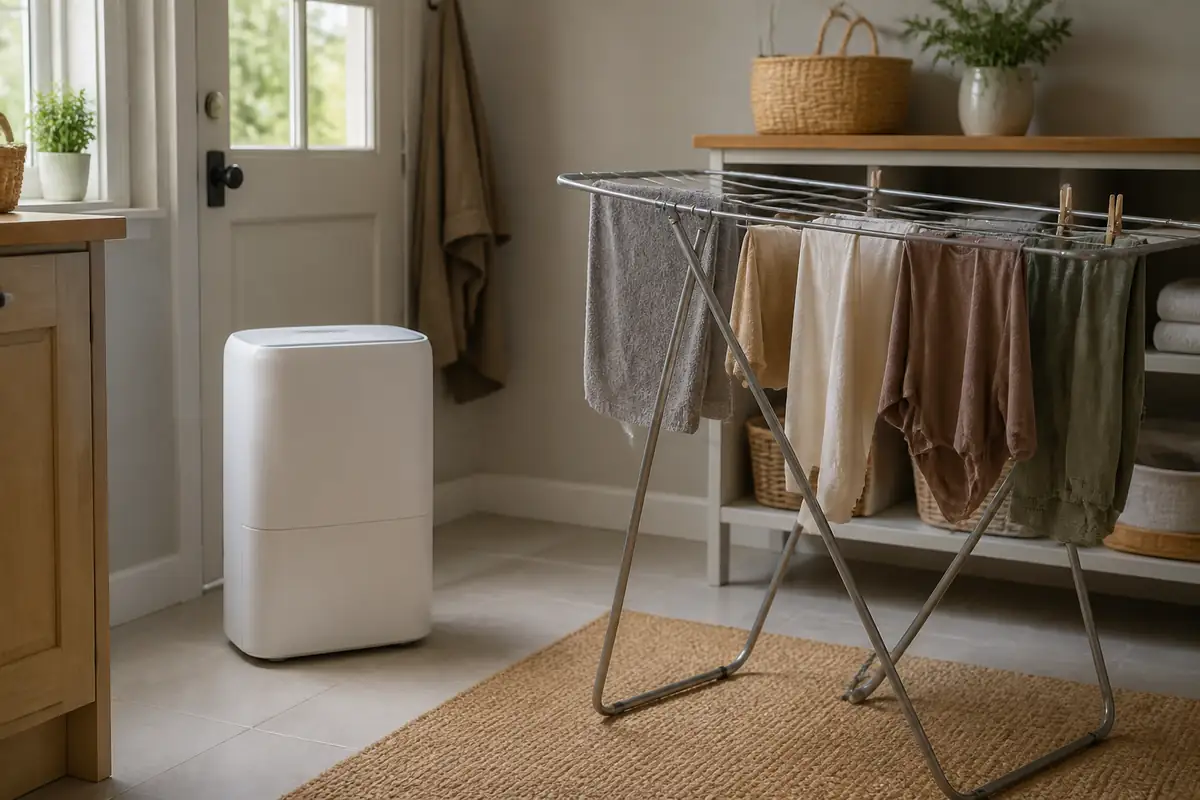
We did not energy-meter or dry a laundry load with named products and publish no universal pence figure. Recheck manuals, tariffs and conditions before purchase. The image is an editorial illustration, not a photograph from a product test.