Carpet cleaners ownership guide: detergent, storage and maintenance
A carpet cleaner stays useful when solution, extraction, drying and storage are treated as one process. More detergent and repeated wet passes can leave the carpet worse rather than cleaner.
In this guide
Control moisture and residue before chasing appearance
Use only the approved solution and dose, then recover as much liquid as the machine allows. Test the material, plan drying, empty and rinse the system after use, and store every component clean, dry and without strain.
Select the right system with our carpet-cleaner buying guide, compare useful specifications in the value guide, and check the floor itself with the rug ownership guide.
| Symptom | Check first | Controlled response | Avoid |
|---|---|---|---|
| Foam or sticky pile | Solution type, dose and prior residue | Follow rinse guidance and extract | Adding more detergent |
| Weak recovery | Dirty tank, seals, nozzle and hose | Clean and reseat user-serviceable parts | Running repeated wet passes |
| Slow drying | Pass count, extraction, ventilation and humidity | Increase safe airflow and time | Replacing furniture too early |
| Odour in storage | Residual water, tanks, hose and brush | Clean and dry fully | Sealing a damp machine in a cupboard |
Carpet cleaning job record
- Carpet or rug identification.
- Maker cleaning permission.
- Colourfastness test.
- Solution product and dose.
- Passes and water recovered.
- Room conditions and drying time.
- Machine cleaning completed.
- Faults, parts and service.
Identify the floor covering first
Record fibre, construction, backing, installation and any manufacturer restrictions. A fitted synthetic carpet, wool rug and natural-fibre floor covering can require different methods.
Do not infer wet-cleaning permission from appearance. If the material, dye stability or backing is uncertain, use a competent professional rather than creating a whole-room experiment.
Vacuum dry soil before adding liquid
Remove loose debris with a suitable vacuum and treat sharp objects, threads and large particles before using the extractor. Dry soil becomes harder to manage when turned into mud.
Check that the room is clear and the cable route safe. Moving furniture during a wet job increases trip, crushing and staining risks.
Run a controlled hidden-area test
Test colour, texture and cleaning response in an inconspicuous place using the exact intended solution and method. Allow the test to dry fully before accepting it.
An immediate clean appearance does not prove that dye, pile, backing or residue will remain stable after drying. Record the test area and result.
Use only approved detergent
Match the detergent to the machine and floor-covering guidance. Household washing liquid, dish soap, disinfectant or fragrance can foam, leave residue or damage components.
Save the product name, dilution and safety information. Never mix cleaning chemicals, and keep the solution away from children, pets and food preparation.
Measure the dose rather than estimating
Use the supplied measure or an accurate dedicated tool and follow the concentration for tank volume. More detergent does not create proportionally more cleaning.
Overdosing can increase foam and sticky residue that attracts soil. If the carpet was previously overtreated, the response may need a professional plan rather than repeated home rinsing.
Fill tanks with the machine isolated
Switch off and unplug before removing or filling tanks unless the exact instructions state another safe sequence. Keep water away from the body, plug, socket and extension connections.
Seat caps, valves and seals correctly and wipe spills before reconnecting power. Do not carry a full tank over an energised machine.
Plan passes before starting
Divide the room into manageable sections and follow the documented wet and recovery strokes. Move at a repeatable pace rather than saturating a stubborn patch with many uncounted passes.
Use extra dry recovery passes where the manual permits. Stop if water is not being recovered, foam enters the wrong area or the machine sounds or smells abnormal.
Treat stains without improvising chemistry
Blot fresh spills and use only a compatible pre-treatment according to the floor and machine instructions. Record what caused the mark and what has already been applied.
Heat, bleach, vigorous rubbing and mixed spot products can set stains or alter colour. A valuable rug or unknown stain may justify professional treatment.
Watch the dirty-water tank
Empty before the maximum mark and whenever recovery changes. Foam can trigger a float or enter places liquid should not reach, depending on design.
Do not bypass shut-off systems or keep operating when the machine indicates a full tank. Use gloves and sensible hygiene when handling recovered water.
Recover moisture before leaving the room
Complete the permitted extraction strokes and inspect whether the nozzle makes even contact. A blocked path, loose tank or worn seal can leave more water behind.
The repairability guide helps distinguish a cleanable nozzle or replaceable seal from a fault requiring service. Do not dismantle electrical areas.
Dry the room safely
Provide ventilation and suitable heating or dehumidification without creating condensation, electrical or unattended-heater hazards. Keep people and pets off the carpet until it is genuinely dry.
Drying time depends on material, moisture, extraction and weather. Do not use a fixed clock as proof and do not replace furniture while the pile or backing remains damp.
Prevent furniture marks and dye transfer
Move furniture only when safe and protect the wet carpet from wood stain, rust or dirty feet. Follow the carpet and furniture guidance on blocks or foil where applicable.
A heavy item placed early can compress damp pile and slow drying. Photograph room layout before moving pieces so they return without dragging across the surface.
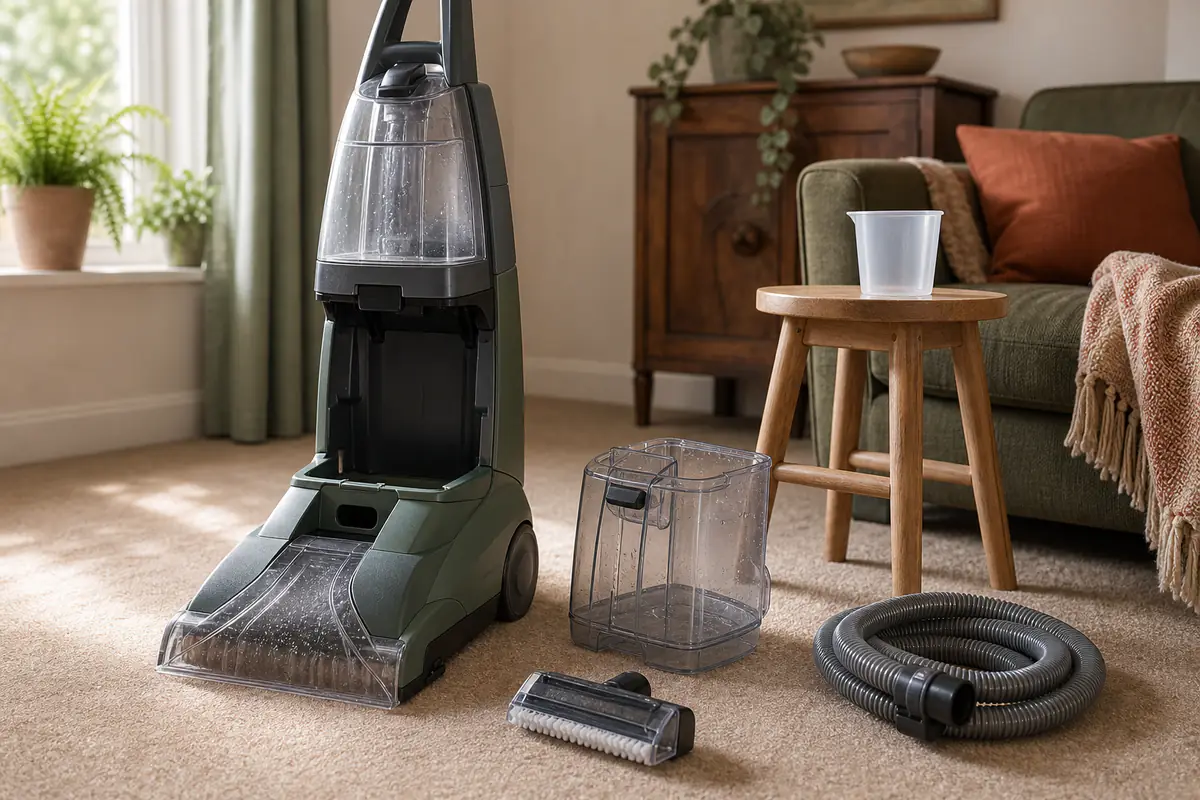
Clean the tanks immediately after use
Dispose of recovered water appropriately, rinse tanks by the manual and remove hair or debris from user-serviceable screens. Do not leave solution in the clean tank for an undefined future job.
Check seals while visible but do not oil or treat them unless instructed. A tank that is stored dirty can develop odour, residue and blocked valves.
Rinse hoses, tools and brushes as directed
Flush only by the documented method and remove fibres from brush and nozzle areas after isolating power. Inspect tool channels in good light rather than pushing wire into them.
The specification guide is useful when ordering a replacement hose or tool: fit, seal and part code matter more than visual similarity.
Dry every part before reassembly
Air-dry tanks, caps and washable parts in a clean ventilated place. Keep openings protected from insects and dirt without sealing retained moisture inside.
Do not use high heat to accelerate drying unless expressly permitted. Heat can distort plastic, seals and brush components.
Store upright without cable strain
Choose a dry, frost-protected location where the machine cannot fall and residual liquid cannot reach electrics. Coil the cable loosely using the designed hooks without sharp bends.
Support hoses and tools so they are not crushed. Keep detergent sealed in its original labelled container and separate from the machine if leakage could cause damage.
Diagnose one layer at a time
For poor spray or suction, check fill level, tank seating, caps, filters, nozzle, hose and permitted blockages in the manual order. Change one condition and retest on a small controlled area.
Stop for electrical smell, heat, damaged cable, leaks into the body or abnormal noise. Compare the cautious stop-and-service method in our vacuum ownership guide rather than repeatedly cycling power.
Keep ownership costs visible
Record detergent, filters, belts, brushes, tools, service and storage space. Compare the realistic annual cost with hiring or professional cleaning for the household frequency.
Browse Home & Kitchen for related maintenance. A machine used rarely still needs dry storage and a pre-use inspection; dormancy is not maintenance-free.
Continue cleaning or stop the job?
Material and extraction remain controlled
The test is stable, solution is approved, recovery is even and safe drying capacity is ready.
Moisture, colour or equipment is uncertain
Dye movement, saturation, foam, poor recovery, electrical signs or an unknown valuable floor covering needs a safer route.
Balanced verdict
Carpet-cleaner ownership is moisture management. Test first, dose exactly, recover thoroughly, dry the room and clean the complete liquid path before storage.
Maintenance prevents residue and damp from turning one cleaning job into the next fault.
Official checks:
HSE chemical safety information ↗
GOV.UK product safety advice ↗
Electrical Safety First home guidance ↗
GOV.UK recycling collections ↗
Frequently asked questions
Can ordinary laundry detergent be used in a carpet cleaner?
Use only the solution approved for the exact machine and floor covering; improvised detergent can foam, leave residue or damage components.
Why does a carpet feel sticky after cleaning?
Overdosed detergent or earlier residue may be involved. Follow the documented rinse and extraction advice rather than adding more product.
How can carpet drying be accelerated?
Recover as much liquid as permitted and use safe ventilation and suitable room conditions without creating electrical or heater hazards.
Should clean solution remain in the tank?
Normally empty and clean the system after use according to the manual; do not store an undefined mixture for the next job.
When should professional cleaning be used?
Use competent help for uncertain fibres, unstable dyes, valuable rugs, major contamination, saturation or equipment faults beyond safe user maintenance.
Methodology and limitations
We assessed carpet-cleaner ownership through floor identification, dry preparation, testing, detergent selection, dosing, tanks, passes, extraction, drying, furniture, post-use cleaning, storage, faults and cost. The method treats recovered water and complete drying as core evidence rather than judging success only by immediate colour. We separated safe user cleaning from electrical, contamination and material problems that need competent help. We did not clean individual carpets, endorse chemicals or specify a universal drying time. Exact machine, detergent and floor-covering instructions take priority.
Limitations
Fibres, dyes, backing, installation, prior treatments and machines vary. Water, electricity, chemicals, mould and contaminated recovery create risks. Stop when the material or equipment is uncertain and use qualified cleaning or electrical help where appropriate.