Wide-fit shoe widths explained: UK fittings, toe-box shape and construction
“Wide fit” is not a shared UK measurement. A width letter, toe-box outline, last volume, upper material and fastening all affect usable space, so compare the brand’s own system and the exact style rather than translating one label blindly.
In this guide
Buy the shape and volume, not the word “wide”
Find the range’s width chart, identify where extra room is added and compare it with the widest, deepest and longest parts of the foot. A broader forefoot does not guarantee a roomy instep or heel. A secure adjustable fastening and compatible last are more useful than simply sizing up.
This guide explains adult shoe-width systems and construction for ordinary retail purchases. It does not diagnose foot conditions or prescribe footwear for pain, diabetes, injury, orthotics or specialist needs. Seek an appropriately qualified professional when fit has a medical or mobility context.
Separate length, width and volume
Length runs from heel to longest toe. Width is usually discussed at the forefoot, while volume includes vertical space over toes, ball, instep and midfoot. A foot can be broad but shallow, narrow with a high instep, or different between left and right. One “wide” label cannot describe every combination.
A larger length size usually increases several dimensions at once. That can place the flex point too far forward and let the heel move without solving a local pressure point. Use the correct length first, then compare width, last shape and volume. The online trainers guide applies this sequence to casual footwear.
| Evidence | What it can show | What it cannot prove | How to use it |
|---|---|---|---|
| Width letter | Position within that brand’s system | Equivalence across brands | Read the same range’s chart |
| Forefoot circumference | Combined width and depth at one line | Toe shape or heel hold | Compare with the stated method |
| Outsole width | External platform at a point | Internal usable space | Use only as supporting evidence |
| Removable insole outline | Approximate internal shape and length | Upper volume and construction | Compare without assuming exact fit |
| Product reviews | Recurring style-specific fit patterns | Your size or objective dimensions | Use to form questions, not a verdict |
Width-system questions to answer
- Is the label standard, wide, extra-wide or a letter?
- Does the chart define women’s and men’s widths separately?
- Which point is measured: foot width, circumference or shoe?
- Does added room sit at toes, ball, instep, heel or throughout?
- Is the style built on a distinct wide last or only a softer upper?
- Can laces, straps or buckles regulate volume securely?
- Are half sizes and alternative widths available independently?
Width letters are brand systems
UK retailers may use letters such as C, D, E, F, G, H or combinations, but sequence and meaning vary by brand, gender category, age group and range. Clarks, for example, states that its adult standard widths differ between women’s and men’s shoes. Another retailer can use “E” or “EEE” differently.
Do not convert a successful letter from one brand into a universal width. Record the brand, range, style, size and width together. The current chart is the authority for its own products, and even then style construction can alter fit.
The last determines the three-dimensional shape
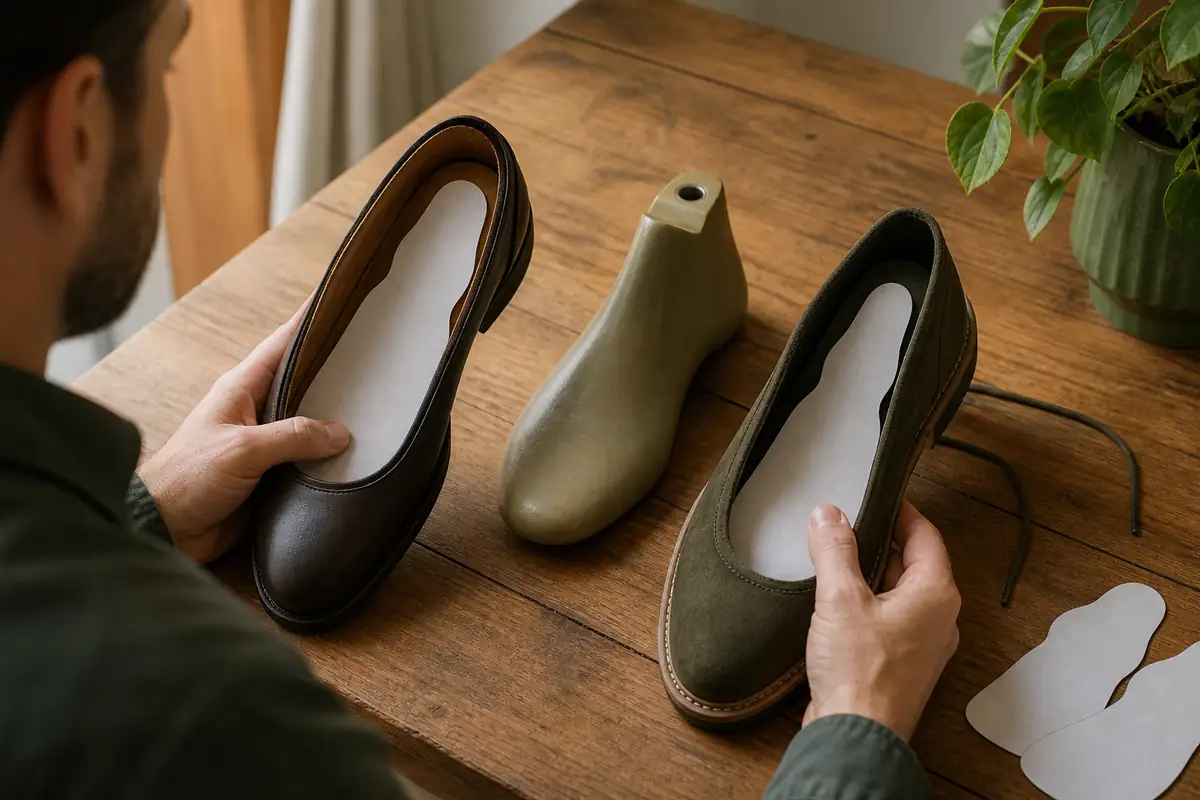
A last is the form around which a shoe is built. It influences toe shape, ball position, instep volume, waist, heel and overall curvature. Two shoes with the same nominal size and width can fit differently because their lasts are pointed, rounded, anatomical, tapered, high-volume or shallow.
Look at the shoe from above and compare the outline with the foot rather than expecting the foot to adapt to fashion geometry. A wide label on a strongly tapered toe may still crowd toes. A broad toe box on a low-volume last may still press the instep.
Toe-box width is not the whole fitting
Useful toe space allows toes to lie without being pushed together or against the upper. Check the longest toe, the angle of the big-toe side and the smaller-toe line. The internal shape matters more than a broad-looking external sole, because walls, lining and reinforcement consume space.
Too much empty toe-box width can also reduce control if the midfoot and heel do not secure the foot. The objective is room where needed and hold where needed, not maximum volume everywhere.
Ball position must align with flex
The widest part of the forefoot should sit near the widest part of the shoe and the natural flex zone. If the foot is pushed forward to find width, toes lose length. If the shoe is lengthened to gain width, the flex point can move ahead of the ball of the foot.
Check the external crease only after a clean indoor trial; forcing a new shoe to bend can mark it and affect a return. Construction such as a rigid shank, platform or rocker behaves differently and should follow the manufacturer’s intended use.
Instep and midfoot volume can be the real constraint
A shoe can fit at the forefoot yet compress the top of the foot or gape around a lower-volume instep. Product descriptions rarely quantify vertical volume. Look for adjustable lacing, multiple strap positions, elastic panels and tongue construction, then examine whether adjustment opens usable space or merely changes surface tension.
Slip-on designs have less regulation. Elastic can ease entry but may not provide enough hold or may create concentrated pressure. A wide-foot range should explain whether width is paired with extra instep volume.
Heel width and hold remain important
Many broad-forefoot shoppers have an average or narrow heel. A shoe widened throughout may slip at the back even though the toe area improves. Look for a shaped heel counter, adjustable fastening and a last that narrows appropriately behind the ball.
Do not automatically solve major heel movement with a thick insole, heel grip or smaller size. Add-ons change volume and foot position, and can create new pressure. A different last may be the correct solution.
Upper materials change tolerance, not the last
Soft leather, suede, knitted textile and woven fabric can yield differently from patent, coated synthetics or heavily reinforced uppers. That affects comfort and adaptation but does not transform a wrongly positioned toe box or flex point. “Will stretch” is not a fit plan.
Read the complete composition with the materials guide and inspect lining and reinforcement. Natural leather variation and break-in should not be used to justify pain or visible distortion during a clean trial.
Construction changes usable width
Seams, overlays, toe caps, piping and stiff counters reduce flexibility where they sit. A waterproof membrane adds another layer. A stitched welt or cupsole can constrain expansion at the edge, while a soft moccasin construction may conform more readily. None is automatically superior; the pressure-free shape matters.
For boots, shaft and calf fit are separate from foot width. The leather boots guide covers shaft, sole and care questions that a wide forefoot label does not answer.
Fastening should regulate rather than disguise fit
Laces provide adjustment across several zones when eyelet range and tongue width permit it. Buckles and straps offer defined positions; hook-and-loop can provide continuous adjustment within its overlap. The foot should remain secure without pulling closures to their limit.
If lacing leaves the tongue exposed at the edges or eyelets spread dramatically, the shoe may lack volume. If the facing closes completely while the foot still slides, the last may be too roomy. Check that the fastening is usable for the wearer’s dexterity and routine.
Compare product-page evidence
A strong listing states size system, width, materials, fastening, heel or sole details and care. Better still, it gives internal or foot measurements and explains the measuring method. Model photos and generic “true to size” claims are weak substitutes for dimensions.
Use the size-chart principles even though footwear uses different points: body or foot measurements are not the same as finished-product measurements, and two methods cannot be compared as if identical. Verify an unfamiliar seller with the online-shop checklist.
Protect the clean try-on
Read the return policy before marking soles or bending the upper. Try both shoes indoors on a clean surface with the intended socks, insoles or tights. Walk, turn, stand and sit. Check toe freedom, ball alignment, instep pressure, heel hold and fastening range.
Keep labels and packaging as required. Photograph a genuine defect or misdescription before wear. The returns-policy audit helps distinguish the statutory fault route from a change-of-mind return.
Choose the wide fitting when
- Correct length aligns the ball and flex point.
- The range defines where extra room is added.
- Toe, instep and forefoot sit without pressure.
- Fastening and heel still secure the foot.
Choose a different last when
- Sizing up moves the flex point forward.
- The toe tapers against the foot outline.
- Extra forefoot width creates heel instability.
- Construction presses a specific high-volume area.
Balanced verdict
Wide fit is a relationship between the foot and a three-dimensional last, not a promise attached to one letter. Compare length, forefoot, toe shape, instep, heel and construction as separate evidence.
When the brand does not explain its width system, use the label only to choose candidates. A clean home trial or competent fitting decides whether the shape works; discomfort is not an acceptable break-in strategy.
Check current official information:
Clarks adult shoe-fitting FAQsClarks shoe-fit guidanceGOV.UK returns and refunds
Frequently asked questions
Is an E fitting always wider than a D?
Only within a defined brand system. Letter sequences and standard widths vary, so compare the current chart for the exact range.
Should I size up for wide feet?
Not automatically. Extra length can misalign the flex point and loosen the heel. Try the correct length in a wider or differently shaped last.
Does a wide toe box mean a wide shoe?
No. The midfoot, instep and heel may remain narrow or shallow. Inspect the whole last and fastening.
Will leather stretch enough?
Some leather can yield with wear, but it should not be expected to correct a wrong toe shape, pressure point or misplaced flex zone.
Why does one wide style fit and another not?
Last shape, upper material, reinforcement, fastening and sole construction can differ even within one labelled width.
Can an insole fix a shoe that is too wide?
It changes volume and foot height but may not correct last shape or heel geometry. A better-fitting shoe is preferable when available.
How we researched this guide
Recommended Today reviewed current Clarks UK adult fitting and width guidance, UK returns information and footwear construction principles, separating length, width, volume, last shape, upper and fastening.
Limitations
We did not measure individual lasts or fit-test shoes. Brand systems, feet and constructions vary, and specialist needs require individual advice. Recheck the exact width chart and return terms before purchase. The image is an editorial illustration, not a photograph from a product test.