Buying trainers online: sizing, fit checks and return conditions
Trainer size is not a reliable fit guarantee. Foot length, width, volume, toe shape, heel hold, intended socks and the shoe’s internal construction all matter. A sensible online order starts with measurements and a use case, then protects the right to return an unworn pair.
In this guide
Measure both feet and buy the shape, not just the number
Use the larger foot’s heel-to-toe length, check width and volume clues, and compare them with the exact brand and model chart. Try the shoes indoors late in the day with the intended socks. The heel should feel controlled, the midfoot secure without pressure and the toes free to move without sliding.
This guide concerns everyday and fashion trainers bought online. Running, court, hiking, work-safety and medical footwear need activity-specific assessment. We do not diagnose foot conditions; persistent pain, numbness or instability deserves advice from an appropriately qualified professional.
Define the job before looking at styles
Write down where the trainers will be worn, for how long, on which surfaces and in what weather. Daily commuting places different demands on an upper and outsole from gym lifting or occasional social wear. Decide whether grip, cushioning, low weight, weather resistance, stability, easy cleaning or smart appearance is the priority.
Do not infer performance from a sporty silhouette. Fashion trainers may not publish the test evidence needed for serious sport, while technical running shoes can be excessive for quiet office use. Our everyday trainers guide covers construction and ownership; this article focuses on reducing online fit and return risk.
| Evidence | What it tells you | What it cannot prove | Action |
|---|---|---|---|
| Size label | Brand’s nominal length category | Width, volume or model consistency | Use exact model chart |
| Foot length | Basic length requirement | Toe shape and movement allowance | Measure both feet standing |
| Width option | Intended forefoot breadth | Instep and heel volume | Read last and fit notes |
| Customer review | Possible recurring pattern | Your fit or correct measurement | Use as a prompt, not proof |
| Free returns | Potentially lower fit risk | Eligibility and condition details | Save current policy before wear |
Record these before ordering
- Length of each foot while standing.
- Forefoot width at the widest points.
- Whether the instep is low, medium or high.
- Normal sock thickness and any insole or orthotic.
- Exact brand, model and regional size chart.
- Retailer’s unworn try-on and return conditions.
- Delivery and return costs in the failed-fit scenario.
Measure at the time and in the socks that matter
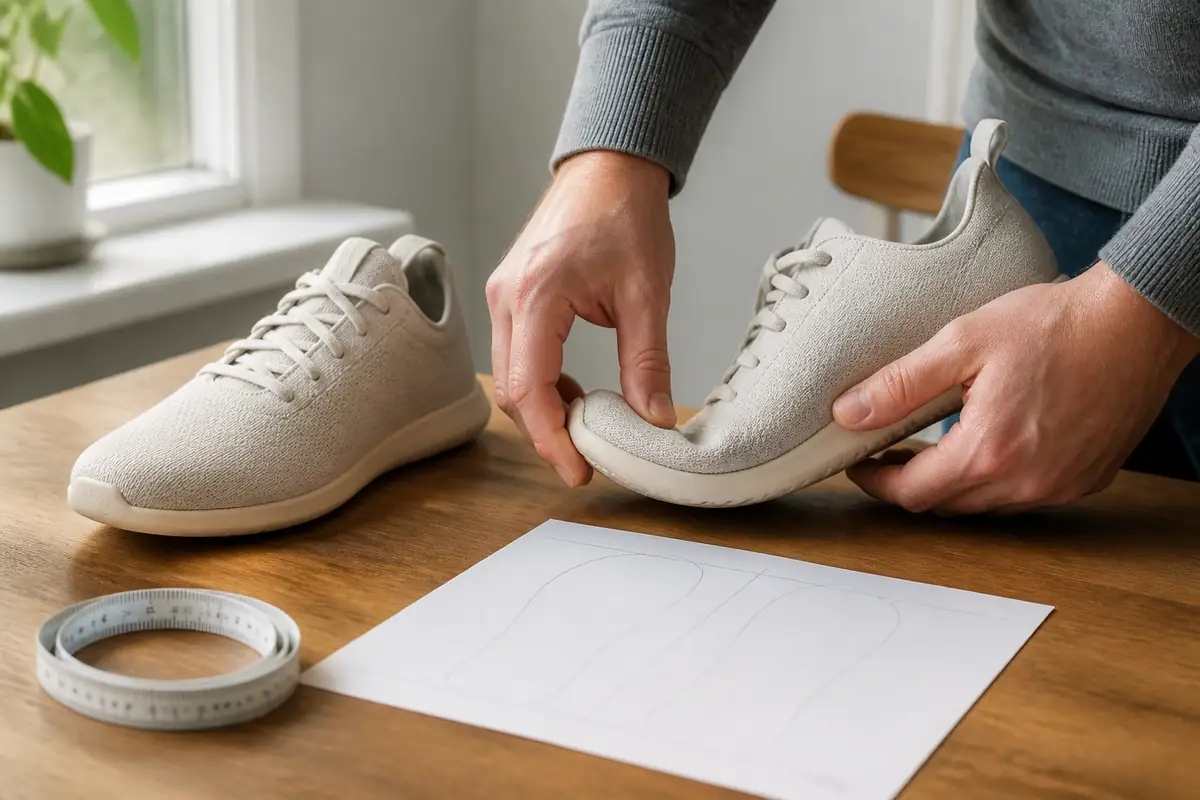
Feet can change with time of day, temperature, activity and life stage. Measure in the afternoon or evening after normal movement. Stand with weight distributed naturally, wearing the socks intended for the shoe. Trace or mark heel and longest toe on plain paper without angling the pencil under the foot, then measure the straight distance. Repeat for both feet.
For width, mark the widest forefoot points while standing. Home measurements are approximate, so compare them with the brand’s instructions rather than adding an invented universal allowance. If a retailer gives only a UK-to-EU conversion, ask for centimetres or an internal measurement. The size-chart principles apply to the evidence problem even though footwear uses different dimensions.
Length, width and volume must agree
A shoe can be long enough but too shallow over the toes or instep. It can also be wide enough at the forefoot yet loose at the heel. Look for stated width options, last shape, toe-box profile, fastening range and removable insole. Product photographs from above and behind can reveal taper and heel shape, but perspective makes them unsuitable for exact measurement.
Do not automatically solve width pressure by sizing up. Extra length can move the flex point away from the ball of the foot and create heel movement. A different width or model is usually a more coherent answer. People using prescribed insoles should check internal volume and whether removing the supplied footbed affects fit or returns.
Brand conversions are starting points, not standards
UK, EU, US and centimetre labels can be converted differently by brands. Men’s, women’s and unisex versions may use different conventions even when the physical product appears similar. Always use the chart attached to the exact model, and check whether its centimetre value describes foot length or shoe length.
Customer comments such as “size down” are subjective. A reviewer may prefer a tight fit, have a narrow foot or compare with another brand’s label. Repeated comments can prompt scrutiny, but should not override measured evidence. If a model has materially changed, older reviews may describe a previous construction.
Materials influence comfort but do not rescue poor shape
Knitted and mesh uppers may accommodate some contours, but stretch can reduce hold and does not guarantee width. Leather may soften, yet a painful new shoe should not be bought on the promise that it will eventually become the correct shape. Synthetic overlays, toe caps and seam positions create fixed pressure zones. Inspect where rigid components cross the foot.
The outsole and midsole should flex where the foot bends for the intended movement; extremely soft cushioning is not universally more comfortable or stable. Read our materials guide for interpreting upper composition, and never treat a material name alone as durability evidence.
Choose a retailer with a usable return process
Before paying, read the time limit, condition requirements, exclusions, return charge and method. Check whether footwear boxes are treated as product packaging that must remain undamaged. A free postal label is not useful if the nearest drop-off is inaccessible, and a store return may cost time and travel.
Save the policy and the item page. UK cancellation rights and retailer goodwill policies are not identical, while bespoke or hygiene-sensitive goods can have exceptions. The returns-policy audit explains how to test the practical route. Add expected return cost to each candidate before comparing prices.
Run a clean indoor fit check
Try both shoes on a clean, dry surface with the intended socks. Lace from the toe upwards with even tension; do not overtighten to stop a fundamentally loose heel. Stand, walk, turn, rise onto the toes and sit. The toes should not hit the front on movement, and the forefoot should not spill over the sole edge.
Check for heel lift, side pressure, rubbing seams, toe contact, numbness or burning. Compare left and right because the larger foot may decide the size while the smaller needs lacing adjustment. Ten careful indoor minutes can reveal obvious conflict, but it cannot predict long-term comfort or performance.
Do not compromise the return while testing
Keep tags, inserts, spare laces, tissue and box. Do not wear the trainers outdoors, on a treadmill, at the gym or on a dirty floor while the decision is open. Avoid flexing them aggressively, applying protector or replacing the insole unless the policy clearly allows it. Photograph any mark or fault found on opening.
If the pair is faulty, report the specific issue rather than simply saying it does not fit. Keep proof of posting, parcel weight if available and tracking until the refund completes. The genuine-shop checklist is useful before ordering from an unfamiliar specialist seller.
Calculate the whole ownership cost
Include delivery, return transport, replacement insoles, care products and likely replacement frequency. A discounted pair is poor value if the shape produces discomfort or the sole is unsuitable for the surface. Avoid ordering many speculative sizes when clear measurements would narrow the choice; multiple parcels increase administration and the risk of missed return deadlines.
For a pair likely to be worn repeatedly, use the cost-per-wear method with a conservative wear estimate. Stop the calculation if fit or safety is doubtful. No low projected cost justifies pain.
Order when the evidence is strong
- The exact model chart includes usable measurements.
- Length, width and volume clues suit both feet.
- The shoe construction matches the real activity.
- The clean return route is affordable and accessible.
Pause or shop in person when
- Measurements sit between incompatible shapes.
- Previous footwear causes pain or numbness.
- The seller hides condition or return charges.
- The specialist activity requires professional fitting.
Balanced verdict
Buying trainers online can work when the retailer supplies model-specific measurements and the buyer protects a clean indoor return. A size label alone is weak evidence; length, width, volume, fastening and intended movement must agree.
Online choice is not automatically better than an in-person fitting. When foot needs are complex or the activity is demanding, access to knowledgeable fitting and safe movement assessment can be worth more than a wider catalogue.
Check current official information:
GOV.UK returns and refundsGOV.UK distance selling rulesNHS foot pain guidance
Frequently asked questions
Should I size up in trainers?
Not by default. Use the exact chart and assess length, width and volume; sizing up can create excess length and heel movement.
How much toe room should trainers have?
Enough for natural toe movement without impact or sliding, judged against the brand’s fit guidance and intended activity rather than one universal number.
Can a tight trainer stretch to fit?
Some materials soften, but rigid parts and seams may not. Do not buy a painful shape based on hoped-for stretching.
Can I test trainers outdoors and return them?
Retailer conditions commonly require an unworn, resaleable state. Keep testing indoors unless the current policy explicitly says otherwise.
Do unisex trainer sizes fit the same?
No universal rule applies. Check the model chart, width and shape instead of relying on the unisex label.
When should I seek fitting advice?
Seek appropriate professional advice for persistent pain, numbness, significant asymmetry, prescribed devices or footwear for demanding sport or work.
How we researched this guide
Recommended Today reviewed UK distance-selling and returns guidance and compared the measurement, shape, construction, try-on and return evidence needed to reduce online footwear risk.
Limitations
We did not fit-test individual trainers or provide medical assessment. Feet, shoes and retailer policies vary. Recheck the model chart and return terms before purchase. The image is an editorial illustration, not a photograph from a product test.