How to choose leather boots: uppers, soles, fit and care
Leather on the product title does not describe the whole boot. Check the labelled upper, lining, sock and outer sole, then examine ankle volume, flex point, heel hold, tread and whether the construction can be maintained or resoled.
In this guide
Fit the boot first; pay for leather and construction second
A good leather boot holds the heel without painful pressure, bends near the foot’s flex point, leaves usable toe room and works with the socks and terrain intended. Confirm material labels for upper, lining and sole rather than assuming every visible panel is leather. Stitched-looking edges, premium leather terms and “water resistant” claims need precise construction or test evidence.
This guide focuses on everyday leather ankle and casual boots, not safety footwear, technical mountaineering or medical fitting. Specialist uses need the relevant certification and expert advice.
Translate the label into a complete boot
| Component | Question | Useful evidence | Common assumption |
|---|---|---|---|
| Upper | What covers most of the outside? | Footwear material symbol or written label | All visible brown material is leather |
| Lining and sock | What contacts the foot? | Separate material declaration | Leather upper means leather lining |
| Outer sole | What contacts the ground? | Material, tread and attachment description | Stitching always means resoleable |
| Closure | Can volume be adjusted? | Laces, zip, elastic or buckles | Pull-on is equally secure for every foot |
| Weather claim | What resistance was tested? | Membrane, seam and care information | Leather is automatically waterproof |
A ten-minute indoor fit check
- Wear the sock thickness intended for normal use.
- Stand with weight on both feet and check toe room.
- Walk on a clean surface and use stairs if available.
- Confirm the widest foot is not squeezed at the joint.
- Notice heel lift without forcing the laces tight.
- Check ankle edge and tongue for concentrated pressure.
- Make sure the boot bends where your forefoot bends.
- Keep soles pristine until the return decision is final.
Read footwear material symbols correctly
UK footwear labelling identifies the main material making up at least 80% of the upper surface, the lining and sock surface, and the outer sole. Where no material reaches that level, the two main materials should be shown. Those are three separate areas; “leather upper” says nothing automatic about lining or sole.
Use the leather terms guide to understand full-grain, top-grain, split and bonded descriptions. Even a correct leather name does not reveal thickness, tannage, finish or how well panels were cut and assembled.
Distinguish finish from the underlying leather
Heavy pigment can create uniform colour and stain resistance while hiding natural variation; aniline or lightly finished leather can show more grain and develop patina but may mark more easily. Suede and nubuck need different cleaning and weather expectations from smooth leather.
Look for a consistent surface without flaking, sticky patches or colour transfer during normal dry handling. Natural creasing at the flex point is expected; plastic-looking cracks through the finish are not desirable. Product photography should include close views under neutral light.
Choose the last shape before the labelled size
The last is the form around which the boot is shaped. Toe shape, instep volume, heel cup and overall width can change fit even when length is nominally the same. A pointed toe may need extra internal length so toes still sit behind the narrowing area; a broad-looking toe is not proof of a wide fit.
Measure both feet late in the day and use the brand’s exact chart, but treat conversion tables as a starting point. If the listing omits width and internal length, fit uncertainty remains. The shortlisting guide helps reject styles that cannot document the required width, closure or use.
Heel hold should be secure, not locked painfully
A small amount of movement can occur in a new pull-on or stiff boot, but repeated lifting that causes rubbing is not a break-in plan. Laces allow the instep and ankle to be adjusted; elastic-sided boots rely more on last shape; zips provide access but do not necessarily adjust volume.
Check whether your heel seats fully before tightening. Insoles and thick socks can reduce volume but also crowd toes or change flex position. Do not buy an obviously loose or short boot expecting accessories to rebuild its shape.
The flex point must match your foot
Walk and observe where the upper creases. The boot should flex near the ball of the foot rather than folding into toes or resisting until the heel slips. Very rigid soles can suit some tasks but may feel tiring in everyday walking; extremely flexible soles may offer less protection on rough ground.
Break-in can soften a firm leather upper and footbed, but it should not correct wrong length, severe width pressure or a misplaced toe cap. Pain is not evidence of quality.
Inspect sole attachment without guessing
Cemented soles are bonded to the upper and can make light, flexible boots; some can be repaired, while others are difficult to separate. Welted, stitchdown and directly moulded constructions have different appearances and repair options. Decorative stitching can imitate a functional seam.
Look for an explicit construction description or ask the maker. Inspect even bonding, consistent stitch spacing and no open gaps. A visible welt does not prove a particular method. For long ownership, ask a local repairer whether the exact sole and upper can be worked on before assuming “resoleable”.
Choose tread for the surface, not the rugged look
A smooth leather sole can suit dry formal use but offers limited grip in wet conditions. Rubber compounds and lug patterns vary in traction, flexibility, noise and wear. Deep lugs can carry mud indoors; very hard flat rubber may still slip on smooth wet floors.
There is no outsole that prevents every slip. Match tread to pavements, office floors or country paths and walk cautiously when conditions change. Technical hiking and workplace hazards require purpose-designed footwear rather than a fashion boot with an aggressive pattern.
Treat weather resistance as a system
Leather can resist some moisture when appropriately finished and maintained, but water can enter through seams, elastic panels, zip tapes and the upper-to-sole join. A waterproof membrane adds a barrier but can affect breathability and still depends on construction.
Ask whether the claim is waterproof, water-resistant or merely weather-ready, and follow the exact care instructions. Dry wet boots naturally away from direct heat, remove insoles if advised and allow the pair to dry fully before the next wear.
Check lining, footbed and internal finishing
A leather lining can mould and manage moisture differently from textile, while insulated textile can add warmth. Neither is automatically better. Feel for exposed seams, rough counters and adhesive ridges. A removable footbed helps drying and replacement but may be integral to fit.
Inspect inside with a hand, not by forcing the boot. If a nail, staple or hard edge is detectable, stop wearing and pursue the appropriate fault route. Do not add a thick insole until you know it will not reduce toe space.
Plan care for the exact finish
Brush off dry dirt, use a product suitable for the leather and test on an inconspicuous area. Conditioner can darken or soften; wax can change appearance; suede needs dedicated methods. More product is not better, and household oils can damage finish or stitching.
Use shoe trees or supportive paper only as appropriate, rest boots between wet wears and repair heel top pieces before wear reaches the main heel. The care-label guide covers general symbols, but footwear maker instructions take priority for coatings and membranes.
Assess repairability before paying a premium
Ask whether replacement heels, zips, elastic panels and soles are available, and whether the upper has enough remaining life to justify work. A resoleable construction is valuable only when fit is good and a repair service is accessible.
Estimate purchase, care and plausible repair costs with the cost-per-wear method. A cheaper boot worn comfortably for many seasons can beat an expensive “heritage” story unsupported by construction detail.
Protect the return option during fitting
Try boots indoors on a clean surface, crease them only through ordinary walking and keep packaging and inserts until the decision. Outdoor grit can remove a change-of-mind option. Check who pays return postage and whether the retailer accepts a different-size exchange.
Use the returns-policy audit and the UK returns guide. A mislabelled material or manufacturing flaw is different from a style that simply does not fit.
The fit is excellent and use is frequent
Construction is documented, a repairer can service the exact boot and the upper is worth maintaining.
Weight, flexibility or budget leads
A well-made bonded construction fits the task and you are not paying a false premium for decorative stitching.
Balanced verdict
The best leather boot is a well-fitting footwear system, not a leather percentage with a sole attached. Verify the three labelled material areas, flex and heel hold, then match tread and weather construction to real use.
Pay more only for evidence you can use: better leather, sound assembly, serviceable parts and a fit that earns repeated wear. No break-in story should excuse pain or wrong dimensions.
Check current official information:
GOV.UK footwear labellingGOV.UK product labelling lawGOV.UK returns and refunds
Frequently asked questions
Does leather upper mean the whole boot is leather?
No. Lining and sock, and outer sole, are labelled separately and may use other materials.
Should leather boots feel tight when new?
They may feel firm, but toes should have space and there should be no severe width or ankle pressure. Leather cannot correct the wrong length.
Is stitched construction always resoleable?
No. Stitching may be decorative, and repair depends on the exact construction, materials and available service.
Are leather boots waterproof?
Not automatically. Finish, seams, closure, membrane and upper-to-sole join all affect resistance.
How much heel slip is acceptable?
A small amount may settle in some designs, but repeated rubbing or major lift suggests the last or volume is wrong.
Can conditioner fix cracked leather?
Conditioner may maintain suitable leather but cannot reverse structural cracking or a failing surface coating.
How we researched this guide
Recommended Today reviewed current UK footwear-labelling and consumer guidance. We assessed boots by material areas, last and volume, flex, sole attachment, tread, weather system, care, repairability and returns.
Limitations
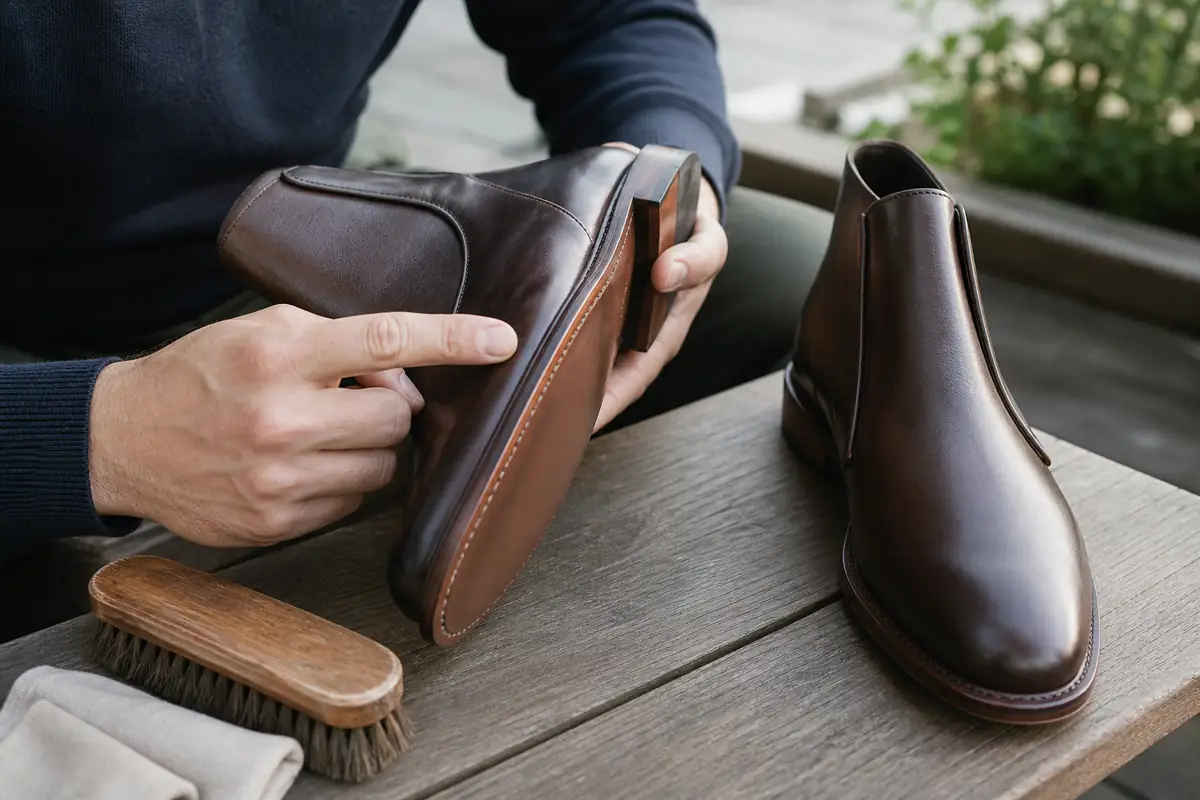
We did not fit-test or cut apart individual boots, verify proprietary leather grades or test slip and water resistance. Specifications change; recheck the exact label and construction on publication day. The original image shows fictional plain leather boots and unbranded care tools with no copied design, label, text, logo, package or price. Links are editorial and non-affiliate.