Sizing Charts and Fit: How to Order Clothes That Actually Fit
UK, EU and US sizes don't map cleanly and vanity sizing makes it worse. How to measure yourself once and read any brand's chart against it.
In this guide
Use the label as a starting point and measurements as the decision
There is no universal UK clothing size that transfers reliably between shops. Measure your body and one garment that already fits, then compare those numbers with the exact brand chart, garment measurements, fabric and intended cut. Treat UK, EU and US conversions as approximate and check the return route before ordering more than one size.
Almost everyone owns clothes in three different sizes, and almost everyone treats this as a personal failing. It is not. Clothing sizes are not standardised, have never been standardised, and are set by each brand for its own purposes.
The way out is to stop shopping by size and start shopping by measurement — one afternoon of setting up, and then a repeatable process that works on any brand in any market.
| Evidence on the product page | How much to trust it | How to use it |
|---|---|---|
| Garment measurements | Strongest evidence when the exact size and measuring method are stated | Compare with a similar item you own and like, measured flat in the same places |
| Brand body-size chart | Useful starting point, but specific to that brand’s block and intended customer | Match your current body measurements, then allow for the stated fit and fabric |
| Model height and size | Helpful context, not a substitute for dimensions | Use it to judge length and silhouette only when the model’s proportions are relevant |
| Customer fit reviews | Useful when several reviewers give measurements and agree on a pattern | Look for repeated comments about the same size, colourway, fabric and pressure points |
| UK, EU or US conversion | Approximate | Use once to find a candidate size, then return to the brand’s own measurements |
Why the same size differs between brands
Every brand fits its garments to a block: a base pattern representing the proportions of its target customer. From that block it grades upwards and downwards to produce a size range. Two brands with different blocks produce different garments at the same label size, and the difference is not just girth — it is proportion, which is why one brand’s trousers fit at the waist and not the hip while another does the reverse.
Three further factors compound it. Sizes drift over time, so a label size can mean something different from what it meant years ago. Fabric behaviour changes fit substantially: the same pattern in a stretch fabric and a rigid one produces different garments, which is why fabric composition belongs in a sizing decision. And garments are graded for a range of body shapes, so a size that fits one measurement may not fit another on the same person.
None of this is solvable by finding your “real” size. There isn’t one.
The measurements to take and how to take them
Take these once, write them down, and keep them where you shop — a note on your phone is enough. Wear close-fitting clothing, keep the tape level and snug without compressing, and stand normally rather than holding yourself in.
- Chest or bust — around the fullest part, tape level under the arms.
- Underbust, if you buy garments that fit there.
- Natural waist — the narrowest part of the torso, which is usually above where trousers sit.
- Hip — around the fullest part, feet together.
- Inside leg — from crotch to the point where you want a hem to fall, measured in the shoes you would wear.
- Shoulder width — point to point across the back.
- Sleeve length — from shoulder point to wrist with the arm slightly bent.
- Neck, for anything with a collar.
Two additions make the system far more powerful. Record whether you are long or short in the body and arms relative to standard grading, because that explains more repeat problems than girth does. And measure two or three garments you already own that fit perfectly, flat, and keep those numbers — they are the benchmark everything else is compared against.
Body measurements versus garment measurements
This distinction resolves most online sizing failures.
Body measurements describe you. Most brand size charts are body charts: they tell you which size a person of given dimensions should select.
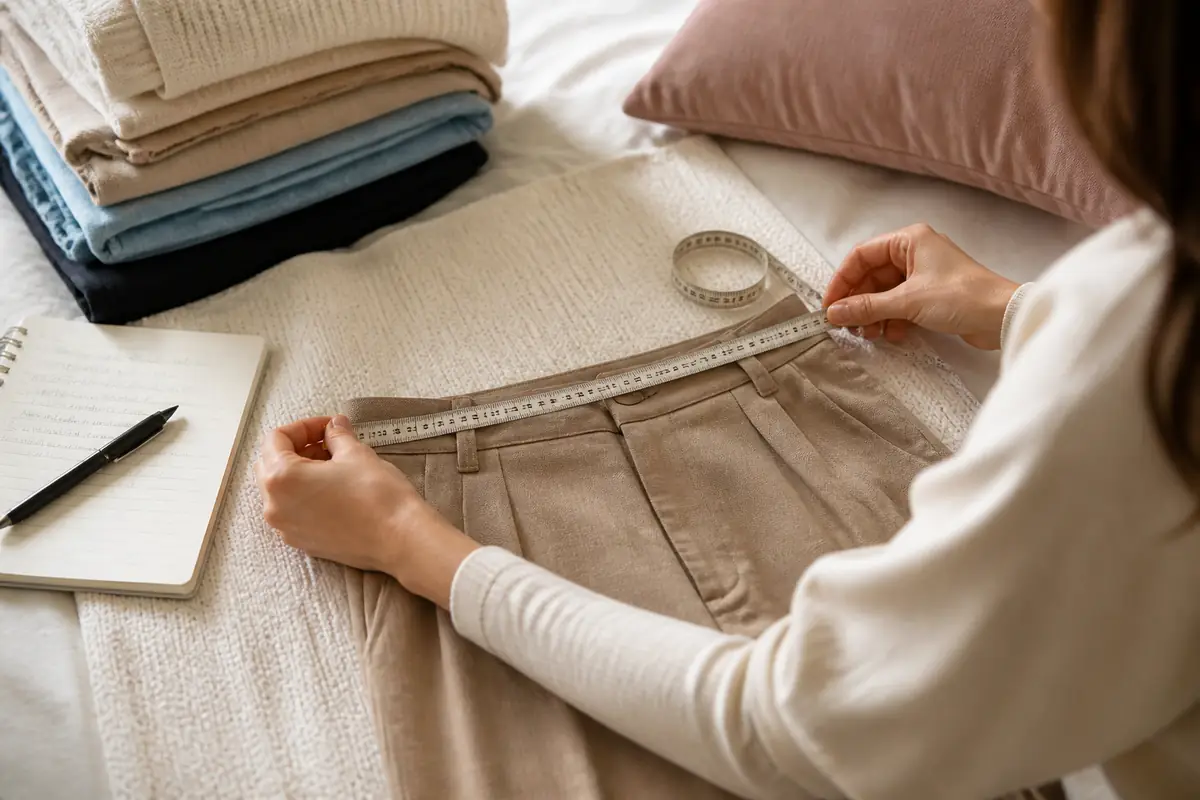
Garment measurements describe the item laid flat — chest across, length, sleeve, waist. Where a retailer publishes these, you can compare them directly against a garment you own that fits, which removes the brand’s judgement from the process entirely.
The difference between the two is ease: the extra room designed in for movement and silhouette. Ease is a design decision, not an error, and it varies enormously by garment type — a tailored jacket, a shirt and an overshirt with identical chest measurements are three different fits.
When only a body chart is offered, the useful question to ask customer service is the flat measurement of the specific size. Retailers hold it, and a seller who will supply it is showing the same confidence as one publishing fabric weight, discussed in how to judge clothing quality.
UK, EU, US and international conversions
Conversion tables are conventions, not standards. They differ between brands, between garment categories, and between menswear and womenswear, and they are least reliable where sizes are already vague.
Some categories convert more predictably because they are stated in measurements rather than in arbitrary numbers — collar and sleeve, waist and inside leg, or a centimetre-based system — and those are worth preferring where a brand offers them. Where a garment is sold only in S/M/L, treat the letter as a rough band and go to the measurements immediately.
Practical approach: use a conversion as a starting hypothesis, then confirm it against the brand’s own chart, then confirm that against your own numbers. Never convert twice — going from one market’s convention to another and then to a brand’s internal chart compounds two approximations.
Fit descriptions: slim, regular, relaxed and oversized
Fit words describe the amount and distribution of ease, and they are relative to the brand’s own block rather than to any external reference. One brand’s slim is another’s regular.
Read them as directions rather than definitions. Slim and tailored indicate less ease and more shaping through the waist. Regular or classic is the brand’s default. Relaxed adds ease throughout. Oversized is a design intention rather than a size — sizing up in a regular fit rarely produces the same result, because the proportions were not drawn that way.
Two details matter more than the word. Model information — height and the size worn — lets you calibrate the photograph against yourself. And where a brand offers length variants, or shorter and longer options in the same size, that brand has taken proportion seriously and is usually worth staying with once you find your fit.
Using reviews for fit information
Fit is the one thing reviews report better than any chart, because reviewers volunteer the comparison a size chart cannot make.
What to look for: reviewers stating their own measurements and the size they chose; repeated agreement on direction, such as consistent reports that an item runs small in the shoulder; and comments on how the garment changed after washing, which is fit information a chart never contains. Filter to reviews of the same colourway where possible, since fabric can differ between finishes of the same style.
What to discount: single reports contradicting a clear pattern, comments from reviewers whose stated measurements are unlike yours, and anything that reads as a review of delivery rather than of the garment. Screen for manipulated review sections first using how to spot fake reviews, then mine the genuine ones for the repeated, specific observations.
Ordering two sizes and returning one: the rules
The measurements and return route agree
You have compared the exact garment measurements, allowed for fabric and fit, and checked the deadline, condition requirements and return cost.
The label is doing all the work
You are converting between size systems without checking the brand chart, or return fees and exclusions would make a two-size order impractical.
Our verdict
Measurements beat the size printed on the label. Order when the brand’s exact garment chart, fabric behaviour and return terms support the choice; pause when you are converting between generic UK, EU or US sizes without garment-level evidence.
Buying two sizes with the intention of returning one is normal and lawful for online orders, and it is often the cheapest route to a good fit. Three things keep it clean.
Know the right you are using. For goods bought at a distance you generally have a statutory right to cancel within the relevant period and a further period to send goods back, separate from any goodwill policy the retailer offers. The deadlines, refund timings and who pays return postage are set out in UK returns and refunds rights.
Handle the garment as you would in a shop. Trying something on is expected; wearing it out, removing tags or laundering it is not, and excessive handling can reduce what you get back.
Check the cost before ordering. Return postage is commonly the customer’s, and some retailers deduct a fee. Where returns are charged, the cost of ordering multiple sizes should be weighed against the alternative, and it belongs in the arithmetic in cost per wear just as much as the purchase price does.
One long-term note: keep a record of what fitted, by brand and size, alongside your measurements. After a few purchases you will have a personal conversion table more accurate than any published chart — and, incidentally, a much shorter shortlist, in the spirit of how to judge product quality online.
Check current official UK return rules:
Frequently asked questions
Why am I a different size in different shops?
Size labels are not standardised. Each brand fits garments to its own block and grades from there, so two garments labelled the same size can differ in every measurement.
What is the difference between body and garment measurements?
Body measurements describe you; garment measurements describe the item flat. The gap is ease, built in deliberately. Garment measurements are more useful, because you can compare them with something you already own.
Do UK and EU sizes convert reliably?
Only approximately. Conversions are conventions rather than standards and vary by brand and garment type, so treat a converted size as a starting point to check against measurements.
Can I order two sizes and return one?
Generally yes for online orders, using your statutory cancellation right. Check return costs first, handle garments as you would in a shop, and keep tags until you decide.
How we write this guide
This article is research-led. It draws on established garment pattern-making practice — blocks, grading, ease, and the difference between body and garment measurement charts — together with the statutory distance-selling cancellation rights described in our returns guide, which are set out there against the underlying regulations.
We publish no size conversion tables and no measurement ranges. Conversions are brand conventions rather than standards, and a table printed here would be wrong for many retailers while appearing authoritative; the method given instead works against any brand’s own chart. No garments were handled, and no brands are named or ranked.
Recommended Today may earn commission from links to retailers. Commission does not influence our editorial content or the order of any recommendation. This guide is reviewed at least every 18 months. Next scheduled review: February 2028.