Wide-fit shoes online: measuring feet, fit checks and returns
Measure both feet at the time and in the socks relevant to the shoe, then compare the numbers only with a chart using the same method. A home measurement narrows the shortlist; an indoor movement check decides whether the last actually fits.
In this guide
Measure the larger foot, but fit both feet
Record standing length, forefoot width and ball circumference for left and right feet. Check toe-box outline, instep volume and heel hold as well as the seller’s width label. On arrival, try both shoes indoors on a clean surface and stop if there is pressure, instability or a distorted upper.
This is a practical adult home-measuring and online trial method. It does not replace professional fitting for pain, injury, diabetes, swelling, orthotics or other specialist requirements. Seek suitable professional advice when ordinary retail sizing is not enough.
Gather the right tools and conditions
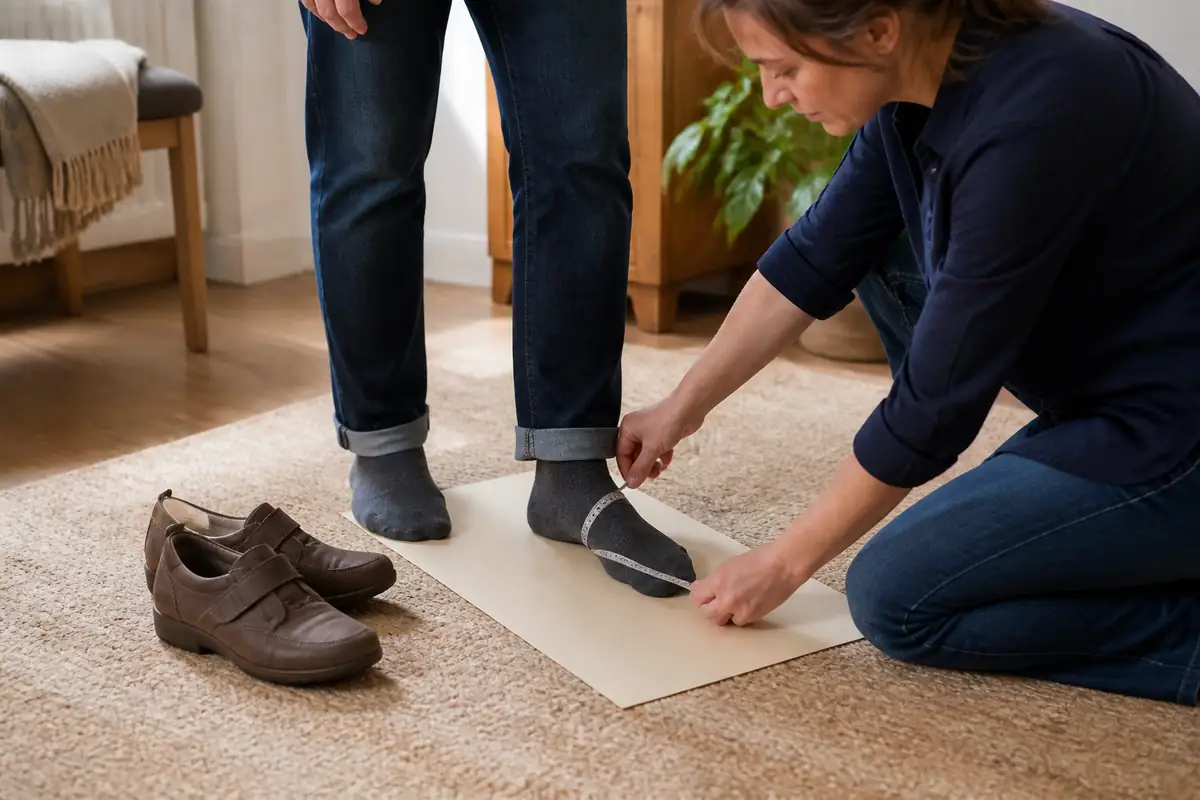
Use plain paper larger than the foot, a pen held vertical, a flexible tape and a rigid ruler. Wear the socks or tights intended for the shoe. Measure on a hard level floor, not deep carpet, and have another person trace if that improves balance and accuracy.
Measure later in a typical day if feet normally change with activity, but follow any brand instruction specifying another time. Record date, socks and method so the result can be repeated. Measurements taken months apart or during unusual swelling should not be merged casually.
| Measurement | Method | Common error | Use |
|---|---|---|---|
| Standing length | Heel to longest toe with weight distributed | Assuming the big toe is always longest | Choose starting length size |
| Forefoot width | Straight distance across widest marks | Angling the ruler or tracing a loose sock | Compare only with matching width method |
| Ball circumference | Tape around widest forefoot joints | Pulling tape tight or letting it slope | Estimate combined width and depth |
| Instep circumference | Brand-specified route over midfoot | Using an unstated measuring line | Assess volume when chart provides it |
| Existing insole | Compare outline from a genuinely fitting shoe | Treating it as exact internal dimensions | Supporting shape evidence |
Foot-measuring record
- Left and right length in millimetres.
- Left and right widest forefoot width.
- Ball circumference for each foot.
- Relevant instep or heel measurement if the chart requests it.
- Sock thickness and time measured.
- Current successful shoe brand, style, size and width.
- Any pressure, heel slip or toe-shape problem to avoid.
Trace standing length
Stand naturally with weight shared. Keep the pen upright while tracing so the line does not grow by the pen’s angle. Mark the furthest heel point and the longest toe, which may not be the big toe. Measure the straight distance between them in millimetres.
Repeat each foot. If results differ, use the larger foot to choose a starting length while ensuring the smaller foot remains secure in the actual shoe. Do not add an arbitrary growth or comfort allowance unless the brand chart instructs it; required internal space depends on shoe type and shape.
Measure forefoot width
Mark the widest points around the ball of the foot and measure the straight line across the tracing. This is a two-dimensional width. A retailer may instead quote circumference, finished shoe width or an internal measurement, none of which is directly interchangeable.
Keep the original tracing. Its outline shows whether the foot is straight, tapered, fan-shaped or asymmetric, which can be more informative than one number. Compare it with a removable insole only as an approximation: shoe walls, lining and toe spring affect usable space.
Take ball circumference when requested
Wrap the flexible tape around the widest forefoot joints while standing or in the position the brand specifies. Keep the tape level and in contact without compression. Circumference reflects both width and depth, so two feet with the same straight width can produce different results.
Do not convert circumference into width using an internet table from another brand. Use it only where the retailer defines its measurement and fitting system.
Measure instep or heel only to a defined diagram
High or low instep volume often explains why a nominally wide shoe presses or gapes. However, the route for an instep circumference is not universal. Follow the exact diagram and keep the tape placement consistent. Heel-to-instep measurements likewise need a defined start and end.
If the product chart supplies only length and a generic “wide” label, note the missing evidence. Our wide-fit width-system guide explains why toe box, last, instep and heel must be considered separately.
Compare the chart without silent conversions
Check whether the chart describes foot measurements or finished-shoe measurements. Confirm UK size, width column and whether women’s and men’s systems differ. If a measurement falls between sizes, follow the brand’s advice and shortlist adjacent options where the return policy makes that reasonable.
International conversions are approximate. The size-chart method applies here too: retain the original unit, method and source instead of rounding several times across UK, EU and US labels.
Use a successful shoe as a second reference
Record the full brand, style, size, width and how long it has been worn. Remove the insole only if designed to be removable and trace it without stretching. Compare length, widest point, toe outline and where the ball sits. A worn or compressed insole can distort the conclusion.
Do not assume another style from the same brand shares the last. Product reviews and customer-service answers should identify the exact style. A remembered size without model and width is weak evidence.
Read photographs for shape, not scale
Top-down and outsole images can reveal taper, asymmetry and fastening range. Side views show toe spring, depth and collar. They cannot establish internal millimetres without a reference and can be distorted by camera angle.
Look for removable-insole length, fit notes, last name or customer-service measurements. Treat “runs wide” and “true to size” as subjective summaries. The shortlisting method helps keep missing evidence visible.
Choose fastening for volume control
Laces can adjust several zones, while straps and buckles regulate defined points. Slip-ons depend more heavily on last and elastic. Ensure a wide foot can enter without forcing and that the closure still has adjustment left once secured.
For orthotic use, confirm removable insole, internal depth and manufacturer guidance; ordinary added width does not guarantee orthotic compatibility. Specialist requirements need specialist fitting.
Order with the return path open
Before buying adjacent sizes or widths, calculate delivery and return charges, refund times, exclusions and whether each item must be returned separately. Check whether the seller supplies a prepaid label and whether original boxes must remain undamaged.
GOV.UK says online customers generally have a cancellation period for eligible goods, while handling beyond what would be possible in a shop can affect deductions. Faulty or misdescribed goods are a separate issue. Use the returns-policy audit before ordering.
Run a clean indoor fit check
Try shoes later in a typical day, with intended socks and any ordinary insole. Fasten them properly and stand on a clean hard surface. Check both feet for toe freedom, ball alignment, instep pressure, sidewall bulging, heel hold and whether the foot sits flat.
Walk, turn, rise onto the forefoot gently and use stairs only where it will not mark soles. The shoe should flex in an appropriate area, remain secure and not create sharp pressure. Do not rely on a painful break-in. The everyday trainer guide adds sole, cushioning and use-case checks.
Interpret common fit failures
Toe contact can mean insufficient length, unsuitable taper or the foot sliding forward. Forefoot pressure may indicate inadequate width, depth or a restrictive seam. Heel slip can result from excess length, wide heel geometry, low instep or inadequate fastening. One symptom can have several causes.
Change one variable at a time. If length is correct but the toe outline conflicts, try another last before sizing up. If one foot differs, fit the larger and ask whether a safe, modest adjustment for the smaller foot is appropriate.
Inspect construction before wear
Compare left and right shoes, seams, sole bond, lining, fastening and insole. Check that the ordered width appears on the label or product identifier. Photograph damage, a mismatched pair or a description error before outdoor use.
For leather shoes and boots, read the leather footwear guide before applying products. Conditioner or waterproofing can alter appearance and end a clean return option.
Keep the shoes when
- The larger foot has correct length and ball alignment.
- Toes, forefoot and instep sit without pressure.
- Fastening secures both heels without distortion.
- Normal indoor movement remains stable and comfortable.
Return or refit when
- Sizing up was needed only to gain width.
- The upper bulges, cuts in or wrinkles from mismatch.
- Heel movement persists after proper fastening.
- Comfort depends on promised stretching or modification.
Balanced verdict
Home measurements reduce random orders, but they do not convert a brand label into guaranteed fit. Use length, width, circumference, shape and a known shoe to build the shortlist, then let the clean two-foot movement test decide.
If measurements and chart agree but repeated styles fail in the same place, the problem is probably last geometry or volume rather than your measuring competence. Change the shoe shape or seek a fitter instead of buying longer shoes.
Check current official information:
Clarks adult shoe-fitting FAQsClarks shoe-fit guidanceGOV.UK returns and refunds
Frequently asked questions
Should I measure both feet?
Yes. Record both, use the larger foot for the starting size and confirm that the actual shoe secures the smaller foot.
Is foot width the same as ball circumference?
No. Width is a straight distance; circumference wraps around the forefoot and includes depth.
Can I trace over thick socks?
Use the sock thickness intended for the shoe, but avoid a loose sock edge that distorts the outline.
How much space should I add?
Follow the exact brand method. A universal allowance ignores shoe type, toe shape and whether the chart already includes fitting space.
Should wide feet buy a larger size?
Not automatically. A longer shoe can misalign flex and loosen the heel; prefer the correct length in a compatible width and last.
Can I test shoes outdoors before returning?
Check the retailer’s terms. A clean indoor try-on preserves condition and gives useful fit evidence without marking soles.
How we researched this guide
Recommended Today reviewed current Clarks UK fitting guidance and UK online-return information, then built a repeatable method for length, width, circumference, chart comparison and clean home trial.
Limitations
Home measurements are approximate and we did not fit-test individual footwear. Feet, lasts and brand methods vary, and specialist needs require appropriate advice. Recheck the exact chart and returns terms before purchase. The image is an editorial illustration, not a photograph from a product test.