Fridge freezer noise and placement guide: ventilation, floor and open-plan rooms
A fridge freezer can meet its headline dimensions and still be wrong for the room. Compare installation clearances, door swing, floor level, nearby heat, cabinet geometry, stated airborne-noise emissions, normal operating sounds and access for cleaning and service.
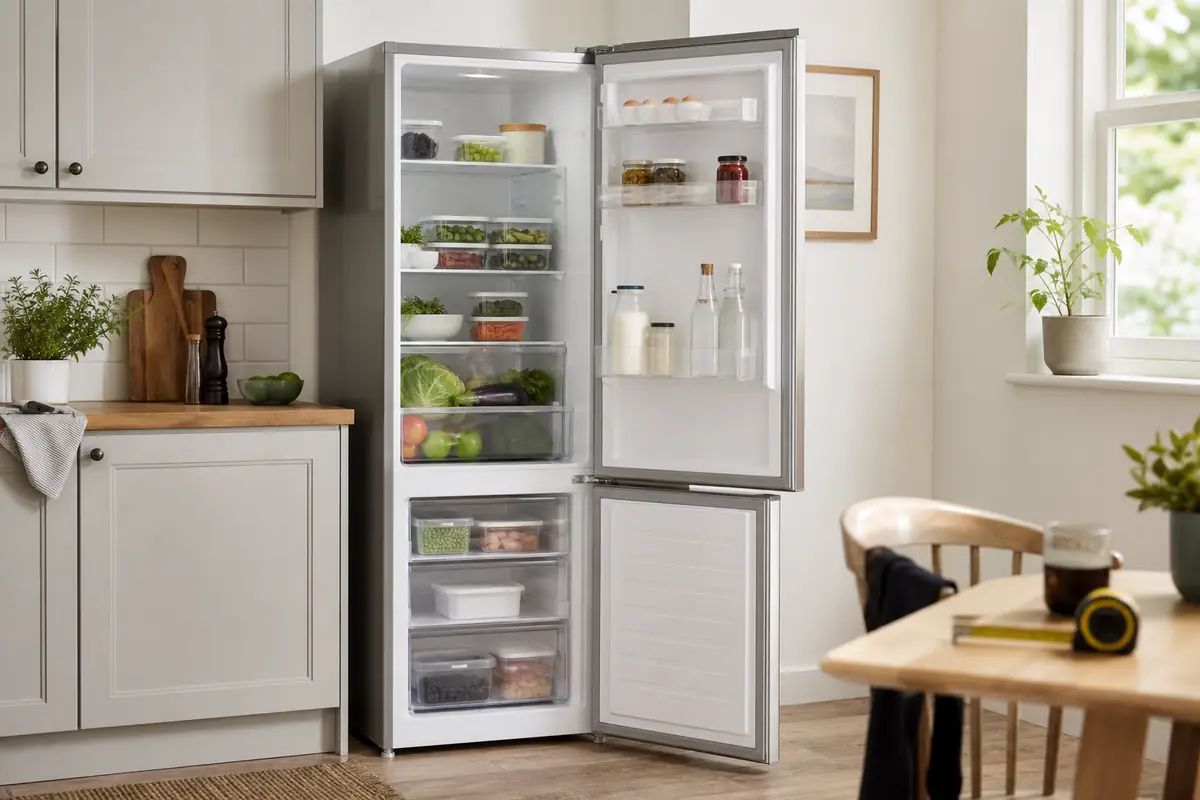
In this guide
Measure the operating space, not only the cabinet box
Use the manufacturer installation drawing for rear, side and top clearance, then map doors, drawers, sockets, floor and listening position. Treat the energy-label noise value as comparable evidence under stated conditions, not a promise that every cycle or room will sound identical.
Start with our fridge-freezer dimension method, use the large-appliance access checklist, and compare ownership through appliance running costs.
| Placement question | Evidence | Why it matters | Failure sign |
|---|---|---|---|
| Can heat leave the appliance? | Manufacturer top, rear and side clearances | Ventilation affects performance and energy use | Blocked grille or hot enclosed pocket |
| Can doors and drawers open fully? | Hinge side, door angle, handle and wall offset | Interior fittings need more than 90-degree opening | Crisper or freezer drawer cannot be removed |
| Is the floor stable and level? | Floor material, adjustable feet and loaded weight | Poor contact can amplify vibration or twist doors | Rocking cabinet or doors drifting |
| Is the room noise-sensitive? | Energy-label dB, noise class and listening distance | Open-plan rooms expose cycles differently | Buzz or resonance dominates quiet use |
Placement survey before ordering
- Save the exact model installation drawing and manual.
- Measure opening at floor, middle and top.
- Map ventilation clearances without optimistic rounding.
- Draw both doors at the required opening angle.
- Check sockets, pipes, skirting, radiators and sunlight.
- Assess floor level, strength and vibration paths.
- Mark the main seated or sleeping listening position.
- Leave a route for cleaning, defrosting and service.
Installation drawings outrank nominal dimensions
A listing may publish width, height and depth for the cabinet, while the manual adds hinges, handles, rear spacers, door projection and ventilation. Save the exact model drawing and measure the real opening at several heights because walls, worktops and floors are rarely perfectly square.
Our fridge-freezer buying guide covers capacity and format. This guide asks a narrower question: whether that appliance can operate, open and be heard acceptably in the intended position.
Ventilation space is functional, not decorative
Refrigeration moves heat from inside the cabinet into the room. Blocking specified grilles or reducing clearances can impair performance, raise consumption and shorten component life. Follow the model-specific location and distance rather than copying a gap from another appliance.
Do not close a freestanding unit inside furniture unless the manufacturer permits that installation. Built-in and freestanding models manage airflow differently. A neat flush appearance is not evidence of correct cooling around the condenser and compressor.
Door geometry can consume the saved centimetres
A door may open at 90 degrees yet still prevent removal of a shelf, crisper or freezer drawer. Check the stated angle, hinge projection, handle, adjacent wall and whether the door needs to pass a worktop edge. Reversible hinges help only when the model supports reversal and the new side suits the room.
Draw the open door on a floor plan and include people moving through the kitchen. A narrow aisle that works with doors closed can become blocked during loading. Do not assume a French-door or split-door design automatically needs less side clearance.
Floor level affects doors, seals and vibration
Use a stable, load-capable floor and the levelling method in the manual. An appliance that rocks can transmit vibration, let doors drift or prevent seals meeting evenly. Check after loading because weight distribution changes when shelves and door bins are full.
Do not wedge the appliance with improvised soft material that blocks airflow or settles over time. Protect a vulnerable floor with a method approved for the weight and ventilation, and retain safe access to adjustable feet.
The energy label gives a comparable noise field
Current household refrigeration energy labels include airborne acoustical noise emissions and a noise-emission class. Record both from the exact model rather than a family listing. A lower stated number can support a shortlist, especially in an open-plan home.
The laboratory figure is not a promise about every click, gurgle, fan change, defrost cycle or resonance in a particular room. Use it as standardised evidence alongside cabinet design, installation and retailer fault support.
Normal sounds occur in cycles
Compressors, fans, refrigerant flow, ice movement and defrost components can start and stop. Read the manufacturer’s sound explanation before judging a showroom unit that is unplugged or a newly installed unit still reaching temperature.
Record duration, timing and conditions rather than describing a sound only as loud. Persistent scraping, severe vibration, alarm or change from the documented pattern warrants checking installation and contacting support; do not open electrical or refrigerant systems yourself.
Open-plan rooms need a listening-position test
Measure the distance and sightline from the appliance to the sofa, desk or dining place used during quiet hours. Hard floors, bare walls and cabinet voids can reflect or amplify vibration. A model acceptable in a closed kitchen may be intrusive beside a home-working desk.
Compare stated noise with the household’s tolerance and background, not with a phone-app reading treated as laboratory proof. If noise is critical, choose a retailer with a clear return and fault-assessment process and preserve installation evidence.
Heat sources increase the placement burden
Follow instructions on proximity to ovens, radiators, boilers, direct sun and room-temperature range. A gap that physically fits may expose the cabinet to heat or a climate outside its stated class, affecting efficiency and temperature control.
Do not solve heat exposure by blocking the appliance into an insulated pocket. Rework the layout or choose another format. Our small-kitchen guide helps compare appliance footprint against genuine workflow.
Sockets and plumbing must remain serviceable
Check plug type, cable reach and whether the socket remains accessible as instructed. Avoid pinching a lead behind the cabinet or relying on an unsuitable extension. A water or ice connection adds approved hose routing, isolation and leak access.
Plan how the appliance will be disconnected and moved without damaging flooring or cabinetry. Installation convenience on day one should not trap a future engineer or prevent cleaning behind the unit.
Delivery clearance is different from installation clearance
Measure gates, lifts, stairs, turns, doors and packaging, then compare the carrier’s access conditions. Removing appliance doors or packaging may require authorised personnel and may not solve a narrow turn. Use the exact packed dimensions where published.
The delivery-surprise checklist helps document access. Protect floors and identify who removes the old appliance, packaging and transit restraints before the vehicle arrives.
Allow settling and initial cooling exactly as instructed
Transport orientation and manufacturer instructions determine whether the appliance must stand before connection. Follow the exact manual and installer advice rather than a universal number repeated online. Record when power was connected and when food was loaded.
A newly started appliance can run for longer while reaching temperature. Keep vents clear, use suitable temperature checks and avoid declaring a noise fault from the first minutes unless there is a safety concern or explicit installation error.
Service access is part of repairability
Ask whether fans, drawers, seals, hinges and common parts can be obtained and how engineers reach service areas. Our repairability guide turns vague longevity claims into evidence.
A tightly integrated installation can increase labour and damage risk even when the appliance itself is repairable. Photograph the completed clearances and keep the manual, serial record and installer details with the purchase evidence.
Run a documented first-week check
After correct installation, note door closure, seal contact, temperature, floor stability, condensation, alarms and the timing of sounds across several cycles. Keep airflow and loading normal. Do not silence vibration by pushing the appliance harder against a wall.
If a pattern seems abnormal, compare the manual, record a short sample from the normal listening position and contact the seller or manufacturer route without dismantling. The repair-fund guide helps plan ownership after cover ends.
Choose a freestanding or integrated placement?
Access, airflow and replacement flexibility matter
The visible cabinet suits the room, clearances remain open and future removal or service can happen without rebuilding furniture.
A coordinated cabinet line justifies installation complexity
The exact housing, hinges, ventilation and service route are designed for the model and the household accepts replacement constraints.
Balanced verdict
A quiet fridge freezer begins with a compatible room and correct installation. Use the exact drawing, preserve ventilation, map door and drawer movement, level the loaded cabinet and compare standardised noise evidence with the real listening position. A lower dB figure cannot rescue a resonating or overheated installation.
Browse the Home & Kitchen archive and compare energy evidence with our energy-efficient appliance guide.
Official checks:
GOV.UK household refrigeration energy-label fields ↗
GOV.UK energy-labelling regulations guidance ↗
Frequently asked questions
Is a lower fridge-freezer dB figure always quieter at home?
It is useful standardised evidence, but room acoustics, installation, cycles and vibration can change perceived sound.
Can a freestanding fridge freezer be placed inside a cabinet?
Only when the manufacturer permits that installation and its ventilation and service requirements are met.
Why do fridge-freezer doors need more than 90 degrees?
Some shelves and drawers require a wider door angle for removal, so check the exact manual and adjacent wall clearance.
Should a new fridge freezer run continuously at first?
Initial operation may be longer while temperature stabilises. Follow the manual and contact support for safety concerns or abnormal patterns.
Can a phone app verify the advertised noise rating?
No — A phone in a room is not the standard laboratory measurement. Use it only as a personal record, not proof of the label figure.
Methodology and limitations
We reviewed current GOV.UK household refrigeration energy-label fields and energy-information guidance, then assessed placement by clearances, doors, floor, heat, acoustics, delivery, initial operation and service access. We did not install or sound-test named appliances.
Limitations
Models, manuals, noise values and installation rules vary. Verify the exact model drawing, room and delivery route, use competent installation where required, and seek support for abnormal noise, temperature or electrical concerns.