Dishwashers value guide: capacity, construction and running cost
A dishwasher’s place-setting headline matters less than whether its racks fit your plates, pans and glasses. Compare exact dimensions, installation, loading geometry, eco energy and water figures, programme duration, noise, service and ownership cost.
In this guide
Measure the space and your crockery before ranking efficiency
Choose the smallest practical machine that fits ordinary loads without constant rearrangement. Use the official energy-label fields—capacity, kWh per 100 eco cycles, litres per eco cycle, programme duration, noise and efficiency class—then add installation, detergent, maintenance and repair access.
Start with our dishwasher place-settings guide, use the appliance measuring method, and check the retailer with our online shop verification guide.
| Format | Best fit | Evidence to verify | Main compromise |
|---|---|---|---|
| Full-size 60 cm | Larger households and mixed cookware | Exact cavity, rack layout, capacity and consumption | Half-empty cycles or poor pan geometry |
| Slimline 45 cm | Narrow kitchens and smaller loads | Width tolerances, tall-plate clearance and basket depth | Less flexible pan and glass space |
| Integrated | Continuous cabinet appearance | Door panel, hinge, plinth, ventilation and controls | Installation complexity and hidden display |
| Freestanding | Simpler replacement and visible controls | Depth including hoses, top clearance and finish | May project beyond adjacent units |
Dishwasher shortlist sheet
- Measure width, height, depth, door swing and service route.
- Photograph plumbing, socket, waste and cabinet constraints.
- Measure the largest plate, pan, glass and cutlery item.
- Compare rack adjustment, tine spacing and spray clearance.
- Record every current energy-label field for the eco programme.
- Price installation, detergent, salt, rinse aid and likely servicing.
- Check spare parts, warranty labour and engineer coverage.
- Verify delivery, connection, old-machine removal and damage procedure.
The installation drawing comes before capacity
Measure the cavity at several points because floors, units and walls can be uneven. Record width, height and depth, then add hoses, plug, door projection, handle and ventilation. For integrated machines, include furniture door size, hinge system, plinth and the route needed by an installer.
Do not force a nominal 60 cm appliance into a nominal 60 cm space. Use the manufacturer drawing for the exact model. Our appliance dimensions guide provides a doorway, turning and service-clearance method that transfers well to dishwashers.
Place settings are a standard, not your kitchen
The label’s eco capacity gives a comparable number of standard place settings, but households load cereal bowls, mugs, lunch boxes, pans, baking trays and tall glasses. Measure the largest repeat items and compare rack photography, adjustable tines, shelf height and spray-arm clearance.
The place-settings guide explains the translation. A larger stated capacity can be less useful when fixed tines waste space or the top rack blocks dinner plates. Loading geometry should win over the largest number.
Racks and baskets determine daily friction
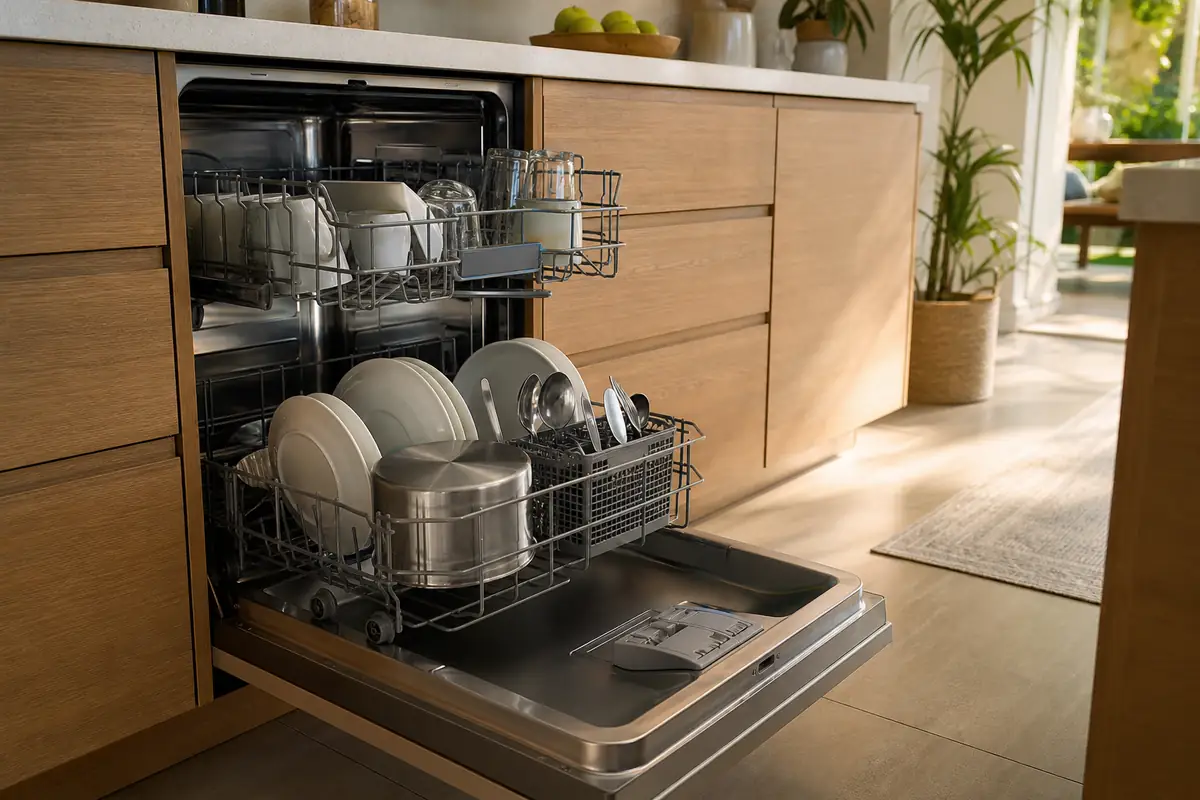
A height-adjustable upper rack can create room for tall plates or glasses, but check whether adjustment works when loaded. Folding tines increase flexibility when they remain stable. A third cutlery tray frees lower space but may reduce glass height; a basket is faster to unload for some households.
Inspect wheel tracks, stops, handle strength, coating and the way delicate stems are supported. Try representative clean items in a showroom where permitted, or study dimensioned diagrams. A rack that needs constant puzzle-solving is an ownership cost.
Read every field on the current energy label
The official UK label includes efficiency class, rated eco capacity, energy consumption per 100 eco cycles, water per eco cycle, eco programme duration, airborne noise and noise class. Compare the same programme basis rather than mixing a quick-cycle figure with eco data.
An A-to-G class is useful context, but actual annual use depends on cycles, loading and tariff. Record the numeric kWh and litres because two machines in one class can still differ. The QR-linked product sheet can provide additional model evidence.
Calculate running cost with your cycle count
Estimate annual electricity as kWh per 100 cycles multiplied by expected cycles and divided by 100, then multiply by the tariff used for comparison. Estimate water from litres per cycle the same way. Keep tariff and cycle count separate so the calculation can be updated.
Add detergent, salt, rinse aid and cleaning products. Do not claim an exact lifetime saving from one snapshot tariff. A slightly less efficient machine can still be better total value when it fits loads properly and avoids repeated or half-empty cycles.
Eco duration is not a defect by itself
Eco programmes often use longer time to reduce energy while achieving the tested cleaning result. The label displays duration so the household can decide whether scheduling works. Compare delayed start, remaining-time indication and drying behaviour rather than judging performance from speed alone.
Quick programmes can be useful for lightly soiled items but may use resources differently and have capacity limits. Read the manual before buying. A machine should support the cycles actually needed without encouraging every load onto the most intensive option.
Noise needs room context
The label gives airborne noise in dB and a noise class. Small numeric differences are not equally noticeable in every kitchen, and installation can change vibration. Open-plan homes, night use and hard surfaces make noise evidence more important.
Check whether reviews separate water movement, pump, drain and drying sounds. Correct levelling and secure cabinetry matter. Do not pay a large premium for a low figure if the dishwasher sits behind a closed utility door, but do not ignore tone and cycle length in a studio space.
Drying performance depends on load and material
Plastic containers often retain droplets because they cool differently from ceramic or glass. Door-opening systems, heat, fans and rinse aid can affect drying, but compare programme conditions and items rather than one universal claim. Check whether an opening door conflicts with children, pets or nearby furniture.
Load concave items so water can drain and follow rinse-aid guidance. A perfectly dry promotional glass does not prove that a lunch-box lid will be dry. Decide whether towel-drying some plastics is acceptable before paying for a feature.
Programmes should match real soil
Useful programmes may include eco, intensive, automatic, glass, quick, maintenance and a partial-load option. Count the ones that solve actual loads, then examine temperature, duration and restrictions in the manual. A long programme list is not value when most differ only slightly.
Sensor programmes can adjust use according to the detected load, but the maker should explain the operating range. Follow food-scraping and filter guidance rather than pre-rinsing automatically; the correct practice depends on manual and local circumstances.
Installation and removal belong in the quote
Confirm who disconnects the old appliance, supplies hoses or valves, fits an integrated door, tests for leaks and removes packaging. Delivery to the room is not the same as installation. Photograph the route and existing connections before ordering.
Use a competent installer where the work requires it. Do not improvise extensions, damaged sockets or unsuitable plumbing. Our electrical safety checklist covers the purchase-stage questions without replacing an electrician or plumber.
Repairability and service can outweigh extra programmes
Check warranty length, parts versus labour coverage, call-out process, engineer availability and access to baskets, seals, filters, pumps and electronics. A familiar feature list is less valuable when a minor rack part is unavailable.
Ask how long key spares are expected to remain obtainable and whether diagnostic information is accessible. Save the model and serial location. A repairable mid-range dishwasher can outperform a feature-heavy product with weak service.
Delivery inspection protects a difficult return
Before accepting installation where practical, inspect packaging and visible panels for impact. Confirm the exact model and accessories. Photograph damage and report it immediately through the seller’s process; do not conceal a dent behind cabinetry without recording agreement.
After installation, check level, door movement, hose connections, leaks, controls and a supervised test cycle. Retain documents and transport protections only as the seller instructs. Our appliance delivery checklist helps organise evidence.
Shortlist on ownership cost, not purchase price
Add appliance, delivery, installation, furniture work, removal, expected electricity and water, consumables and service risk. Do not invent a precise lifespan; compare scenarios over the same reasonable period and update tariffs later.
A larger capacity is not automatically cheaper, and an app is not value when it duplicates front-panel controls. The strongest model fits the cavity and crockery, runs the required loads efficiently and can be serviced without disproportionate disruption.
Choose full-size or slimline?
Mixed cookware and larger loads fill the racks
The cavity, route and plumbing fit, rack geometry handles the household’s pans and plates, and typical cycles are sensibly loaded.
Space and smaller regular loads dominate
The 45 cm format fits the cavity, tall items still clear the spray system and reduced rack flexibility does not force extra cycles.
Balanced verdict
Dishwasher value is a fit-and-load problem before it is an energy-class problem. Measure the complete installation and representative crockery, then compare rack geometry and all numeric eco-label fields. Add installation, consumables, service and repair evidence to the purchase price.
Browse the Home & Kitchen archive and compare appliance retailers through the shop directory.
Frequently asked questions
How many place settings does a household need?
Use the label as a comparison, then test actual plates, bowls, pans, glasses and lunch boxes against rack geometry and washing frequency.
Is an A-rated dishwasher always cheapest to run?
Not necessarily — Use the numeric kWh per 100 eco cycles, water per cycle, expected use and current tariffs, then include purchase and service costs.
Why is the eco programme so long?
Longer operation can reduce energy while meeting the tested result. Compare label duration with the household schedule and read the manual.
Is a cutlery tray better than a basket?
It can free lower-rack space and separate items, but may reduce upper clearance and take longer to load. Test against your crockery.
Can a dishwasher be installed by the delivery driver?
Only if the purchased service explicitly includes the required connection and cabinetry work. Confirm scope, competence, parts and testing before delivery.
Methodology and limitations
We reviewed official UK dishwasher energy-label fields and energy-labelling guidance, then built a comparison covering dimensions, loading geometry, programmes, water, energy, noise, installation, consumables, delivery and repair access. We did not hands-on test named machines.
Limitations
Model dimensions, labels, programmes, tariffs, installation services and spare-part support change. Verify the exact model drawing, product sheet, manual, quote and retailer terms before ordering.