Chest freezers buying guide: capacity, baskets, garage suitability and access
A chest freezer offers efficient bulk storage only when the household can reach, rotate and identify what is inside. Compare usable layers, baskets, room temperature limits, energy evidence and lid access before choosing litres.
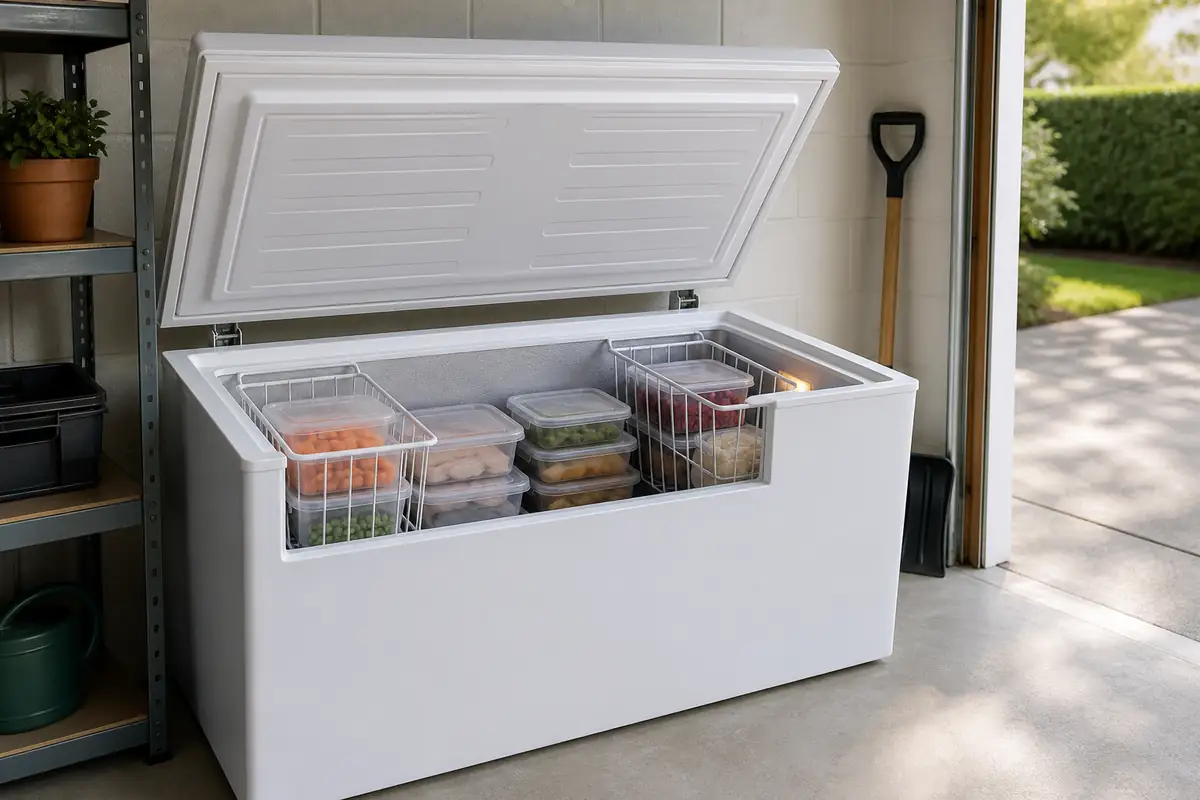
In this guide
Choose an inventory system and installation site before capacity
The best chest freezer is a correctly rated appliance whose bottom can be reached safely and whose baskets support food rotation. A large empty box wastes floor area and can hide food; garage suitability must be stated for the exact model and ambient-temperature range.
Use our fridge-freezer layout guide for label evidence and the appliance running-cost method for annual kWh.
| Question | Evidence | Test | Main risk |
|---|---|---|---|
| Can the freezer reach its position and open with the required clearance? | External and packaged dimensions, ventilation, lid arc | Measure route, floor and open-lid height | Measuring only floor footprint |
| Can food be reached? | Internal depth, baskets and divider options | Mock lowest reach and basket lift | Losing food at the bottom |
| Will the room suit it? | Manufacturer ambient and garage statement | Record seasonal room temperatures | Assuming every freezer works in an unheated garage |
| What will it cost? | Annual kWh, label, defrost method | Multiply kWh by current unit rate | Comparing class without volume |
Chest-freezer site record
- Measure delivery route, footprint, ventilation and lid clearance.
- Check floor level, strength, socket and cable route.
- Record the manufacturer ambient-temperature range.
- Map ordinary and peak food volume by basket and lower layer.
- Save the chest freezer’s exact model label and product sheet so rated kWh, storage volume and noise can be compared with another usable basket layout.
- Confirm alarm, drain and defrost instructions.
- Price delivery, installation and old-appliance removal.
- Plan a written inventory and first-in-first-out rotation.
Measure the lid in three dimensions
A chest freezer needs floor footprint, ventilation clearance and room for the lid to open fully. Measure under shelves, boilers, sloping ceilings and garage doors. A lid that stops halfway makes baskets difficult to lift and creates unsafe reaching.
Check the delivery route using packaged dimensions, turns and thresholds. Confirm whether doors can be removed and who handles unpacking. A successful final fit does not excuse an impossible corridor or step.
Reach matters as much as litres
Measure internal depth and compare it with the shortest regular user’s safe reach. Deep capacity can be unusable when a person must lean on the rim or lift heavy frozen food from below shoulder control. Stable removable baskets and dividers create reachable zones.
Use baskets for frequently accessed small items and reserve lower layers for labelled larger packs. Do not overload baskets beyond their rating. A grab list should say exact zone, not merely “in freezer”.
Map capacity from actual food habits
Count current frozen drawers during an ordinary week and a peak batch-cooking or holiday period. Group meat or alternatives, vegetables, bread, prepared meals and ice packs. Convert the list into baskets and lower zones rather than choosing by household-size marketing.
Extra volume can support fewer shopping trips, but it also encourages forgotten stock. If the inventory cannot be maintained, a smaller organised freezer may hold more usable food than a larger chaotic one.
Garage suitability must be model-specific
Unheated garages can become colder or hotter than a kitchen. The appliance manual should state the permitted ambient range and any special garage or outbuilding suitability. Do not infer this from the word freezer or from another model in the same brand.
Record real winter and summer temperatures at the proposed site. If conditions fall outside the manual, choose another model or location rather than improvising heaters, insulation or extension wiring around an appliance.
Read energy evidence with volume
UK refrigerating-appliance labels use A–G classes and provide annual electricity consumption and volume information. Save the exact model label and product sheet. Compare annual kWh alongside usable capacity, because a larger freezer cools more space.
Multiply annual kWh by the relevant electricity unit rate and repeat over expected ownership. The running-cost guide prevents a headline class from replacing arithmetic.
Manual and low-frost systems change maintenance
Many chest freezers need manual defrosting. Check drain position, recommended trigger, safe tools and food-storage plan. Ice reduces usable volume and can obstruct baskets or seals; aggressive scraping can damage the liner.
Low-frost claims can reduce frequency but do not eliminate correct loading, closure and maintenance. Include temporary cool storage and drying time before calling the appliance convenient.
Alarms and controls must be usable from the site
A power or temperature warning is useful only if someone can notice it. Check whether the model has visible or audible alarms and whether a smart notification depends on Wi-Fi reaching the garage. A simple independent temperature alarm may add resilience if suitable.
A display may show a set point rather than food temperature. Follow the manual for commissioning and use an appropriate thermometer. Avoid blocking control or condenser areas with storage.
Installation needs a suitable socket and floor
Use a fixed suitable socket according to the manual and avoid trailing unsuitable extensions through a garage. Check floor level and strength, moisture exposure and access for cleaning. Our electrical safety guide covers plug, recall and damage checks.
Follow transport-settling instructions before switching on. Photograph delivery condition, model and serial numbers, then confirm the lid seal and temperature before loading valuable food.
An inventory protects food and money
Maintain a dated list by zone and move older items toward the next-use basket. Label home-frozen food clearly and follow official food-safety advice on freezing and storage. A full freezer is not useful when packages cannot be identified.
Set a monthly lower-layer review and a defrost reminder. The system should work without opening the lid for long searches, which also reduces warm-air entry and frost.
Serviceability affects long ownership
Check guarantee, local service, seal, basket, hinge and thermostat availability. A damaged basket or seal can make a mechanically working freezer difficult to use. Search the exact model family and save parts diagrams where available.
Our repairability guide separates replaceable parts from sealed-system work. Include removal cost and food-loss planning in lifetime value.
Plan for power cuts without opening the lid
Save the manufacturer’s stated storage time during power failure and understand the test conditions. During an outage, keep the lid closed and follow official food-safety advice rather than repeatedly checking by touch. A thermometer and outage timestamp make later decisions more informed.
Do not refreeze food merely because the outside still feels cool. If safety is uncertain, use authoritative guidance. A larger freezer can represent a larger potential food loss, so include alerting, insurance terms and a contact plan in ownership.
Loading order protects airflow and fragile packages
Follow the manual’s loading and fast-freeze instructions. Freeze suitable quantities without blocking specified walls, vents or sensors, and let prepared food cool safely before freezing. Keep raw and ready-to-eat items securely wrapped and labelled.
Flat packages can save space but should not create unstable stacks that fall when a basket is lifted. Use rigid zones and leave handles accessible. The inventory should match physical labels, including freeze date and contents.
Compare delivery and removal as separate services
Kerbside delivery, room-of-choice placement, unpacking, installation and old-appliance collection are different promises. Save what is included and prepare a clear safe route. Confirm whether the old appliance must be empty and defrosted before collection.
Do not transfer frozen food until the new unit reaches the required temperature. If a service fails, document it separately from product quality so the remedy and evidence remain clear.
Lid seals and hinges need routine inspection
Wipe the seal according to the manual and check that packaging, frost or a misaligned basket does not prevent closure. A paper test is not universal manufacturer guidance, so use the stated inspection method and report damage rather than stretching the gasket. Record any repeat frost pattern that may identify a closure problem.
Hinges and counterbalance mechanisms carry a heavy lid. Keep hands clear, do not let children climb or lean into the cabinet and never rely on an improvised prop. If the lid drops or will not stay safely open as designed, stop using it for loading and seek service.
Choose compact or high capacity?
Ordinary and peak stock fit a simple zone map
The bottom remains reachable, energy and floor space are lower, and stock can rotate without several hidden layers.
Measured bulk storage consistently needs it
The household maintains an inventory, can reach every zone and the installation site stays within the exact ambient rating.
Balanced verdict
A chest freezer is an organisation and site decision before a capacity decision. Measure lid access and reach, verify garage conditions, read annual kWh and build a basket map. More litres help only when food remains visible and safe.
Browse Home & Kitchen and use the dimension-tolerance guide before ordering.
Official checks:
GOV.UK energy-labelling guidance ↗
UK household refrigerating-appliance label fields ↗
Frequently asked questions
Can every chest freezer be kept in a garage?
No — Verify the exact manufacturer ambient-temperature range and any garage suitability statement for the model.
How much chest-freezer capacity is needed?
Map an ordinary and peak food load by baskets and lower zones. Household-size rules are less reliable than actual stock.
Are chest freezers cheaper to run?
Design can reduce cold-air loss when opened, but compare the exact annual kWh and usable volume rather than assuming.
How often should a chest freezer be defrosted?
Follow the model manual and act before ice obstructs seals, baskets or useful volume.
How can food be found at the bottom?
Use stable baskets, labelled lower zones and a dated inventory with first-in-first-out rotation.
Methodology and limitations
We reviewed current UK refrigerating-appliance energy information and built a framework covering route, lid clearance, reach, ambient rating, usable capacity, defrosting, controls, energy, inventory and service.
Limitations
Ambient ratings, models, kWh, prices and services change. Confirm the exact manual, label, product sheet, room conditions and delivery route before purchase.