Fridge freezer dimensions: measuring ventilation, doors and delivery routes
The cabinet width is only the beginning. A workable fridge freezer needs model-specific ventilation, enough door swing for drawers, level-floor adjustment and a delivery route that clears every turn.
In this guide
Measure an operating envelope and a delivery envelope
Record the narrowest width, lowest height and usable depth of the appliance position, then add every clearance stated in the exact installation manual. Separately measure doors, halls, stairs, lifts and turns on the delivery route. Confirm door swing, handle projection, drawer removal and services before ordering; “standard size” is not a safe specification.
This guide is for planning a purchase, not installing electrical, plumbing or joinery work. Manufacturer instructions control. Recommended Today did not install or performance-test a fridge freezer.
The measurements that decide fit
| Measurement | Record | Common mistake |
|---|---|---|
| Appliance niche | Width at front, middle and rear; height at both sides; usable depth | Taking one measurement from a room that is not square |
| Ventilation | Top, side, rear and plinth clearances from the exact manual | Assuming the cabinet can touch walls or units |
| Door operation | Opening angle, handle sweep, wall spacing and drawer travel | Checking that the door opens but not that shelves come out |
| Delivery route | Clear openings after doors, hinges and obstacles; turning space | Using the frame width while ignoring the door leaf |
| Services | Socket, plug, cable, water connection and isolation access | Trapping a plug or hose behind the appliance |
Build a measuring record
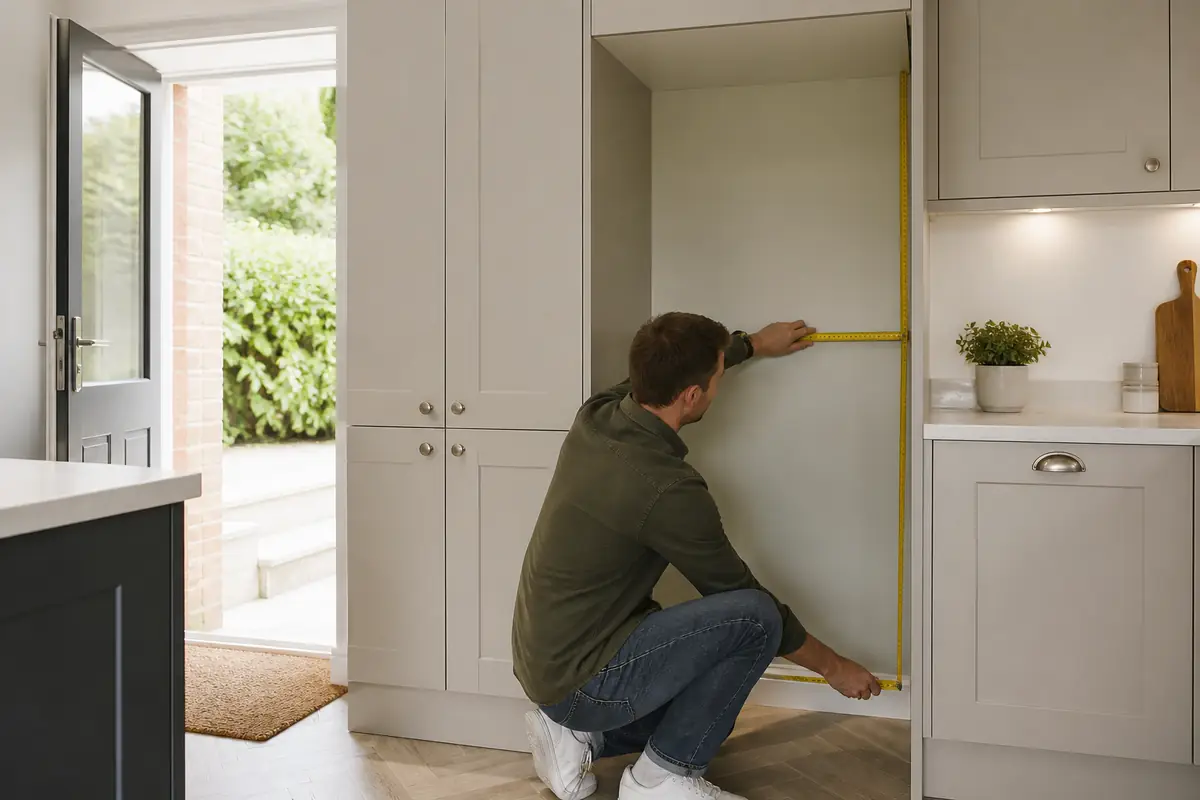
Use a rigid tape, spirit level and simple plan. Measure in millimetres and write the number immediately. For an alcove, take width at low, middle and high points; height at left and right; depth along both sides. Use the smallest width and height. Skirting, pipes, sockets, radiators, trim and an uneven floor all reduce the real opening.
Photograph the tape in position and label each image. A measurement without a location is easy to reverse later. The same evidence-led habit appears in our furniture measuring guide, while the product-shortlisting method keeps non-negotiable dimensions separate from preferences.
Minimum fridge-freezer survey
- Three niche widths, two heights and both side depths.
- Floor level and any front-to-back slope.
- Skirting, cornice, pipe, socket and radiator projections.
- Clear door swing and space to remove bins and shelves.
- Every delivery opening, turn, stair and lift dimension.
- Model number and downloaded installation manual.
Freestanding and integrated dimensions are different questions
A freestanding model occupies floor area and needs its published clearances. It may project beyond worktops, particularly once the door and handle are included. An integrated model belongs to a specified housing and ventilation arrangement, with door-panel dimensions, hinge system and plinth airflow to match. Do not substitute the visible external dimensions of an integrated appliance for its installation drawing.
Some product pages list dimensions in different orders. Never assume a three-number sequence means height × width × depth. Copy the labelled fields. Check whether depth includes doors and handles, and whether diagrams give a second depth with doors open. Keep the PDF or screenshot used for the order.
Ventilation is model-specific
Refrigeration equipment releases heat. The installation manual specifies how air enters and leaves, and those instructions are part of safe, efficient operation. Bosch’s current UK installation guidance, for example, describes an unobstructed ventilation route and gives a 200cm² outlet example for relevant installations; that figure must not be treated as universal. Another model or housing can require different top, rear, side or plinth arrangements.
Do not close vents with stored bags, trim or a tight worktop. Space that appears wasteful may be the operating clearance. Poor ventilation can increase running effort and temperature risk. Compare energy information only after confirming the appliance can be installed as designed; our energy-efficient appliance guide explains why label figures do not override real placement, and the appliance running-cost guide keeps annual energy separate from purchase price.
Door swing, walls and drawer access
A door can clear the cabinet and still fail in daily use. Check the angle required to pull out crisper drawers, freezer bins, shelves and water-filter components. A wall or tall unit beside the hinge may stop the door before those parts clear. Handles can strike radiators or adjacent doors.
Confirm whether hinges are reversible and whether reversal is a customer task, a paid service or prohibited on the chosen model. Consider the kitchen route: which hand will hold the door while loading, and will an island or open dishwasher block movement? A French-door or American-style model needs both door sweeps mapped on the floor.
| Check | Pass condition | Evidence |
|---|---|---|
| Closed position | Cabinet and handle fit without crushing services | Installation drawing and niche record |
| Normal opening | Door clears wall, unit and opposing traffic | Door-swing diagram or taped floor arc |
| Maintenance opening | Drawers, shelves and filters can be removed | Manual plus measured angle |
| Cleaning access | Reachable without unsafe lifting or trapped cable | Planned pull-out space and instructions |
Measure the complete delivery route
Start at the vehicle unloading point and walk to the final position. Measure gates, communal entrances, hall turns, stair width and headroom, lift door and cabin, internal doors and the kitchen approach. Use clear openings with the door at its maximum practical position, not nominal frame size. Remove only items that can genuinely be removed before delivery.
At a turn, width alone is insufficient: the packaged appliance has length and depth, so it needs a diagonal sweep. Compare the manufacturer’s packaged dimensions when available. Ask the retailer what packaging can be removed at which point and who accepts risk. Do not assume delivery staff will remove doors, bannisters or appliance doors.
Record parking restrictions, steps and floor protection. If access is uncertain, send the retailer written measurements before ordering and keep its response. Our online-shop verification guide helps confirm the contracting seller and service terms.
Capacity: litres do not describe layout
Net volume helps compare broad capacity, but internal arrangement controls usefulness. Count adjustable shelf positions, door-bin heights, drawer dimensions and freezer access. A large figure may include shapes your containers cannot use. Measure a typical tall bottle, weekly vegetable load and frozen box rather than buying litres without a storage plan.
Separate fridge and freezer needs. A household that batch-cooks may prefer freezer drawers; frequent fresh shopping may value adjustable fridge shelves. Door-opening frequency, ambient location and loading habits affect real use. Our small-kitchen buying guide helps value circulation space instead of maximising appliance size.
Delivery, installation and removal services
Read exactly what the selected service includes: room-of-choice delivery, unpacking, levelling, door reversal, water connection, disposal and packaging removal may be separate. Check whether the old appliance must be disconnected and empty. A plumbed model needs a suitable connection and isolation route specified by the manufacturer.
Inspect on arrival before the team leaves where practical. Photograph packaging damage, dents, incorrect model numbers and the serial label. Do not energise a transported appliance sooner than its manufacturer permits; required standing time can depend on how it was carried.
Every envelope works
The operating clearances, door use, services and packaged delivery route are documented with margin.
Any critical dimension is assumed
The manual is unavailable, a turn is unmeasured, ventilation is improvised or the seller will not confirm the service.
Balanced verdict
The right fridge freezer is the largest useful model that can be delivered, ventilated, opened, maintained and removed safely in the actual home. External dimensions, capacity and price are only shortlist inputs. Installation drawings and a measured route decide whether the purchase is viable.
Leave honest margin. A few millimetres on a product page should not be treated as installation tolerance, and a larger capacity is poor value when doors or drawers cannot operate.
Check current official information:
Bosch UK fridge ventilation guidanceGOV.UK product safety alerts and recalls ↗
Frequently asked questions
How much gap should I leave around a fridge freezer?
Use the exact model’s installation manual. Top, rear and side requirements vary, so a generic number cannot safely replace the manufacturer’s diagram.
Does appliance depth include the handle?
Sometimes product pages provide more than one depth. Check the labelled diagram and confirm cabinet, door and handle depth rather than interpreting an unlabelled number.
Can a fridge freezer stand next to a wall?
Only when the model’s side clearance and door-opening requirements are satisfied. A wall can prevent full opening and drawer removal even when the closed cabinet fits.
Should I measure the appliance without packaging?
Use packaged dimensions for delivery access and installed dimensions plus required clearances for the final position. Both envelopes matter.
Can delivery staff remove appliance doors?
Do not assume so — Confirm the paid service and manufacturer procedure in writing before ordering; some tasks require trained installation or are excluded.
How we researched this guide
Recommended Today reviewed official UK manufacturer installation guidance and mapped it to a repeatable niche, operation and delivery-route survey on 28 August 2026. We did not install or test an appliance.
Limitations
Clearances, packaged dimensions, hinge procedures, standing time and services vary by exact model and retailer. Building constraints and electrical or plumbing work require suitable competent advice.