How to Choose a Living-Room Rug: Size, Pile, Material and UK Prices
Choose the layout before the colour. This UK guide explains living-room rug size, pile, material, care and current prices, with practical advice for measuring the seating area.
In this guide
Measure the seating group, then buy the lowest-maintenance texture you enjoy.
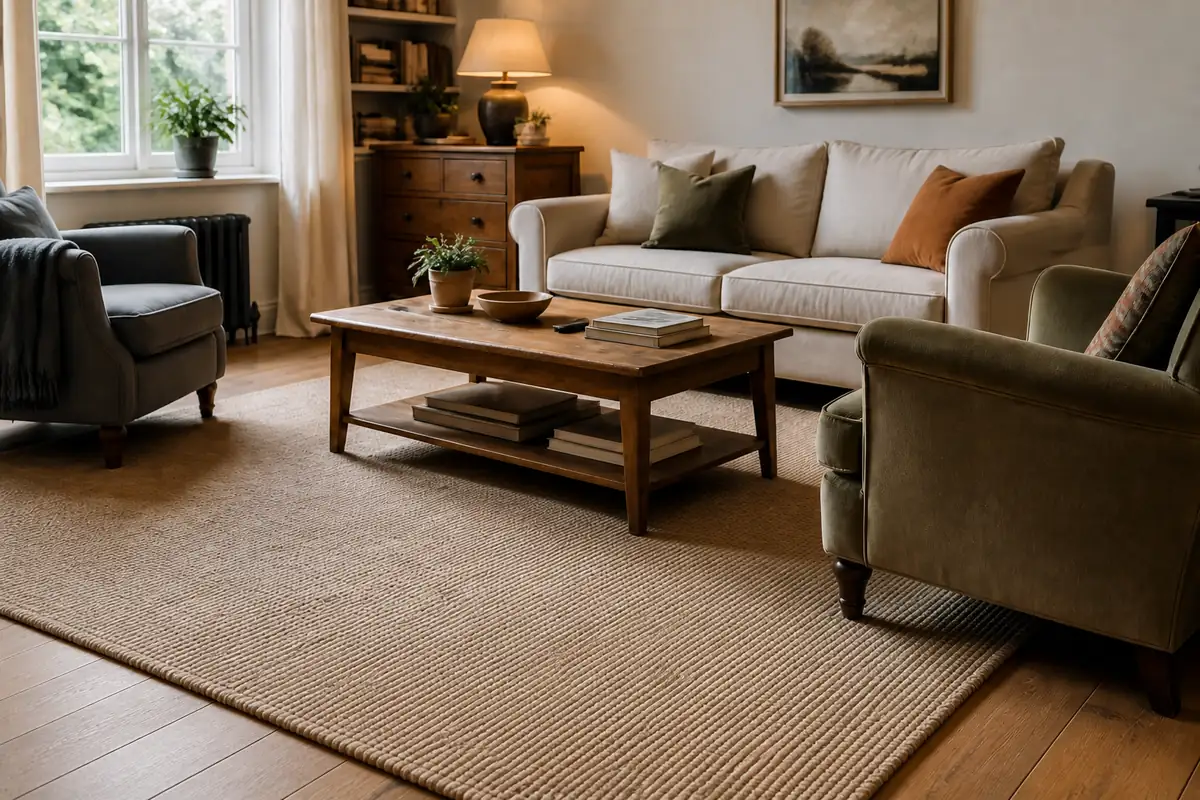
For most living rooms, place at least the front legs of the sofa and chairs on the rug. Choose low pile or flatweave for busy homes, doors and easy vacuuming; choose deeper pile for softness where spills and traffic are limited. Tape the proposed outline on the floor before ordering and add a suitable underlay unless the rug already has effective non-slip backing.
This guide compares dimensions, materials, care and current retailer examples. It does not claim to have handled the sampled rugs. Colours vary by screen and fibres can feel different from photographs, so a swatch, store visit or carefully protected home inspection is valuable where available.
Use this alongside our furniture measuring guide, Dunelm review and Wayfair UK review.
Living-room rug sizes: which layout works?
| Common size | Likely use | Main risk |
|---|---|---|
| 120×170cm | Compact room or a clearly defined small seating nook | Can float beneath only the coffee table |
| 160×230cm | Many two- or three-seat sofa arrangements with front legs on | May be narrow with a large corner sofa or two armchairs |
| 200×300cm | Larger seating group, more furniture legs on the rug | Door clearance, cost and difficult return handling |
| 240×340cm or larger | Large open-plan zone or all furniture fully on | Heavy, expensive and harder to clean or rotate |
These are starting points, not rules. Sofa width, chair angle, hearths, doors and walking routes determine the real answer. A 160cm-wide rug under a 220cm sofa leaves only a modest reveal at each side; that may feel pinched. Aim for a visible border beyond the seating where the room allows it.
Three reliable rug layouts
Front legs on
The front legs of the sofa and armchairs sit on the rug while rear legs remain on the floor. This joins the furniture without demanding the largest size and is the most adaptable layout for UK living rooms. Keep the placement consistent: one chair half-on and another floating can look accidental.
All furniture on
The entire seating group sits on the rug. This creates a generous, unified zone in a large or open-plan room. Leave a clear floor border around the rug rather than pushing it wall to wall, and verify that the largest rolled package can reach the room.
All furniture off
A smaller rug sits centrally with furniture around it. This can work in a very compact or deliberately minimal arrangement, but the rug must be large enough to relate to the seating. A small rectangle trapped beneath the coffee table often makes the room feel fragmented.
Current UK rug prices at 160×230cm
| Example checked 20 August 2026 | Material and pile | Displayed price |
|---|---|---|
| IKEA TIOKRONA | 100% jute, flatwoven, 6mm | £49 |
| IKEA JÄRNVÄG | Polypropylene low pile with synthetic-rubber backing | £99 |
Price snapshot: the official IKEA UK pages were checked on 20 August 2026 for the stated 160×230cm variants. Delivery, underlay and collection can change the total, while local stock depends on postcode. Recheck size, availability, price and return route at checkout.
The table is not a quality ranking. The £49 jute flatweave and £99 synthetic low-pile rug solve different problems: the first prioritises a natural texture and easy chair movement, while the second adds cushioning and a stain-resistant surface. Compare price per useful year only after checking how the material fits the household.
Low pile, high pile or flatweave?
Flatweave
Flatwoven rugs have little or no raised pile, so chairs move more easily and crumbs remain near the surface. They suit busy rooms, dining zones and many robot vacuums. They provide less cushioning and can move on smooth floors without the correct backing or underlay.
Low pile
Low pile adds softness while remaining easier to vacuum than a deep shag. It is the safest general-purpose choice for a living room with regular traffic. Check actual pile height and care instructions; retailer labels are not perfectly standardised.
High pile and shaggy
Deeper pile feels warm, absorbs sound and makes a relaxed seating area inviting. It also traps debris, can show compression beneath furniture and may obstruct doors or some cleaning heads. Choose it where comfort outranks effortless maintenance, not because a close-up image looks luxurious.
Door clearance includes rug plus underlay. Open every nearby door over the taped outline and measure the gap. A thick rug that prevents a door opening fully is not the right size or pile, however attractive it is.
Rug materials compared
| Material | Strengths | Trade-offs |
|---|---|---|
| Wool | Resilient, warm, naturally springy and often long-lived | Higher price, initial shedding and care requirements |
| Polypropylene | Affordable, durable, colourfast and often stain-resistant | Synthetic feel varies; heat and care limits apply |
| Polyester | Soft, vivid colour and recycled options widely available | Can flatten in heavy traffic and attract oily marks |
| Jute | Natural texture, strong flatweave and warm neutral appearance | Moisture-sensitive, rougher and harder to spot-clean |
| Cotton | Lighter, casual and sometimes machine washable | Can crease, shrink or move; large sizes exceed domestic washer capacity |
| Viscose | Silky sheen and colour variation | More delicate around moisture, crushing and heavy use |
Material percentages matter more than a poetic collection name. Read the user surface, backing and care label. “Washable” requires detail: machine capacity, temperature, detergent and drying method. A 160×230cm rug may fit the label’s washing claim but not the household machine once wet and heavy.
For children or pets, prioritise cleanability, stable backing and a pattern that tolerates everyday marks. Pale high pile can be beautiful in a low-traffic room but demanding beside a garden door. Natural fibres are not automatically more sustainable if a mismatch causes early replacement.
How to measure before buying
- Draw the room and mark walls, doors, hearth, vents and fixed furniture.
- Measure the seating group at its real angles, not just the sofa width.
- Choose a layout: front legs on, all on or deliberately all off.
- Mark the proposed rug with low-tack masking tape or sheets of newspaper.
- Walk every route and open doors, drawers and recliners.
- Measure the taped rectangle again; do not rely on the nominal plan.
- Check the rolled package length against stairs, lifts and corners.
Leave enough exposed floor for the room to breathe, but do not obsess over a universal border. Irregular rooms and bay windows need visual balance rather than exact symmetry. Photograph the taped layout from the doorway and sofa; the camera often reveals when a rug is undersized.
Our measurement guide covers access routes and delivery. A 230cm-long rolled rug can be harder to turn on a staircase than its diameter suggests.
Underlay, safety and underfloor heating
An underlay reduces movement, protects the floor and can make a thin rug feel more substantial. Match it to the floor type and keep it slightly smaller than the rug so it does not show. Built-in rubber backing may reduce the need, but confirm that it is suitable for the specific floor finish.
Check underfloor-heating compatibility explicitly. Thickness, backing and thermal resistance affect performance. IKEA describes TIOKRONA as suitable with underfloor heating, while Wayfair provides product-specific flags. Do not extend that statement to every rug from the brand.
Loose corners and sliding rugs create trip risks. Flatten rolled edges according to manufacturer guidance and keep routes well lit. Do not improvise with adhesive that could mark wood, laminate or stone.
Colour, pattern and online photographs
Start with undertone rather than exact screen colour. Warm beige, cool grey and green-grey can look similar online but clash in the room. View images on more than one screen and read descriptions, yet accept that lighting changes everything. Wayfair itself warns on relevant listings that colours may differ with light and resolution.
A patterned rug hides small marks and can connect several colours already in the room. A plain rug makes texture and pile more visible. Large motifs need enough floor area to be read; small busy patterns can calm visually when furniture covers much of the centre.
If the retailer offers samples, use them beside the sofa in daylight and artificial light. Otherwise preserve packaging and inspect carefully within the return policy before placing heavy furniture. Our home-furnishing quality guide explains how to assess materials and construction alongside colour and shedding reports.
Cleaning and long-term ownership
Follow the product care label, not generic internet advice. IKEA’s jute TIOKRONA specifies immediate dry scraping for dry spots, blotting wet spots and professional cleaning when needed; it should not be washed. The polypropylene JÄRNVÄG is also listed as non-washable. Another synthetic rug may permit hand washing, so material name alone does not establish care.
Vacuum and rotate regularly to spread traffic and sunlight. Some rugs prohibit rotating brush heads because they can pull fibres. Deal with spills promptly by blotting rather than rubbing. Budget for professional cleaning if the size, material or backing makes home treatment unrealistic.
Furniture cups can reduce indentations, and occasional rotation redistributes pressure. Sunlight can fade colours unevenly. These small habits may extend useful life more than paying for a fashionable label.
Delivery and returns: the overlooked cost
Wayfair publishes a 30-day return policy for most items, but eligibility, refund method and return charges must be checked for the exact product. Large rugs are awkward to repack, and marketplace-style brand names make exact specifications important. Our Wayfair review explains the seller and delivery checks.
IKEA availability and delivery depend on postcode and store. Dunelm offers collection and home-delivery routes across a broad rug range; the Dunelm review covers current return handling. Do not discard wrapping until size, colour and condition are accepted. Photograph damage before unrolling further.
Which rug should you choose?
Low pile or flatweave
Choose stable backing, clear care instructions and a pattern or mid-tone colour that tolerates daily traffic.
Deeper pile
Choose softness and sound absorption after checking doors, vacuum compatibility, shedding and professional cleaning.
Our verdict
Our default is a 160×230cm low-pile rug with the front legs of a two- or three-seat arrangement on it. Move to 200×300cm when seating is wider or all furniture should sit on the rug. The best material is the one your household can maintain, not the most expensive fibre.
Check current examples:
Frequently asked questions
What size rug works with a three-seat sofa?
160×230cm is a common starting point with front legs on, but wide sofas and chairs may need 200×300cm. Tape the exact outline first.
Should a rug go under the sofa?
Usually at least the front legs should sit on it to connect the seating group. Large rooms can place all furniture fully on the rug.
Is low pile better for a living room?
It is the most practical general choice because it is easier to vacuum and less likely to obstruct doors. High pile offers more softness.
Do I need a rug underlay?
Often yes for grip, floor protection and cushioning, unless the rug has suitable effective backing. Match underlay to the floor and heating system.
Can a large rug be machine washed?
Only when the care label permits it and the machine can safely handle the wet weight. Many 160×230cm rugs require spot or professional cleaning.
How we prepared this rug guide
We reviewed the official IKEA UK product pages on 20 August 2026 and compared the same 160×230cm size, recording material, pile, care, price and return implications. We also used official retailer guidance where it clarified measuring, placement and care. We did not handle or test the sampled rugs.
Limitations: prices, stock, colour, delivery and return terms change, and availability depends on postcode. Recheck the exact size, material and checkout total before ordering. Measure the room and access route first.