Dishwasher place settings explained: capacity, programmes and running cost
A place-setting number is a standardised capacity measure, not a promise that your pans, mugs and lunch boxes will fit. Compare the racks, Eco-cycle label data and installation limits as carefully as the headline capacity.
In this guide
Choose for the awkward items you wash, then verify the Eco figures
Place settings help compare rated capacity, but rack geometry decides whether a dishwasher works in your home. A larger number can be useful for plates and cutlery, yet tall glasses, deep bowls, frying pans and reusable bottles may consume space very differently. Shortlist models that accept your largest everyday items, then compare energy per 100 Eco cycles, water per Eco cycle, programme duration, noise and the true installed dimensions.
This guide explains the information available before purchase. Recommended Today did not laboratory-test a dishwasher or estimate a universal household saving. Running cost depends on the exact model, tariff, water charges, load pattern and programme used. Use the calculation below with current figures from the product’s official energy label.
What a dishwasher place setting actually means
UK energy-label data uses rated capacity in standard place settings for the Eco programme. In regulation, rated capacity is the maximum number of place settings, together with serving pieces, that can be cleaned, rinsed and dried in one cycle when the machine is loaded according to the supplier’s instructions. It is a repeatable comparison measure, not a count of people fed or a description of your own crockery.
A standard load represents specified tableware. Real kitchens add cereal bowls, large mugs, wine glasses, chopping tools, food-storage lids and cookware. A household of two that cooks from scratch may create a more difficult load than a larger household using similar flat plates. Treat the rating as a first filter, then recreate your normal load using rack diagrams, dimensions and an in-store inspection where possible.
| Capacity clue | What it can tell you | What it cannot prove |
|---|---|---|
| Place settings | Rated Eco-programme capacity under a standard loading method | That your pans, bowls and glasses fit together |
| External width | Whether a full-width, slimline or compact format may suit the opening | Usable rack volume or internal height |
| Third rack | Potential cutlery and utensil space | That tall glasses still clear the rack above |
| Adjustable upper rack | Potential flexibility between upper and lower zones | That adjustment works while fully loaded |
| Folding tines | Potential room for deep or irregular pieces | That large items avoid spray arms and detergent flap |
Full-size, slimline or compact?
The category name does not replace measurement. Full-size built-in and freestanding machines are typically selected for wider openings; slimline models trade width for capacity; compact or tabletop machines may suit a constrained kitchen but still need water, drainage, ventilation and safe worktop support. Product dimensions can exclude projecting hoses, doors, handles or installation clearances.
Measure opening width at the front and back, height at several points, and depth to the nearest obstruction. Record the route for inlet, waste and power without crushing hoses. For an integrated model, include furniture-door compatibility and the clearance required as the door opens. Apply the measuring discipline from our washing-machine capacity guide: space, access and real loads matter more than a headline number.
Capacity test before ordering
- List the largest dinner plate, bowl, glass, pan and reusable bottle washed weekly.
- Check maximum plate or glass dimensions in the manual, not a retailer summary alone.
- Inspect rack adjustment, folding tines, cutlery basket or third drawer.
- Confirm spray arms and detergent dispenser remain unobstructed.
- Measure the opening, door swing, hose route and connection positions.
- Save the energy label and product information sheet for the exact model code.
Read the energy label as one data set
The rescaled UK label uses classes A to G and shows more than the coloured letter. For dishwashers, the official label data includes rated Eco capacity, energy consumption in kilowatt-hours per 100 cycles, water consumption in litres per Eco cycle, Eco duration and airborne noise. A product information sheet provides further model-specific detail. Compare the same programme basis across candidates.
Do not translate the class directly into a cash saving without the consumption figure. A larger machine and a smaller machine may have different capacity as well as energy use. If you regularly run partial loads, actual cost per cleaned item may be worse than the label suggests. Our energy-efficient appliance guide explains why class, capacity and behaviour must be read together.
Calculate a transparent running-cost estimate
For electricity, divide the label’s kWh per 100 Eco cycles by 100, then multiply by your current unit rate and expected annual cycles. For water, multiply litres per Eco cycle by annual cycles, convert to cubic metres by dividing by 1,000, and apply the relevant metered water and wastewater charges. If you do not have a water meter, that second figure may not change your bill directly, although consumption still matters.
Keep standing charges out of an appliance-to-appliance comparison because buying a different dishwasher does not usually remove the household standing charge. Do not use Eco figures to price intensive, rapid or automatic cycles. Those programmes can use different time, temperature, energy and water. Record a low, typical and high cycle count rather than pretending one estimate is exact.
| Cost input | Where to find it | Calculation |
|---|---|---|
| Electricity per Eco cycle | Energy label: kWh per 100 cycles | Label figure ÷ 100 |
| Annual electricity | Your cycle estimate and current tariff | kWh/cycle × cycles × unit rate |
| Annual metered water | Label litres/cycle and supplier charges | Litres × cycles ÷ 1,000 × combined rate |
| Consumables | Your detergent, salt and rinse-aid choices | Real price per dose × cycles |
| Maintenance | Manual and warranty terms | Keep separate; do not invent a fixed annual figure |
Eco, auto, intensive and quick programmes
Eco is the regulated comparison programme for normally soiled tableware and may take longer because lower-intensity heating and extended phases can reduce resource use. A long displayed duration does not by itself mean higher electricity use. Judge it using the label. Auto or sensor programmes adapt within a model’s stated range; intensive cycles target heavily soiled, robust cookware; quick cycles prioritise time and may have limits on soil level or drying.
Programme names and options vary. Check the manual for temperature, suitable load, drying behaviour and whether an option changes consumption. Bosch’s official guidance, for example, warns that place settings and programmes vary by model. Avoid assuming a familiar programme name behaves identically across brands.
Rack design matters more than catalogue capacity
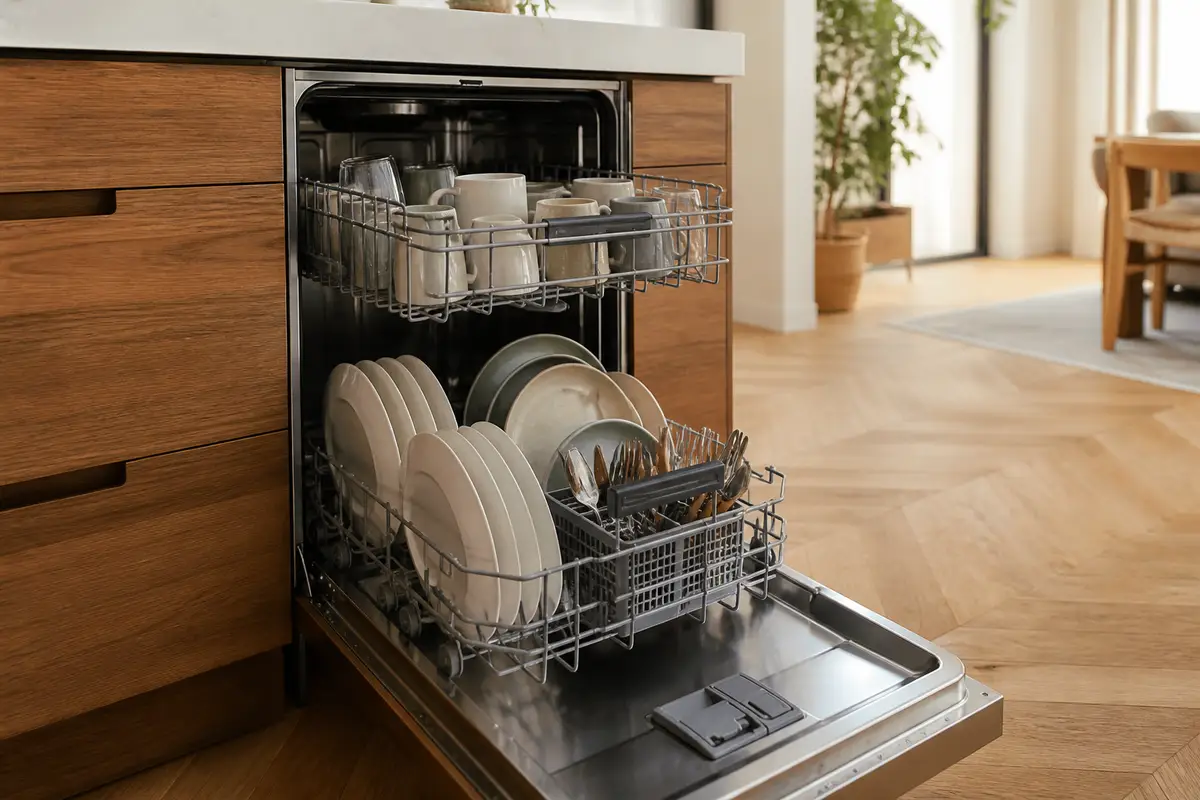
Take your awkward items seriously. Closely spaced fixed tines may suit flat plates but fight deep pasta bowls. A cutlery drawer frees lower-rack space but can reduce upper clearance. A height-adjustable rack is useful only if the adjustment range resolves the collision you actually have. Stemware supports, bottle jets and folding sections can be valuable, but only when they match regular loads.
Cookware also needs care. Some non-stick pans should be hand-washed even when a dishwasher-safe claim appears, because repeated harsh detergent and heat can shorten surface life. Follow the maker’s instructions and our non-stick pan care guide. The induction-pan guide separately explains material and base checks; hob compatibility does not prove dishwasher suitability.
Noise, drying and everyday convenience
Noise is reported in dB(A) and a class on the label. It matters most in an open-plan room, at night or when long Eco cycles overlap with conversation. Compare labelled values but remember installation and surrounding cabinetry can change perceived sound. Do not infer quietness from “silent” branding alone.
Drying performance depends on programme, load, material and technology. Plastics often retain droplets because they store less heat than ceramic or metal. Auto-opening, heat-exchange or extra-dry options can change the result and sometimes the duration or energy use. Read the manual and count the post-cycle tasks you are willing to accept.
You can fill it without delaying hygiene
Your normal load includes bulky dishes or cookware, the racks accept them, and you can run full or efficiently loaded cycles at a sensible frequency.
Space and regular load are genuinely limited
The machine fits safely, holds the items used each day and avoids routine half-empty cycles without forcing awkward stacking.
A disciplined dishwasher shortlist
- Measure the installation space, access, connections and door path.
- Describe one realistic dirty load, including awkward pieces.
- Check racks and clearances in the manual or showroom.
- Compare the complete label, not the class alone.
- Calculate Eco cost with current tariff and honest cycle scenarios.
- Read programme and drying limits for the exact model code.
- Verify seller, delivery and return terms before payment.
Use our product-shortlisting framework to eliminate models that fail space or load requirements before comparing minor features. If buying from an unfamiliar seller, run the checks in our genuine-shop guide.
Balanced verdict
Place settings are valuable for standardised comparison, but rack fit and label data decide whether the capacity is useful. A high-capacity machine can reduce cycle frequency for one household and create inefficient partial loads for another. A slimline machine can fit the room but fail on large plates or pans.
Measure first, test a real load against the rack design and calculate running cost from the exact energy label. Compare current retailer service separately: our AO versus Currys appliance comparison explains delivery and installation questions, while the UK returns guide covers cancellation and faulty-goods distinctions.
Check current official information:
GOV.UK energy-labelling guidanceOfficial UK dishwasher label fieldsUK ecodesign and energy information regulationsBosch UK dishwasher programmes guide
Frequently asked questions
How many people does a 14-place-setting dishwasher serve?
It does not map reliably to fourteen people. The rating describes a standard test load for the Eco programme. Your cookware, bowls and meal pattern determine useful household capacity.
Does a bigger dishwasher always cost more to run?
No — Compare labelled kWh per 100 Eco cycles, litres per cycle and how fully you will load it. Size alone does not provide a running-cost answer.
Why can the Eco programme take so long?
Time and energy are not the same measure. Eco programmes may use longer phases while controlling heating and water. Use the labelled consumption and duration rather than judging efficiency from time alone.
Is a cutlery drawer better than a basket?
It can free lower-rack space and separate utensils, but it may reduce clearance below. A basket is removable and may suit taller upper-rack items. Test against your load.
Can I use the energy label to compare quick programmes?
No — The prominent consumption figures relate to the Eco programme. Check the manual for other programmes and do not price them using Eco data.
How we researched this guide
Recommended Today reviewed current UK government energy-labelling requirements, the official dishwasher label fields, relevant regulations and manufacturer programme guidance. We built a decision method around installation, standard capacity, rack usability, transparent running-cost arithmetic and return practicality.
Limitations
We did not install, meter or laboratory-test a dishwasher. We did not assume a tariff, water rate, cycle count or detergent cost. Model specifications, policies and prices can change and must be rechecked before purchase.