Electrical safety checks before buying a product online
A low price cannot compensate for an unknown seller, unsuitable plug, missing instructions or no traceable manufacturer. Check the product and supply chain before payment, then inspect the delivered item before first use.
In this guide
Verify seller, product identity and UK suitability as one decision
Prefer a traceable trader, exact model, clear manufacturer or importer details, suitable UK plug and voltage information, intelligible safety instructions and a usable returns route. Check official recalls and reports. Do not treat a familiar marketplace, a conformity mark or a high review score as a substitute for the complete evidence set.
This guide supports safer shopping but cannot certify an individual product from a listing. Electrical work, repairs and suspected unsafe products require appropriate qualified or official advice. Never energise an item that appears damaged, wet, counterfeit or incorrectly supplied.
Start with the supply chain, not the star rating
| Check | Stronger evidence | Warning sign | Action |
|---|---|---|---|
| Seller | UK identity, address and contact route | Only a display name or messaging handle | Resolve identity before paying |
| Product | Exact brand, model and technical data | Generic photos with changing descriptions | Do not assume equivalence |
| Power | UK plug, voltage, frequency and wattage stated | Travel adaptor added as an afterthought | Choose a UK-suitable model |
| Documents | Clear instructions, warnings and responsible business | No manual or copied fragments | Ask for documents before purchase |
| Remedy | Returns, support and parts route | Overseas return disclosed late | Price the risk or choose another seller |
Eight checks before checkout
- Identify the legal seller and its location.
- Record the exact model and intended use.
- Confirm rated voltage, frequency and power.
- Check for a compliant UK plug, not a loose travel adaptor.
- Find manufacturer or importer details and safety instructions.
- Search official product safety alerts and recalls.
- Check returns, warranty and fault-reporting routes.
- Save the listing and order evidence.
Identify the legal seller
A marketplace can host both established retailers and third-party traders. The platform name does not automatically identify who placed the product on the market or who must handle a fault. Save the “sold by” line, business address, return country and contact route.
Use our genuine online-shop checklist for domain, identity and payment checks, and the marketplace responsibility guide when several businesses appear. Be cautious if the seller requests payment or communication outside the platform.
Confirm the exact model and intended environment
A family name may cover different power supplies, protection ratings or regional variants. Record the full model number and compare it with the manufacturer’s UK information where available. Check whether it is intended for indoor, outdoor, bathroom, kitchen, workshop or travel use; similar appearance does not make two variants interchangeable.
Read the product-specification guide before treating a long feature list as evidence. For water and dust exposure, our IP-ratings explainer shows what the code does and does not promise. A seller-created “waterproof” label without a relevant rating or instructions is weak evidence.
Check voltage, frequency, power and plug
For a UK mains product, the listing should make supply requirements clear. Confirm rated voltage and frequency, and ensure the household circuit and intended socket arrangement are suitable. High-wattage heating products deserve particular attention because extension leads, overloaded adaptors and coiled cables can add risk.
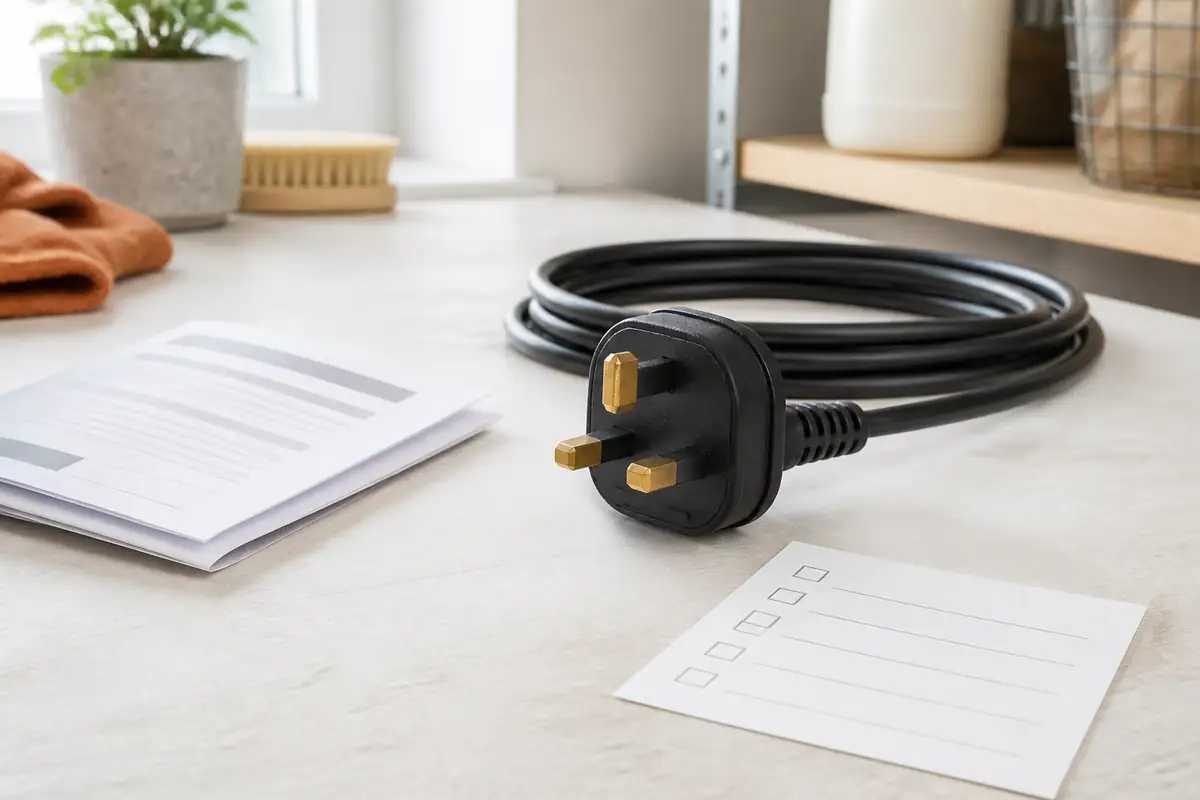
A compliant UK three-pin plug is not the same as a foreign plug supplied with a travel adaptor. Do not assume an adaptor changes voltage or makes a permanently used appliance suitable. Avoid listings whose plug changes between images, title and description. If the product is dual-voltage, the switching method and lead still need to be appropriate.
Treat markings as one part of traceability
Some products must carry applicable conformity markings and safety information, but a symbol alone is not a guarantee of quality or authenticity. Look for legible model, rating and responsible-business details and instructions that match the item. Misspelt labels, inconsistent model numbers or warnings unrelated to the product are reasons to stop.
OPSS advises consumers to consider who and where they buy from, whether safety markings and instructions are present, and whether manufacturer details are available. Check the current official guidance rather than relying on a seller’s explanation of a logo.
Search official safety alerts and recalls
Search by brand, model and product type in the GOV.UK Product Safety Alerts, Reports and Recalls service. A result may concern a batch, date range, plug, charger or specific marketplace listing rather than every item with a similar name, so read the identification details carefully.
No search result does not prove a product is safe. New or obscure products may have limited history, and a recall database is reactive. Still, a known recall, corrective action or seller removal is material evidence that should be resolved before ordering or using the item.
Read the manual before buying
Read the manufacturer’s UK manual before ordering. It can reveal ventilation gaps, charging requirements, maximum loads, cleaning restrictions and installation work omitted from a short listing. Use our product specification checklist to record these requirements. If a supposedly established model has no accessible UK instructions, ask the manufacturer before buying.
Check whether setup needs fixed wiring, specialist installation, earthing, wall mounting or a particular circuit. Do not plan unqualified electrical work around a bargain. If a product’s safe routine does not fit the household, choose another design rather than intending to ignore the instructions.
Assess chargers, batteries and accessories
A product and charger should be treated as a system. Confirm the supplied charger or power supply matches the model and UK supply. Avoid mixing a battery, charger and adaptor merely because connectors fit. For rechargeable products, check charging location, temperature, supervision, storage and replacement guidance.
Second-hand electricals need special caution: damage, modification, missing recalls and unknown battery history may not be visible. Our refurbished versus second-hand guide distinguishes trader grading and remedies from a private sale. Do not buy a used heating or high-power product when safety history cannot be established.
Price the remedy and support route
Check who handles a fault, where the product must be returned, whether batteries or accessories are available and whether repair information exists. A long warranty headline is less useful when the provider is untraceable or return postage is disproportionate.
Our warranty versus guarantee guide separates commercial promises from statutory rights. Keep the model, seller and purchase documents using the purchase-record method; they also make later recall identification easier.
Inspect the parcel before first use
Compare the delivered model, rating, plug and accessories with the order. Check casing, cable, strain relief, pins, vents, battery area and controls for damage, looseness, heat marks, corrosion or unexpected modification. Read the instructions before connecting power.
Stop if the item smells burnt, rattles unexpectedly, arrived wet, has exposed conductors, an ill-fitting plug or contradictory rating information. Photograph the condition and contact the seller. Do not dismantle a mains product to “see if it is fine”; that can add danger and complicate evidence.
Use safely after the buying decision
Register for safety notifications where a manufacturer offers them without making warranty rights conditional on unnecessary marketing consent. Retain the model and serial. Follow cleaning, ventilation and inspection instructions, and respond to recall notices promptly.
Do not run high-power products through unsuitable multiway adaptors or extension arrangements. Replace or professionally assess damaged leads and plugs rather than using tape as a permanent repair. Keep heaters and hot appliances away from materials and locations prohibited by their instructions.
Check connected features and software support
An electrical product with an app or cloud account adds another dependency. Confirm whether core controls still work without a subscription or internet connection, which phone systems are supported and how long security updates are expected. A discontinued app can reduce usability even when the electrical hardware remains sound.
Record the permissions requested at setup and change default credentials where the instructions support it. Do not connect an unknown product to the main home network merely to test whether it works. Our smart-home compatibility guide helps separate protocol, account and ecosystem questions. Software support does not replace electrical safety, but it belongs in the same whole-life purchase decision.
The evidence forms a coherent chain
The seller, exact model, UK power arrangement, responsible business, instructions, recall search and remedy route all align.
Safety depends on assumptions
The seller is unclear, plug or voltage is improvised, documents are missing or the listing changes identity between sections.
Balanced verdict
Electrical safety cannot be established from price, appearance, reviews or one marking. A safer purchase has traceable responsibility, a specific UK-suitable product, usable instructions and a realistic route if something is wrong.
Apply the checks before payment and again on delivery. When evidence conflicts, do not power the item while investigating. The cost of choosing a better-documented product is often small compared with the consequences of an unsafe or unsupported one.
Official UK sources
Frequently asked questions
Does a UK plug prove an electrical product is safe?
No — It is one check. Seller identity, exact model, ratings, markings, instructions, condition and recall information also matter.
Is a travel adaptor acceptable for permanent use?
Do not assume so — An adaptor does not change voltage or establish that the product and arrangement are suitable for ongoing UK use.
Does a conformity mark guarantee quality?
No — Applicable marking supports conformity information, but it does not replace traceability, correct ratings, instructions or inspection.
Should I buy a charger separately?
Only when the product maker’s specifications clearly identify a compatible, appropriately rated charger and cable. Connector fit alone is insufficient.
What should I do if a delivered item looks unsafe?
Do not power it. Preserve packaging and order evidence, photograph the problem, contact the seller and use official reporting or advice routes when appropriate.
Are second-hand electrical goods safe to buy?
Some may be, but unknown damage, modification, battery condition and recall history increase uncertainty. Prefer traceable testing and remedies.
How we researched this guide
Recommended Today reviewed current OPSS product-safety advice, GOV.UK safety alerts and product-labelling information, then applied those checks to online listings, marketplaces, regional variants and delivery inspection.
Limitations
We did not electrically test a product or assess a particular installation. Rules and alerts change, and product safety is model-specific. Recheck official sources and the manufacturer’s current UK instructions before purchase, and use qualified help where required.