Induction-compatible pans: how to check bases, size and performance
A magnet that grips the base is a useful first test, not a quality verdict. Reliable induction cooking also depends on the magnetic area, flatness, zone match, pan construction and controlled heating.
In this guide
Confirm the exact pan, test the whole base and match it to the hob manual
Look for an explicit induction symbol or manufacturer statement, then check that a magnet grips firmly across a broad, flat base. Compare the pan’s contact diameter with the hob’s minimum and recommended zone size. A compatible pan can still heat slowly, cycle noisily or brown unevenly when its magnetic layer is small, thin, warped or poorly matched to the zone.
Induction does not heat the glass like a traditional solid plate. The hob creates a changing magnetic field that induces current in suitable cookware, and the pan itself becomes the heat source. That is why an aluminium body can work when it has a magnetic steel base, while some stainless-steel pans do not.
What makes a pan induction-compatible?
The base needs enough ferromagnetic material for the hob to detect and energise it. Cast iron and carbon steel usually satisfy that requirement. Enamelled cast iron normally works because the iron remains beneath the enamel. Aluminium, copper, glass and ceramic are not inherently magnetic, but manufacturers can add a bonded or encapsulated magnetic steel plate.
Stainless steel is not one material. Its alloy and construction determine magnetic response. Some grades are magnetic, others weakly magnetic or non-magnetic. A “stainless steel” description therefore does not prove induction compatibility. Trust the exact product page, packaging symbol and care guide—not the material name alone.
Compatibility also concerns the bottom, not the cooking surface. A non-stick aluminium pan may have a stainless induction disc; an uncoated stainless pan may use an aluminium heat-spreading core between steel layers. Our cookware materials guide separates the cooking surface from the structural and heat-spreading layers.
The magnet test: useful, but perform it properly
- Use a small ordinary magnet. Test the outside bottom while the pan is cold and away from the hob.
- Check centre and edge. A strong central patch with weak outer response may indicate a smaller magnetic disc than the visible pan.
- Feel the grip. A firm hold is more promising than a magnet that barely clings, although there is no universal household force threshold.
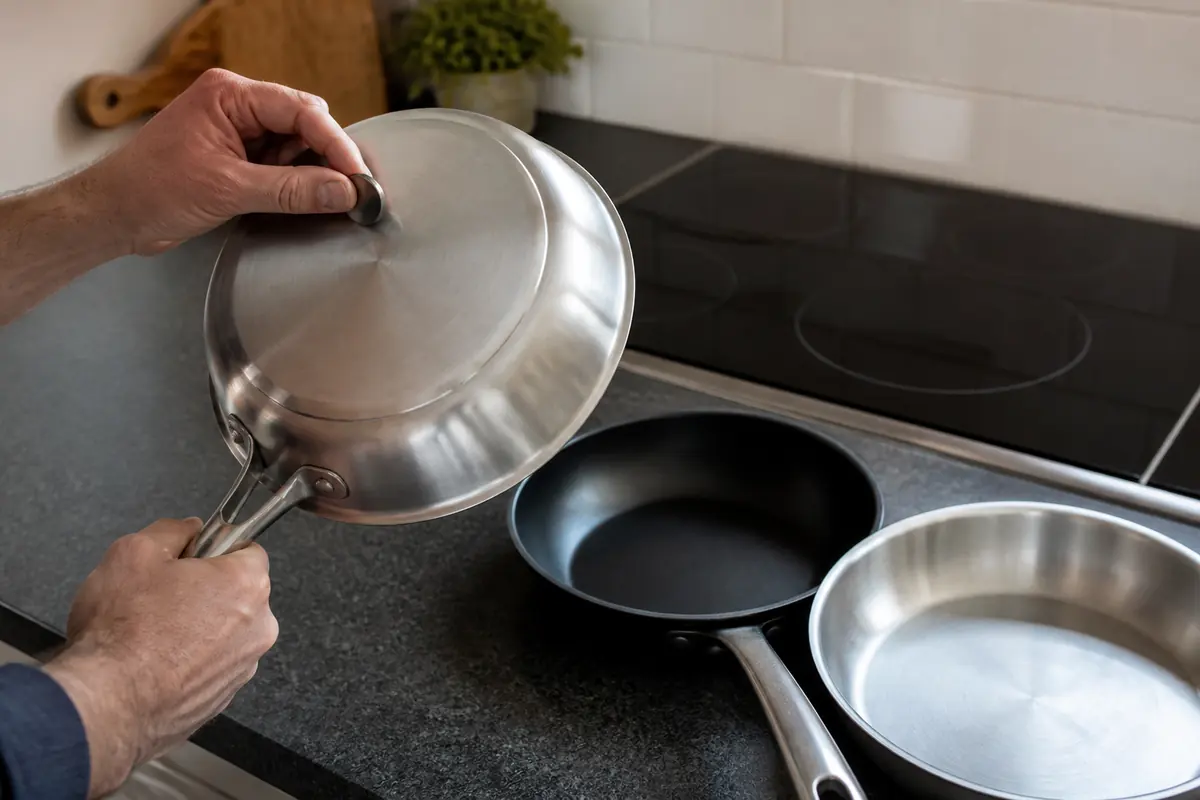
- Inspect the plane. Place a straight edge across the cold base and look for rocking, deep stamping or damage.
- Verify the specification. A magnet test cannot reveal the manufacturer’s minimum zone, temperature limits or guarantee.
A positive magnet test says the hob may recognise the pan; it does not guarantee fast, even heating. A negative result on an old pan is a strong warning, but the hob manual and manufacturer listing remain the final checks. Never place loose magnets on a powered hob or near medical devices contrary to their guidance.
Induction base construction compared
| Construction | Induction route | Strength | Watch for |
|---|---|---|---|
| Cast iron | Iron body is magnetic | Heat retention and broad magnetic mass | High weight, slow response and risk to glass if dragged or dropped |
| Carbon steel | Steel body is magnetic | Responsive, durable and seasonable | Can warp with thermal shock; needs drying and seasoning |
| Magnetic stainless with aluminium core | Outer steel couples with hob; aluminium spreads heat | Useful balance of response, distribution and corrosion resistance | Layer thickness and magnetic area vary |
| Aluminium with bonded induction disc | Magnetic plate is attached beneath conductive body | Low weight and quick response | Disc may be smaller than pan; flatness and bond quality matter |
| Enamelled cast iron | Iron core remains magnetic | Retention without seasoning the enamelled cooking surface | Heavy; enamel and glass hob need careful handling |
Base diameter matters more than rim diameter
A frying pan advertised as 28cm is normally measured across the top rim. Its flat contact base may be much smaller. Induction hobs have a minimum detectable diameter and a recommended zone range; both belong in the appliance manual. A small milk pan may fail on a large zone even if its material is magnetic.
The reverse mismatch matters too. A broad pan on a small coil can receive most energy in the centre, leaving the outer area cooler. A hob with flexible zones can improve coverage only within its design. Trace the pan’s actual flat base onto paper and compare it with the zone specifications. Our kitchen-appliance buying guide explains why the manual and installation constraints matter more than a feature badge.
Do not judge the coil by a decorative circle alone. Some printed rings are guides rather than exact inductor boundaries. A hob may also share power between zones. The appliance running-cost guide explains why wattage, duration and control strategy all matter more than one headline power number.
Flatness, thickness and heat spreading
Induction transfers energy without needing physical contact for conduction, but a flat base still improves stability, sensor behaviour and consistent distance from the glass. A pan that rocks can make noise, spill oil to one side and heat unevenly. Slight engineered concavity when cold may flatten as the pan warms; distinguish that from a damaged or permanently bowed base using the manufacturer instructions.
A thicker, well-bonded conductive layer can spread a concentrated energy input. Thickness alone is not a ranking: a heavy cast-iron pan responds slowly, while a light aluminium-core pan changes temperature quickly. Choose response for the food. Eggs and sauces benefit from control; searing may benefit from stored heat.
Compatibility logos rarely state the magnetic disc diameter, mass or temperature uniformity. Look for a cross-section, base measurement, total weight and credible care instructions. If the retailer provides only “all hobs”, ask for the exact model documentation before buying.
Current UK induction-pan price and construction snapshot
These official IKEA UK examples were checked on 27 August 2026. They demonstrate that compatibility appears at several prices and with different surfaces; they are not performance rankings.
| Exact listing | Displayed price | Construction and care | Decision point |
|---|---|---|---|
| MIDDAGSMAT non-stick stainless-steel frying pan, 24cm | £9 | Sol-gel coating; aluminium between steel layers; hand wash; 0.62kg | Light, low-cost entry; coating and booster care matter |
| IKEA 365+ non-stick stainless-steel frying pan, 28cm | £15 | Sol-gel coating; stainless/aluminium bottom; oven-safe; hand wash | Check whether the coated surface suits the intended food and lifespan |
| IKEA 365+ stainless-steel frying pan, 28cm | £19 | Aluminium between stainless layers; dishwasher and oven-safe; 0.98kg | Uncoated technique differs from non-stick |
| VARDAGEN carbon-steel frying pan, 28cm | £29 | Carbon steel; season before use; hand wash; oven-safe; 2.31kg packed | Durability and browning trade against weight and maintenance |
Price note: record the article number, exact size and selected surface. Store stock, delivery and prices can change. “Compatible with all hobs” confirms intended use, not equal heating performance across every induction model.
Check current specifications and prices:
IKEA MIDDAGSMAT 24cm listing ↗IKEA 365+ coated 28cm listing ↗IKEA 365+ stainless 28cm listing ↗IKEA VARDAGEN carbon-steel listing ↗
Why an induction pan can buzz, pulse or seem slow
A faint buzz or hum can arise as magnetic layers and pan components vibrate. Laminated cookware may sound different at high power, and a light pan can transmit more audible vibration. Hob cooling fans and power electronics add their own noise. Persistent loud rattling, error codes or unstable heating warrant checking the manual and trying another confirmed pan.
At low settings, some hobs regulate average heat by cycling energy rather than supplying a perfectly continuous trickle. A thin pan reveals those pulses more clearly; a heavier or more conductive construction smooths them. On shared-power hobs, using another zone can reduce available boost.
A pan that seems slow may have a weak or small magnetic base, be oversized for the coil, contain a large cold food load or be tested against an unrealistic boost expectation. Diagnose one variable at a time rather than replacing the hob immediately.
Booster mode: fast, but easy to misuse
Induction boost can deliver high power quickly. IKEA’s current coated-pan guidance specifically warns against rapidly heating a dry, empty pan with the booster because it can warp the pan and damage non-stick performance. Add food or liquid as directed and use medium settings for ordinary preheating unless the manufacturer says otherwise.
Thermal shock can also deform a base: do not run a hot pan under cold water. Lift cookware instead of sliding it across the glass, keep the underside dry and clean, and centre it before powering the zone. Heavy cast iron needs two-handed placement where appropriate.
Check oven limits for handles, coatings and lids separately. “Oven-safe” on one size or finish does not transfer to another. A plastic handle may make an induction pan unsuitable for the oven even though the base works perfectly on the hob.
Before buying: a seven-point induction checklist
- Read the hob manual for minimum and recommended base diameter.
- Confirm the exact pan listing explicitly says induction-compatible.
- Test magnetic grip across the base when evaluating existing cookware.
- Check cold flatness, contact diameter, total weight and handle length.
- Choose cooking surface and maintenance for the food, not the hob logo.
- Read booster, utensil, dishwasher and oven instructions.
- Keep proof of purchase and test detection promptly within the return period.
Measure storage and lifting comfort as well as the zone. The small-kitchen guide helps map the full handle envelope, and our ownership-cost guide includes coating replacement, seasoning time and delivery.
Certainty and even contact matter
The base attracts a magnet across the cooking area, sits flat and matches the hob-zone diameter and manufacturer’s instructions.
Avoiding replacement is worthwhile
Test each base and confirm stable heating; an adapter disc is not an automatic cure for poor contact, control or safety.
Balanced verdict: what should you prioritise?
Buy an induction pan only after confirming its magnetic base and matching its actual contact diameter to the hob. Then judge the heat-spreading layer, flatness, weight, surface and care. A £9 pan can be genuinely compatible, while a premium pan can still be a poor physical match for a small zone.
Do not replace every pan automatically when moving to induction. Test existing cookware and retain the pieces that are flat, strongly magnetic and useful. For product faults and guarantee language, use our warranty and rights explainer; browse more practical coverage in Home & Kitchen.
Check current official information:
IKEA MIDDAGSMAT 24cm listing ↗IKEA 365+ coated 28cm listing ↗IKEA 365+ stainless 28cm listing ↗
After confirming pan compatibility, compare the installation and space trade-offs in our Induction hob vs portable induction plate: which works better in a UK kitchen?.
Frequently asked questions
How can I tell if a pan works on induction?
Look for the induction symbol or explicit manufacturer statement. A magnet should grip firmly to a broad part of the base. Then compare the flat-base diameter with the hob manual’s minimum and recommended sizes.
Will every stainless-steel pan work on induction?
No — Stainless alloys and base constructions differ. Some are magnetic and some are not. Verify the exact pan rather than relying on “stainless steel” in the title.
Can aluminium pans work on induction?
Yes, when a manufacturer adds a suitable magnetic steel plate or layer to the base. Plain aluminium is not ferromagnetic, so the exact construction matters.
Why does my induction hob not detect a small pan?
The magnetic contact area may be below the zone’s detection threshold, weakly magnetic or off-centre. Try the correct smaller zone and consult the hob’s minimum-base specification.
Can boost mode warp a frying pan?
Rapidly heating an empty pan can create damaging temperature gradients. Several current coated-pan instructions warn specifically against empty booster heating. Follow the exact pan and hob guidance.
Does a stronger magnet mean better cooking performance?
Not necessarily — It confirms magnetic response but does not measure heat spreading, flatness, thickness, coating, balance or zone match. Treat it as a compatibility screen, not a quality score.
How we researched this induction-pan guide
Recommended Today reviewed current official IKEA UK cookware listings and care instructions across coated stainless, uncoated stainless and carbon-steel pans, plus manufacturer guidance on induction base sizing. We recorded exact prices, materials, weights and care on 27 August 2026 and compared the engineering implications without cooking with the products.
Limitations
We did not measure magnetic force, thermal uniformity, power draw or cooking results. Hob detection thresholds and coil layouts vary, and product constructions can change while names remain similar. Recheck the exact article number, hob manual, base diameter, stock and care instructions before purchase.
This is an independent compatibility and buying guide, not a product ranking. Official links were non-affiliate at the time of research.