Dehumidifiers value guide: capacity, construction and running cost
A dehumidifier earns its cost only when it removes useful moisture in the real temperature and room, can be emptied and cleaned easily, and runs at tolerable noise and energy use.
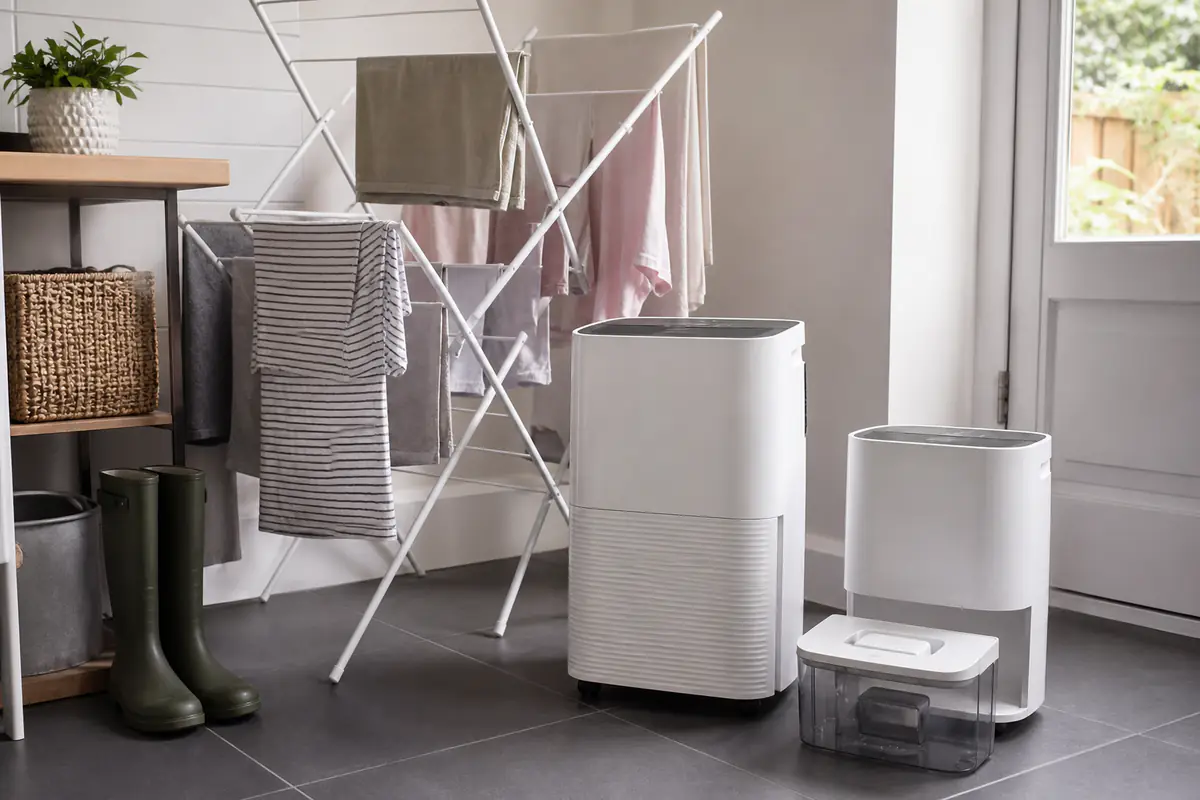
In this guide
Size to the moisture problem and operating conditions
Treat litres per day as a test-condition result, not the amount every home will collect. Compare technology, temperature, airflow, controls, tank or drain, noise, rated input, maintenance and support as one ownership system.
Begin with the full dehumidifier buying guide and use the laundry-mode guide for drying clothes. The running-cost method explains rated power without promising savings.
| Design | Potential strength | Check in your conditions | Trade-off |
|---|---|---|---|
| Compressor | Often efficient in warmer rooms | Performance at room temperature | Can weaken in cold spaces |
| Desiccant | Can work better in cooler conditions | Rated input and exhaust warmth | May use more power |
| Small tank | Compact and lighter to empty | Shut-off and emptying frequency | More interruptions |
| Continuous drain | Longer unattended operation | Fall, hose and destination | Installation constraints |
Dehumidifier value inputs
- Room and source of moisture.
- Typical temperature and door position.
- Manufacturer test conditions.
- Rated power by selected mode.
- Tank volume and shut-off.
- Continuous-drain arrangement.
- Noise at useful settings.
- Filter, cleaning, warranty and recall route.
Identify the moisture source first
Condensation from occupants, cooking, bathing or laundry differs from leaks, penetrating damp and building defects. A dehumidifier can remove airborne moisture but does not repair a defective roof, pipe or wall.
Record room, symptoms, timing, ventilation and temperature. Seek competent building or health advice where mould, damage or persistent damp indicates a wider problem rather than buying a larger appliance by default.
Set a measurable outcome
Choose an outcome that can be observed without pretending a household sensor is a laboratory instrument: fewer condensation events, a stable reasonable humidity range, shorter laundry drying time or less frequent musty smell after the source is addressed. Record temperature beside humidity because relative humidity changes as air warms or cools.
Avoid targeting an unnecessarily low number. Excessive drying can be uncomfortable, waste energy and affect materials. Use the appliance humidistat as a control tool, compare it with a separate indicator cautiously and follow appropriate health or building guidance for the situation.
Define the operating zone
Note room volume, connected spaces, door position, typical minimum temperature and where air can enter and leave the unit. An open-plan area and a closed bedroom create different workloads.
Manufacturers may describe room-size ranges, but those depend on assumptions. Treat them as screening information and compare the extraction test conditions and control strategy behind the claim.
Read litres per day with its conditions
Extraction ratings are measured at stated temperature and relative humidity. Warm, humid test conditions can produce a large number that a cool UK room will not approach.
Compare models at the same conditions where possible and look for performance data nearer the intended room. Do not translate a nominal 20 litres per day into a promise that the tank will collect that amount daily.
Choose compressor or desiccant deliberately
Compressor models cool a surface to condense water and often suit heated living spaces. Desiccant models absorb moisture in a rotating material and can retain performance in cooler rooms while releasing some warmth.
The choice affects rated input, noise character, room temperature and useful extraction. Do not declare one technology universally cheaper; compare the exact mode and conditions.
Account for defrost behaviour in cooler rooms
A compressor coil can frost at lower temperatures, so the appliance may pause extraction to defrost. Check the operating range and how the manufacturer describes low-temperature performance rather than assuming every powered hour removes water at the same rate.
A desiccant unit avoids the same refrigeration cycle but has its own power and heat trade-offs. For a garage, conservatory or unheated utility space, compare credible extraction at the actual winter temperature and decide whether the space itself is suitable for the appliance.
Avoid severe undersizing and casual oversizing
An undersized unit can run continuously without controlling the space, while an oversized model may cost more, occupy more room and cycle differently. The moisture load and temperature matter more than floor area alone.
A modest capacity buffer can help laundry or connected rooms, but only when the appliance can operate safely and airflow is not blocked. Use the exact manufacturer guidance for placement and clearance.
Judge the humidistat and controls
A useful humidistat allows a sensible target and cycles the appliance without constant manual intervention. Check target range, hysteresis, display accuracy limits, restart behaviour and whether the desired setting exists outside automatic modes.
A bright display, app or many presets do not guarantee better control. Prioritise a stable target, clear tank warning, timer behaviour and recovery after a power interruption.
Distinguish timer, scheduler and continuous operation
A countdown timer may only delay start or stop, while a scheduler can repeat at chosen times. Confirm what happens after a power interruption and whether automatic restart is appropriate for the intended supervised or unattended use.
Continuous mode often ignores a humidity target and can increase energy use or over-dry a small space. Treat it as a task setting for a defined period, not the default proof that the machine is working harder and therefore better.
Treat laundry mode as a defined workflow
Laundry mode may increase fan speed, extend operation or target lower humidity. It does not replace garment care instructions, ventilation or safe spacing, and it does not make every room suitable for drying.
Read the laundry-mode guide before comparing cycle claims. Measure moisture removed and time in the actual setup rather than accepting a universal drying promise.
Compare tank capacity with daily effort
A larger tank reduces emptying frequency but increases weight and spill risk. Check handle, lid, pour path, water-level visibility and whether the unit stops reliably when full or removed.
Estimate likely emptying frequency from comparable real-condition evidence, not the headline extraction rate. An awkward tank can be a bigger ownership cost than a small difference in electricity.
Plan continuous drainage safely
Confirm hose diameter, connection, maximum run, required downward fall and suitable drain destination. Gravity drainage cannot push water uphill, and a loose hose can cause the very moisture damage the appliance was bought to reduce.
Do not improvise a route across a doorway or into an unstable container. Where a pump is needed, check whether it is built in, supported and maintained under the exact instructions.
Measure noise at the setting you will use
A single decibel figure may apply to a low fan mode that extracts slowly. Compare sound at useful settings, distance and room conditions, and consider compressor cycling or desiccant fan tone.
For bedrooms, check whether lights can dim and whether control beeps or restart noises disturb sleep. Do not compromise safe placement merely to move the appliance farther away.
Consider heat output and room interaction
All dehumidifiers add some heat to the room through electrical use and the dehumidification process, though the amount and character differ. This can be welcome in a cool utility room and undesirable in a small warm bedroom.
Do not count that heat as free or claim a heating saving without measuring the whole household need. Keep doors and windows in the intended position during comparisons so one unit is not credited for treating a smaller air volume.
Calculate running cost from rated input and time
Find rated power for the selected mode, multiply kilowatts by realistic operating hours and the household unit rate. This estimates electricity consumed, not money saved through avoided heating or damage.
Controls and humidity affect duty cycle, so a maximum-power calculation can be an upper scenario rather than a prediction. Use the appliance running-cost method and record assumptions.
Compare useful extraction per unit of energy
When comparable official data exists, divide useful moisture removed under the same conditions by electricity consumed. Do not combine one model’s warm-humid laboratory rating with another model’s cool-room result.
Real households can run a seemingly efficient unit longer because placement, doors or target settings differ. A short monitored trial in the return window provides better ownership evidence than projecting a perfect annual saving from one specification.
Check filters and cleaning access
Inspect filter removal, intake grille, tank corners and float mechanism. Washable does not mean maintenance-free; follow drying and replacement instructions and never operate with a wet filter unless explicitly permitted.
A unit that is difficult to clean can lose airflow, smell or be abandoned. Include replacement-filter availability and cost where the design requires it.
Plan safe placement and electrical use
Use a stable level surface, maintain stated clearances and keep intake and outlet unobstructed. Follow instructions around bathrooms, wet hands, extension leads and unattended use.
Check the exact product in official recall sources and keep model and serial evidence. Use the manual-before-buying checklist for installation, drainage, storage and warnings.
Compare support, warranty and repairability
Look for a UK contact route, manual, spare filter or tank availability, warranty process and clear fault handling. Complex app features have little value if core parts and support disappear.
Separate a voluntary warranty from statutory remedies with the warranty and guarantee guide. Do not open a mains appliance or bypass a safety switch to diagnose it.
Plan seasonal storage
Before storage, switch off, unplug, drain the tank and hose, clean permitted parts and allow them to dry fully. Follow the manual for any waiting period after transport and store the unit upright where required.
Keep the hose, plug, filters and instructions together and inspect them before the next damp season. A cheaper appliance that is stored wet, loses a proprietary tank part or cannot obtain filters can become poor value quickly.
Test the real room during the return window
Record starting humidity, temperature, setting, hours, water collected, interruptions and noise over several representative sessions. Consumer humidity sensors have limits, so focus on repeatable direction rather than false precision.
Keep packaging and avoid damage while testing normal functions. If the unit cannot reach a reasonable target in suitable conditions, preserve evidence and use the returns guide.
Recognise where the value really lies
Pay for extraction that remains useful at the room temperature, dependable controls, manageable tank or drain, tolerable sound, maintainable airflow and credible support. Avoid paying for app features or a huge warm-condition rating that the household will not use.
The best-value unit is the smallest complete solution that controls the defined moisture load safely and consistently. If building repair or ventilation is the real solution, the best appliance purchase may be none.
Create a seven-day ownership log after purchase: room, temperature, starting and ending humidity, setting, hours, tank water, noise interruptions and laundry or condensation outcome. This does not create laboratory accuracy, but it reveals whether the chosen machine is solving the defined task. Compare that evidence with energy used and the effort of emptying and cleaning before the return decision expires.
Compressor or desiccant dehumidifier?
The room is usually heated
Comparable-condition extraction, noise, tank or drain and rated input work in the actual living space.
Cool-room performance matters
Useful extraction at lower temperature justifies the power, heat output and sound of the exact model.
Balanced verdict
Dehumidifier value is useful water removal per tolerable hour in the actual room. Match technology and capacity to temperature and moisture, then include control, drainage, noise, cleaning, electricity and support.
Use the linked general and laundry guides for sizing and clothes-drying decisions without duplicating this ownership calculation.
Official checks:
GOV.UK product safety advice ↗
GOV.UK product recalls and alerts ↗
GOV.UK Energy Technology List guidance ↗
NHS damp and mould guidance ↗
Frequently asked questions
Does a 20-litre dehumidifier collect 20 litres every day?
Not necessarily — The rating comes from stated test conditions; cooler or less humid rooms usually produce less.
Is a compressor or desiccant model cheaper to run?
It depends on exact rated input, temperature, extraction, controls and hours needed. Compare both in your conditions.
Can a dehumidifier fix damp?
It can remove airborne moisture but cannot repair leaks, penetrating damp or structural defects. Identify the source first.
Is a bigger tank always better?
No — It reduces emptying frequency but adds weight and can be harder to carry and pour; continuous drainage may be more useful.
Can I leave a dehumidifier running overnight?
Only as permitted by the exact instructions and safe setup. Consider placement, drainage, noise, electrical warnings and supervision guidance.
Methodology and limitations
We assessed dehumidifier value through moisture source, room temperature, rated test conditions, compressor and desiccant design, capacity, humidistat, laundry mode, tank, drainage, noise, rated power, cleaning, safety, support and real-room testing. Official UK safety, recall, energy and health guidance was reviewed on 1 September 2026. We did not electrically or independently performance-test a model.
Limitations
Extraction, noise and duty cycle vary with room, weather, sensor, settings and maintenance. Product specifications and tariffs change. This is buying guidance, not building, electrical or medical advice; investigate persistent damp appropriately.