Electric foot warmers buying guide: fit, controls, safety and cleaning
An electric foot warmer heats a small personal space rather than a room. That can make it practical for seated use, but fit, sensation, controls, cable routing, cleaning and exact instructions are safety-critical.
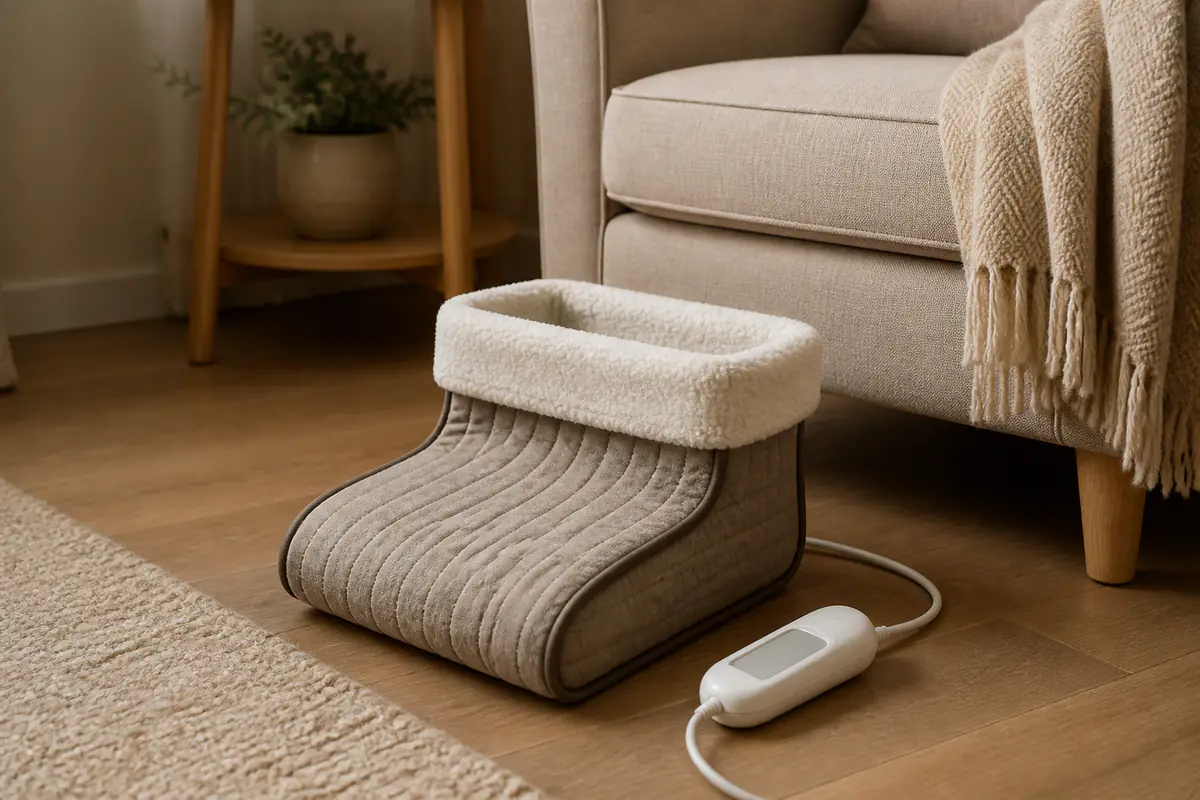
In this guide
Prioritise safe fit, simple controls and a removable washable liner
Choose a traceable UK product with clear instructions, timer or shut-off information and a cable that reaches without crossing a walkway. Do not use it to treat symptoms, while asleep, when wet or in any way the exact manual forbids.
This is distinct from our room-heater guide and the electric blanket guide. Check retailer authenticity with the genuine online shop checklist.
| Feature | Evidence to check | Useful outcome | Risk |
|---|---|---|---|
| Fit | Internal width, depth and opening | Feet rest without compression | Heat concentration or restricted movement |
| Controls | Settings, display, buttons and timer | Simple repeatable use | Accidental high setting |
| Liner | Removal and exact wash method | Hygiene without wetting electrics | Incorrect reassembly or damp use |
| Cable | Length, connector and route | No extension or trip path | Crushing, tangling or damaged lead |
Foot warmer safety shortlist
- Traceable manufacturer and UK seller.
- Exact intended user and use position.
- Internal dimensions and mobility.
- Heat settings and timer behaviour.
- Controller accessibility.
- Cable and socket route.
- Removable liner and cleaning method.
- Warranty, recall and return evidence.
Understand what the product does
An electric foot warmer is a low-volume textile appliance intended to warm feet during defined seated use. It is not a room heater, hot-water treatment, medical device or replacement for investigating persistent cold, pain, numbness or circulation concerns.
Check whether the product is a boot, pouch, mat or dual-foot chamber because posture, heat distribution and movement differ. Use only for the stated purpose and user group.
Check suitability before product features
Read warnings for reduced heat sensation, circulation conditions, diabetes, pregnancy, implanted devices, children, pets and users unable to operate controls or remove their feet. Exact instructions and professional advice take priority.
A lower setting does not automatically make an unsuitable product safe. Where sensation, cognition or mobility is impaired, seek appropriate clinical advice rather than relying on retailer summaries.
Measure internal space, not outer fluff
Compare internal width, depth, height and opening with both feet in ordinary socks. Thick padding and removable liners reduce usable space, while product photography can exaggerate scale.
Feet should rest without forced overlap, pressure or a sharply flexed ankle. An oversized chamber can also allow bunching or poor contact, so choose measured fit rather than the largest exterior.
Decide between one pouch and separate boots
A shared pouch allows feet to move together and may be easier to enter, while separate boot forms can limit movement and create more edges or cords. Check how quickly the user can exit without standing on the appliance.
Do not walk in a stationary warmer unless the exact product is designed and approved for it. Moving while connected can damage the lead or cause a fall.
Inspect heat settings and control logic
Look for clearly differentiated settings, tactile or visible controls, start-up behaviour and whether the product remembers a previous level. A high default can be unsuitable for a user expecting gentle heat.
Controls should be reachable without bending dangerously or pulling the cable. Accessibility features matter more than a large setting count when buttons or displays cannot be used reliably.
Check timer and automatic shut-off evidence
Record whether a timer limits each session, whether shut-off is automatic and how it resets. Do not infer behaviour from a generic clock icon or another model’s manual.
A timer is a backup, not permission to sleep, cover the appliance or leave it unattended. Follow the exact supervision and session instructions.
Plan cable routing before purchase
Measure from the intended chair to a suitable socket without stretching, coiling tightly, running beneath rugs or crossing a doorway. Include the controller and any detachable connector in the route.
Avoid extension leads unless the manufacturer explicitly permits the complete arrangement and it is assessed safely. Never place furniture legs on the cable or trap connectors where heat and pressure accumulate.
Confirm power and plug information
Use a product intended for the UK supply with a traceable responsible business, correct plug and clear rating information. Do not use a travel adaptor to make an unknown appliance appear compatible.
Check the plug, lead and controller before each use. Scorching, exposed wires, looseness, unusual smell, noise, local hot spots or intermittent operation are reasons to unplug safely and stop.
Assess textile construction
Inspect seams, lining attachment, padding distribution and whether heating elements can bunch or become exposed. The foot opening should not create a pressure point or invite folding the product against instructions.
Softness is not electrical-safety evidence. A plush cover can hide damage, so choose a design that can be inspected and follow replacement guidance.
Prefer a genuinely removable liner
A removable liner can make hygiene easier if its removal, washing, drying and reassembly are clearly documented. Confirm which component is washable and whether the controller must be disconnected.
Never immerse the electrical body unless the exact instructions explicitly permit a defined process. Reconnect only when every permitted washable component is fully dry and correctly fitted.
Treat spills and damp as stop conditions
Use the warmer in a dry area away from drinks, wet footwear and damp floors. If liquid reaches the appliance, disconnect safely without touching wet electrical parts and follow manufacturer guidance.
Do not test whether it still works while damp. Water damage can be hidden, and drying the surface does not prove internal electrical safety.
Do not sleep with a foot warmer by default
Personal warming appliances can continue heating while awareness and movement decrease. Unless the exact product explicitly permits a supervised use mode, treat sleep and overnight use as excluded.
Do not cover the controller or product with heavy bedding, cushions or another heat source. Combined insulation can alter heat dissipation.
Check skin regularly during initial use
Start with the lowest instructed setting and a short supervised session, checking comfort and skin where sensation is normal. Heat should never be endured because a setting is marketed as therapeutic.
Stop with pain, burning, pronounced redness, dizziness, numbness or other concern and seek appropriate advice. This guide cannot diagnose cold feet or prescribe heat treatment.
Keep children and pets outside the design unless approved
Cords, controllers, heat and soft padding create chewing, entanglement and overheating risks. Do not assume a household pet can share a human warming appliance.
Choose only a purpose-designed product with appropriate instructions for the intended user and supervise as required. Store unplugged and inaccessible when not in use.
Check recalls and traceability
Record manufacturer, model, batch or serial information, seller and purchase date. Search official UK product-safety alerts for the exact product and register it where a legitimate manufacturer provides that route.
Read the genuine-shop and traceability guide. An unbranded marketplace listing with no responsible business makes alerts, spares and remedies harder to manage.
Compare running cost without false precision
Use rated power, intended session duration and current tariff to estimate electricity cost as a range. A personal warmer often uses less power than room heating, but it does not warm air, walls or other occupants.
Use the method in the portable-heater cost guide and do not claim whole-home savings without comparing the complete heating need and safe use.
Plan storage and seasonal inspection
Cool the appliance, unplug it and store it dry without sharp folds, crushing or objects placed on top. Keep controller and manual together so the next season begins with the correct inspection.
Do not wrap the cable tightly around the warmer. Before reuse, inspect seams, connector, plug and lead and replace rather than improvise a repair when damage is present.
Protect the return and fault route
Read return hygiene and electrical-item conditions before opening. Test basic function promptly without soiling the liner and keep packaging, instructions and seller records.
Use the warranty and guarantee guide for faults and the online returns guide for change-of-mind evidence.
Foot warmer or room-heating solution?
One seated person needs local warmth
Suitability, fit, controls, cable, dry use and exact instructions are all clear.
The space or several people need heat
Local foot warming cannot address the actual room-temperature, damp or building problem.
Balanced verdict
Buy an electric foot warmer as a controlled appliance, not a soft accessory. Traceability, suitability, fit, timer, cable, cleaning and inspection must all work.
Pause when warnings, seller identity or electrical evidence are incomplete.
Official checks:
Electrical Safety First product safety guidance ↗
GOV.UK product recalls and alerts ↗
GOV.UK product safety advice ↗
NHS health information ↗
Frequently asked questions
Can an electric foot warmer be used overnight?
Do not assume so — Follow the exact product instructions; reduced awareness makes sleep a high-risk use.
Can the whole foot warmer go in a washing machine?
Only components explicitly identified as washable may be cleaned by the stated method, then dried fully before correct reassembly.
Is a foot warmer cheaper than heating a room?
Its rated power may be lower, but it warms one local area and is not an equivalent solution to every room-heating need.
Can someone with poor circulation use one?
Suitability requires the exact warnings and appropriate healthcare advice; reduced sensation or circulation can increase harm risk.
What damage means stop using it?
Stop for damaged cable, plug, connector, controller, fabric or seams, local hot spots, scorching, smell, noise or intermittent power.
Methodology and limitations
We assessed electric foot warmers through intended use, medical and sensory limits, fit, controls, timers, cables, electrical traceability, textiles, cleaning, moisture, heat exposure, recalls, running cost, storage and remedies. Official UK safety and recall information was reviewed on 1 September 2026. We did not electrically or thermally test a model.
Limitations
Products, users, health needs and instructions vary. This is buying guidance, not medical or electrical advice; the exact manual and qualified professional guidance take priority.