How to use a product manual before buying: setup, maintenance and hidden requirements
The product page sells the outcome; the manual often reveals the work. Reading instructions before purchase can expose clearances, compatible supplies, account requirements, cleaning intervals, warnings, replacement parts and conditions that change the true cost or suitability.
In this guide
Treat the manual as a pre-purchase specification
Find the exact model manual on the manufacturer’s official site and read installation, first use, routine maintenance, troubleshooting, safety and disposal before paying. Record every requirement the retailer omitted. If the manual is unavailable, ambiguous or belongs to another model, treat that as unresolved evidence.
This guide applies to household, beauty and technology products. It does not authorise DIY work on mains electricity, gas, pressure, refrigeration or other hazardous systems. Installation and repair must follow law, manufacturer instructions and competent-person requirements.
Find the exact document, not a similar screenshot
Use the full model code, including regional or suffix characters. Search the manufacturer’s official support site and compare the product image, ratings and included parts with the retailer listing. A manual for the previous generation may have different connections, app requirements or maintenance.
Prefer a dated PDF or support page with a stable model reference. Save a local copy for comparison but recheck the official version before installation. Record the document version and download date so a later revision can be identified rather than silently replacing the evidence used for the purchase. The genuine-shop guide helps verify that manufacturer and retailer pages are legitimate.
| Manual section | Hidden question | Possible cost | Decision evidence |
|---|---|---|---|
| Installation | Space, services, tools and competence? | Fittings, labour or room changes | Measured site and written quote |
| First use | Charging, seasoning or calibration? | Time, consumables or account | Complete setup sequence |
| Maintenance | Cleaning and replacement interval? | Filters, descaler, brushes or labour | Named parts and method |
| Warnings | Who or where cannot use it? | Unsuitable purchase or adaptation | Real household conditions |
| Troubleshooting | Which faults are user-resolvable? | Service visit or replacement | Support and diagnostic route |
Manual audit in fifteen minutes
- Confirm model, voltage, dimensions and supplied components.
- Read every safety warning and placement clearance.
- List setup tools, services, accounts and permissions.
- Record cleaning and consumable intervals.
- Search the document for filter, battery, update and replace.
- Check troubleshooting and authorised service routes.
- Add all discovered costs to the shortlist.
Installation can disqualify a product early
Manuals may specify ventilation, wall strength, drainage, water pressure, socket position, circuit rating, ambient temperature, level floor or minimum clearances. Compare each figure with the intended location before ordering. Measure doors, stairs and handling space as well as the final aperture.
Identify which work requires a competent installer, permission or building-control process. Do not assume a retailer’s basic installation includes alteration, making good or waste. The installation-quote guide provides a scope matrix once the manual has defined the requirement.
First use reveals time and dependency
A product may need a full charge, cleaning cycle, calibration, seasoning, firmware update or rest period before use. Some features need Wi-Fi, a phone, location permission or an account. Decide whether the core function works without the cloud and what happens if the service changes.
Check whether a charger, adapter, hose, bracket or starter consumable is included. Retailer photographs can show accessories that are optional. The parts list in the manual should match the exact box contents; any discrepancy needs written clarification before purchase.
Maintenance determines whether convenience lasts
Record each task, interval, tool and drying time. A self-clean label may still require emptying, filter washing or descaling. If several components must dry for a day, the product may be unavailable between uses. Check whether maintenance is triggered by time, usage or a sensor.
Ask whether the average user can reach the part safely and whether disassembly affects the warranty. A maintenance task that is awkward or poorly documented is likely to be postponed, which can reduce performance or safety. Our care-label guide shows the same ownership principle for textiles.
Consumables can lock the owner into one supplier
Search for filters, bags, blades, brush heads, cartridges, descaler, detergent and batteries. Record the exact part number, pack size, expected interval and current availability from official and independent sources. A generic-looking component may use a proprietary fitting.
Calculate a conservative annual cost and test what happens if the part is discontinued. Do not invent a lifespan from one review. The total-cost guide keeps recurring supplies separate from purchase price.
Warnings belong at the start of the decision
Read restrictions on children, pets, medical devices, moisture, heat, altitude, ventilation, flammable materials and unattended use. Confirm the product suits every likely location and user. A warning is not something to work around with an unofficial accessory.
Check storage and cooling. Heated or battery products may require a non-combustible surface and temperature range. If the manual’s safe routine conflicts with the household, choose a different design. The electrical-safety checklist adds seller, plug and recall checks.
Troubleshooting shows service boundaries
A useful manual distinguishes normal behaviour, user maintenance, reset steps and faults requiring service. Review the error-code table and ask whether diagnosis remains available without an app. If the proposed fix is repeatedly “contact support”, assess the accessibility and cost of that support.
Do not interpret troubleshooting instructions as permission to open a hazardous product. Check which panels are user-accessible and which seals or fasteners must remain untouched. Retain serial and model information for support.
Parts diagrams reveal design, not guaranteed availability
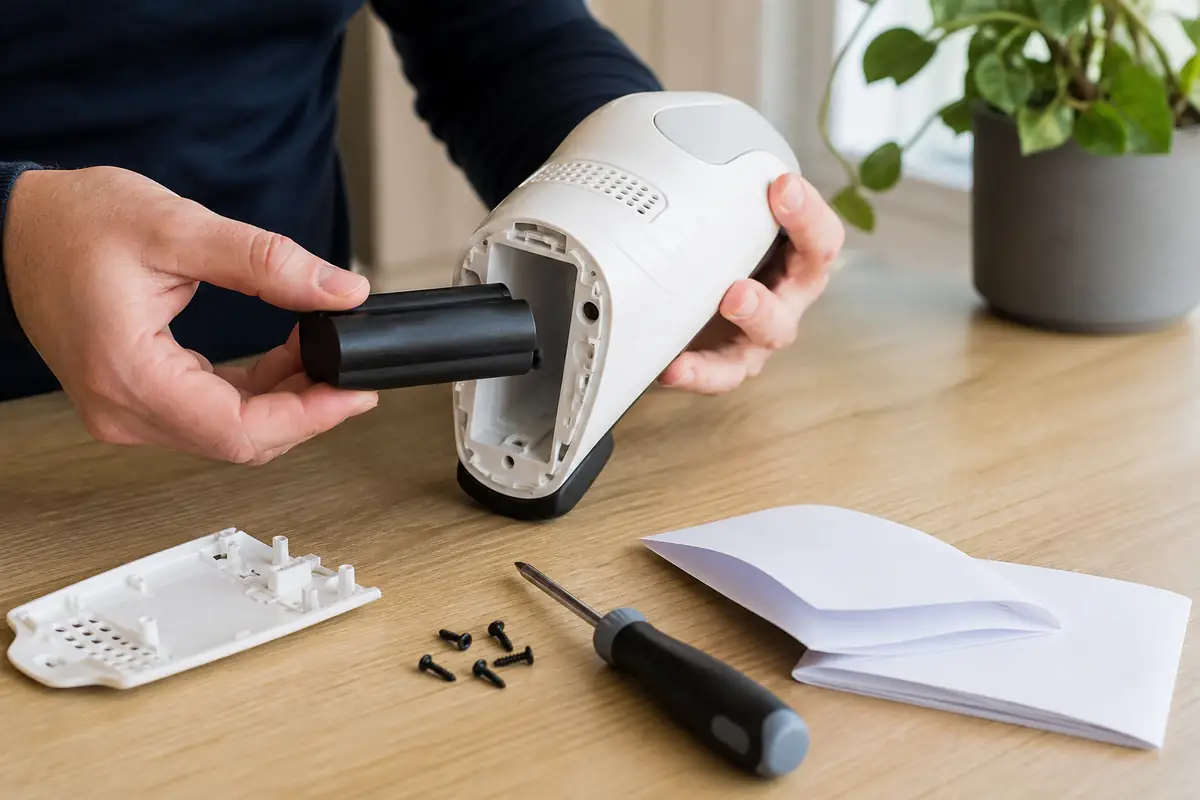
An exploded diagram can show replaceable assemblies and standard fasteners, but the part may still be restricted to professional repairers or unavailable locally. Search exact part numbers before buying and ask how long support is promised. Confirm whether batteries are replaceable by the user, service centre or nobody.
For the broader question of parts and repair networks, use our existing appliance repairability guide. This manual audit is narrower: it finds requirements that affect suitability even when no failure occurs.
Software and data terms can change the product
Connected products may require an operating-system version, account, subscription, cloud connection or data permission. Check the core offline function, promised software-support period, export options and reset process before resale. A QR code is not a durable substitute for essential instructions.
Read the privacy notice separately; the manual may mention only setup. Decide whether account and data requirements are proportionate to the function. The long-lived tech guide covers software support and ports.
Warranty conditions often hide in maintenance language
Look for registration, authorised consumables, service intervals, proof requirements and exclusions. A long motor or battery headline may cover only one component. Save the warranty terms that apply at purchase and keep receipts for required service or parts.
A voluntary warranty does not replace statutory rights. The warranty versus guarantee guide explains the distinction. Do not undertake an unsafe repair merely to preserve or avoid a claim.
Compare the manual with the sales page
Create a discrepancy list: dimensions, capacity, accessories, performance modes, exclusions and maintenance. Ask the retailer or manufacturer for written clarification. A manual can lag a product update, but unexplained inconsistency is not evidence to ignore.
Save the listing, manual version and reply. If a feature is essential, make it explicit before purchase. The like-for-like guide helps compare two manuals against the same requirement matrix.
Proceed when the manual shows
- Compatible installation and safe household use.
- Achievable maintenance and available supplies.
- Clear offline or software-support boundaries.
- An accountable service and documentation route.
Pause when you find
- Missing exact-model documentation.
- Unbudgeted installation or proprietary consumables.
- Warnings that conflict with the intended location.
- Essential functions dependent on unclear support.
Balanced verdict
A manual is one of the most useful pre-purchase documents because it describes obligations after the sale. It can expose installation, care, consumable and software requirements before they become sunk costs.
A detailed manual does not prove reliability, and a short one does not prove simplicity. Use it alongside independent evidence, seller terms and exact-model support.
Check current official information:
UK product safety alerts and recallsGOV.UK consumer rightsGOV.UK ecodesign guidance
Frequently asked questions
Where should I find the manual?
Use the manufacturer’s official support site and match the full regional model code, version, ratings and included components.
What if no manual is available before purchase?
Ask the manufacturer or retailer. Treat missing exact-model instructions as unresolved evidence, especially for installation or safety.
Does a parts diagram mean I can repair it?
No — Availability, competence, safety and service restrictions still matter. Verify exact parts and authorised routes.
Should I read every page?
At minimum review installation, safety, first use, maintenance, troubleshooting, specifications, service and disposal, then search key terms.
Can the manual contradict the retailer listing?
Yes through errors or version changes. Ask for written clarification and rely on the exact product and agreement evidence.
Do warranty terms belong in the manual?
Sometimes, but they may be separate. Find the full current warranty and consumer-rights information before purchase.
How we researched this guide
Recommended Today reviewed current UK product-safety, consumer and ecodesign guidance and built a manual audit across installation, setup, maintenance, warnings, parts, software, warranty and disposal.
Limitations
Manual quality and legal requirements vary by product. This is not installation or repair advice. Recheck the exact document before purchase.