Clothing hangers buying guide: shoulder shape, width, grip and wardrobe space
The thinnest hanger is not automatically the best space saver. Match the shoulder span, garment weight and fabric, then leave enough air to remove clothes without crushing collars or dragging neighbouring pieces.
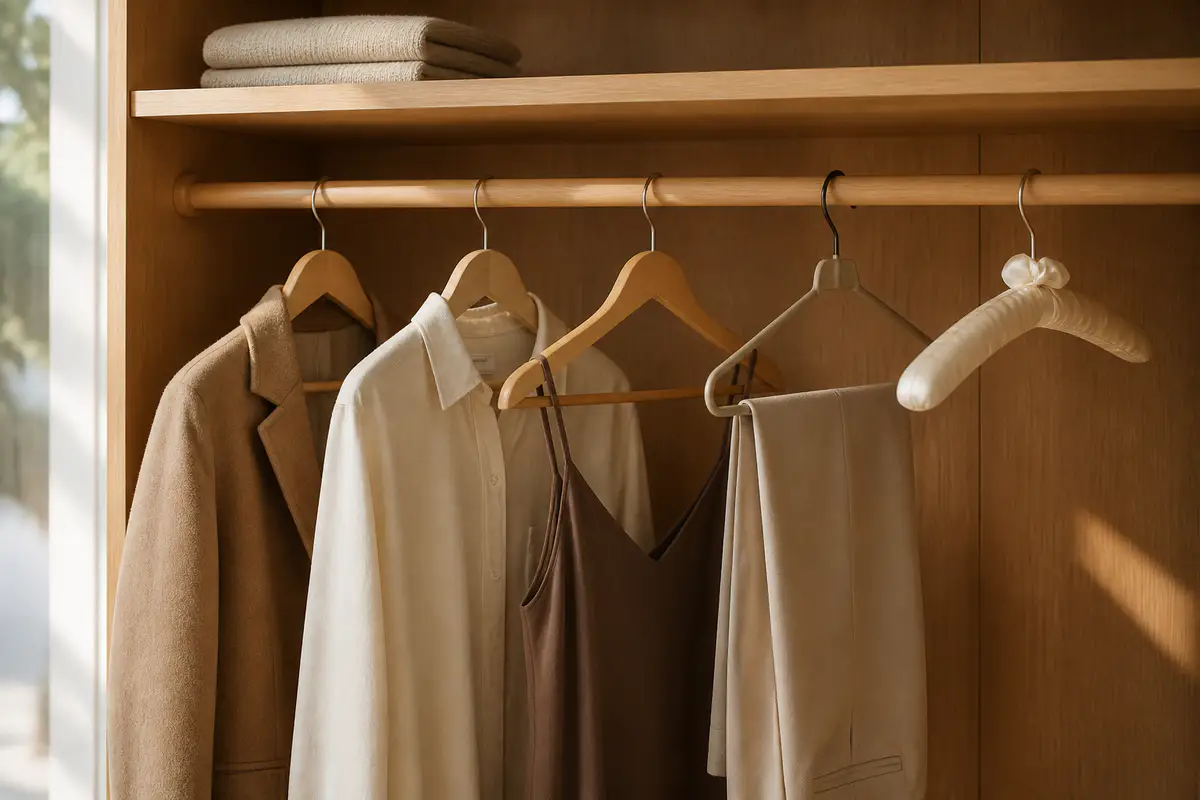
In this guide
Quick verdict
Use broad, shaped hangers for structured jackets and coats; smooth, correctly sized hangers for shirts and dresses; and fold heavy or loose knitwear. Add grip only where a garment slides, because aggressive clips and flocking can mark delicate fabric. Before replacing a whole wardrobe, test a small matched set with the heaviest, widest and most slippery garments.
A hanger is a support tool, not neutral storage. Too narrow and it pushes a point into the shoulder; too wide and it stretches sleeves or distorts the head. A rail packed with ultra-thin hangers can still crease clothes because there is no hand space. Start with the wardrobe itself, then the garment. Our workwear capsule wardrobe guide helps reduce duplicate pieces before buying storage accessories.
Measure the rail before the hanger
Record the rail’s usable length, height and distance to shelves, doors and the wardrobe back. Count garments by type rather than dividing total width by the thinnest hanger advertised. Coats and textured knits need more breathing room than flat camisoles. Long dresses need clear drop without resting on a shelf.
Check the hook opening against the rail diameter and any cover. The hook should move without force but should not jump off during ordinary use. A swivel hook can make presentation easier, while another joint can become a failure point under heavy loads. Low wardrobes need the total drop from rail to hanger shoulder, not just body width.
| Garment | Useful hanger features | Main risk to avoid |
|---|---|---|
| Tailored jacket or coat | Broad, shaped shoulders; strong neck and hook | Narrow ends creating shoulder dents |
| Shirt or blouse | Smooth edges; width close to shoulder span | Snags, collar compression and sleeve stretching |
| Strappy dress | Small strap notches or gentle grip | Sharp notches catching delicate fabric |
| Trousers or skirt | Smooth bar, soft clips or fold support | Deep clip marks and sliding |
| Heavy or loose knitwear | Usually folded on a shelf or over a broad bar | Gravity stretching shoulders and length |
Shoulder width is the first fit measurement
Lay the garment flat and observe where its shoulder seam or natural shoulder ends. The hanger end should support that area without reaching down the sleeve. There is no single adult size: petite shirts, broad coats and dropped-shoulder garments differ. Children’s hangers can be useful for narrow pieces, but only if their shape and strength suit the load.
A pronounced point at the end concentrates pressure. A rounded end spreads it. Thick suit hangers may preserve a structured shoulder yet consume rail space, so reserve them for garments that benefit. A uniform wardrobe does not require one hanger shape for every item.
Five garments to use in a trial set
- The widest tailored coat, to test strength and shoulder reach.
- The lightest silky blouse, to reveal slipping and rough edges.
- A strappy dress, to test notches without snagging.
- The heaviest trousers, to test bars, clips and hook rotation.
- A delicate knit, to confirm whether folding is safer than hanging.
Thickness versus real wardrobe capacity
Slim hangers can increase the nominal number on a rail, but clothing thickness remains. When the rail is overfilled, garments rub, buttons catch and sleeves fold behind neighbouring pieces. Retrieval becomes a two-handed pull that can bend hooks or stretch necklines. Leave an access gap and measure capacity with real clothes.
Group hanger thickness by use. A compact set for light tops can sit beside stronger shaped hangers for outerwear. If the wardrobe is still crowded, edit the contents using the decisions in our wardrobe colour-system guide rather than buying progressively thinner plastic.
Grip, flocking and notches
Grip is valuable for smooth straps and wide necklines, but the surface should not transfer colour, shed fibres or bond to fabric during long storage. Flocked surfaces collect dust and may be difficult to clean. Rubberised sections can age, become sticky or mark certain finishes. Test contact on a concealed area and avoid prolonged pressure on delicate pieces.
Notches should be rounded and positioned for straps. Deep, sharp cuts can catch lace, loose threads or fine lining. A garment with hanging loops may use them to distribute weight, provided the care label and construction support it. Tuck excessively long loops safely inside once the item is on the hanger so they do not catch adjacent hooks.
Trouser bars and clips
A bar needs enough friction to prevent a folded pair sliding to one side, but abrasive texture can polish or mark fabric. A rounded, clean bar reduces a hard fold line. For garments prone to creasing, consider a full-length clamp designed to spread pressure, after testing its pads.
Clips should move smoothly and have clean, cushioned faces. Place them on structurally stable areas such as a waistband, not fragile embellishment. Adjustable clips are useful only if they stay aligned under load. For a skirt that marks easily, fold a clean strip of acid-free tissue or suitable fabric between clip and garment, checking that added bulk does not weaken the hold.
Choose shaped support when
- The garment has tailoring, shoulder pads or substantial weight
- Long storage makes shoulder deformation more likely
- The wardrobe has enough depth and rail spacing
- The hook and neck are rated for the load
Choose compact support when
- Garments are light, unstructured and correctly sized
- Edges are smooth and grip is genuinely useful
- Rail access remains comfortable after filling
- The hanger does not flex permanently under ordinary use
Wood, metal, plastic and padded bodies
Material names do not establish durability or environmental benefit on their own. A robust hanger kept for years may be preferable to a weak alternative repeatedly replaced. Wood can offer broad shaping but needs smooth finishing and secure joints. Metal can be slim and strong but exposed ends, corrosion or narrow pressure points are concerns. Plastic varies greatly in stiffness and repairability.
Padded hangers protect some delicate shoulders and increase friction, yet fabric covers collect dust and seams can catch. Check whether the cover can be cleaned or replaced. Avoid vague claims such as “eco” unless the maker states material composition, recycled content, source and end-of-life route clearly.
Ventilation, damp and garment preparation
Do not hang clothes while they are still damp unless the care instructions and drying setup support it. A closed wardrobe traps moisture and odour. Dry laundry fully on an appropriate setup; our clothes-airer buying guide covers spacing and stability. After steaming, allow heat and moisture to dissipate before closing the door; see the garment steamer guide.
New garments can carry loose dye, finishing residue or packaging creases. Follow the care label and the checks in our before-first-wear clothing guide. A clean hanger cannot compensate for storing a damp or soiled garment.
Dust, moth risk and long-term storage
Hangers do not prevent textile pests. Clean susceptible clothing, vacuum the wardrobe and inspect seams and dark undisturbed areas. Use a breathable garment cover only where appropriate, and avoid trapping moisture. Our laundry bags and garment protection guide distinguishes washing protection from long-term storage.
Rotate rarely worn items and inspect hanger contact points. Heavy garments can slowly change shape even on a good hanger. Fasten enough buttons to keep the front aligned without creating tension. Remove belts or dense accessories if their weight pulls the garment unevenly.
Buying quantities without waste
Count the garments that should actually hang, then add a small operational margin. Buying a hundred identical hangers before testing can lock in the wrong shoulder width and create an unnecessary disposal problem. Start with five to ten, use them through a season and inspect both clothes and hardware.
Check whether the retailer sells small packs and replacement clips or bars. Compare price per usable hanger only after rejecting rough, undersized or weak products. A lifetime claim without written scope, exclusions and a practical claim route is not a reliable durability measure.
Reuse and end of life
Offer sound, clean hangers to local reuse organisations only if they accept them. Charity shops may have specific policies and should not be treated as a disposal route without asking. Mixed-material hangers can be difficult to recycle because hooks, flocking, foam and body materials are bonded.
Check local-council instructions rather than relying on a generic recycling symbol. Do not put wire hangers into household recycling unless the service explicitly accepts them; they can tangle sorting machinery. Repair a loose screw or replaceable grip only when the body remains safe and the repair will not snag clothing.
Official and sector references
- GOV.UK: textiles and resource-policy context
- WRAP: UK textiles action and circular-use resources
- GOV.UK: find local recycling collections
Local acceptance rules and product material claims change. Confirm the current council service and the maker’s composition information before disposal.
Balanced verdict
The best hanger is the one that supports a particular garment without stretching, snagging or wasting rail access. A mixed system is usually more rational than a perfectly uniform wardrobe: shaped support for tailoring, smooth standard hangers for shirts and deliberate folding for heavy knits.
Do not confuse maximum count with useful capacity. Test fit, strength and surface on representative clothes, then expand gradually. The approach costs slightly more attention at the start and prevents a much larger pile of unsuitable hangers later.
Frequently asked questions
Are thin velvet hangers best for every garment?
No — They save some rail width and add grip, but can shed, mark fabric or provide too little shoulder support for tailoring.
How wide should a clothes hanger be?
It should support near the garment’s natural shoulder end without reaching down the sleeve or creating a point. Measure representative garments rather than using one universal size.
Should jumpers be hung or folded?
Heavy and loose knits are commonly safer folded because gravity can stretch shoulders and length. Follow the garment care guidance.
Do wooden hangers prevent shoulder bumps?
Material alone does not. Width, end shape and garment fit determine pressure; a narrow pointed wooden hanger can still distort a shoulder.
Can old hangers go in household recycling?
Only if the local service accepts the exact material and construction. Mixed materials, wire hooks and flocking often require another route.
Methodology and limitations
We compared hanger choices through rail dimensions, shoulder support, garment weight, grip, clips, materials, ventilation, long-term storage and disposal. UK government and WRAP textile resources were reviewed on 30 August 2026. No specific hanger brand was durability-tested.
Limitations
Garment construction, finishes, wardrobe humidity and local recycling acceptance vary. Test a small set with representative clothing and follow every care label.