Cordless vacuum cleaners ownership guide: filters, batteries, parts and storage
A cordless vacuum keeps its value when airflow, brush movement and battery care are maintained without improvisation. A short routine after use prevents many apparent power and runtime failures.
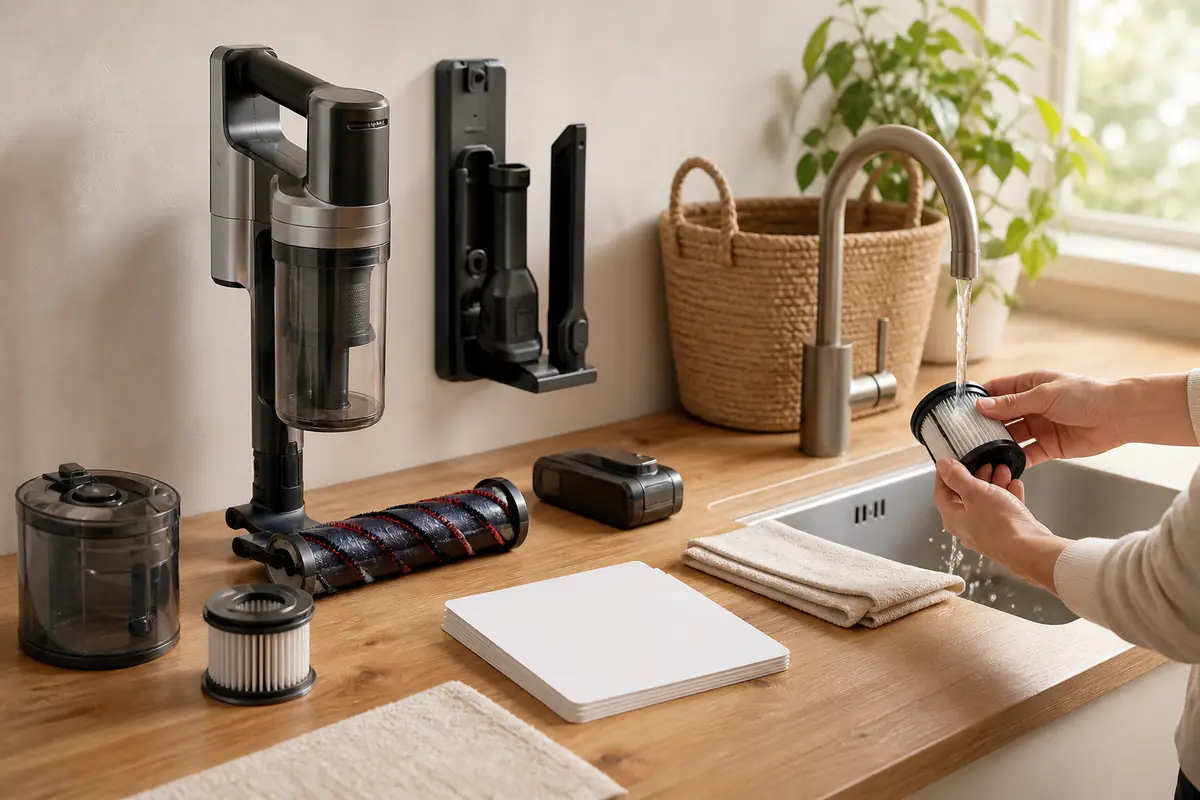
In this guide
Restore the air path before blaming the motor or battery
Reduced pickup can come from a full bin, blocked airway, wrapped brush or damp filter. Power down, follow the exact disassembly order, clean only approved washable parts and record runtime under comparable conditions.
Start with the cordless vacuum value guide, use the detailed buying guide, and decode claims through vacuum specifications explained.
| Symptom | First check | Controlled action | Avoid |
|---|---|---|---|
| Weak pickup | Bin, airway, head and filter | Clear in manual order | Probing powered unit |
| Short runtime | Mode, tool, temperature and charge | Repeat a standard run | Comparing unlike modes |
| Brush stops | Wrapped material and floor setting | Remove as instructed | Cutting near wiring |
| Odour | Bin, dry filter and trapped debris | Clean approved parts and dry fully | Reassembling damp |
Cordless vacuum service record
- Record the cordless vacuum’s model and serial number before seeking a matching battery, filter or repair.
- Map every filter and airway.
- Empty before maximum fill.
- Remove hair from brush safely.
- Dry washable parts fully.
- Log mode-specific runtime.
- Keep battery ventilated.
- Record part numbers and support.
Keep the manual with the exact model
Save a local copy of the official manual, model, serial and purchase proof. Product families can use different filters, batteries, latches and cleaning instructions despite similar appearance.
Photograph the assembled tool and each removable part before first deep cleaning. This makes correct reassembly easier and reduces the temptation to force a clip.
Empty the bin before airflow collapses
Treat the maximum line as a limit, not a target that must be reached. Fine dust, hair and bulky debris can obstruct cyclones or shrouds before the visible bin appears full.
Power down and empty according to the manual, avoiding a face-level dust cloud. People with allergies should use suitable controls and not compress debris by hand.
Trace the complete airway
Check floor head, wand, elbows, bin inlet, cyclone path and filters in the stated order. Use the approved access points rather than pushing a sharp object through hidden wiring or seals.
A partial blockage can produce pulsing, overheating protection or weak pickup. Photograph what was removed and stop if an object cannot be reached safely.
Remove brush wrap without damaging the head
Disconnect power or battery as instructed before opening the head. Use the provided tool or approved method and keep blades away from bristles, belts, wiring and fingers.
Inspect end caps and bearings for trapped hair but do not add oil unless the manual specifies it. Refit covers and locks fully before testing.
Wash only parts identified as washable
A filter that looks like foam or fabric is not automatically washable. Follow the exact temperature, rinsing and replacement instructions for each stage.
Never wash the motor body, powered head, cyclone or battery unless explicitly designed for it. Water damage can create safety risk and invalidate support.
Dry filters completely
Allow the full stated drying period in a ventilated place and inspect seams and depth, not just the surface. A damp filter can restrict airflow, create odour and move moisture into the machine.
Do not accelerate drying with an oven, microwave, tumble dryer, radiator or hairdryer unless the manufacturer explicitly permits it. Keep a genuine spare only when the manual supports rotation.
Measure runtime under comparable conditions
Record battery age, charge state, power mode, fitted tool, floor and duration. Maximum mode with a powered head cannot be fairly compared with an advertised figure measured in a lighter configuration.
Repeat the same route after cleaning airflow components. If runtime remains materially changed, use official diagnostics rather than buying a battery from appearance alone.
Charge in a safe environment
Use the approved charger and keep the battery and dock ventilated, dry and away from heat. Inspect cable, plug, contacts and casing without touching damaged components.
Stop use and isolate safely if the battery swells, leaks, becomes abnormally hot, smells unusual or is physically damaged. Seek official safety and disposal advice.
Avoid storing at temperature extremes
Do not leave the vacuum or battery in a hot car, freezing shed or direct sun. Temperature affects charging, runtime and long-term cell health.
For long storage, follow the exact charge-state and recharge interval instructions. Generic lithium advice should not override the manufacturer’s battery-management system.
Match the floor head and setting
Use the appropriate head, roller and suction setting for carpet, hard floor, rugs and delicate surfaces. Test on an inconspicuous area where the floor manufacturer requires caution.
High suction or an aggressive brush is not automatically better. It can make movement difficult, scatter debris or affect loose fibres and finishes.
Manage fine dust and unsuitable debris
Check whether the machine is approved for ash, plaster dust, liquids, sharp material or construction debris. Household cordless vacuums are often not designed for these hazards.
Use the right specialist collection method. Damage caused by an unsuitable job is not evidence that a more powerful everyday vacuum was needed.
Store tools so they remain findable
Give each nozzle, brush and adapter a labelled location and keep the charging route free of trip and crush hazards. Do not hang the machine from a fitting not rated for its weight.
A rarely used tool adds value only when it can be found and fitted. Photograph part numbers before labels wear and avoid incompatible lookalike adapters.
Plan batteries and parts before failure
Use the repairability and spare-parts guide to record filter, roller, battery, charger and latch availability. Check official compatibility by full model.
Use total cost of ownership to price supported replacements without assuming every third-party battery is safe or equivalent.
Close faults with evidence
For repeated shutdown, error lights or reduced performance, note conditions, maintenance, runtime and official troubleshooting already completed. Do not conceal water, impact or unsuitable debris exposure.
Browse Home & Kitchen for related ownership decisions. Recycle batteries and electrical equipment through accepted routes rather than household waste.
Keep seals and mating surfaces clean
Inspect bin seals, filter seats and tool connections for dust, hair or visible damage while the machine is powered down. A displaced seal can reduce airflow without a dramatic blockage.
Wipe only as the manual permits and refit parts evenly. Do not use grease, adhesive or improvised foam to repair an air seal unless official service instructs it.
Use wall docks and stands safely
Fix a wall dock into a suitable substrate with the specified clearances and cable route. Consider the combined weight of machine, tools and repeated removal forces.
A freestanding dock must remain stable on the actual floor and outside door or child routes. Do not let charging contacts carry the mechanical weight in an unintended position.
Control odour at the source
Empty organic debris promptly, clean approved bin parts and ensure washable filters are completely dry. Fragrance products can mask a problem and may be unsuitable for the air path.
If a burning or electrical smell appears, stop use and disconnect safely. Do not continue a diagnostic run simply to see whether the smell clears.
Review maintenance frequency by use
Homes with pets, fine dust or long hair may need more frequent bin, brush and filter attention than a calendar average. Record actual restriction and debris instead of servicing blindly.
Excessive disassembly can also wear clips and seals. Use the manual interval as a baseline and perform only the approved work justified by use and inspection.
Separate pickup problems from floor resistance
A head that is hard to push can reflect suction setting, roller choice, pile depth or a sealed floor interface rather than stronger cleaning. Compare the manual’s recommended configuration.
Do not force the machine across a delicate or loose covering. Protect the floor and select a compatible head instead of treating physical resistance as a useful performance measure.
Record noise changes before continuing
A new whistle, grinding sound or repeated cut-out should be logged with fitted tool, mode and floor. Stop and inspect approved access points rather than continuing until a visible failure appears.
A harmless change can come from airflow after cleaning, but contact, bearing or motor noise needs official guidance. Audio recordings may help support when paired with exact conditions and model details.
What should you do when performance falls?
Pickup or pulsing follows debris and maintenance
A safe bin, blockage, brush and fully dry filter routine restores normal behaviour.
The fault persists or involves safety
Repeatable runtime, motor, charger or battery symptoms remain after documented approved checks.
Balanced verdict
Cordless vacuum ownership is disciplined airflow and battery care. Empty, clear, clean and dry in the exact model order before replacing parts.
Supported filters and batteries are part of the original purchase value, not an optional afterthought.
Official checks:
GOV.UK product safety advice ↗
Electrical Safety First product safety ↗
GOV.UK electrical waste guidance ↗
Recycle Your Electricals guidance ↗
Frequently asked questions
Can every cordless vacuum filter be washed?
No — Wash only the filters the exact model manual identifies as washable and dry them for the full stated period.
Why does a cordless vacuum pulse?
A blockage, full bin, restricted filter or protection system may be involved; follow the official diagnostic order.
How should runtime be compared?
Use the same battery state, mode, tool, floor and route, and record maintenance and temperature.
Can any replacement battery be used?
Use only a battery whose safety and full-model compatibility are confirmed by an authoritative source.
How should a damaged battery be handled?
Stop using and charging it, keep away from heat and combustibles, and follow official safety and disposal advice.
Methodology and limitations
We assessed cordless vacuum ownership through airflow, bins, brush heads, filter washing and drying, runtime, charging, storage, parts, troubleshooting and recycling. We did not test individual vacuums.
Limitations
Filter designs, batteries, chargers, floor heads, diagnostics and safety instructions vary. Follow the exact model manual and official support for persistent or safety-related faults.