Carpet cleaners buying guide: tank size, extraction, tools and drying
A carpet cleaner applies liquid and removes dirty solution. Useful performance depends on floor compatibility, controlled delivery, recovery airflow, maintainable tanks and enough drying time.
In this guide
Buy the complete cleaning and drying system, not the largest tank
Tank capacity only helps when the machine remains movable, the recovery path can be cleaned and extraction leaves a manageable moisture load. Confirm the carpet and detergent instructions, test a hidden area, ventilate well and keep people and pets off damp fibres until dry.
Compare floor-care roles with cordless versus robot vacuum, size rugs through the living-room rug guide, and plan moisture with the dehumidifier guide.
| Area | Evidence | Practical test | Risk |
|---|---|---|---|
| Compatibility | Carpet maker and machine directions | Hidden colourfast area | Shrinkage, bleeding or damage |
| Tanks | Usable fill, emptying and seals | Lift at realistic water weight | Spills and awkward handling |
| Extraction | Head seal, suction path and passes | Recovered water and residual damp | Over-wetting |
| Tools | Hose reach, head size and rinse access | Stairs and upholstery geometry | Buying accessories that cannot be cleaned |
Pre-purchase carpet-cleaning audit
- Identify carpet fibre and backing.
- Check manufacturer cleaning restrictions.
- Measure open floor, stairs and storage.
- Record clean and recovery tank design.
- Check detergent specification and dosing.
- Plan vacuuming, test patch and passes.
- Allow ventilation and full drying time.
- Confirm parts, filters, hose and brush cleaning.
Confirm the floor can be wet cleaned
Identify carpet, rug or upholstery fibre, construction, backing, dye and maker instructions. Some natural fibres, loose dyes, glued constructions or specialist finishes may require professional methods or prohibit the machine and detergent combination.
A carpet cleaner is not a universal spill-removal device. Test colourfastness and texture in a hidden area using the exact solution and process, then allow it to dry before treating a visible room.
Separate dry soil removal from extraction
Vacuum thoroughly first. Hair, grit and crumbs burden brushes, channels and recovery tanks and can turn into debris that is harder to remove after wetting. Use edge and crevice tools where the cleaner head will not reach; the cordless-vacuum guide covers ordinary dry pickup.
Treat spots according to carpet and chemical directions without mixing products. More detergent is not more cleaning; excess residue can attract soil, foam in the recovery path or increase rinsing and drying work.
Calculate tank size at carried weight
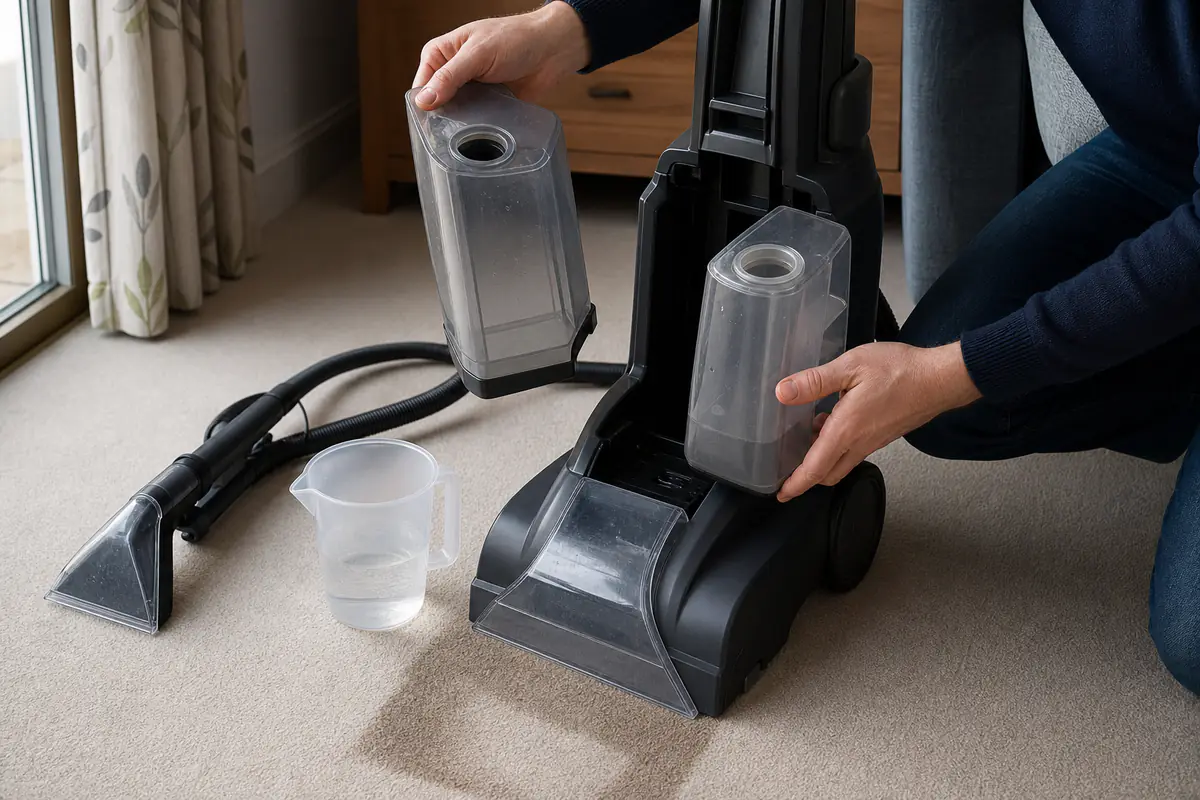
A litre of water adds roughly a kilogram before the machine, tank and dirty solution are counted. Compare usable fill lines, handle geometry, lid security, sink clearance and how far each tank must be carried.
Large tanks reduce refills on open rooms but can be awkward on stairs and in small sinks. A smaller tank may be safer and faster when each fill, dose and empty cycle is simple and controlled.
Prefer clean and dirty water separation
Separate clean-solution and recovery tanks prevent extracted soil being reapplied. Check whether seals, floats, strainers, lids and channels can be removed, inspected and rinsed without tools or trapped residue.
Transparent plastic helps monitor levels but does not show hidden ducting. Look for diagrams and maintenance instructions that explain the complete liquid and airflow path.
Read the floor head as an extraction system
Head width affects coverage, while edge shape, brush action, solution jets, suction opening and seal affect agitation and recovery. A broad head can be inefficient when furniture creates narrow lanes or the seal breaks on uneven pile.
Check whether brushes stop for delicate areas and whether the clear nozzle removes for cleaning. Hair and fibres around a powered brush can reduce movement and strain the drive.
Drying passes matter as much as wet passes
A controlled wet pass delivers solution; subsequent dry-only passes remove as much liquid as practical. Rushing repeatedly over the same area with solution can saturate backing without improving surface cleaning.
Use overlapping straight lanes according to instructions and monitor recovery. When little more water is collected, stop rather than heating or scrubbing the same fibre indefinitely.
Plan the room in exits and zones
Start away from the exit so nobody must cross cleaned carpet. Move only furniture that can be handled safely and protect feet or bases from moisture and dye transfer where the maker recommends it.
Small zones keep fill, recovery and drying observable. Keep children and pets away from equipment, cords, solution and damp areas until the carpet is fully dry and residue risk is resolved. Use the home-readiness audit to identify cables, thresholds and low obstacles before restoring automated cleaning.
Choose hose tools by real geometry
Measure stair tread depth, riser, turns and the distance from a stable machine position. A long hose is useful only when it stores securely, maintains airflow and does not pull the machine towards an edge.
For upholstery, confirm maker compatibility, tool width, solution control and fabric test requirements. Check whether the tool, clear cover and hose can be flushed and dried after use.
Compare detergent rules and ongoing supply
Some warranties or dosing systems specify compatible formulas. Record concentrate size, dose per tank, rinse guidance, storage and hazard information rather than comparing bottle price alone.
Never mix cleaning chemicals. Keep products in original labelled containers, away from heat, children and pets, and follow ventilation and protective instructions on the exact product.
Drying depends on water load and environment
Extraction, pile, backing, room temperature, humidity, ventilation and outdoor weather all affect drying. Open appropriate ventilation, use safe air movement and consider controlled dehumidification without placing electrical equipment on wet flooring.
Do not replace observation with a promised drying time. Check the whole area, including edges and under protected feet, before returning furniture, rugs or normal traffic.
Weight, cord and storage affect every session
Record dry weight, filled weight, handle positions, wheel path, cable length and stair carrying. A capable machine that cannot be moved, drained or stored without strain will be used less often or unsafely.
Measure cupboard footprint with handle, hose and tools in their stored positions. Tanks and hoses should dry before enclosure to reduce odour and residue.
Maintenance starts immediately after cleaning
Empty recovery water promptly according to local and product directions, rinse tanks and removable nozzles, clear hair and allow parts to dry. Do not store dirty solution or a sealed damp hose.
Check availability and price of belts, brushes, filters, seals and tools. A replaceable wear part can extend ownership; a hidden, inaccessible channel can make hygiene and performance decline.
Decide between buying, hiring and professional work
Buy when compatible areas are large or frequent enough to justify storage and maintenance. Hire when use is occasional and the transport, deposit, detergent and return window remain practical.
Use a suitable professional where fibre, staining, flooding, contamination or drying risk exceeds domestic equipment and knowledge. Browse Home & Kitchen for connected floor and moisture decisions.
Which route fits the home?
Compatibility and drying are controlled
The carpet permits extraction, tanks and tools fit the rooms, and cleaning, recovery, ventilation and storage can be completed safely.
Fibre, dye or moisture risk is uncertain
The carpet has unclear construction, specialist care, flooding, contamination or a drying problem that domestic extraction may worsen.
Balanced verdict
A useful carpet cleaner removes dirty solution predictably and can be cleaned, carried, dried and stored without creating a second problem. Prioritise compatibility, recovery path and drying plan before tank size or accessory count.
Plan the hidden test, room zones and maintenance before the first fill rather than improvising with wet carpet.
Official checks:
NHS information on damp and mould ↗
HSE COSHH guidance ↗
GOV.UK electrical safety guidance ↗
Frequently asked questions
Is a larger carpet-cleaner tank always better?
No — It reduces refills but increases carried weight and may be awkward to fill, empty and clean.
How many drying passes should I make?
Follow the machine and carpet instructions and continue controlled dry-only passes while meaningful water is recovered, without overworking the area.
Can carpet cleaner be used on rugs?
Only when the rug fibre, dye, backing and maker permit the exact extraction method and solution. Test a hidden area first.
Can I use ordinary detergent?
Use only products and doses approved for the carpet and machine. Never mix cleaners.
How long will a carpet take to dry?
There is no fixed universal time. Water load, extraction, pile, humidity, temperature and ventilation all affect drying.
Methodology and limitations
We assessed carpet cleaners by floor compatibility, pre-vacuuming, tank design, extraction head, hose tools, detergent, carried weight, zone planning, drying, maintenance, storage and buy-hire-professional alternatives. We did not clean a carpet or rank products.
Limitations
Carpet construction, dyes, stains, equipment and environments vary. Manufacturer instructions and a hidden dry-down test take priority. Specialist contamination, flooding or mould may require professional assessment.