& Other Stories vs COS UK: which modern high-street retailer suits your wardrobe?
Both retailers sell design-led clothing above much of the high street, but they organise choice differently. Compare one matched garment by measurements, composition, construction, care and delivered cost rather than choosing an aesthetic at brand level.
In this guide
Start with & Other Stories for expressive choice; start with COS for restrained shape
& Other Stories offers the broader route into dresses, decorative details and seasonal styling, while COS makes a stronger first shortlist for clean tailoring and fabric-led basics. Neither wins automatically on quality or fit. The better purchase is the exact product with clearer measurements and construction for the same wardrobe job.
Read the full & Other Stories UK profile and our COS UK review for their individual delivery, returns and product checks. This page owns the direct choice between them.
The two retailers at a glance
| Decision | & Other Stories | COS |
|---|---|---|
| Range character | Expressive dresses, tailoring, knitwear and accessories | Clean silhouettes, modern tailoring and fabric-led basics |
| Current trouser sample | Selected listings at £67, £77, £119 and £169 | Sampled silhouettes at £75, £85, £95, £119 and £139 |
| Standard delivery timing checked | Four to five working days | Four to five working days |
| Online return fee checked | £3 postal deduction; eligible store returns | £3 processing deduction |
| Best starting question | Does a distinctive cut earn its wardrobe place? | Do the minimalist proportions fit the wearer? |
The underlying category and policy checks were refreshed on 5 October 2026. These samples show overlapping budgets, not exhaustive ranges or confirmed size availability; the actual order must still be judged on its selected variant and checkout conditions.
Range: breadth versus editing
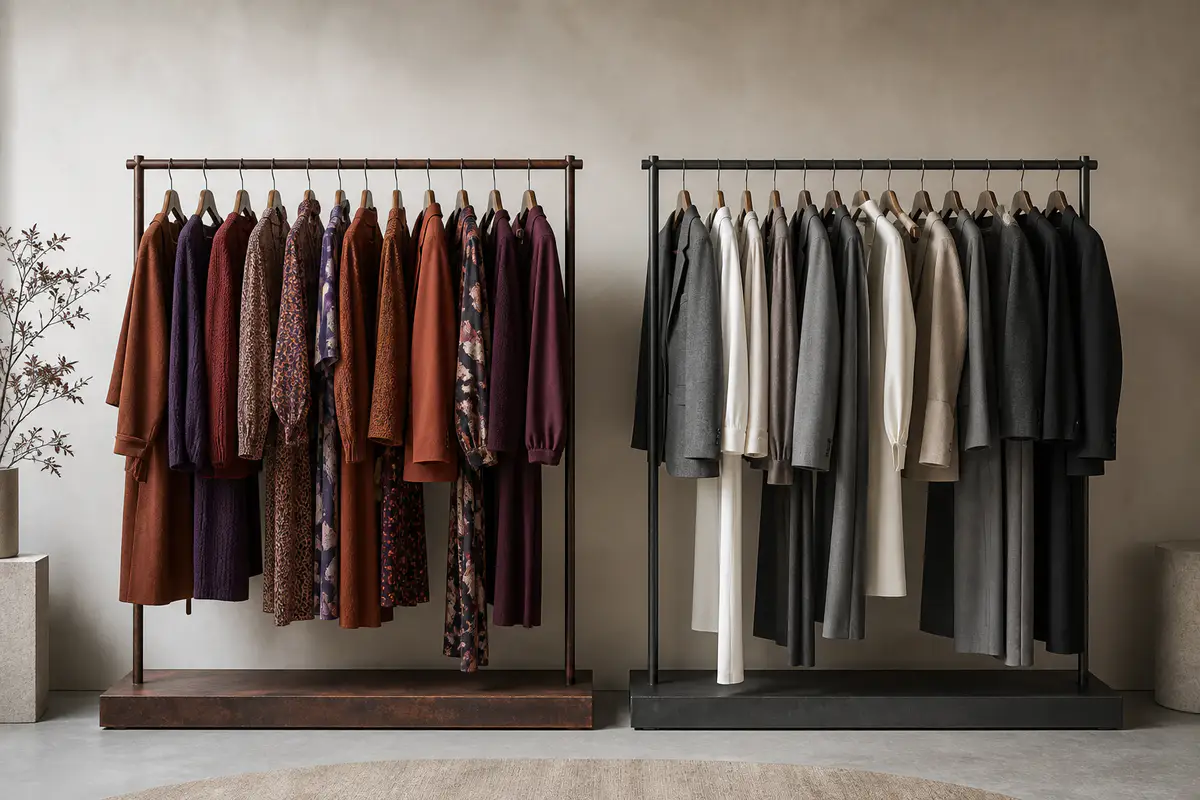
& Other Stories makes it easier to build a visually complete outfit across dresses, jewellery, shoes and bags. That breadth helps when colour and detail are central to the brief. It also increases the risk of adding coordinating items that were not needed.
COS presents a more restrained language, with recurring attention to trouser shape, shirt volume, outerwear and knitwear. This can simplify coordination, yet “minimal” is not the same as versatile. An extreme barrel leg or dropped shoulder can be as specific as a printed dress.
Use the capsule-wardrobe guide to count real outfits and care compatibility before calling either piece a staple.
Price: compare matched specifications
Consider the £77 loose-fit tailored listing at & Other Stories beside the £75 COS elasticated barrel style: the near-identical budget buys a different waist and leg treatment. At £119, & Other Stories wool-blend tailoring and COS relaxed twill wide-leg trousers still need a material and proportion comparison, not an automatic tie.
A £119 match is meaningless unless the garments solve the same job. Compare fibre percentages, cloth construction, lining, pockets, fastenings, rise, inside leg and care. A lined office trouser and unlined summer culotte should not be ranked by price alone. The fabric-composition guide helps translate labels.
Sizing: cut is more important than reputation
Neither retailer has one fixed fit. & Other Stories moves across fitted dresses, relaxed shirts and multiple trouser silhouettes; COS uses substantial volume and shaped legs as design tools. Measure the body and a good garment, then compare the dimension that controls the cut.
For trousers, record waistband position, rise, hip, thigh, inside leg and hem. For jackets and shirts, record shoulder, cross-back, chest, sleeve and body length. Use our clothing sizing guide to distinguish body and finished-garment figures.
Ordering several speculative sizes increases temporary spend and return handling. Eliminate unsuitable fabric, rise and length first, then order the smallest sensible test set or use a store where stock permits.
Construction: inspect the same stress points
Fair garment comparison
- Match the wardrobe job, category and season.
- Compare the selected colour and exact composition.
- Measure equivalent garment points.
- Inspect seams, pockets, zip, buttons, lining and hem.
- Price cleaning, pressing and feasible alterations.
- Add delivery and return-route cost.
- Keep the product with the stronger whole-case evidence.
Do not reward decorative complexity automatically; it can add failure points. Do not reward simplicity automatically; a plain garment still needs balanced grain, secure seams and good finishing. Our clothing-quality guide provides an inspection sequence.
Delivery and time-critical orders
The standard estimates were broadly aligned at four to five working days. & Other Stories listed £7 home shipping and £5 pickup or locker shipping, becoming free above £70; COS’s free-shipping offer applied to members spending over £50. Address-specific checkout costs matter more than a headline threshold when your basket is small.
A delivery comparison should include the time left to inspect fit and obtain a replacement, not just the fastest dispatch option. Check address coverage, stock and any split shipment before committing to an event outfit; express availability can differ between locations and busy periods.
Returns: similar fee, different practical route
The regular return windows differed: 28 days at & Other Stories and 30 at COS, with sale purchases limited to 14 days at both. Each published a £3 deduction, described respectively as a postal-return fee and processing fee. & Other Stories excluded discounted online goods from its store-return route.
Decide which route you can actually use before buying two competing pairs, especially when a store trip would require a separate journey. The clothing returns guide helps retain order and parcel evidence while keeping the fitting exercise reversible.
Choose by wardrobe question
Colour and detail define the gap
You need an expressive dress, knit or accessory-led outfit and can verify construction and care on the exact piece.
Shape and restraint define the gap
You want modern tailoring or a fabric-led basic and have measured the volume, rise, shoulder and length carefully.
Discounts and long-term value
Do not compare a sale product with a full-price alternative until the reference price, size availability and return conditions are clear. Use our discount guide. A lower price for the wrong proportion is not better value.
Estimate realistic wear, alterations and cleaning with the cost-per-wear guide. Neither retailer’s visual identity proves durability; update the estimate after actual use.
Product-page evidence and online shortlisting
Both retailers use editorial photography to communicate proportion, but an attractive silhouette is not a measurement. Record the model information only as context, then look for garment length, rise, fit description, fabric weight clues, lining and close views of fastenings. If one page gives materially better evidence, that can reduce the risk of ordering even when the competing garment looks stronger in the campaign image.
Colour names are not standard. “Stone”, “mole”, “cream” and “oatmeal” can describe noticeably different tones on different screens and under different light. Compare every available view and read the fibre and care label. For a colour-critical outfit, a store check or a reversible order route is more reliable than matching product thumbnails.
Care burden can reverse the price comparison
A garment that requires specialist cleaning, frequent pressing or careful reshape-and-dry handling may cost more to own than a slightly dearer alternative with compatible care. This does not make dry-clean-only clothing bad; it means the maintenance must suit the planned frequency. Read the full care instructions before removing tags and check whether trims, lining and outer fabric impose different constraints.
Wool content does not guarantee the same warmth or durability. Cloth structure, yarn, finish, garment pattern and abrasion all matter. Equally, a lower wool percentage is not automatically inferior when the blend serves stretch, recovery or washability. Compare the entire material stack and construction rather than awarding points for one headline fibre.
Accessories and basket discipline
& Other Stories can make coordinated accessories easy to add, while COS can make tonal layers feel like part of one system. That merchandising is useful for inspiration and risky for basket size. Write the missing wardrobe job before browsing and judge every additional item separately. A belt or bag should not inherit the justification of the trousers that prompted the visit.
For accessories, inspect dimensions, closure, lining, hardware finish, weight and care. Jewellery materials and plated finishes need their own evidence. A complete-looking outfit on screen can conceal several separate care routines and return decisions.
Four realistic decision scenarios
Where to start, then what to verify
- A restrained office trouser: start at COS, then compare rise, inside leg, waistband construction, pockets and crease recovery with the closest & Other Stories option.
- An occasion dress with colour: start at & Other Stories, then verify lining, closure, bra compatibility, sitting comfort and cleaning before keeping it.
- A long-term neutral coat: search both. Compare total weight, shoulder room over layers, fastening, pocket construction, lining and realistic wet-weather care.
- A knit for frequent rotation: search both by composition and shape, then test softness, recovery, pilling risk, wash method and drying space rather than buying by logo or palette.
When neither retailer is the right answer
A two-brand comparison should not force a purchase. If neither retailer provides the required measurements, care, fabric or return route, pause. Alteration can solve length or a simple waist adjustment, but it cannot cheaply correct every shoulder, rise, armhole or fabric problem. Second-hand availability may help with an established style, provided condition, measurements and seller evidence are clear.
The strongest no-buy signal is a vague wardrobe job combined with urgency. Save the product references, measure existing clothes and return after the event pressure has passed. A delayed good match is better value than two quick returns and a compromised third choice.
Balanced verdict
& Other Stories wins the first browse for expressive, coordinated fashion; COS wins the first browse for clean, shape-led clothing. The final decision should be narrower: match one garment, measure it, open every material layer, inspect construction and price the reversible return route. Where evidence is equal, choose the piece that completes more existing outfits with easier care.
Continue through the Fashion archive for related decisions.
Check current official information:
& Other Stories UK range ↗& Other Stories returns ↗COS UK range ↗COS returns ↗
Frequently asked questions
Does the October sample show COS always costing more than & Other Stories?
No consistent price winner emerges from these selected trousers; compare a pair’s fabric, shape and care against an equivalent wardrobe job before treating the budget as decisive.
Should I start at COS or & Other Stories for a restrained office outfit?
Try COS first for a clean silhouette, then use the closest & Other Stories alternative to test whether the rise, cloth and movement are a better match for your working day.
Can I use a store return for either retailer’s discounted online order?
Do not assume the same eligibility: the checked & Other Stories policy ruled out that route for online sale and discounted items.
Is an & Other Stories size label interchangeable with a COS one?
Measure the dimension that controls each pattern rather than transferring a label across brands; a fitted bodice and a dropped shoulder deliberately allow different amounts of room.
What would make one of these two fashion retailers the better purchase?
The deciding evidence is narrower than brand reputation: an exact garment should fit, tolerate your care routine and complete existing outfits without repairs or alterations that overwhelm its price.
Methodology and limitations
We refreshed the two retailers’ UK trouser samples, delivery rules and return information on 5 October 2026, then compared the same wardrobe decisions across both. This is a published-evidence comparison with an inspection framework, not a wear test or a ranking of every collection.
Limitations
A selected price pair cannot establish that two fabrics or patterns are equivalent. Stock and individual fit remain unproven until the shopper checks the actual variant, and future policy changes can alter which trial order is easier to reverse.