Choosing a wrap dress: overlap, fastening, fabric and fit
A wrap silhouette can be adjustable, but it is not automatically forgiving. The useful questions are whether the front remains covered while moving, where the waist tie sits, how the fabric behaves and whether the fastening can be secured without distorting the dress.
In this guide
Choose secure overlap before a flattering fitting-room pose
A good wrap dress keeps enough front overlap when you sit, reach and walk, while the waist seam and tie settle naturally at your torso. Check the garment’s construction, not just its name: a true wrap opens fully, a fixed-wrap style is sewn closed, and a faux wrap may give the look with far less adjustability.
“Wrap dress” covers several constructions that behave differently. One may have a waist tie threaded through a side opening; another may close with an internal button; a third may only cross at the bodice while the skirt is fixed. That distinction affects coverage, dressing ease, alteration and the chance of the knot loosening. Buying well means testing the moving garment rather than judging a still photograph.
Identify the construction before comparing sizes
| Construction | What adjusts | Main check |
|---|---|---|
| True wrap | Bodice and skirt close around the body | Front overlap remains sufficient through movement. |
| Fixed or faux wrap | Usually little beyond a tie or elastic waist | Buy for the sewn garment dimensions, not presumed flexibility. |
| Wrap bodice | Neckline may cross while skirt stays fixed | Bust coverage and waist seam sit without pulling. |
| Buttoned wrap | Fastening points set the circumference | Buttons are reinforced and offer a useful second position. |
| Tie-side dress | Outer tie controls shape; inner closure anchors it | Inner fastening lies flat and does not take all the strain. |
A product page should show the inside and state how the garment closes. If it does not, inspect customer imagery cautiously and ask the retailer. A decorative tie on a fixed dress is not the same as an adjustable wrap. Compare the garment measurements with a dress that already fits, using our size-chart guide rather than relying on one familiar size number.
Test overlap at the skirt and neckline
Overlap is the amount of fabric that remains doubled after fastening. At the skirt, stand normally, take a long step, sit, cross one leg and rise. The under-panel should remain well inside the outer edge. A dress that covers only when the tie is pulled uncomfortably tight is too small or poorly proportioned for the wearer.
At the neckline, look for a smooth cross-over rather than tension radiating from the bust. A small concealed press stud can add security, but it should not be the only thing holding an undersized bodice together. If a camisole would be needed, make that part of the outfit decision rather than discovering it after the returns period.
Place the waist where the dress expects it
The waist seam, belt loops and side opening reveal the intended position. If they sit noticeably above or below the natural waist, tightening the tie may pull the neckline and hem off balance. Petite and tall versions can change torso length as well as hem length, so check the retailer’s description instead of assuming the label concerns only the skirt.
Try the knot at the side, back and front only where the design allows. A bulky bow under a coat may be uncomfortable, while a narrow slippery tie can loosen. Our cost-per-wear framework is useful here: an attractive dress that needs constant adjustment is unlikely to earn frequent wear.
Match fabric behaviour to the required structure
- Woven viscose: can drape attractively but may crease, shrink or change shape if care instructions are ignored.
- Cotton poplin: gives clearer structure and overlap, though a firm fabric may pull at the waist if undersized.
- Jersey: stretches and travels well, but thin versions can cling and a heavy skirt may drag the neckline down.
- Linen blends: feel airy and textured; expect creasing and check whether the wrap edge rolls outward.
- Satin weaves: can look polished but may slip at the knot and show pulling around fastenings.
Read the fibre composition and care label together. “Silky” describes a feel, not necessarily silk. GOV.UK’s textile-labelling guidance explains that fibre content must be shown for textile products, which gives buyers a factual starting point. Our fabric-composition guide then connects that composition with likely care and wear.
Check the fastening as a load-bearing detail
A true wrap often has an inner tie or button and an outer tie. Neither should feel as though it will tear from a single point. Look for secure stitching, a clean side opening and enough tie length to make a stable knot without an oversized trailing bow. If the inner tie is very thin, it should still lie flat rather than cutting into the waist.
Move before removing tags. Raise both arms, carry a shoulder bag, put on a coat and sit in a dining chair. Check whether the knot shifts, the waist rotates or the under-panel pulls across. A tiny hand stitch, hook or press stud can refine an otherwise correct fit; it should not be used to rescue extensive gaping.
Plan underwear, layers and weather
A wrap neckline may suit a plunge, balconette or camisole differently. Test the exact underlayer because a contrasting edge can become visible as the bodice moves. In cooler weather, a thin roll neck under a sleeveless fixed-wrap dress may work better than forcing a cardigan over a large waist bow.
Wind exposes a mobile skirt more readily than a sewn front. A generous overlap, heavier fabric or discreet internal fastening reduces the problem. For occasion dressing, take the intended coat and shoes to the fitting session; our occasionwear guide explains how to test the complete outfit rather than an isolated dress.
Judge pattern placement and return evidence
Large prints can vary between garments because pieces are cut from different parts of the cloth. If placement matters, a product image may not guarantee the delivered item. Also check whether the wrap edge interrupts stripes or the pattern makes the overlap visibly uneven. Plain fabric is not inherently better, but it makes pulling and misalignment easier to see.
When buying online, retain the order confirmation and return the garment within the retailer’s stated process if it is unsuitable. GOV.UK explains cancellation rights for most distance purchases, with exceptions. Our clothing-returns guide separates statutory rights from a shop’s voluntary policy, and our returns-policy checklist helps assess delivery deductions and return routes.
Compare alteration potential before compromising fit
A dressmaker may be able to add a discreet neckline fastening, shorten ties, adjust a hem or secure an overlap. Moving a shaped waist seam, enlarging an under-panel or correcting a twisted grain is far more involved. Ask for an alteration estimate before keeping a sale purchase whose basic structure is wrong.
Inspect seam allowance, print matching and the position of belt loops without unpicking anything during the return window. If the dress is valuable or delicate, use a qualified alterations professional. Include that cost and turnaround in the purchase decision rather than treating tailoring as free future work.
Also check the hem while the dress is tied at the comfortable tension, because tightening or rotating the wrap can change how the front edges hang. Photograph the correct fastening route for future reference if the inner tie and side opening are not obvious, but never pull a tie through a seam gap that is not a finished opening.
Before deciding, repeat the movement test after ten minutes rather than immediately after arranging the dress. Fabric and knots can settle with warmth and motion. If coverage depends on constant surveillance, choose another construction; confidence during ordinary movement is part of fit, not an optional styling preference.
Which wrap construction fits the decision?
You value adjustable circumference
The overlap is generous, both closures are secure and you are comfortable checking the knot and coverage during wear.
You value predictable coverage
The sewn shape fits your torso, the neckline lies flat and the decorative crossover gives the look without a moving front.
Balanced verdict
A wrap dress is successful when adjustment and security work together. Prioritise the under-panel, waist position and fastening strength; then consider fabric, neckline and styling. A true wrap offers useful flexibility, while a fixed wrap may be calmer for work, travel or windy days. Neither construction is universally better.
Continue with our shirt-dress fit guide, clothing-alterations guide, fashion-sale checklist and the Fashion archive.
Check current official sources:
GOV.UK textile labelling guidance ↗GOV.UK returns and refunds guidance ↗
Frequently asked questions
Is a wrap dress always adjustable?
No. A faux or fixed wrap may be sewn closed and offer no more adjustment than an ordinary dress.
How much skirt overlap is enough?
There is no universal measurement. The practical test is whether the under-panel remains comfortably inside the outer edge while sitting, walking and taking a long step.
Can a gaping wrap neckline be altered?
A small hook, press stud or hand stitch can secure minor movement. Extensive pulling usually indicates that the bodice size or torso proportions are wrong.
Which fabric is easiest for travel?
A mid-weight jersey or crease-tolerant blend can be convenient, provided it does not stretch the neckline or cling more than wanted.
Should I size up in a wrap dress?
Use garment measurements and movement tests. Sizing up may improve overlap but can lower the neckline or misplace the waist, so it is not an automatic fix.
Methodology and limitations
We assessed wrap dresses through construction, moving overlap, fastening, waist placement, fibre and care information, layering and returns. This is a fit-led buying framework, not a hands-on review of a named dress.
Limitations
Brand blocks and individual proportions vary. Recheck the exact garment measurements, construction, composition, care label and current return terms before ordering.
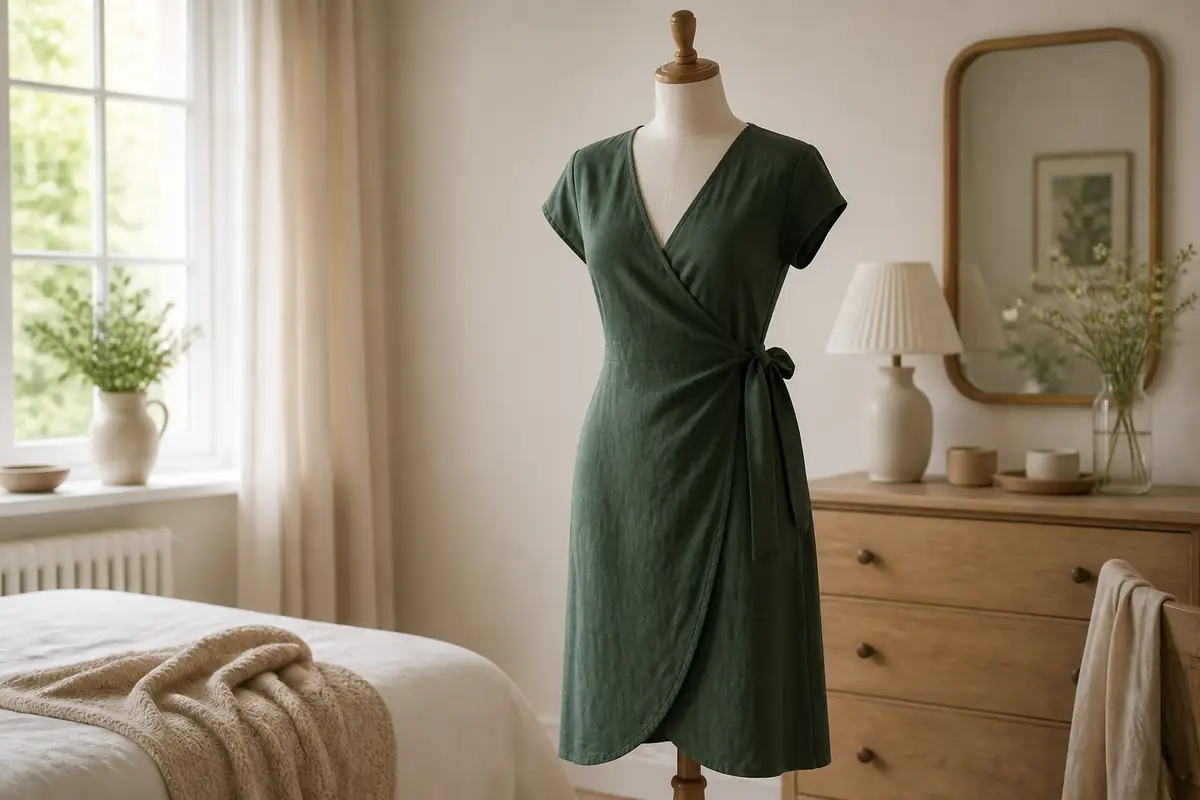
The image is an editorial illustration, not a photograph from a product test. Links are editorial and non-affiliate.