Toaster ownership guide: placement, crumbs, stuck food, cleaning and faults
Safe toaster ownership depends on a clear worktop, intact UK plug and cable, regular crumb removal and a strict unplug-and-cool routine before cleaning or dealing with stuck food.
In this guide
Unplug, cool and follow the exact manual
Keep the toaster clear of curtains, cupboards and water; empty the crumb tray as instructed and never insert metal tools into the slots. Stop using it after damage, burning smell, sparking, repeated tripping, abnormal heating or a matching safety alert.
Choose the right appliance first with our toaster buying guide, set a safe cleaning routine with the countertop appliance guide and preserve the manual using the manual-before-purchase guide.
| Situation | Immediate action | Do not | Next check |
|---|---|---|---|
| Crumb build-up | Switch off, unplug, cool and use the tray as instructed | Shake a live or hot toaster | Manual frequency and tray fit |
| Food stuck | Cancel, unplug and allow full cooling | Insert metal or fingers into slots | Manufacturer removal method |
| Smoke or burning smell | Cancel if safe, isolate power and stop use | Run another cycle to investigate | Food debris, damage, alert and service |
| Cable or plug damage | Stop use and isolate safely | Tape, bend or continue using | Retailer, competent repair or replacement |
Monthly toaster ownership record
- Stable dry placement and ventilation.
- Plug, cable and strain relief condition.
- Slot and lever movement while cool.
- Crumb-tray removal and cleaning.
- No loose food or foil in slots.
- Manual and exact model retained.
- Recall database and registration details.
- Any smell, noise, heat or tripping change.
Place the toaster before connecting it
Use a stable, level, dry worktop with enough clearance from curtains, blinds, paper, towels and wall cupboards. Toast can ignite and heat rises. Follow the manufacturer’s stated clearances rather than estimating from the body size. Do not place the appliance on a hob, draining board, unstable trolley or surface that can be damaged by heat.
Keep the slots visible during use and never operate beneath a cupboard if the instructions prohibit it. The lead should reach a suitable wall socket without crossing a sink, hot surface or walkway. Do not position the toaster where a child or pet can pull the cable. A tidy worktop is not cosmetic: it removes fuel and makes smoke or abnormal behaviour easier to notice.
Use the correct socket and inspect the cable
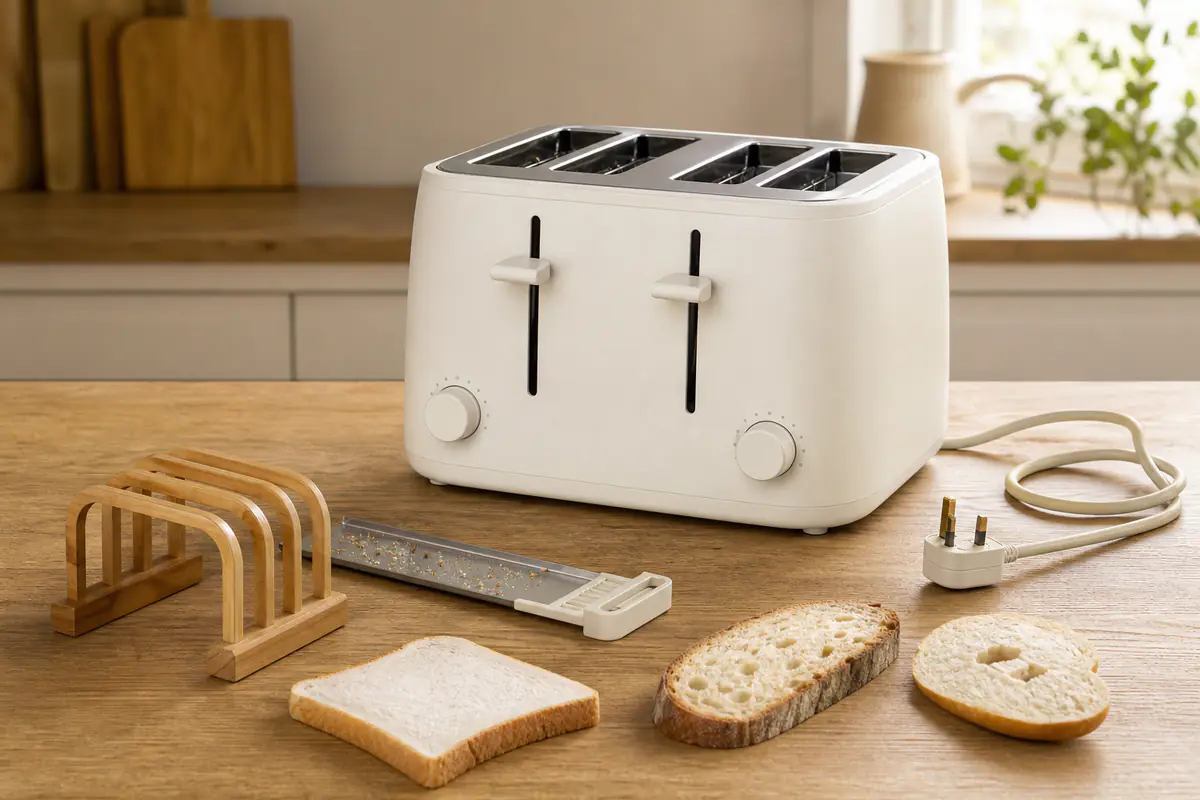
A UK toaster should have an intact fused three-pin plug appropriate to the product. Check the plug, pins, cable, strain relief and body before first use and periodically afterwards. Stop if insulation is split, pins are loose, the cable is crushed or the entry point moves. Do not disguise damage with tape or a decorative cable sleeve.
High-power kitchen appliances should not be crowded onto an overloaded extension lead. Use a suitable fixed socket and follow Electrical Safety First guidance. Keep the cable loosely routed and never coil it around a warm toaster. If the plug or lead becomes unusually hot, smells, crackles or causes repeated tripping, unplug safely and stop use rather than moving it to another socket as an experiment.
Supervise every cycle
Stay in or close to the kitchen while the toaster operates. Use only foods and accessories permitted by the exact manual. Thick bread, loose toppings, filled sandwiches, damaged pastries or oversized slices can touch hot elements or jam the carriage. A “wide slot” label does not make every bakery product safe.
Use cancel rather than forcing the lever. If bread repeatedly needs turning or pushing, the slot and food are a poor match. Never cover the slots or warm food on top unless the manufacturer supplies and approves a model-specific rack. Keep aerosols, cooking oil and alcohol away from the hot appliance. The genuine-shop guide helps avoid unsafe counterfeit accessories.
Control crumbs before they become fuel
Crumbs collect below the elements and can scorch, smoke or attract pests. Empty the removable tray at the frequency and by the method in the manual. Always cancel, switch off where provided, unplug and wait until fully cool. Slide the tray out over a clear surface and avoid tipping debris back into the electrical body.
Wipe the tray only as instructed and dry it fully before replacement. Make sure it seats correctly; never operate the toaster without a required tray. Do not shake or invert the appliance unless the manual explicitly permits it, because crumbs can lodge on elements or mechanisms. Record a cleaning date if several people share the kitchen so responsibility is not assumed and forgotten.
Handle stuck food without reaching into slots
If food jams, press cancel if it is safe, unplug at the wall and let the toaster cool completely. Do not insert a knife, fork, spoon or any metal object. Electrical Safety First warns against using metal implements in a toaster. Fingers can also contact sharp or hot internal parts, so cooling does not turn the slot into a safe access point.
Follow the model-specific removal instructions. Some manuals allow gentle release after cooling; others direct the owner to service. If the carriage, centring guides or elements are bent, do not force them back. Repeated jams show that the food, slot or mechanism is unsuitable. Replace the breakfast method rather than normalising a dangerous retrieval ritual.
Clean the exterior without introducing water
Unplug and cool fully before wiping. Use only the materials and moisture level permitted by the manual, usually a soft lightly damp cloth followed by drying. Never immerse the toaster, run it under a tap, spray cleaner into the slots or allow liquid into controls. Abrasive products can damage finish or markings without improving hygiene.
Grease from adjacent cooking can settle on the casing and vents, so maintain spacing from hobs and fryers. Do not polish around a connected plug or move the toaster by its cable. The body should be clean enough to reveal cracks, loose parts and heat discolouration. A cosmetic mark alone is not proof of danger, but a change combined with smell or abnormal heating deserves immediate stop-use.
Recognise a fault rather than repeating the cycle
Stop after sparks, flames, smoke unrelated to visible food, persistent burning smell, buzzing, a failing lever, erratic browning with abnormal heat, melted material, damaged slots, electric shock, a blown fuse or repeated tripping. Do not run the appliance empty to see whether the fault returns. Disconnect safely and keep others from reconnecting it.
Photograph external condition, plug and model details without dismantling. Contact the seller or manufacturer through an official channel and describe the sequence factually. The fault-evidence guide helps show context and scale. The faulty-goods guide explains the retailer route without treating a voluntary warranty as the only remedy.
Check safety alerts and registration
Record the exact model, serial or batch identifier and purchase seller. Register the appliance through the manufacturer or Register My Appliance where appropriate so safety notices can reach the owner. Registration does not prove safety or remove consumer rights, and it should be completed only through an official domain.
Search the UK Product Safety Alerts, Reports and Recalls service for the exact model when behaviour changes and periodically for long-owned appliances. A notice normally applies to defined identifiers, not every product sharing a brand. Follow the action stated in the official notice. The registration evidence guide keeps the identifier and proof secure.
Store, move and retire safely
After use, unplug if the instructions require and allow full cooling before moving or storing. Empty crumbs before transport, protect the lever and do not pack the cable tightly against sharp edges. A cupboard must be dry and large enough that the appliance is not forced under heavy pans. Never store it while heat or smell remains.
When repair is offered, use a competent authorised route for a mains appliance. Do not open the body to recover crumbs or replace electrical parts unless the manufacturer explicitly provides a safe service process and the person is competent. Retire an unsafe or unsupported toaster through an appropriate electrical recycling route after preserving fault and purchase evidence; do not donate a product with an unresolved safety problem.
Clean, service or replace?
The issue has a documented safe route
The unit is unplugged and cool, the manual permits the action and no electrical or heat damage is present.
Safety or support is uncertain
There is cable, plug, body or element damage, abnormal heat, sparking, repeated tripping or a matching recall action.
Balanced verdict
The safest toaster routine is visible use, regular tray cleaning and zero improvisation inside the slots. Unplug, cool and follow the manual; stop after electrical damage or abnormal heat and preserve the model and seller evidence.
Use the linked toaster buying, countertop care, manual, seller, fault, faulty-goods and registration guides.
Official checks:
Electrical Safety First toaster safety guidance ↗
Electrical Safety First home guidance ↗
UK Product Safety Alerts, Reports and Recalls ↗
Register My Appliance service ↗
Frequently asked questions
Can I use a knife to remove stuck toast?
No — Cancel, unplug and cool the toaster, then follow the exact manual. Never insert metal implements into slots.
How often should I empty the crumb tray?
Use the frequency in the manufacturer’s instructions and sooner when visible build-up occurs. Always unplug and cool first.
Can I wash a toaster under the tap?
No — Never immerse it or allow water into slots, controls or electrical parts. Use only the manual-approved wiping method.
Is auto pop-up enough supervision?
No — Stay nearby during every cycle and cancel immediately if food jams, smoke appears or behaviour changes.
When should I stop using a toaster?
Stop after plug, cable or body damage, sparking, flames, abnormal heat, persistent burning smell, shock, tripping or a matching safety alert.
Methodology and limitations
We reviewed current Electrical Safety First toaster and home guidance, the OPSS safety-alert route and appliance registration information on 2 September 2026. We separated ownership, placement, crumb, jam, cleaning, fault, recall and retirement decisions from the existing toaster purchasing guide. We did not operate, dismantle or electrically test a toaster.
Limitations
Manuals and model designs differ. Product alerts, repair routes and manufacturer advice change. This guide does not replace the exact instructions or qualified electrical assessment. Do not diagnose internal faults from symptoms alone; isolate an unsafe product and use official seller, manufacturer or competent service routes.