Toaster Buying Guide: Slot Size, Controls, Cleaning and Repairability
The best toaster fits the bread you actually buy, produces repeatable browning and can be cleaned safely without wasting worktop space.
In this guide
Measure the bread and the counter before comparing features
Choose a two-slot toaster for one or two regular users, or a four-slot model only when simultaneous capacity justifies the extra width and power. Look for published slot dimensions, useful independent controls, high lift, a removable crumb tray and accessible support. “Wide slot” is not a standard measurement, and a premium finish does not prove even browning or repairability.
This guide compares design decisions rather than naming a universal best toaster. We have not toasted bread, measured browning or tested electrical safety. Manufacturer pages show features and dimensions; independent performance testing is needed for evenness and speed.
Start with the breakfast job
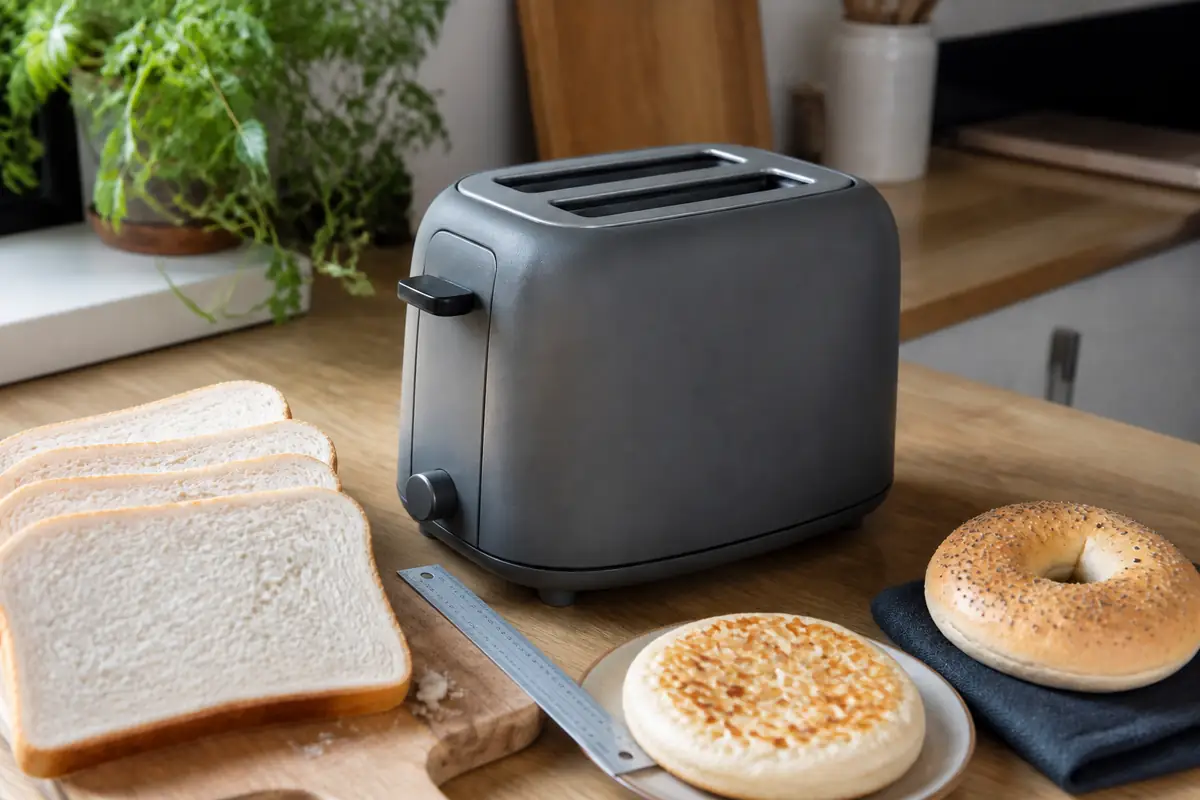
Write down how many slices are toasted together and what goes into the slots: standard sliced bread, tall bloomers, crumpets, bagels, waffles or frozen slices. Also note whether users prefer different browning levels. Capacity that remains unused occupies worktop and can increase the connected load without improving breakfast.
| Household pattern | Likely layout | Check carefully |
|---|---|---|
| One or two slices at a time | Two conventional slots | Slot length, width and high lift |
| Four slices together | Four slots with two control zones | Independent levers/dials and counter width |
| Tall artisan or larger sliced bread | Long-slot design | Usable slot length and centring |
| Bagels and buns | Wide slots or dedicated bagel mode | Actual thickness, one-sided function and instructions |
| Small crumpets or waffles | High-lift mechanism | Retrieval without touching hot metal |
For a small kitchen, a narrow model that stores easily can be better than a feature-heavy four-slice appliance. Use our small-kitchen buying framework to map counter, cupboard, socket and door clearance.
Slot size: demand numbers where possible
Terms such as wide, extra-wide and long are marketing descriptions unless supported by measurements. Measure a representative slice at its widest, thickest and tallest point. Leave room for centring guides and normal variation; do not force food into a slot.
A current Russell Hobbs Classics two-slice page, checked on 27 August 2026, specifies 135 × 33mm slots. Dualit’s current two-slice NewGen lists 28mm-wide slots, while its four-slice specification gives 28 × 140 × 120mm. These examples show why “wide” alone is insufficient and why dimensions must be linked to a specific model.
Measure these before buying
- Your widest regular bread slice.
- Maximum thickness of bagels or crumpets.
- Worktop width and depth.
- Vertical clearance beneath wall cupboards.
- Distance to the socket without stretching the lead.
- Space to remove the crumb tray.
Do not insert oversized food, metal tools or loose fillings into a toaster. If a sandwich cage or warming rack matters, verify it is approved for that exact model and follow the manual.
Two slots, four slots or long slots?
A two-slot model is compact and adequate for many households. A four-slot design reduces batches when several people eat together, but the useful version has two independent control zones so one pair can be used without heating all four slots. A long-slot toaster can fit tall or irregular bread while remaining narrow, though slice orientation and centring still matter.
Compactness and simple use lead
Most sessions involve one or two slices, counter space is limited and no regular bread requires a longer slot.
Real bread or batch capacity justifies it
The household routinely toasts more slices together or measured bread will not sit correctly in a conventional two-slot layout.
Controls worth having
Variable browning is basic, but numbered dials are not calibrated colour standards. Bread moisture, thickness, sugar and starting temperature change the result. Look for a clear cancel control and a lever with enough travel to retrieve smaller items.
Defrost mode adjusts the cycle for frozen bread; reheat warms without aiming for a full fresh-toast cycle. A bagel mode may brown one cut face while warming the other, but operation differs by model. “Lift and look” lets the user inspect progress without fully cancelling on some designs. Read the manual, because similar button icons do not guarantee identical behaviour.
Control layout, noise and shared use
A toaster is often used before the kitchen is fully awake. Check whether buttons are legible without tiny labels, whether the lever can be operated with a comfortable grip and whether a four-slot model gives each pair a clearly separated dial. Audible completion is not universal, and a loud mechanical release can matter in an open-plan home even when it has no bearing on browning quality.
If several people use the appliance, a simple repeatable control can be more valuable than many modes. Photograph or note the preferred setting, but expect adjustment when bread changes. Controls should not be placed where steam, grease or an adjacent appliance makes them awkward to reach.
Useful controls in priority order
- Immediate cancel.
- Repeatable browning dial or timer.
- High lift for small items.
- Independent zones on a four-slot model.
- Defrost for regularly frozen bread.
- Bagel or inspection function only if genuinely used.
Our guide to reading product specifications helps separate a function from a decorative control name.
Cleaning and safe placement
Crumbs should fall into a removable tray that can slide out without moving other appliances. Check whether a four-slot toaster has one or two trays and whether the extraction direction suits the counter. A tray is only helpful if it is emptied as the manual instructs.
Unplug and let the appliance cool before cleaning. Never immerse the toaster, poke metal implements into slots or shake crumbs towards live components. Keep the exterior and lead away from water, hob heat and counter edges. Follow the exact manual for frequency and method.
Consider cable storage, stable feet and control visibility. A shiny body can show marks; textured plastic may trap grease; painted metal can chip. Appearance does not prove insulation, electrical safety or longevity. Buy from an identifiable retailer and retain the model and serial details using our retailer-check guide.
Power and running cost
Toasters draw high power for short periods. A 2.2kW four-slot model does not necessarily use more energy per slice than a slower lower-power model, because duration and how many slots heat matter. Manufacturer power ratings help with socket planning, while measured cycle energy is needed for a fair running-cost comparison.
A slot selector can avoid heating unused elements on some designs. Dualit’s Classic range explicitly describes selectors for choosing active slots. Do not assume every four-slice toaster isolates unused slots. Our appliance running-cost guide explains why watts alone are not a bill.
Repairability and support
Many low-cost toasters are not designed for consumer repair. Look for a downloadable manual, warranty terms, model-specific support and named spare parts. Dualit’s current Classic pages state that elements, timer and selector switches are replaceable and that compatible spares are available. That is a concrete support claim, not proof that every local repair will be economical.
Never open a mains toaster unless the manufacturer’s authorised process and a competent repair route make it safe. Ask whether diagnosis, labour, carriage and parts can be obtained after the guarantee. Use our repairability guide to compare evidence, then include likely service life in total cost of ownership.
Buying checklist
- Photograph and measure the regular bread.
- Choose the minimum useful slot count.
- Confirm slot dimensions and worktop footprint.
- Check independent controls and high lift.
- Verify crumb-tray access and manual instructions.
- Record power, lead position and socket plan.
- Check spares, repair route and guarantee.
- Compare delivered cost for the exact model.
Balanced verdict
A good toaster is the smallest model that fits the household’s real bread, produces controllable results and can be cleaned safely. Four slots, premium materials and extra modes are worthwhile only when regularly used. Published slot measurements, accessible crumb trays, independent controls and credible support are stronger evidence than styling or vague “wide slot” claims.
Check current manufacturer evidence:
Russell Hobbs slot dimensions and controls ↗Dualit two-slice NewGen specifications ↗Dualit four-slice controls and dimensions ↗Dualit spares and repairability ↗
Frequently asked questions
Are wide toaster slots a standard size?
No — “Wide” is not a universal measurement. Look for millimetres and compare them with the thickest bread regularly used.
Is a four-slice toaster cheaper to run?
Not automatically — Compare power, cycle duration, active-slot control and slices toasted. A selector can avoid heating unused slots on some models.
What does a bagel setting do?
It commonly toasts one cut face while warming the outside, but operation varies. Check the manual for the exact model.
How should a toaster be cleaned?
Unplug it, let it cool and follow the manual. Empty the crumb tray as instructed; never immerse the appliance or insert metal tools into slots.
Can a toaster be repaired?
Some models have documented replaceable elements, timers or switches; many do not offer an economical route. Use competent authorised service for a mains appliance.
Do numbered browning settings mean the same across brands?
No — They are model controls, not calibrated toast-colour standards. Bread type, moisture, thickness and temperature also affect results.
How we researched toasters
We reviewed current UK manufacturer pages and specifications from Russell Hobbs and Dualit on 27 August 2026, focusing on slot measurements, control functions, power, cleaning access and repair evidence. We did not conduct performance or electrical testing.
Limitations
Specifications, prices, stock, guarantees and parts availability change. Manufacturer feature claims do not establish browning evenness, speed or long-term reliability. Recheck the exact model page and manual before purchase and purchase.