Table lamps value guide: materials, dimensions and delivery
A table lamp must fit the surface, place light at the right height and remain stable with its cable and shade. Compare exact dimensions, socket or integrated light source, bulb limits, controls, materials, safety information and delivery risk.
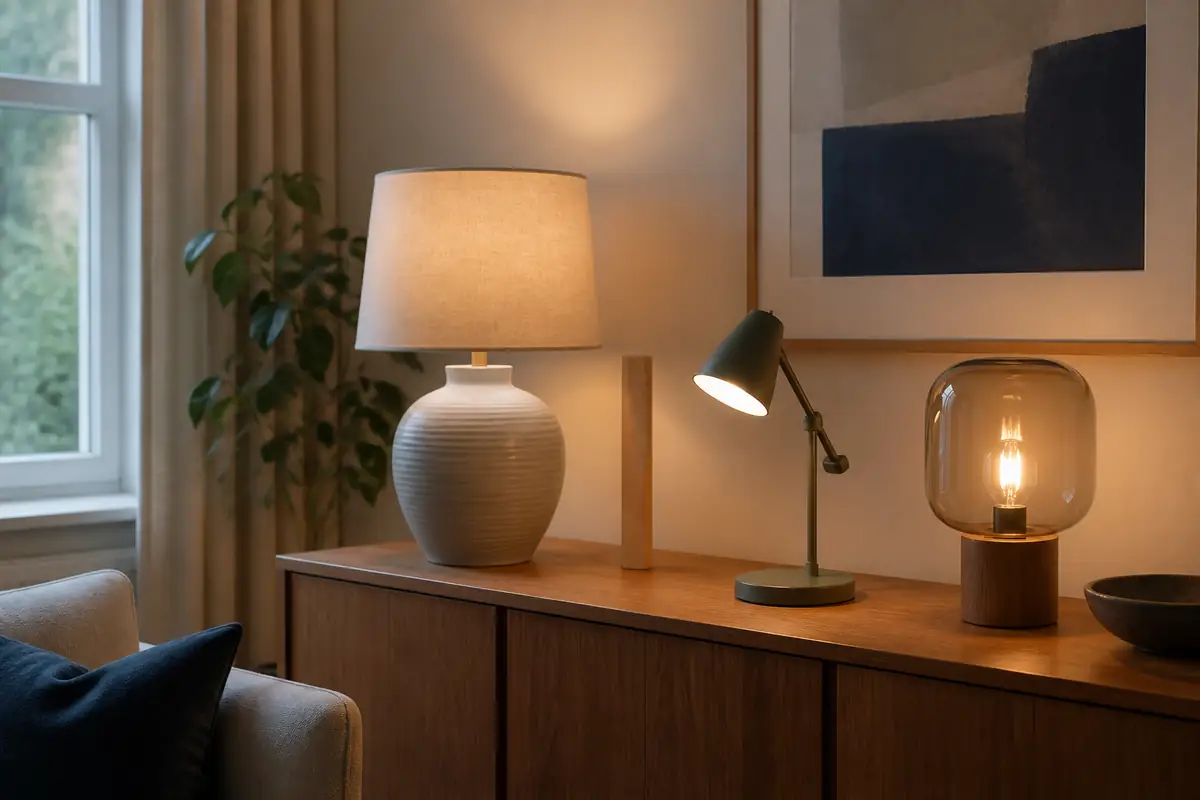
In this guide
Measure the pool of light and physical footprint before choosing the finish
Start with task, surface, eye line and socket position, then require exact lamp and shade dimensions. Check whether the bulb is replaceable, the permitted type and wattage, energy-label information for the light source, switch access, cable route, stability and damage process.
Use our lighting colour guide, compare room scale with the mirror placement method, and verify electrical products through the electrical safety checklist.
| Lamp type | Useful for | Evidence to check | Main risk |
|---|---|---|---|
| Shaded ambient lamp | Bedside, living room and soft general light | Total height, shade diameter, socket and bulb limit | Shade blocks task light or crowds surface |
| Adjustable task lamp | Reading, desk and craft work | Reach, joint stability, beam, glare and switch | Joint droops or head shines into eyes |
| Integrated LED lamp | Slim or sculptural form | Light output, colour, label, driver and repair route | Whole lamp may fail with light source |
| Decorative glass or ceramic | Visual accent and diffuse light | Weight, base protection, finish, shade and packaging | Fragile delivery and unstable top-heavy shape |
Table lamp shortlist sheet
- Define reading, task, ambient or decorative role.
- Measure surface, total height, shade width and cable route.
- Map seated and standing eye lines.
- Confirm socket, replaceable bulb, cap, wattage and controls.
- For integrated LED, save output, colour, label and service route.
- Check base weight, feet, shade fixing and tip risk.
- Price bulb, delivery, return and replacement shade.
- Photograph packaging and damage before assembly.
The room role determines useful light
A bedside lamp may need gentle ambient light and a reachable switch; a desk lamp needs controlled task light; a living-room pair may support balance rather than reading. Write the activity, distance and desired direction before choosing materials.
Decorative glow and task visibility are different jobs. One lamp can do both only when shade, height, bulb and position support them. Avoid buying a beautiful base that requires another lamp to make the surface usable.
Measure three dimensions, not one height
Record available base footprint, shade diameter and total height. Include overhang, drawers, wall art, headboard and nearby objects. A wide shade can occupy more space than the base and collide with a wall.
Place cardboard templates on the surface and mark seated eye line. Our placement guide explains sight-line checks. For a pair, measure both surfaces rather than assuming symmetry.
Shade geometry controls glare and spread
A tapered shade throws light differently from a cylinder or opaque dome. Check top and bottom diameter, height, lining and transparency. The bottom should usually hide the bare light source from the normal eye line for comfortable ambient use.
A dark lining can reduce output; a pale translucent fabric can glow; perforated or glass shades create visible patterns. These effects are preferences, not universal quality. Match them to wall, screen and reading positions.
Socket and bulb compatibility must be explicit
Confirm cap type, maximum wattage, voltage, bulb shape and whether a bulb is included. For smart bulbs, check physical fit and whether a wall or inline switch must remain powered. Do not exceed maker limits.
A replaceable bulb allows light output and colour to change within permitted specifications. Check whether the shade opening accommodates the chosen bulb without contact and whether ventilation remains clear.
Integrated LED changes the ownership question
An integrated light can enable compact forms, but failure of the LED module or driver may affect the whole lamp. Ask whether either part is replaceable, the warranty scope and the expected service route.
Save light output, colour temperature, colour-rendering information where supplied and dimming compatibility. Avoid treating an exceptionally long rated life as a guarantee for driver, switch or electronics.
Read the light-source energy label
Official UK fields for light sources include A-to-G efficiency, weighted energy use in kWh per 1,000 hours, supplier and model, with a QR link to product information. Compare the numeric consumption for equivalent usable light.
The lamp fitting and the bulb can be separate products. Do not assign the replaceable bulb’s class permanently to the base. A lower-energy source is useful only when its light output, distribution and controls fit the task.
Controls need to be reachable in darkness
Check inline switch distance from the base, rocker or pull access, touch zones and dimming steps. A switch trapped behind furniture creates daily friction. Touch controls can be convenient but may misfire and can depend on compatible electronics.
For bedside use, simulate lying and sitting. For desks, ensure adjustment does not move the switch or cable across work. An app should add value rather than becoming the only way to turn on a basic lamp.
Base materials affect weight and surface care
Ceramic and glass can provide mass but chip; metal can be slim but scratch or ring; wood can vary in grain and movement; stone-like materials may be heavy. Check felt feet, finish, seams and the way cable exits.
Material names do not prove solid construction. Read the complete description and weight. Use a mat where heat, condensation or finish compatibility is uncertain, following both furniture and lamp guidance.
Stability matters around children, pets and cables
Assess centre of gravity, base width, shade mass and cable pull. A tall narrow lamp can tip when the plug route crosses a walkway. Do not rely on staged photographs that hide the cable.
Keep lamps on stable surfaces away from fabric contact and water. Cable management should not crush or tightly coil the lead. Follow manufacturer placement and safety instructions.
Delivery risk rises with shades and brittle bases
Check whether the shade and base travel separately, who assembles them and what packaging protects the harp, ring or glass. Record package dimensions for collection and returns.
Photograph damage before removing all protection and contact the seller promptly. Do not glue or reshape a return candidate. The delivery-access checklist helps preserve evidence, but use the actual retailer route.
Pairs need colour and height tolerance
Two handmade or natural-material bases can vary. Decide whether variation is desirable and check the seller’s matching policy. Compare total heights after shades are fitted, not only base dimensions.
If exact symmetry matters, order and inspect the pair together. A replacement from a later batch may differ in glaze, grain or fabric. Keep both boxes until the decision is complete.
Calculate total installed cost
Add lamp, required bulb, shade where separate, delivery, smart control and any safe cable accessory. Compare replacement bulb availability and integrated-light service. A cheap base with a rare bulb can be false economy.
Estimate realistic hours only to compare energy, not to promise lifetime. The best value lamp fits physically, creates the right light, operates simply and can be maintained or repaired without replacing the whole arrangement.
Run a return-safe evening test
Inspect unplugged first, then follow assembly instructions. Test stability, switch, cable, glare and light pool with the permitted bulb while preserving return condition. Do not modify wiring or use an unapproved dimmer.
View at daytime and evening, seated and standing. If glare, instability or scale fails, repack carefully. An electrical or structural fault should be documented and reported rather than treated as a style return.
Plan the cable and switch as part of the room layout
Measure the route from socket to lamp without stretching a cable across a walkway, trapping it under furniture or creating a loop that children or pets can pull. Confirm the switch can be reached from the normal seated or bedside position without touching a hot bulb or unstable shade. Extension leads should not become a permanent substitute for a poorly located product.
For a desk, check that the cable does not steal the only charging socket or interfere with monitor arms. For a bedside table, leave space for water, glasses and a phone without crowding the base. A compact lamp that forces unsafe cable routing is not a space-saving choice.
Choose replaceable bulb or integrated LED?
Serviceability and light flexibility matter
The socket, bulb shape and maximum load are clear and common bulbs can provide the required output, colour and controls.
Compact form or precise built-in light matters
Output and colour suit the task, driver or module support is credible, controls are usable and whole-lamp replacement risk is acceptable.
Balanced verdict
A table lamp succeeds when its dimensions, shade and light source solve a named task safely. Measure the surface and eye line, verify bulb or integrated-light evidence, controls, stability, materials and cable route, then include delivery and service in cost.
Browse the Style & Gifts archive and Home & Kitchen archive for related room decisions.
Official checks:
GOV.UK lamp and light-source energy-label fields ↗
GOV.UK electrical equipment responsibilities ↗
Frequently asked questions
How tall should a bedside table lamp be?
There is no universal height — Measure surface and seated eye line so the shade hides direct glare while the switch remains reachable.
Is an integrated LED table lamp good value?
It can be, when output, colour, controls and service are suitable. Check whether the module or driver can be repaired or replaced.
What bulb information is essential?
Cap type, shape, voltage, maximum wattage, light output, colour, dimming compatibility and physical clearance.
Does the energy label apply to the lamp base?
Often the labelled light source is separate from the fitting. Check the exact product and do not transfer one bulb rating to every future bulb.
How should a damaged lamp delivery be handled?
Photograph packaging and damage, avoid repair or unsafe energising, and contact the legal seller promptly through the instructed route.
Methodology and limitations
We reviewed official UK light-source energy-label fields and electrical-product responsibilities, then compared table lamps by role, dimensions, shade, source, controls, materials, stability, delivery, service and total cost. We did not electrically test named products.
Limitations
Dimensions, bulbs, integrated modules, labels, stock and services change. Verify the exact fitting, manufacturer instructions, current energy data and retailer terms; use a competent electrician for any fixed-wiring issue.