Cushion Fillings Compared: Feather, Foam and Polyester
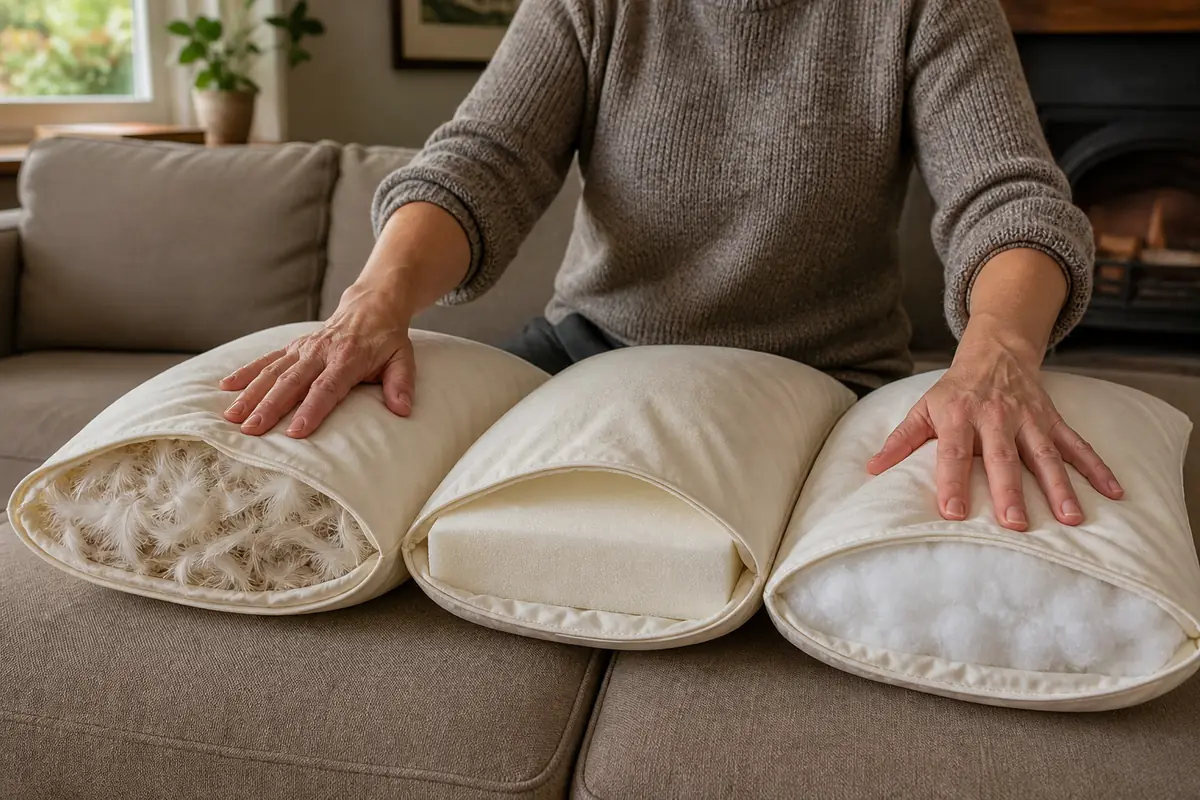
Feather gives a relaxed, shapeable cushion; polyester hollowfibre offers lighter, washable loft; upholstery foam provides defined support. The right filling depends first on whether the cushion decorates, supports a back or carries body weight.
In this guide
Choose the job before the filling.
For decorative sofa cushions, feather suits a soft chopped look while polyester is cheaper, lighter and usually simpler to wash. For a dining seat, bench or replacement sofa base, use correctly specified upholstery foam or a foam-and-fibre construction rather than a loose decorative pad. Size, fill weight and cover fit matter as much as the material name.
This guide compares material behaviour from official UK product specifications and specialist foam information. Recommended Today did not sit on, wash or laboratory-test the examples. Comfort is personal, while allergy and animal-welfare requirements need product-specific evidence rather than assumptions.
Current UK cushion filling price snapshot
| Exact example checked | Displayed price | Published specification |
|---|---|---|
| IKEA INNER 50×50cm cushion pad | £5 | 100% recycled polyester hollowfibre filling, 395g fill weight; suitable indoors and outdoors. |
| IKEA FJÄDRAR 50×50cm cushion pad | £10 | 100% duck feather filling, 750g fill weight; indoor use and tumble drying after washing. |
| John Lewis Duck Feather Cushion Pad | £8–£16 across listed sizes | UK-made range in multiple square and rectangular dimensions; verify the selected size price. |
| John Lewis Textured Weave Foam Seat Pad | £15 | Finished chair pad categorised with foam filling; not equivalent to a loose decorative insert. |
| Dunelm cushion-pad range | Microfibre £3–£8; duck feather £5–£16 | Range-level prices; check individual size, shell, care and fill specification. |
Price snapshot: official IKEA UK, John Lewis and Dunelm pages checked on 15 August 2026. Stock, sizes and prices change. Foam cut-to-size quotes depend on length, width, depth, grade and wrap, so no invented universal foam price is shown.
Feather cushion filling: soft, weighty and shapeable
Feather inserts use small feathers, sometimes blended with down. They compress readily, can be punched or “chopped” into shape and feel substantial because the fill is relatively heavy. That relaxed look works well for decorative cushions and soft back support, especially where the user is willing to plump them.
Fill weight changes the result. The 50cm FJÄDRAR pad checked publishes 750g of duck feathers, while a polyester INNER of the same dimensions publishes 395g of hollowfibre. The comparison does not prove one is better; it explains why two nominally 50cm pads can feel and recover differently.
Feather needs maintenance. It migrates, compacts and can work towards seams, so rotate and plump the pad. Product instructions may require washing at a set temperature and tumble drying until completely dry. Residual moisture can create odour and clumping. IKEA notes that a natural smell may be present initially and can fade with airing or correct washing and drying.
Check the outer shell density, stitching and any feather-proof construction. A sharp quill occasionally escaping does not mean every insert has failed, but repeated leakage can indicate an unsuitable casing or wear. Verify species, down percentage and any welfare certification on the exact item if those issues determine the purchase.
Polyester hollowfibre: light, resilient and accessible
Polyester filling is usually supplied as loose fibre, hollowfibre or a formed pad. Air trapped within crimped or hollow filaments creates loft without feather weight. A well-filled insert can look plump, spring back quickly and be easier to handle through washing and drying.
Not all polyester pads are equal. Fibre thickness, crimp, fill weight, recycled content and casing determine resilience. A cheap underfilled insert leaves empty corners and flattens quickly; a denser or firmer one can provide better shape. The 50cm IKEA INNER checked publishes 395g filling and describes firm support, while other 50cm products may use less or more material.
Polyester is a practical option when easy laundering, low initial price or animal-free materials matter. It is not automatically allergy-proof: dust, detergent residue, mould from poor drying and the cover itself can still cause problems. Follow the care label and make health decisions with appropriate professional advice.
Fibre gradually tangles and compresses. Regular rotation and gentle redistribution help, but once clumps no longer separate, replacement may be more sensible. Read our material-composition guide when the shell, lining and cover use several fibres with different care needs.
Foam filling: defined support, but grade matters
Foam is a cellular solid cut or moulded to shape. It is most useful where the cushion must maintain a controlled profile and carry load: dining-chair pads, window seats, bench cushions and sofa seat replacements. A bare block can feel square and show hard edges, so upholstery foam is often wrapped in polyester wadding and placed inside stockinette before the outer cover.
“High density” and “firm” are not synonyms. Density describes mass per volume and can relate to durability; hardness describes how the foam resists compression. The Foam Shop’s published grade table, for example, separates density bands from hardness in newtons and recommends different grades by application and depth. A dense medium foam can be durable without feeling rock hard.
Thickness changes comfort. A grade intended for a deep 12.5cm seat may behave badly in a thin dining pad, while a packaging foam is not a responsible upholstery substitute. Ask the supplier to specify foam type, density, hardness, intended application and any relevant fire-safety compliance for the finished use.
Memory foam softens and recovers slowly with heat and pressure. As a thin comfort layer over supportive reflex foam it can change surface feel; used alone in the wrong thickness it may feel slow, warm or unstable. A combination is not automatically superior. It must match the person, cover and load.
Feather vs foam vs polyester at a glance
| Characteristic | Feather | Polyester fibre | Upholstery foam |
|---|---|---|---|
| Typical best use | Decorative cushion or soft back | Decorative cushion, occasional back or outdoor-compatible pad where specified | Dining, bench, window or sofa seating |
| Feel | Soft, weighty, mouldable | Light, springy, variable by fill weight | Defined and supportive; grade-dependent |
| Shape recovery | Needs plumping | Usually quicker, can clump over time | Keeps profile; may soften or fatigue with use |
| Care | Product-specific; thorough drying crucial | Often machine washable; verify temperature and drying | Core usually spot-cleaned or kept dry; cover washed separately |
| Fit risk | Underfill looks flat | Low fill leaves empty corners | Exact template, thickness and wrap required |
Decorative cushion or seat cushion?
A decorative insert fills a removable cover and supports light leaning. A seat cushion repeatedly carries body weight and needs load-bearing structure. Do not buy a 50cm feather pad for a dining chair merely because the width matches. It will bottom out, shift and provide little stable support.
For sofa back cushions, a feather-and-fibre mix can balance softness and recovery, while a foam core wrapped in fibre gives a neater outline. For sofa seats, use an upholstery supplier who can match shape, thickness and intended firmness. Our furniture-quality guide explains why cushion construction is part of the furniture, not an afterthought.
How to choose the correct insert size
Measure the cover seam to seam when empty and laid flat. Do not include a floppy flange or piping. A decorative insert slightly larger than the nominal cover can fill corners and create a fuller look; IKEA suggests roughly 5–6cm larger for square covers and 3–5cm for rectangular ones as general guidance. This is not universal: stiff fabric, a narrow zip or a heavily filled pad can make oversizing difficult.
For foam, use the internal cover dimensions and account for wrap. Complex T-shapes, curves and tapers should be templated. A paper pattern must show orientation, front and back, and be checked against the empty cover without stretching it. Our furniture measuring guide provides a consistent method.
Comfort and appearance are separate decisions
A feather cushion can look luxurious but offer insufficient lumbar support. A firm foam seat may support posture but look angular inside an oversized cover. Decide the body contact, length of sitting and desired silhouette separately. For a sofa, the cover fabric also changes friction, heat and how the fill moves; see our sofa-fabric guide.
Try a sample when replacing expensive seat cushions. Sit for long enough to feel compression, then inspect recovery after standing. Recommended Today has not performed that test on the products above, so their published material descriptions cannot support a universal comfort ranking.
Care, odour and moisture
Keep the manufacturer label. Feather must dry completely throughout, not merely at the surface. Polyester can also clump when washed aggressively or dried inadequately. Foam should not be saturated unless its supplier expressly permits it; water held within the cells can be slow to remove.
Use removable washable covers where spills are likely. Vacuum seams gently and air cushions in dry conditions. Outdoor-compatible polyester still needs protection if the product says it should be stored somewhere dry during rain. “Outdoor” is not permission to leave any pad permanently waterlogged.
Allergies, animals and environmental claims
No filling earns a blanket health claim. Feather may be unsuitable for a person who reacts to it, while synthetic fill can still accumulate dust or sit inside a cover treated with substances that concern the buyer. Seek specific material and care information; do not infer medical suitability from “hypoallergenic” without understanding what was tested.
Recycled polyester reduces demand for virgin feedstock but remains a plastic material and may shed fibres during use and washing. Feather is animal-derived, and welfare evidence varies. Foam uses polymers and additives and is harder to recycle through ordinary household systems. Longevity, repair and replaceable covers can matter more than a single material slogan. Our claims-checking approach applies equally to home textiles.
Replacement and value
Replace a decorative insert when redistribution no longer restores loft, odour persists after correct care, or the casing is failing. Replace seat foam when it bottoms out, no longer recovers evenly or creates an unstable sitting surface. Check the frame and support platform first: new foam cannot correct a broken spring or webbing system.
Calculate value from useful life and maintenance, not price alone. A £5 polyester pad replaced yearly can cost more than a durable insert kept for several years, but an expensive feather pad is poor value if the household will not plump or dry it correctly. Use the cost-per-use framework for the comparison.
Cushion filling checklist
- Name the use: decoration, back support, dining pad or load-bearing seat.
- Measure the empty cover and identify square, rectangular or custom shape.
- Record fill weight or foam grade, not only the material name.
- Check complete care instructions, including drying.
- Verify shell and lining for feather containment or washable use.
- For foam, confirm density, hardness, thickness and wrap with the supplier.
- Save the specification so a successful insert can be replaced consistently.
Shape and straightforward care lead
The filling density, cover and maintenance suit frequent use, with replacement cost understood if resilience declines.
Softness and mouldability lead
Regular plumping, allergen considerations and possible feather escape are acceptable for the feel you actually prefer.
Our verdict
Feather wins for a relaxed, shapeable decorative feel; polyester for affordable, light and often washable loft; upholstery foam for controlled seating support. None is universally best. Match the filling to load, cover, care routine and desired appearance, then compare fill weight or foam grade.
For retailer context, see our Dunelm vs Wayfair comparison and IKEA vs Dunelm guide. Browse Style & Gifts or the UK shop directory for related home choices.
Check current product and material information:
IKEA INNER polyester pad ↗IKEA FJÄDRAR feather pad ↗John Lewis duck feather pad ↗Upholstery foam grade table ↗
Check current official information:
IKEA INNER polyester pad ↗IKEA FJÄDRAR feather pad ↗John Lewis duck feather pad ↗
Frequently asked questions
Is feather or polyester better for sofa cushions?
Feather is heavier, softer and shapeable but needs plumping and careful drying. Polyester is lighter, usually cheaper and can recover faster. Fill weight and cover fit are decisive.
Is foam suitable for decorative cushions?
It can create a defined shape, but loose feather or fibre usually suits soft decorative covers better. Foam is most useful where controlled seating support is needed.
Should an insert be larger than the cushion cover?
A slightly larger decorative insert can fill corners, but the correct allowance depends on shape, fabric, zip and fill density. Foam should be measured to the cover and intended wrap.
What foam density is best for a sofa seat?
There is no single density. Density and hardness are different; depth, load and desired feel matter. Ask an upholstery supplier to specify a grade for the precise application.
Can cushion inserts be machine washed?
Some feather and polyester products can, but temperatures and drying instructions differ. Foam cores are commonly kept dry. Follow the exact sewn-in and product label.
How we compared cushion fillings
We checked current official IKEA UK, John Lewis and Dunelm pad listings plus a specialist UK upholstery-foam grade table on 15 August 2026. We compared dimensions, fill weight, composition, price, care and intended use. We did not sit on, wash or endurance-test any example.
Limitations
Product pages cannot establish subjective comfort, odour, compression recovery or long-term resilience, and the same filling can feel different at another weight, depth or cover tension. Allergy and welfare needs require evidence for the exact product.
Prices, stock, compositions and care instructions change. Recheck the exact insert, filling specification and size before purchase.